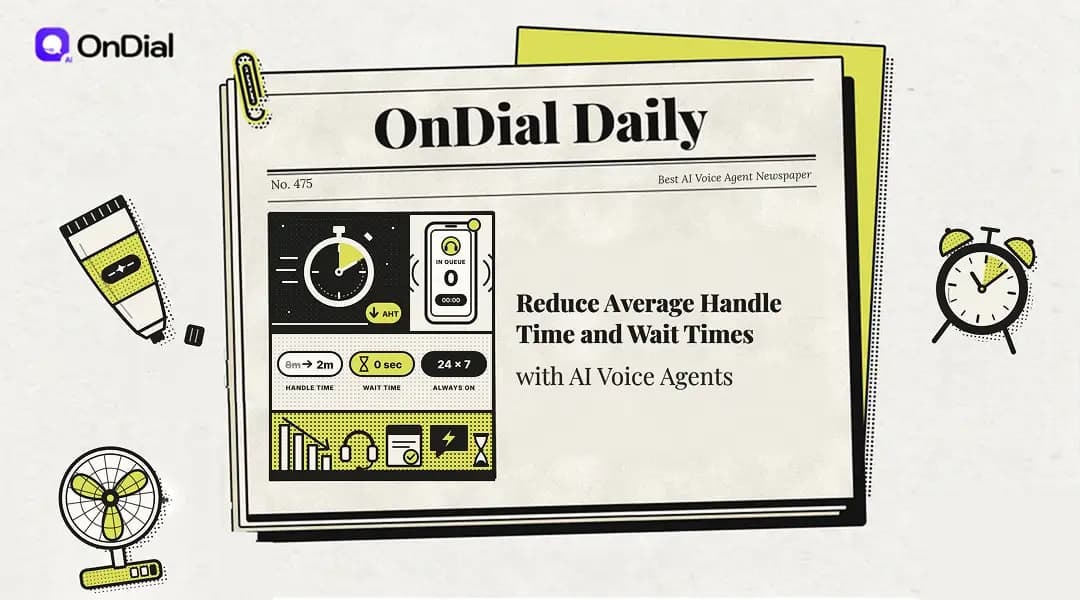
A support queue grows when calls need more minutes than the team has to give. Voice agents for call centers change that math by settling routine calls before they join the queue. To reduce average handle time in a way callers feel, treat AHT as a queue input, not a scorecard.
Picture a broadband provider's support line at 10 a.m. on a Monday. In that hour, 520 calls arrive and 57 agents sit on the phones. Each call averages 6 minutes 20 seconds, so callers wait roughly two minutes before a person answers.
The figures are illustrative, but the queue math is the standard Erlang C model that planners use for staffing.
Where 380 seconds of handle time get spent on a 6:20 call
AHT averages three clocks across answered calls: the conversation, any hold, and the notes typed afterward. In the broadband example, only about 40% of those 380 seconds go to fixing the caller's problem.
Here are illustrative timings for a typical 6:20 call at this desk:
Identity checks, 50 seconds: the agent confirms account number, postcode and a security answer before anything else.
System hunting and hold, 70 seconds: the agent opens the outage map, billing screen and ticket history separately.
Actual resolution, 160 seconds: the agent explains the outage window, takes a payment or moves a technician slot.
Wrap-up notes, 100 seconds: the agent types a summary and picks a disposition code after the caller hangs up.
Identity checks and wrap-up notes, 150 seconds together, involve no judgment at all. They are the easiest place to reduce average handle time without touching the outage conversation.
Abandonment sits downstream of every one of those 380 seconds. Each caller has a patience limit. A longer queue means more hang-ups, repeat dial-ins and angrier openings once someone answers.
Why a small AHT cut can collapse the wait in your queue
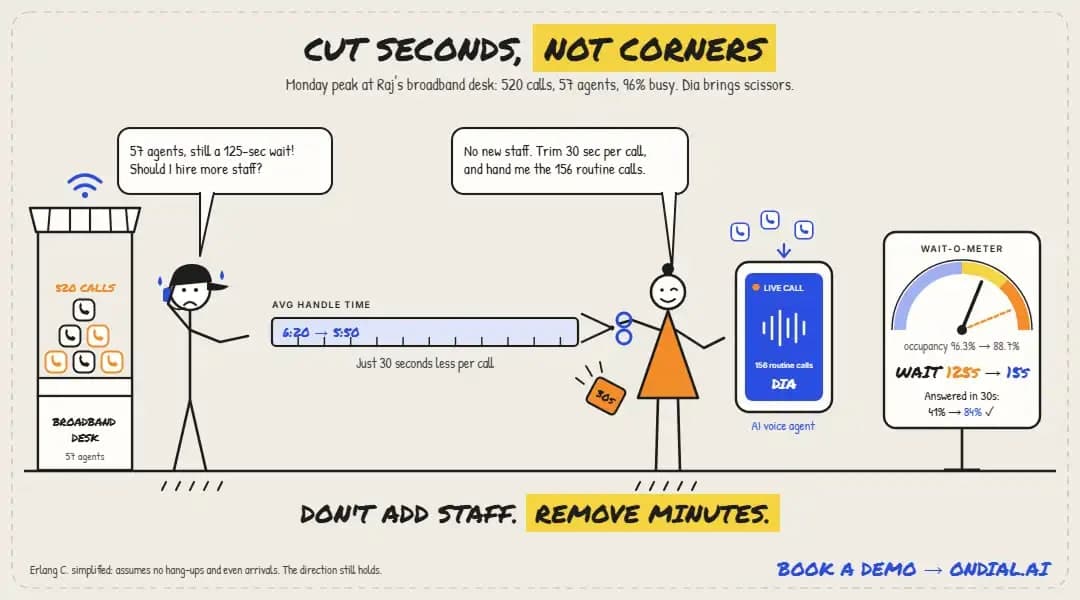
At 96% occupancy, wait time reacts far more than handle time, because the queue has no slack. Nearly every new call at the broadband desk lands behind someone already talking.
Erlang C shows why even a modest effort to reduce average handle time pays off here. Trimming just 30 seconds per call cuts the average wait from about 125 seconds to roughly 15.
Peak-hour scenario at the broadband desk | Agent occupancy | Average wait before answer | Calls answered within 30 seconds |
Today, 520 calls at 6:20 each with 57 agents | 96.3% | About 125 seconds | 41.0% |
Same 57 agents after shaving 30 seconds per call | 88.7% | About 15 seconds | 83.8% |
How to cut call wait times when occupancy runs above 90%
Above 90% occupancy, a small drop in workload buys a large drop in waiting. So at this desk, removing minutes beats rostering extra Monday staff.
Those minutes leave the queue in two ways. Agents take shorter calls, or the 156 routine calls never reach them. An AI voice agent can do both, and at this desk the second lever is bigger.
Erlang C is simplified, since it assumes nobody hangs up and calls arrive evenly. Still, the direction holds: at 96% occupancy, each second per call is worth more than it looks.
What an AI voice agent does with a routine outage call, step by step
On an outage call, the AI voice agent answers, finds the need, then resolves it or prepares a handoff. For the broadband desk, an outage check takes about 2.5 minutes this way.
That is the key difference from a press-1 menu. A classic IVR mostly sorts the caller into a line, while the AI agent completes the outage lookup itself. Sorting alone does little to reduce average handle time, because the agent still does every step.
The pipeline behind that outage call runs in this order:
The telephony layer answers instantly, so the caller skips the queue and the press-1 menu entirely.
Speech-to-text converts the caller's words, including a street name and postcode, into text as they speak.
A language model detects the intent, such as asking whether the evening fibre outage covers their street.
Tool calls query the outage system, billing records or technician calendar through each system's API.
Text-to-speech reads back the answer, for example an expected restore time of 7:40 p.m.
If the caller wants a person, perhaps over a third outage this month, the transfer carries their case summary.
Step four separates a resolved outage call from a merely answered one. Other call types follow this same pattern, which Faster customer resolutions with voice automation explains in more depth. Without live access to the outage map, the agent can only take a message.
Ranking routine intents by agent minutes before automating any
Start with the intents that eat the most agent minutes while needing the least judgment. Here, outage checks, bill queries, payments and technician slot changes are an illustrative 30% of peak calls.
To reduce average handle time across the desk, rank candidates from your own call reasons with four tests:
Volume times handle time: rank intents by total agent minutes per week, not by call count alone.
Clear finish line: pick calls where success is obvious, such as a payment confirmed or a technician slot rebooked.
One system involved: an outage check needs one API, while a plan downgrade may touch billing, CRM and retention.
Low emotional stakes: a caller checking a due date tolerates automation better than one disputing a charge.
Keep billing disputes, cancellations and calls from vulnerable customers with people. On a cancellation call, an extra human minute can save the account, which no deflection rate captures.
Storm days need their own plan, since outage calls can triple within an hour. Desks facing that pattern can compare High call volume voice agents built for sudden surges.
Handoffs that trim 40 seconds from human handle time
A good handoff is how you reduce average handle time on the calls humans still take. In the broadband example, the AI captures identity and call reason first, saving about 40 seconds per transfer.
Three handoff habits decide whether those 40 seconds are actually saved:
Verified identity appears on screen, so the agent skips asking for the account number and postcode again.
A two-line summary states the intent and what the AI tried, such as a remote router restart.
The full transcript sits one click away for disputes that hinge on exact wording.
NBER research measured a second lever, live AI coaching during the call. Across 5,179 support agents, a Stanford and MIT team found an AI assistant lifted hourly resolutions by 14%. Newer, less experienced agents gained 34%, though the study covered chat agents rather than voice.
Outsourced floors gain twice from those 40 seconds, because many client contracts tie fees to service levels. Providers running multi-client operations can see how AI voice agents for call centers and BPOs fit that model.
Why human AHT may climb from 6:20 to 7:33 once routine calls leave
Once the AI absorbs the 156 short calls, the ones left for agents are harder on average. At the broadband desk, human AHT rises to about 7:33 when deflection runs alone.
That climb to 7:33 is a sign of success, not failure. The queue now holds 364 calls instead of 520. Even with longer calls, the average wait falls to about 3 seconds.
Teams that set out to reduce AHT often panic here, because the dashboard moves the wrong way. Most call center efficiency AI pitches stop at deflection rates and never show this 7:33 figure. Re-baseline targets with finance before launch, not after the first monthly report.
How to reduce average handle time in a 520-call peak hour: before and after
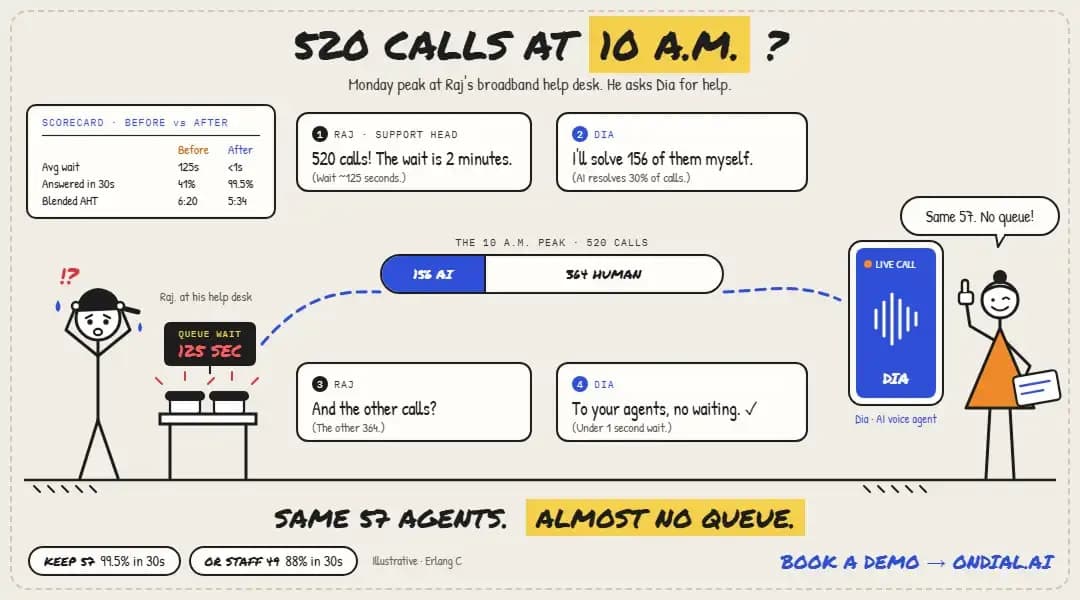
Combine deflection with pre-call capture and the same 57 agents barely queue at all. The table below models the broadband desk's Monday peak, with every figure illustrative and computed with Erlang C.
Metric for the 10 a.m. peak hour | Before AI voice agent | After deflection and pre-call capture |
Calls that still reach a human agent at 10 a.m. | All 520 calls | 364 calls, with 156 resolved by AI |
Human AHT on the calls the 57 agents still take | 6 minutes 20 seconds | About 6 minutes 53 seconds |
AHT blended across the 156 AI calls and 364 human calls | 6 minutes 20 seconds | About 5 minutes 34 seconds |
Agent occupancy with 57 agents on the phones | 96.3% | 73.3% |
Average wait in the Monday queue before a person answers | About 125 seconds | Under 1 second |
Calls answered within 30 seconds | 41.0% | 99.5% |
That 99.5% result gives you a choice. Keep all 57 agents and bank near-instant answers. Or staff 49 and still answer 88% of calls within 30 seconds.
When you reduce average handle time this way, freeing eight agents for callbacks is often the better trade. It also keeps occupancy near 85%, which many planners treat as a sensible ceiling.
Proving the AHT change with a holdout group
A claim that AI helped reduce average handle time needs three proofs: queue, resolution and cost. A holdout works best: send a random 10% of routine calls down the old path for four weeks.
Compare both paths across the same Monday and storm-day hours, tracking these measures:
Average speed of answer and abandonment rate, measured per 30-minute interval rather than as a daily average.
True resolution rate, meaning AI-handled callers who do not call back about the same issue within seven days.
Transfer rate and post-transfer wait, so a caller parked for 90 seconds after handoff counts against the AI.
Human AHT by intent, so the 7:33 average after deflection is not misread as slower agents.
Cost per resolved contact, adding AI minutes and agent minutes together across both paths.
First call resolution belongs beside them, and SQM Group's data explains why. Its research links each 1% FCR gain to 1% higher satisfaction and 1% lower operating cost.
A containment rate alone can mislead, as the outage example shows. Say the AI ends 70% of outage calls, but a third of those callers ring back tomorrow. The queue has simply moved to Tuesday.
Billing disputes, noisy lines and other places AI voice agents fall short
An AI voice agent can reduce average handle time only with live outage data and clear audio. Outside those conditions, it can add a frustrating layer instead of removing one.
Watch for these weak spots before you commit:
No API, no resolution: without live billing access, the AI can only take a postcode and a reason.
Noisy lines: speech-to-text struggles with a caller on speakerphone beside a washing machine, so build a fast exit.
High-stakes conversations: a billing dispute, bereavement account change or formal complaint needs a person from the first sentence.
Turn latency: a two-second silence after a caller reads out a postcode invites them to repeat it, adding turns.
Caller trust is the bigger limit, and Gartner's data shows how thin it is. In a Gartner survey of 5,728 customers, 64% said they would prefer companies not use AI for service. Their top worry, cited by 60%, was that reaching a person would get harder.
So keep a press-zero route to a person on every outage flow. Also, if your desk takes 40 calls a day, the setup effort may outweigh the minutes saved.
A 30-day rollout plan for a support operations manager
A 30-day pilot on three intents shows whether an AI voice agent will reduce average handle time for you. Gartner expects agentic AI to settle 80% of common service issues alone by 2029. You can start far smaller.
First five days: export 90 days of call reasons and rank intents by total agent minutes.
Days 6 to 12: connect the outage, billing and scheduling APIs, then write transfer rules for each intent.
By day 16: have staff call in from cars, cafés and speakerphones to test recognition.
Through day 30: route 90% of the chosen intents to the AI and keep the 10% holdout.
On day 30: compare paths on wait, repeat calls and cost, then bank service level or redeploy agents.
What to test in a platform using your own three intents
Judge vendors on whether they reduce average handle time on your own Monday calls, not a sales recording. Ask each to run your three intents in a trial, then check that:
Each reply starts within about a second, even when a caller interrupts to correct a postcode.
Transfers carry identity and a summary into the agent screen your 57 agents already use.
Reports split handle time, transfers and seven-day repeat calls by intent and by path.
Seeing the queue math on your own call data
Your own Monday peak is a better test for faster call resolution than any vendor benchmark. Bring your interval data and top call reasons, and we can model the before and after together. Book a demo to see an AI voice agent handle your routine calls live.