I want to tell you about a Tuesday afternoon in early 2024.
I was sitting in a cramped BPO operations room in Pune, watching a supervisor pace between rows of agents. Forty-two of them. Each one reading from the same script. Each one asking the same "How may I assist you today?" in the same tired tone. The queue had 300 calls backed up. We were hemorrhaging ₹12 lakhs a month on that floor alone — and the customer satisfaction scores were still mediocre.
That was the moment I started seriously asking: Is there a smarter way?
Two years later, I've implemented AI calling solutions across fintech, healthcare, and real estate verticals. I've seen what works, what fails spectacularly, and what the glossy vendor brochures conveniently leave out. And I can tell you this with certainty: AI calling software in India isn't hype anymore. It's infrastructure. The question isn't whether to adopt it. The question is how to do it without making expensive mistakes.
This article is everything I wish someone had handed me in 2024.
What is AI Calling Software?
Definition & Core Technology
AI calling software is a telephony platform that uses artificial intelligence — specifically natural language processing (NLP), speech recognition, and machine learning — to conduct voice conversations with customers autonomously, without a human agent on the line.
It's not a phone tree. It's not "press 1 for billing." It's a system that listens to what a customer actually says, understands the intent behind those words, and responds in natural, conversational language - in real time.
Think of it as the difference between a vending machine and a knowledgeable shop assistant. One gives you fixed options. The other has a conversation.
How AI Voice Agents Work
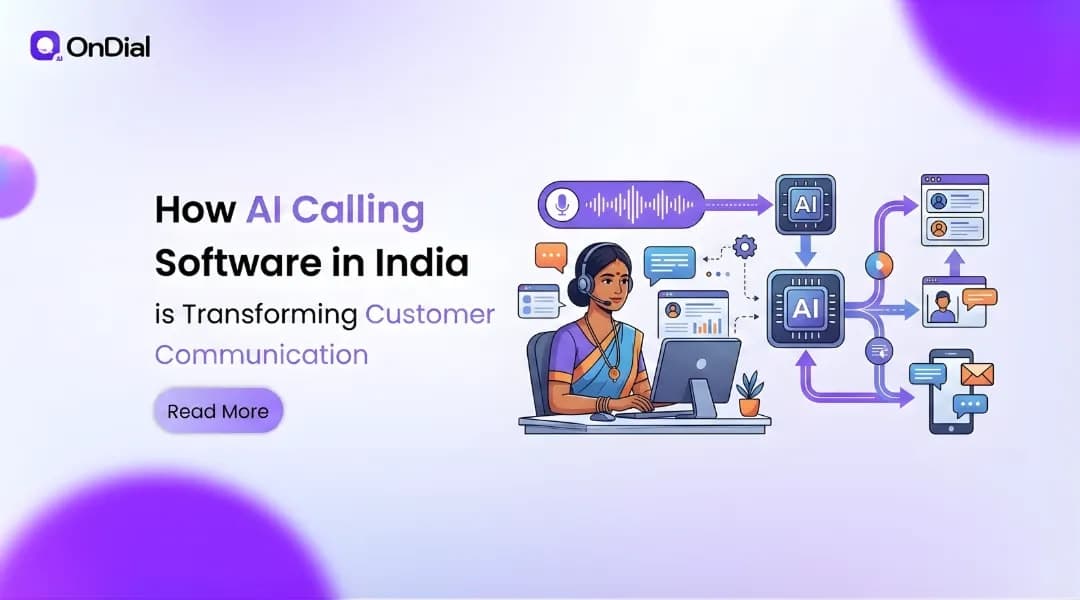
Here's the simplified technical stack - because understanding this helps you evaluate vendors intelligently:
Speech-to-Text (STT): The customer speaks. The system converts audio to text with high accuracy — even over noisy phone connections.
Natural Language Understanding (NLU): The text is parsed for intent (what does the customer want?) and entities (what specific details - account number, date, product name - did they mention?).
Dialogue Management: The AI engine determines the best response based on conversation context and pre-trained business logic.
Text-to-Speech (TTS): The response is converted back to natural-sounding voice and delivered to the customer. In 2026, the best TTS models are genuinely indistinguishable from human speech in controlled conditions.
Integration Layer: The system simultaneously queries your CRM, databases, or ticketing system to pull or push real data - exactly as an actual agent would.
This entire loop now runs in under 500 milliseconds on leading platforms. That's the magic and in 2026, that latency benchmark is table stakes, not a differentiator.
Why AI Calling Software is Booming in India
Cost Efficiency
Let me be direct about numbers - because this is where Indian businesses pay attention.
A trained call center agent in India costs between ₹22,000–₹42,000 per month in salary alone in 2026. Add HR overhead, training costs (₹15,000–₹30,000 per agent), attrition replacement (India's BPO sector attrition runs 35–55% annually, per NASSCOM's 2025 workforce report), and infrastructure and the real cost per agent lands between ₹55,000–₹90,000 per month.
An AI voice agent handles 500–1,000 concurrent calls. Not sequentially. Simultaneously. The per-call cost drops to fractions of a rupee at scale.
24/7 Availability
Your customers don't sleep on your schedule. A patient in Coimbatore needs a prescription reminder at 6 AM. A buyer in Jaipur wants a delivery update at 10 PM. Staffing for that 24-hour window with human agents is either brutally expensive or operationally impractical.
AI calling software doesn't take breaks. It doesn't have bad days. Available every hour of every day, without overtime costs or shift premiums.
Multilingual Capabilities - India's Distinct Advantage
This is the part that genuinely excites me, and I don't get excited easily.
India has 22 official languages and hundreds of dialects. Any communication tool that can't navigate this reality is dead on arrival for large-scale deployment. By 2026, the best AI calling platforms operating in India support Hindi, Tamil, Telugu, Kannada, Bengali, Marathi, and Gujarati — with real-time code-switching detection for Hinglish and regional accent adaptation that has improved dramatically over the past 18 months.
For a fintech company serving rural Rajasthan or a healthcare network operating across Tamil Nadu, this isn't a nice-to-have. It's existential. Companies like OnDial are building voice AI solutions specifically engineered for India's linguistic complexity and that's a structural moat that generic Western platforms, retrofitted for the Indian market, simply cannot replicate.
Key Features of AI Calling Software
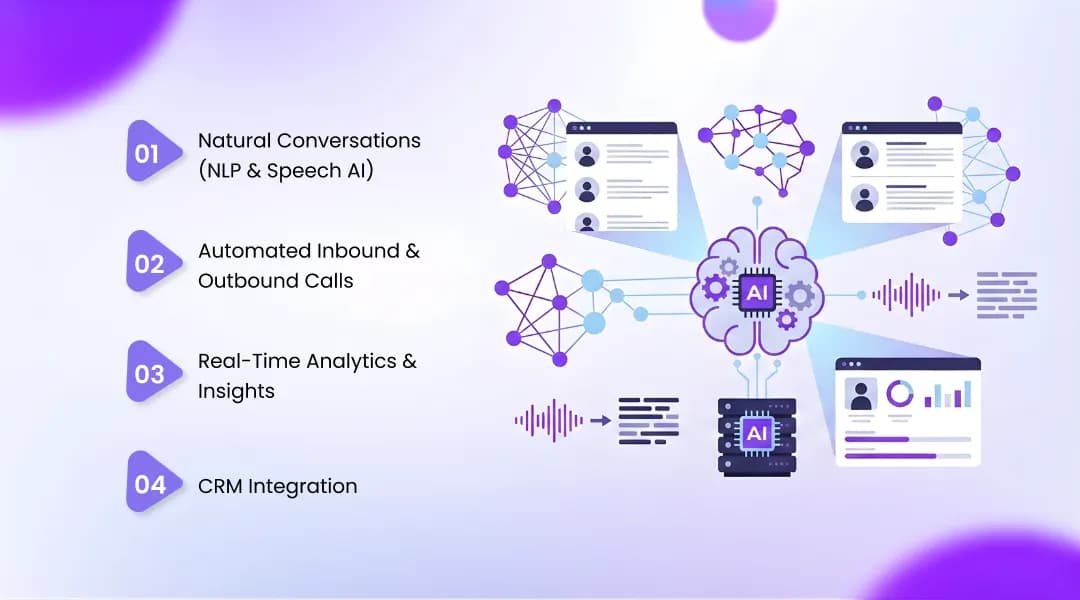
Every vendor's features list looks identical. They all have NLP. They all have CRM integration. They all have "real-time analytics." Here's how to separate the platforms that actually work from the ones that just have a polished UI.
Natural Conversations (NLP & Speech AI)
The bar for "natural" has risen sharply through 2025 and into 2026. Early voice bots sounded robotic and fell apart the moment a caller went off-script. Modern systems trained on Indian conversational patterns handle interruptions, code-switching, background noise, and colloquial phrasing with significantly higher accuracy than platforms from even two years ago.
The test I use with every vendor: give the bot a call where the customer says something completely unexpected - an unusual complaint phrasing, a mixed-language sentence, a regional term. If it panics and loops back to the main menu, walk away.
Automated Inbound & Outbound Calls
Inbound automation handles incoming customer queries - FAQs, order status, account information, complaint logging - without involving a human unless escalation is genuinely required.
Outbound automation is where the revenue impact is often most dramatic: lead qualification, payment reminders, appointment confirmations, survey collection, and post-purchase follow-ups. A sales team that previously made 80 calls a day can now run 1,000+ outreach touchpoints through a well-configured AI voice agent. without adding a single headcount.
Real-Time Analytics & Insights
Every call becomes structured data. Sentiment analysis flags frustrated customers mid-conversation. Call disposition reports surface spiking issues before they become crises. Keyword tracking identifies product or service problems in real time. This is intelligence your human call center simply cannot generate at scale and in a competitive market, that intelligence gap compounds quickly.
CRM Integration
A voice agent that can't communicate with your systems isn't an assistant - it's a fancy answering machine. In 2026, look for platforms with robust, pre-built connectors to Salesforce, Zoho, HubSpot, Freshdesk, Leadsquared, and the ability to connect via REST APIs to custom systems. The ability to pull customer history mid-call and push call outcomes automatically back to your CRM is non-negotiable.
Use Cases Across Industries
E-Commerce: Order Updates & COD Confirmation
India's e-commerce sector has a COD (Cash on Delivery) problem. High RTO (Return to Origin) rates - running 20–35% for COD orders depending on category - are a direct, painful hit to margins. AI calling software now handles COD confirmation calls at scale: calling customers post-order, confirming intent, and flagging likely returns before dispatch. One mid-size D2C brand I worked with reduced their RTO by 18% in the first quarter after deployment. That number compounds. Over a year, the margin recovery is significant.
Healthcare: Appointment Reminders
No-show rates at Indian clinics run 20–30% on average. An AI voice agent calling patients 24 hours and 2 hours before their appointment - in their preferred language, with the option to reschedule instantly - meaningfully reduces that number. More importantly, it frees clinic staff to focus on patient care, not administrative follow-up.
BFSI: Loan Follow-Ups & KYC Verification
For NBFCs and banks, compliance requires touchpoints that are documented, consistent, and auditable. By 2026, with the Digital Personal Data Protection (DPDP) Act's implementation rules now in force, the auditability requirement has become even more acute. AI calling software handles KYC verification calls, EMI reminders, and overdue account follow-ups at scale — with every conversation logged, timestamped, and available for regulatory review. Consistency is something human agents simply cannot guarantee across thousands of daily interactions.
Real Estate: Lead Qualification
A real estate developer in Mumbai shared this with me: they receive 900+ inquiries a month but their sales team can meaningfully engage with maybe 150. AI voice agents now conduct initial qualification calls - gauging budget, timeline, configuration preference, financing intent and hand off only warm, sales-ready leads to human brokers. Time-to-qualified-lead shrinks from days to hours.
Benefits of AI Calling Software for Businesses
Reduced Operational Costs
The math is unambiguous. Replacing or augmenting a 50-agent call center with AI voice agents can reduce communication operations costs by 40–70%, depending on call complexity and integration depth. For businesses in tier-2 and tier-3 Indian cities where scaling human teams is logistically harder, the advantage is even more pronounced.
Improved Customer Experience
Counterintuitive, but true: customers often prefer AI for transactional interactions. No hold music. No being transferred three times. No inconsistent information depending on which agent picks up. Instant, accurate responses. What customers resent isn't talking to a machine - it's talking to a machine that feels like a machine. Good AI calling software, in 2026, increasingly doesn't.
Higher Lead Conversion Rates
Speed-to-lead is still everything in sales. Research consistently shows that responding to an inbound lead within 5 minutes increases conversion probability dramatically compared to a 30-minute response. No human sales team maintains that at scale across hundreds of daily leads. An AI voice agent can - every time, without exception.
Scalability
Campaign launching tomorrow? Your AI system scales in hours, not weeks. Diwali season surge? No emergency hiring cycle. Festival offer flood? Handled. That elastic scalability is operationally transformative for growing Indian businesses navigating unpredictable demand spikes.
AI vs Traditional Call Centers
Factor | Traditional Call Center | AI Calling Software |
Cost per call | ₹18–₹50 | ₹1–₹6 |
Availability | Business hours (+ expensive 24/7 staffing) | 24/7/365 |
Consistency | Variable (agent-dependent) | 100% consistent |
Scalability | Weeks (hiring + training) | Hours |
Language support | Limited by agent pool | Multi-language by design |
Data & Analytics | Manual, incomplete | Automatic, comprehensive |
DPDP Act compliance | Process-dependent | Built-in logging & consent management |
Complex query handling | Strong | Improving - but still escalates |
The honest truth: AI doesn't win in every dimension. Complex, emotionally sensitive calls - a customer disputing a major fraud claim, a patient in acute distress, a high-stakes real estate negotiation - still benefit from human empathy and judgment. The best deployments I've seen in 2025–2026 treat AI as the intelligent first line of communication, with warm, context-preserving human escalation built in from day one.
Challenges & Limitations
I'd be doing you a disservice if I glossed over the hard parts.
Language Nuances
India's linguistic terrain remains demanding. Regional dialects, accent variations, rapid code-switching - even the best NLP models have limits in 2026. A voice bot trained primarily on standard Hindi may still struggle with Bhojpuri-inflected phrasing or fast Marathi-English switching. This is why India-specific training data matters enormously. Ask vendors directly: where was your model trained, on what Indian language corpora, and when was it last updated? The last update date matters more than people realize - models degrade against evolving conversational patterns.
Complex Query Handling
AI voice agents excel at defined, structured interactions. The moment a conversation becomes genuinely complex - a multi-issue complaint, an emotionally escalated customer, a query requiring contextual judgment - the system needs a clean, graceful escalation path to a human agent. If a vendor tells you their AI handles everything without escalation, that's your cue to end the meeting.
Integration Challenges
Connecting a voice AI platform to legacy systems - older CRMs, custom databases, on-premise core banking infrastructure - is consistently harder than the sales demo suggests. Budget for integration time realistically. Request a technical architecture review before signing any contract, not after. Vendors who resist pre-sales technical depth are signaling something important about their post-sales support culture.
The Future of AI Calling Software in India
Hyper-Personalization
The next frontier isn't just recognizing who's calling - it's adapting the entire conversation style, tone, pacing, and content in real time based on that specific customer's history, emotional state, and communication preferences. By late 2026, leading platforms are beginning to deploy adaptive conversation models that adjust without explicit rule programming. This is not science fiction. It's in early production.
Voice AI Advancements
Text-to-Speech quality in 2026 has crossed a meaningful threshold. Sub-300ms response latency, emotionally expressive synthesis, and voice consistency across long conversations are now available on enterprise-grade platforms. The uncanny valley - that slightly-off quality that made early AI voices identifiable — is shrinking rapidly. The ethical implications of this (transparency, disclosure requirements) are conversations the Indian regulatory environment is beginning to address under the DPDP framework.
Industry Adoption Trends
IAMAI's projections - which in 2024 forecast 60% of Indian enterprises above ₹100 crore revenue adopting AI-driven customer engagement tools by 2027 - are tracking ahead of schedule. As of mid-2026, adoption in metro markets among tech-forward businesses has already crossed that threshold in several sectors. The urgency now is in tier-2 cities and traditional industries. Businesses that implement now are building proprietary conversational data sets that become durable competitive advantages. Those who wait are compounding a disadvantage that gets harder to close every quarter
How to Choose the Right AI Calling Software
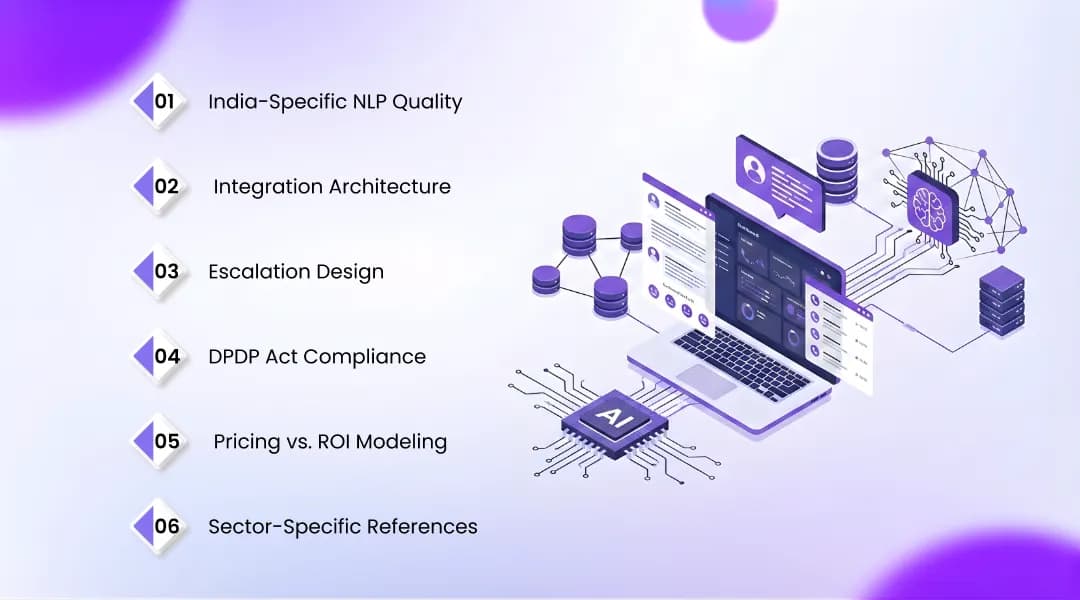
Let me give you the actual checklist - not the marketing version.
1. India-Specific NLP Quality
Request a live demo using real-world Indian language scenarios: regional accents, code-switching, informal phrasing, and an unexpected off-script customer statement. Judge with your ears and your instincts, not the slide deck.
2. Integration Architecture
Ask for the specific API documentation for your CRM or core business system - in the first conversation. If they can't produce it promptly and clearly, that's a signal about how technical conversations will go post-sale.
3. Escalation Design
How does the system hand off to a human agent? Is the transition smooth? Is the full conversation context passed to the human in real time? A broken handoff destroys the customer experience at the exact worst moment - when the customer is already frustrated enough to need a human.
4. DPDP Act Compliance
With India's Digital Personal Data Protection Act implementation now in active enforcement in 2026, this is non-negotiable. Confirm: Where is call data stored? Is it India-resident? How is customer consent captured and managed? How are data deletion requests handled? Any vendor without clear answers to these questions is an operational and legal liability.
5. Pricing vs. ROI Modeling
Don't evaluate cost in isolation. Build a 12-month ROI model that includes: reduction in agent headcount costs or redeployment savings, increase in call handling capacity, improvement in lead conversion rates, and reduced attrition-driven replacement costs. Any credible vendor will help you construct this before you sign - not after.
6. Sector-Specific References
Ask for introductions to clients in your specific vertical. A healthcare deployment is fundamentally different from an e-commerce one. Generic enterprise references tell you almost nothing useful about fit for your use case.
Companies like OnDial (ondial.ai) are specifically built for this moment in the Indian market — with multilingual voice AI capabilities, transparent partnership models, and an implementation approach grounded in India's real communication complexity rather than a global platform adapted for local use. If you're building your vendor shortlist, a direct conversation with their team on your specific use case is worth the time. Their approach to building a conversational AI voice bot is rooted in the operational realities Indian businesses actually face - not theoretical demos.
Conclusion
Here's what two years of implementation work has taught me: the businesses winning with AI calling software in India aren't the ones who moved fastest. They're the ones who moved thoughtfully — who understood their specific communication workflows, selected vendors with genuine India-market depth, built compliance into the architecture from day one, and treated human escalation as a feature, not a fallback.
In 2026, AI calling software is no longer an experiment. It's an operational standard for Indian businesses serious about scale, cost discipline, and customer experience. The competitive gap between businesses that have implemented it well and those still evaluating is widening every quarter.
The question isn't whether your competitors are using this. Most of the serious ones are.
The question is what you're going to do about it.