Here is a stat that should keep every sales leader up at night: leads contacted within five minutes are 21 times more likely to convert, yet the average business takes 42 to 47 hours to respond. That is not a typo. Nearly two full days pass while a hot lead goes cold, browses a competitor's website, and forgets why they filled out your form in the first place. AI lead follow-up calls close this gap by responding in seconds, not days, and the difference in conversion rates is staggering.
I've watched this play out across dozens of projects at OnDial. A business spends thousands generating leads through paid ads and SEO, then lets those leads sit in a CRM queue while reps finish their current meetings. It is the most expensive form of waste in modern sales. If you have felt that frustration, this article breaks down exactly how AI-powered follow-up calls work, why they convert at 3x the rate of manual outreach, and how to build a system that fits your team.
The Speed-to-Lead Gap Is Costing You Revenue
Speed-to-lead is the time between a prospect's first inquiry and your first meaningful response. Research from MIT and InsideSales.com found that calling a lead within five seconds makes you 391% more likely to convert them compared to waiting just two minutes. That number is not aspirational. It reflects the simple reality that a person who just submitted a form is still thinking about their problem, still sitting at their computer, still ready to talk.
Yet 44% of sales reps say they are simply too busy to follow up with leads in a timely manner (Amra and Elma, AI Lead Generation Statistics). Reps are juggling demos, updating CRM records, answering internal Slack messages, and prioritizing existing deals over new inquiries. The result? Leads that were genuinely interested get a callback 48 hours later and can barely remember what they were looking for.
This is not a people problem. It is a systems problem.
Manual Follow-Up Creates Uneven Coverage
Have you ever audited your team's actual response times on a Monday morning versus a Friday afternoon? The variation is enormous. Busy days kill response times because reps naturally prioritize meetings, active deals, and high-pressure tasks over brand-new inquiries sitting in a queue.
Manual outreach also creates inconsistency in qualification. One rep asks five discovery questions; another asks two and schedules a demo. There is no standardized data collection, no behavioral scoring, and no way to ensure every lead receives the same quality of initial engagement. (This is the kind of operational blind spot that slowly drains the pipeline without anyone noticing.)
How AI Follow-Up Calls Actually Work
An AI voice agent for lead follow-up is a system that uses speech recognition, a large language model, and text-to-speech technology to call inbound leads within seconds of form submission. It holds a real conversation, qualifies the prospect, answers questions about your business, and books appointments, all without human involvement.
This is not a robocall or an IVR phone tree. Modern AI voice agents listen, understand intent, handle objections, and respond naturally. The caller often cannot tell they are speaking with AI.
Voice AI vs. Traditional Auto-Dialers
Traditional auto-dialers read scripts line by line. If a prospect asks an unexpected question, the system breaks down. AI voice agents operate differently: they have a goal (qualify the lead, book a meeting), knowledge about your business, and the ability to navigate a conversation dynamically.
At OnDial, we build voice AI solutions that adapt in real time. The AI references the specific form topic or service the lead asked about, not a generic greeting. If a prospect says "I'm interested but not for another month," the AI adjusts its approach rather than pushing for an immediate booking. That contextual awareness is what separates a helpful interaction from an annoying one.
Top platforms in 2026 achieve speech-to-text latency under 300 milliseconds, meaning the pause between a prospect finishing a sentence and the AI responding feels natural, not robotic.
Real-Time Qualification During the Call
Here is where the real conversion lift happens. Instead of simply confirming contact details and scheduling a callback, AI follow-up calls can run a full qualification framework during the initial conversation.
What does an AI qualification call capture?
The AI asks discovery questions tailored to your sales process: budget range, timeline, decision-making authority, specific pain points, and current solutions in use. It scores the lead in real time based on responses and routes qualified prospects directly to your sales team with a complete transcript and context summary.
This means your reps walk into their first human conversation already knowing what the lead wants, their timeline, and how serious they are. According to a McKinsey report, businesses integrating AI into their sales processes have seen up to a 50% boost in lead generation effectiveness.
Building an AI Follow-Up System That Converts
The technology works. But the difference between a system that converts and one that annoys prospects comes down to architecture, not just software.
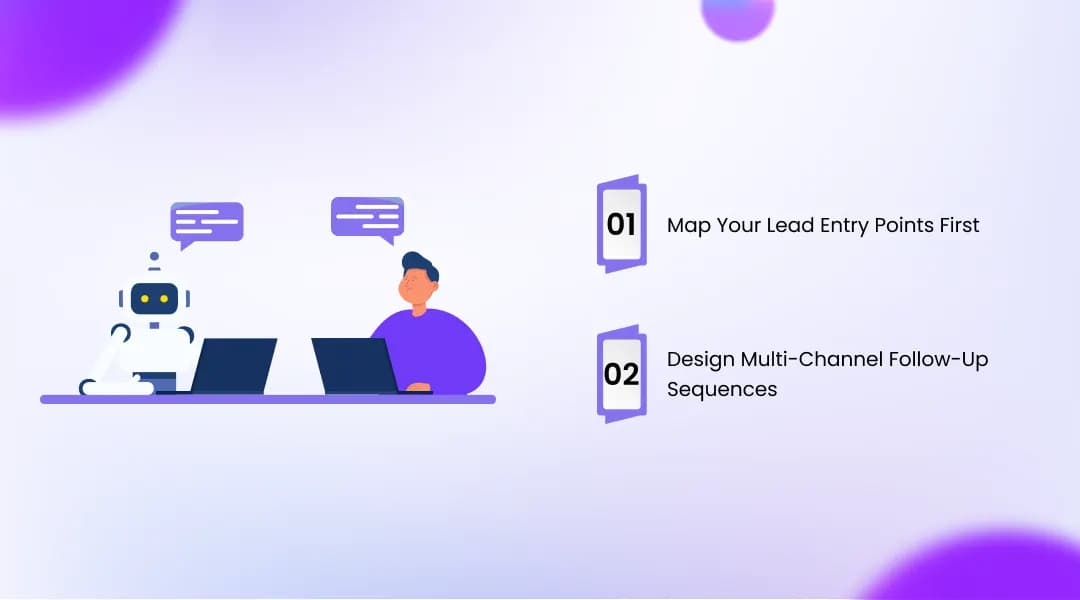
Map Your Lead Entry Points First
Before you configure a single automation, audit every place where leads enter your funnel: website forms, phone calls, social media DMs, chatbots, landing pages, WhatsApp messages, and third-party lead sources.
Each of these touchpoints should trigger your AI system to start the follow-up process immediately. A lead who calls your office at 11 PM should get the same quality of initial engagement as someone who fills out a form at 10 AM on a Tuesday. That consistency is what AI makes possible.
I've personally seen businesses discover that 60% or more of their inbound leads come through channels they were not actively monitoring after hours. Once they connected those channels to an AI voice agent, their effective lead response rate nearly doubled overnight.
Design Multi-Channel Follow-Up Sequences
A single channel is not enough. The best AI follow-up systems coordinate across voice, SMS, email, and messaging apps based on prospect behavior.
A practical sequence might look like this: the AI calls within 30 seconds of form submission. If there is no answer, it sends a personalized SMS referencing the specific inquiry. If there is still no response after four hours, it sends a follow-up message with a direct booking link. The key principle is that each touchpoint references real context from the lead's original inquiry, not generic templates.
One critical mistake to avoid: do not let your AI keep following up after a lead has booked. It sounds obvious, but many systems lack a "booked = true" exit condition, and the AI sends three more messages after the appointment is already on the calendar. That damages trust instantly.
When AI Should Hand Off to Your Sales Team
AI is extraordinary at speed, consistency, and scale. It is not built to replace the human skills that close complex deals. The right model for 2026, based on what I've observed across our client implementations at OnDial, is straightforward: AI handles every initial conversation and every follow-up. Humans handle the actual sales call once the lead is qualified and on the calendar.
The Human-AI Division of Labor
Set clear handoff criteria so your AI knows when to transfer a conversation to a human rep. Complex technical requirements need expert consultation. Emotional objections require empathy, not algorithms. Price negotiations demand flexibility that scripted responses cannot deliver. Strategic accounts deserve personal attention from your senior team.
What should you never automate? Relationship check-ins with existing customers. That is your reputation and referral engine, and it needs the human touch. Think of your AI as the assistant who handles the first 20 minutes of every new relationship. Once a lead is qualified and scheduled, your team takes over.
Measuring What Matters: KPIs for AI Follow-Up
Do not measure your AI follow-up system by vanity metrics. Track these numbers instead: response time (average seconds from lead creation to first contact), qualification rate (percentage of leads meeting your criteria), meeting acceptance rate (qualified leads who agree to a sales meeting), pipeline contribution (revenue value of AI-qualified opportunities), and cost per qualified lead.
One thing I've learned building voice AI solutions: leading indicators like response time predict future performance. Lagging indicators like closed deals validate your approach. You need both. Review your AI's performance monthly, study conversation transcripts for confusion points, and update the knowledge base with new product features and competitive differentiators.
Conclusion
AI lead follow-up calls solve the single biggest leak in most sales funnels: the gap between a prospect raising their hand and your team actually responding. The data is clear. Speed-to-lead determines conversion rates more than almost any other factor. AI makes sub-60-second response times possible at scale. And the businesses adopting this approach are converting at multiples of their previous rates.
The three takeaways that matter most: respond within seconds (not hours), qualify during the first conversation (not the third email), and let AI handle volume while your team handles relationships. At OnDial, we build tailored voice AI solutions that integrate with your existing sales process. If you want to stop losing leads to slow follow-up and start converting at rates your competitors cannot match, visit OnDial and let's build a system designed around how your business actually sells.
AI follow-up calls give sales teams the speed to respond instantly, the intelligence to qualify leads during the first conversation, and the consistency to ensure no prospect falls through the cracks.