Here's a number that should make every sales leader uncomfortable: 78% of customers buy from the first company that responds, according to Lead Connect. Not the best company. Not the cheapest. The fastest. And yet, research compiled by DesignRush shows that 44% of sales reps never follow up with a lead at all.
I've spent years at OnDial building AI voice solutions for businesses across industries, and this gap between intent and action is the single biggest revenue leak I see. Leads come in at 9 PM on a Friday. They fill out a form during lunch. They call while your team is in a meeting. And by the time someone gets back to them, they've already talked to your competitor.
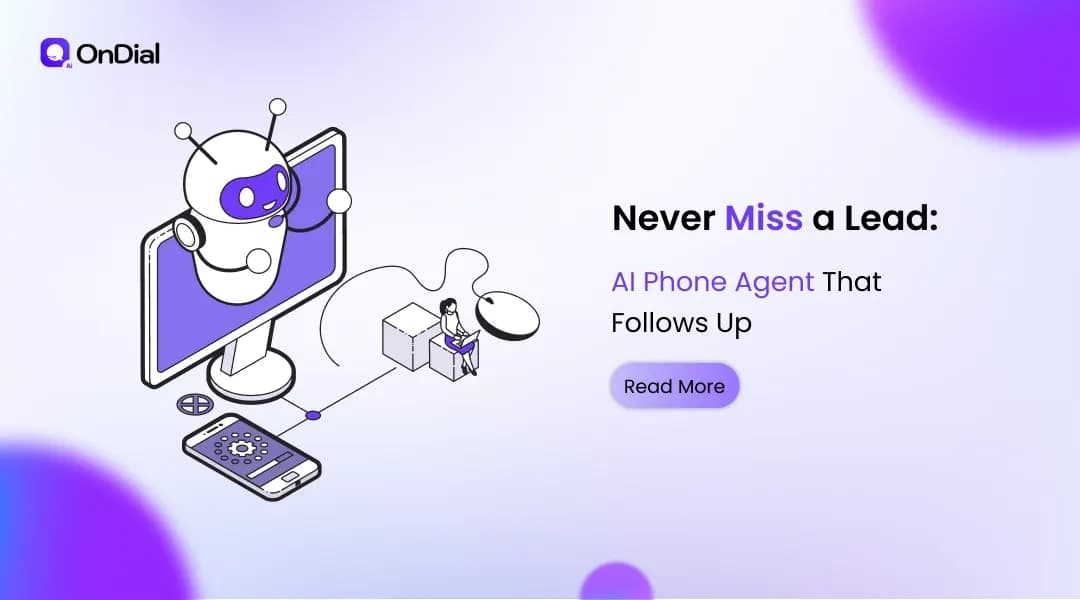
An AI phone agent for lead follow-up is a voice-based system that automatically calls, qualifies, and routes new leads the moment they arrive, without waiting for a human rep to pick up the phone. It works around the clock, follows consistent scripts, and logs every interaction to your CRM.
In this article, I'll break down how AI phone agents handle follow-up, where they genuinely outperform humans, where they don't, and what to look for if you're evaluating one for your business.
Why Most Leads Die Before Anyone Calls Back
The Response Time Problem Is Worse Than You Think
The data on lead response time is brutal. Harvard Business Review found that the average company takes 47 hours to respond to a new lead. That's nearly two full business days. According to the MIT Sloan Management Review, the odds of qualifying a lead drop by 10x after just the first hour of attempted contact.
This isn't a training problem. It's a capacity problem. Your sales reps are in meetings. They're closing existing deals. They're eating lunch. Meanwhile, a lead who just expressed genuine interest is cooling off, minute by minute.
The Follow-Up Gap Nobody Talks About
Even when teams do respond, consistency falls apart fast. Most CRM data tells the same story: the first follow-up happens, the second one is spotty, and the third one barely exists. Organizations lose 70% of prospects through inadequate follow-up processes, according to research cited by Landbase.
Think about that for a second. Seven out of ten potential customers simply vanish because nobody called them back a second time.
(Here's the part that stings: those aren't bad leads. They're leads that needed one more conversation.)
What Is an AI Phone Agent for Lead Follow-Up?
An AI phone agent is software that manages real phone conversations with prospects and customers using speech recognition, natural language processing, and voice synthesis. Unlike robocalls or IVR menus, modern AI phone agents have actual back-and-forth conversations, listening to responses, asking follow-up questions, and making decisions about next steps.
How It Differs From Chatbots and Auto-Dialers
A chatbot handles text. An auto-dialer plays recorded messages or connects calls to live reps. An AI phone agent does something fundamentally different: it talks, listens, and decides. It can ask a prospect about their budget, understand the answer, and route that lead accordingly, all in real time.
The Core Job: Speed and Consistency
The primary value of an AI phone agent for lead follow-up is eliminating the two biggest killers of lead conversion: delayed response and inconsistent outreach. When a new lead enters your CRM, the agent calls within seconds. Every single time. No exceptions, no sick days, no "I'll get to it after this meeting."
How AI Phone Agents Follow Up With Leads
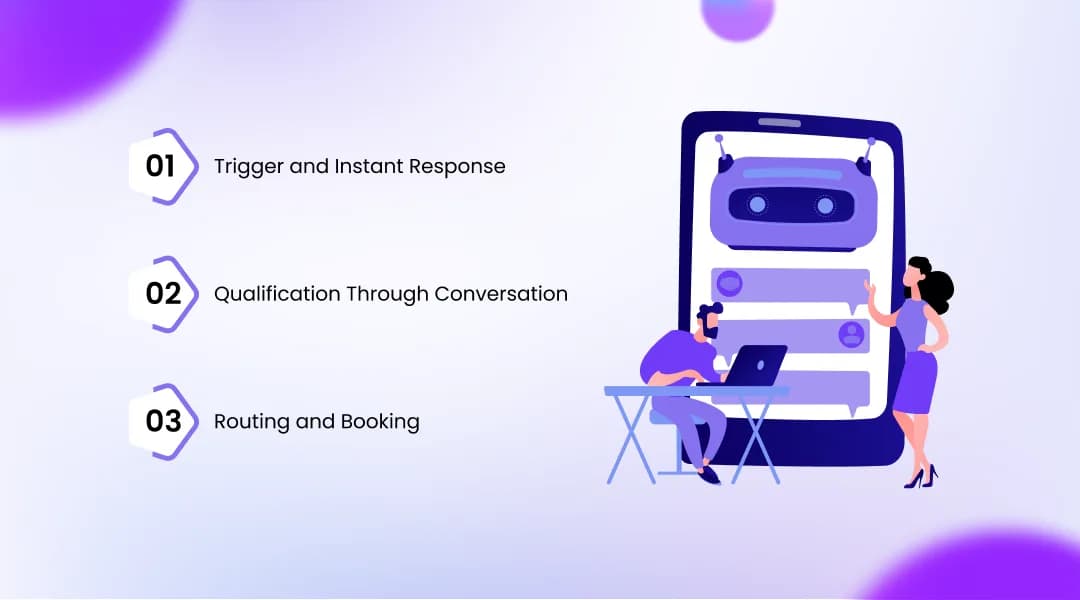
How does an AI phone agent follow up with leads? When a lead submits a form, calls your business, or triggers any CRM event, the AI phone agent initiates a call within seconds. It greets the prospect by name, introduces itself, asks structured qualification questions, scores the lead, and either books a meeting or routes to a human rep, all while logging the full interaction.
Step 1: Trigger and Instant Response
The AI monitors your CRM or lead capture system for new entries. The moment a form is filled, a call is missed, or a chat lead is captured, it triggers an outbound call. Platforms like GoHighLevel and HubSpot support these automated triggers natively.
At OnDial, we've seen this single change, reducing response time from hours to seconds, produce the most dramatic conversion improvements for our clients. Velocify's study of 3.5 million leads found that calling within 60 seconds yields 391% more conversions compared to waiting even two minutes.
Step 2: Qualification Through Conversation
The agent follows a scripted but adaptive conversation. It asks about budget, timeline, needs, and decision-making authority, often following frameworks like BANT. But unlike a rigid form, the AI can respond to unexpected answers, ask clarifying questions, and adjust its approach.
Step 3: Routing and Booking
Qualified leads are immediately routed to a human sales rep or booked into a calendar slot. Unqualified leads receive a polite response and can be enrolled in a nurture sequence. Every outcome is logged to the CRM with a full transcript and qualification score.
What Makes AI Follow-Up Better Than Manual Outreach
Speed That Humans Can't Match
Would you bet your revenue on being the fastest responder every time? That's the real question. AI doesn't need to check its calendar before making a call. It responds in seconds, 24 hours a day, 7 days a week, across every time zone.
Gartner projects that 40% of enterprise applications will feature task-specific AI agents by the end of 2026. The shift isn't theoretical anymore.
Consistency Across Every Lead
Human reps have good days and bad days. They prioritize some leads over others. They forget follow-ups. An AI phone agent applies the same qualification criteria, the same energy, and the same persistence to every single lead.
Cost Efficiency at Scale
A dedicated inside sales agent (ISA) costs $40,000 to $60,000 per year. An AI phone agent system typically runs $500 to $1,500 per month, according to industry pricing data from monday.com. For businesses handling hundreds of leads monthly, the math is straightforward.
How to Choose the Right AI Phone Agent for Your Business
What to Evaluate Before You Buy
Not all AI voice platforms are equal. Here's what actually matters when choosing a system for automated lead follow-up calls:
Latency
If the AI takes more than a second to respond, prospects notice. The 2026 industry benchmark from Speechmatics is under 250 milliseconds. Anything above 800ms creates awkward pauses that erode trust.
CRM Integration
The agent must sync natively with your existing stack, whether that's HubSpot, Salesforce, or a custom system. If data doesn't flow automatically, you're creating more work, not less.
Escalation Logic
What happens when the AI can't answer a question? The best systems transfer to a human immediately, with full context. The worst ones loop or hang up.
Questions to Ask Any Vendor
Before signing anything, ask: Can I hear a real call recording? What's the average call completion rate? How does the system handle objections? What's the actual per-minute cost once you include telephony, speech processing, and AI inference?
Where AI Phone Agents Fall Short
Complex Conversations Still Need Humans
I'll be honest about this because I think transparency matters more than hype. AI phone agents handle structured qualification well. They're excellent at consistent, repeatable tasks. But when a prospect has a nuanced objection, an emotional concern, or a multi-layered question, the AI often stumbles.
The fix isn't to pretend the AI can do everything. It's to design your system so the AI handles the first 80% and hands off the complex 20% to a human with full context. At OnDial, we call this "warm handoff architecture," and it's at the core of every solution we build.
Over-Automation Kills Trust
If a prospect feels like they're talking to a machine that's reading a script, you've lost them. The voice needs to sound natural. The pacing needs to feel human. And the AI needs to identify itself honestly. Trying to disguise an AI as a human backfires more often than it works.
Conclusion
An AI phone agent for lead follow-up solves the three problems that kill most sales pipelines: slow response times, inconsistent outreach, and limited team capacity. The data is clear, the technology is mature, and the businesses that adopt it are already pulling ahead.
The three takeaways that matter most: respond to every lead in seconds, not hours. Use AI for consistent qualification and humans for relationship building. And design your system around honest, transparent handoffs between AI and people.
At OnDial, we build voice AI solutions grounded in this exact philosophy: technology that's honest about what it is, fast where speed matters, and smart enough to hand off when a human touch is needed. If you're losing leads to slow follow-up and want to explore what a tailored AI phone agent could look like for your business, visit OnDial and let's have a real conversation about your pipeline.
AI phone agents don't replace your sales team. They make sure your team only talks to people who are ready to buy, and that no lead ever goes unanswered again.