I need to tell you about the moment I stopped believing in headcount as a strategy.
I was Head of Support Operations at a D2C brand that was growing at 70 percent year over year. We had scaled from 12 agents to 180 in under two years. We had team leads, quality analysts, training managers, and an IVR system I had personally spent four months configuring. On paper, we were a well-oiled machine.
In reality, we were drowning.
Our CSAT was stuck at 3.6 out of 5. First call resolution hovered around 54 percent. Agent attrition was 45 percent annually, which meant I was permanently training people who hadn't mastered the product before their predecessors had finished their notice periods. And every quarter, the answer from leadership was the same: "Hire more people."
So I did. And it didn't work. Because the problem was never the number of agents. The problem was the model itself.
That realization, the understanding that you can't solve a structural problem with incremental staffing, is what led me to AI-powered customer support. Not as a buzzword. Not as a cost-cutting gimmick. As a fundamental rethinking of how customer conversations should work.
Three years and 25+ client deployments later, I can tell you this with confidence: the AI systems available today don't just automate support. The best ones actually talk like humans. Not perfectly. Not always. But well enough that your customers get better experiences than most human-staffed systems currently deliver.
This article is the honest, deployment-tested guide I wish someone had given me before I started. No vendor fluff. No theoretical frameworks. Just what works, what doesn't, and how to tell the difference.
What is AI-Powered Customer Support?
Definition
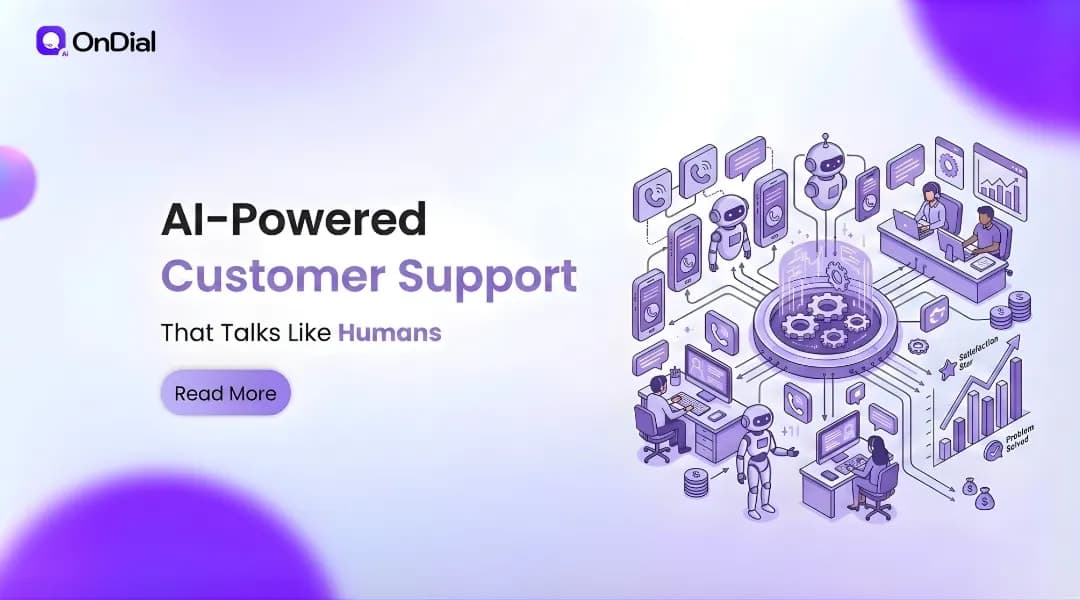
AI-powered customer support is the use of artificial intelligence to handle customer interactions, through voice, text, or both, in a way that understands natural language, maintains context across a conversation, and resolves issues without requiring a human agent for every interaction.
That last part matters. This isn't about routing calls to a queue faster. It's about resolving the customer's problem within the AI conversation itself.
Key Components (NLP, ML, Voice AI)
Three technologies make this possible:
Natural Language Processing (NLP) enables the system to understand what a customer is saying, not just the words, but the intent behind them. When someone says "I've been charged twice for the same thing and I'm really frustrated," the AI needs to extract the intent (duplicate charge dispute), the emotion (frustration), and the expected action (refund or investigation).
Machine Learning (ML) allows the system to improve over time. Every conversation generates data. The best platforms learn from that data to handle similar queries better, recognize new patterns, and reduce escalation rates progressively.
Voice AI is the layer that makes phone-based support possible. Using automatic speech recognition (ASR) and text-to-speech (TTS), voice AI agents conduct real spoken conversations on the phone, which remains the highest-volume and highest-stakes support channel for most businesses.
Difference Between Chatbot vs Conversational AI
This is one of the most misunderstood distinctions in the market, and getting it wrong leads to expensive mistakes.
A basic chatbot follows scripted decision trees. It matches keywords and returns pre-written answers. It's useful for simple FAQ deflection, but it breaks the moment a customer's question doesn't fit the script.
A conversational AI system understands open-ended speech, maintains context across multiple turns, accesses backend data in real time, and adapts its responses based on what the customer actually needs. It's the difference between a phone tree and a phone conversation.
When someone asks about the difference between a chatbot and a conversational AI voice bot, this is the answer: one follows a script. The other holds a conversation.
Why Human-Like AI Is Reshaping Customer Support
Emotional Intelligence in AI
I'll be honest. Three years ago, I would have laughed at the phrase "emotional intelligence in AI." I'd seen enough terrible bots to know that most of them had the emotional range of a parking meter.
But the technology has moved. Modern AI customer experience solutions don't just detect what a customer is asking. They detect how the customer is feeling. Tone analysis, word choice patterns, pace of speech, these signals are now being processed in real time to adjust the AI's response style, vocabulary, and escalation behavior.
Is it the same as a skilled human agent reading the room? No. But it's dramatically better than the robotic, flat-toned bots that created the bad reputation AI support still carries.
Natural Conversations vs Scripted Replies
The gap between a scripted reply and a natural conversation is the gap between a vending machine and a restaurant. One gives you what's available. The other gives you what you actually want.
When a customer says "yaar, mera order galat aaya hai aur main bahut frustrated hoon," a scripted bot tries to match keywords and probably fails. A human-like AI chatbot built on strong NLP recognizes the intent (wrong order received), the emotion (frustration), and responds with, "I'm sorry about that, Rahul. Let me pull up your order details and get this sorted right away."
That's not magic. That's good engineering married to good conversation design.
Real-World Experience Improvements
I've measured this across deployments. When businesses move from scripted chatbots to conversational AI, three things happen consistently: average resolution time drops (because the AI doesn't need to transfer through three departments), customer satisfaction improves (because the interaction feels responsive, not mechanical), and repeat contact rates decrease (because problems actually get solved the first time).
One SaaS client I worked with saw their CSAT jump from 3.4 to 4.2 within 60 days of deploying a conversational AI system. Same product. Same customer base. Different experience.
Key Features of Human-Like AI Support Systems
Not all AI support platforms are created equal. Here's what separates the ones that actually sound human from the ones your customers will despise:
Context-Aware Conversations
The AI must remember what was said thirty seconds ago and connect it to what's being asked now. If a customer says "I want to return the blue one, not the red one" after discussing a multi-item order, the system needs to understand which item "the blue one" refers to. Without context awareness, you don't have a conversation. You have a series of disconnected transactions.
Multilingual Support
For Indian businesses, this is non-negotiable. Over 90 percent of India's internet users prefer interacting in a language other than English. A conversational AI customer support system that handles only English is ignoring the vast majority of its potential users.
The platforms that work in India, companies like OnDial, handle Hindi, Tamil, Telugu, Marathi, Bengali, Kannada, and, critically, Hinglish, the natural blend of Hindi and English that most urban Indian callers actually speak. Not as separate language modes, but as fluid, code-switching-aware conversation.
Voice + Text Integration
Your customers don't pick one channel and stay there. They might start on WhatsApp, switch to a phone call, and follow up via email. A strong AI support system operates across voice and text channels while maintaining conversation continuity. The customer shouldn't have to repeat their issue because they switched from chat to phone.
Personalisation
When the AI integrates with your CRM, it knows who's calling, what they bought, when they last contacted support, and what their unresolved issues are. "Hi Priya, I see you reached out yesterday about your subscription renewal. Would you like to pick up where we left off?" That's not just efficient. That's the kind of experience that builds loyalty.
Continuous Learning
Every conversation should make the AI smarter. The platform should learn from successful resolutions, identify new intent patterns, flag edge cases for human review, and progressively reduce its escalation rate. If your AI isn't getting better every month, your vendor isn't investing in the product.
Benefits of AI-Powered Customer Support
These are measured outcomes from real deployments. Not projections. Not vendor promises.
24/7 Availability
Your customers don't call between 9 and 6 because it's convenient for them. They call when they have a problem. An AI support agent handles every call, at every hour, without shift changes, overtime costs, or the quality degradation that comes from tired agents working late-night rotations.
When I deployed 24/7 AI voice support for an e-commerce client, we discovered that 27 percent of their total call volume occurred outside business hours. For years, those calls had gone to voicemail. Most were never returned.
Reduced Operational Cost
The fully loaded cost of a human-handled support call in India runs ₹15 to ₹40. An AI-handled call costs ₹1 to ₹5. For a company handling 8,000 calls per day where 60 percent are repetitive Tier 1 queries, the annual savings are substantial. One BFSI client documented ₹47 lakhs in savings in their first year after deploying AI customer service automation.
Faster Response Time
Zero hold time. Zero queue. The AI picks up the first ring. I tracked this metric in my first major deployment: our average speed of answer dropped from 3 minutes 10 seconds to under 4 seconds. The impact on customer sentiment was visible in the data within two weeks.
Scalability
Diwali sale. Exam results week. Product recall. Campaign spike. Any event that triples your call volume overnight becomes manageable without a hiring scramble. AI scales with configuration, not recruitment.
Improved Customer Satisfaction
Customers who get their problem solved quickly, in their own language, without hold time or transfers, rate the experience higher. Consistently. I've measured CSAT improvements of 12 to 20 points across multiple deployments within the first 90 days.
Let me ask you something directly: when was the last time your support system genuinely surprised a customer in a good way?
AI vs Traditional Customer Support
Cost Comparison
Factor | Traditional Support | AI-Powered Support |
Cost per Interaction | ₹15 to ₹40 | ₹1 to ₹5 |
Scaling Cost | Linear (more agents = more cost) | Marginal (more calls ≠ proportional cost) |
Training Investment | Continuous, per agent | One-time setup + ongoing optimisation |
Attrition Cost | 35 to 45% annual turnover | Zero |
Efficiency Comparison
Traditional support handles one call per agent at a time. AI handles hundreds of concurrent conversations. Traditional support quality varies by agent, shift, mood, and tenure. AI delivers consistent quality on every interaction. Traditional support takes weeks to scale. AI takes hours.
Human Dependency
AI doesn't eliminate the need for humans. It eliminates the need for humans to do work that shouldn't require a human. The difference matters.
Hybrid Model (AI + Human Agents)
The best support operations I've seen in 2026 are not all-AI or all-human. They're hybrid. The AI handles the 60 to 70 percent of queries that are repetitive, data-driven, and pattern-based. Human agents handle the 30 to 40 percent that require judgment, empathy, complex reasoning, or authority to make exceptions.
The result? Agents do more meaningful work. Customers get faster, better service. Costs go down while satisfaction goes up. That combination is rare in business, which is exactly why it gets attention in the boardroom.
Use Cases Across Industries
E-commerce
Order tracking, return initiation, delivery rescheduling, payment confirmation. These queries represent 50 to 70 percent of inbound volume for most D2C brands. A conversational AI voice bot resolves them in under 60 seconds, in the customer's language, at any hour. One fashion brand I worked with reduced support costs from ₹7.8 lakhs to ₹2.6 lakhs per month by automating these workflows.
Healthcare
Appointment booking, confirmation, and rescheduling. Prescription refill reminders. Lab report notifications. A multi-location hospital chain deployed AI voice agents across Hindi, English, and Tamil.. No-show rates dropped 31 percent. The scheduling team was redeployed to handle complex patient inquiries.
BFSI
EMI reminders, loan status inquiries, KYC verification follow-ups, insurance claim status updates. An NBFC client running 50,000 monthly reminder calls was managing only 16,000 through agents. The AI handled the full volume across three languages, and on-time payment rates improved 22 percent.
EdTech
During enrollment seasons, inquiry volume can spike 400 percent. AI voice agents handle initial screening: course interest, eligibility, fee structure, campus preferences. Qualified leads get transferred to human counselors. One EdTech client saw counselor conversion rates improve 38 percent because counselors stopped spending time on calls that were never going to convert.
Telecom
Plan inquiries, balance checks, recharge assistance, complaint logging. A regional telecom provider handling 90,000 monthly calls deployed voice AI for the top eight query types. The AI resolved 59 percent without human involvement. Customer effort scores improved 25 percent.
How AI Mimics Human Conversations
Let me pull back the curtain on what's actually happening when an AI system "talks like a human."
Natural Language Processing (NLP)
NLP is the brain of the operation. It doesn't just identify words; it interprets meaning. "I need to change my plan" could mean a mobile recharge plan, a travel itinerary, or an insurance policy, depending on context. Good NLP resolves that ambiguity using conversational history, customer profile data, and intent classification models.
Speech Recognition & Synthesis
Automatic speech recognition (ASR) converts the customer's spoken words into text, handling accents, background noise, filler words ("umm," "actually wait"), and mid-sentence corrections. Text-to-speech (TTS) then generates natural-sounding responses with appropriate pacing, intonation, and emotional tone. The best TTS engines today are nearly indistinguishable from a human reading a well-written script.
Sentiment Analysis
The AI monitors emotional signals throughout the conversation. If a customer's tone shifts from neutral to agitated, if they start using sharper language or speaking faster, the system can adjust: slow down, simplify its language, acknowledge the frustration, or proactively offer escalation to a human agent.
Context Memory
This is what separates a conversation from an interrogation. The AI remembers what was discussed earlier in the call. If a customer says "that's not what I meant" or "go back to the previous option," the system retrieves the relevant context and adjusts. Without this capability, every exchange feels like starting over.
Challenges & Limitations of AI Support
I'd be doing you a disservice if I pretended this technology is flawless. It isn't. Here's where it struggles:
Lack of Deep Emotional Understanding
AI can detect frustration. It cannot truly understand grief, anxiety, or the complex emotional texture of a customer who's been let down repeatedly. For interactions that require genuine human empathy, such as a sensitive insurance claim, a medical concern, or a complaint that's really about feeling unheard, human agents remain essential. The key is building your system to recognize these moments and route accordingly.
Data Dependency
AI is only as good as the data it trains on and the systems it connects to. If your CRM is outdated, your knowledge base is incomplete, or your call recordings are sparse, the AI's performance will reflect those gaps. Garbage in, garbage out applies here as firmly as it does anywhere else in technology.
Privacy Concerns
Voice AI processes names, account numbers, financial details, and health information. In regulated industries like BFSI and healthcare, data handling must comply with applicable standards. Ask your vendor specific questions about encryption, data residency, retention policies, and access controls. Vague answers are not acceptable.
Do you know, specifically, where your customer voice data is stored and who has access to it? If the answer is unclear, that's the first conversation to have before any AI deployment.
Best Practices to Implement AI Customer Support
After deploying across 25+ companies, here's what I've learned works:
Start with FAQs Automation
Don't try to automate everything on day one. Identify the 8 to 10 queries that represent 60 percent of your inbound volume. Automate those first. Prove the model. Build confidence in the system. Then expand.
Train AI with Real Conversations
Don't write hypothetical scripts. Feed the AI your actual call recordings, chat logs, and ticket data. Real customer language is messy, colloquial, and context-dependent. The AI needs to learn from reality, not from a product manager's imagination of how customers "should" talk.
Use Hybrid Support Models
Deploy AI for Tier 1 queries. Route complex issues to humans with full context from the AI conversation. This isn't a compromise. It's the optimal architecture. Both the AI and your human agents perform better when they're handling work that matches their strengths.
Continuously Optimise
Review AI performance monthly. Analyse escalation patterns. Identify intents the AI is struggling with. Update conversation flows based on real outcomes, not assumptions. The best AI support systems aren't deployed. They're cultivated.
Companies like OnDial approach deployment as the start of a partnership, not the end of a sales cycle, because they understand that optimisation after go-live is where the real value gets built.
Future of AI in Customer Support
Voice-First Interactions
India's next hundred million internet users are voice-first. They prefer speaking over typing. The businesses building voice AI infrastructure now, using platforms designed for conversational AI for business, are positioning themselves for a customer base that will interact with brands primarily through spoken conversation.
Hyper-Personalisation
The next wave of best AI customer support software won't just know who's calling. It will predict why they're calling based on recent interactions, browsing behavior, and purchase history. Conversations will begin with context, not questions.
AI Agents Replacing Tier-1 Support
This is already happening. The trajectory is clear: within two to three years, the majority of Tier 1 support interactions at scale-focused companies will be handled by AI agents. Not because businesses want to eliminate jobs, but because customers prefer the speed, consistency, and availability that AI provides for straightforward queries. Human agents will shift toward higher-value, more complex, and more rewarding work.
Conclusion
Here's what 13 years of running support operations and three years of deploying AI have taught me:
The companies delivering the best customer experiences right now aren't the ones with the biggest support teams. They're the ones that figured out which conversations need a human and which ones are better handled by AI.
AI-powered customer support that talks like a human isn't a future concept. It's a current reality. The technology works. The economics are clear. The customer preference data is unambiguous.
But it requires thoughtful deployment. The right vendor. Realistic expectations about what AI handles well and where humans remain essential. A commitment to optimisation over time, not just a one-time installation.
If your current support model involves hiring more agents every quarter to deliver the same mediocre experience, the model is the problem, and platforms like OnDial are built for exactly this shift. And the alternative is already here.
Stop scaling the problem. Start solving it.