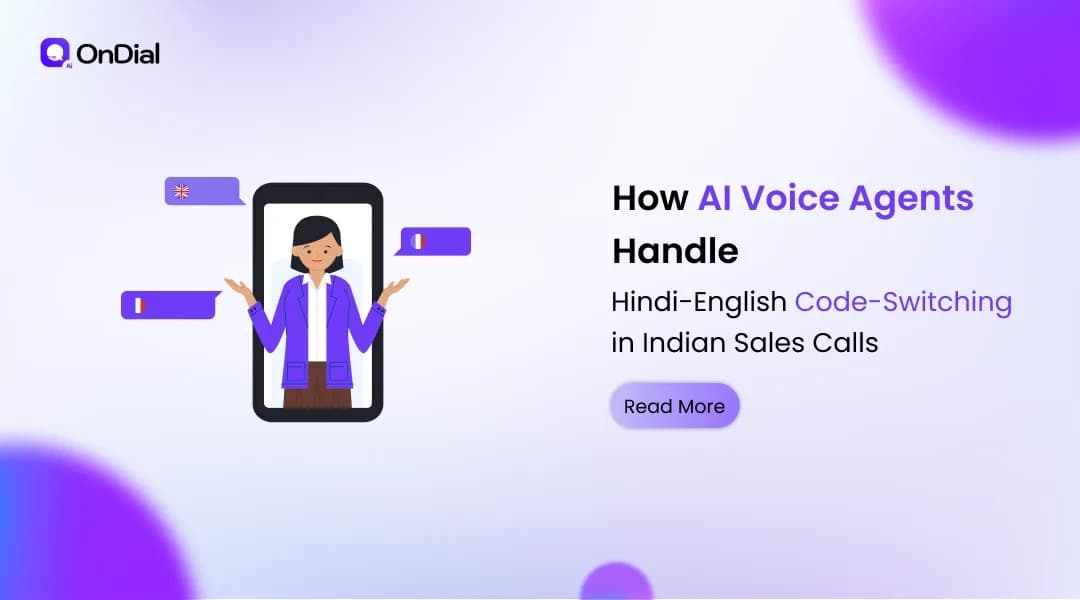
Here is a number that should stop every Indian sales leader mid-scroll: 91% of Indian sales professionals now consider AI agents essential for business success, according to DQ India's 2026 report. Yet the majority of AI voice platforms on the market today still struggle with the single most common speech pattern in Indian commerce: Hinglish. AI voice agents that handle Hindi-English code-switching recognize and respond to the natural, mid-sentence blending of Hindi and English that defines how most Indian customers actually speak on sales calls.
If you have ever watched a promising AI-powered sales call fall apart the moment a prospect said "Haan, mujhe interest hai but abhi budget thoda tight hai," you already know the problem. The agent freezes. Misinterprets. Responds in the wrong language. And the lead is gone.
I have spent years at OnDial building voice AI specifically for this reality. In this article, I will walk you through why code-switching matters for sales, how the technology actually works, what breaks when it does not work, and exactly what to demand from any vendor before you sign.
Why Hinglish Is the Real Language of Indian Sales
The Code-Switching Reality on Sales Calls
Code-switching is the practice of alternating between two or more languages within a single conversation, or even within a single sentence. In India, this is not an edge case. It is the default.
A customer calling about a home loan does not speak pure Hindi. They do not speak pure English. They say things like "EMI kitni hogi for the 20-year plan?" or "Payment UPI se kar sakta hoon kya?" Research from IIT Guwahati's Hindi-English code-switching corpus found that in typical bilingual conversations, roughly 67% of each sentence consists of Hindi words and 33% English words, with intra-sentential switching (mid-sentence language changes) being the most common pattern.
That is not a quirk. That is how 400 million bilingual Indians communicate every day. And on a sales call, it is the language of trust.
What "Hindi Support" Usually Means (and Why It Falls Short)
Here is the uncomfortable truth most vendors will not tell you: "Hindi support" on a product page almost always means the system was trained on clean, formal Hindi audio from Delhi NCR speakers. A Hindi speaker in Patna, Lucknow, or Ranchi uses different phonetic patterns, different vocabulary, and switches to English at different trigger points.
(I have personally listened to hundreds of call recordings where a vendor's "Hindi-supported" agent completely lost context the moment a customer inserted three English words into a Hindi sentence. It is painfully common.)
Most platforms treat Hindi and English as two separate modes. The system detects a language, picks a model, and processes accordingly. But real Indian speakers do not pause between languages. They do not announce "now I will switch to English." The shift happens inside a single breath.
How AI Voice Agents Handle Hindi-English Code-Switching Under the Hood
The STT-LLM-TTS Pipeline
Every AI voice agent runs on a three-stage pipeline. Understanding this pipeline is the key to understanding where code-switching succeeds or fails.
Speech-to-Text (STT) converts the caller's spoken words into text. This is the first and most critical stage for code-switching. A bilingual ASR model must recognize Hindi phonemes, English phonemes, and the hybrid phonemes that emerge when an Indian speaker pronounces English words with Hindi-influenced articulation, all within a single audio stream.
Large Language Model (LLM) interprets the transcribed text, understands intent, and generates the appropriate response. For code-switched input, the LLM must parse meaning from a sentence that might contain Hindi grammar with English nouns, or English syntax with Hindi discourse markers.
Text-to-Speech (TTS) converts the response back into spoken audio. The best systems respond in the same code-switched register the customer used, matching not just language but tone and formality level.
Where Code-Switching Breaks (and Why)
The biggest failure point is Stage 1: STT. Industry testing shows that off-the-shelf English ASR systems produce word error rates (WER) of 35-45% when processing Hinglish speech. Purpose-built Indian ASR systems bring that figure below 8%. That is not a marginal improvement. That is the difference between understanding a customer and losing them.
Have you ever been on a call where you had to repeat yourself three times? Your customers feel the same frustration, except they do not repeat themselves. They hang up.
The second failure point is less obvious but equally damaging: response language mismatch. A customer speaks in Hinglish. The agent responds in formal English. The conversational rhythm breaks. The warmth disappears. And on a sales call, warmth is revenue.
The Sales Impact: What Happens When Code-Switching Fails

Lost Leads and Dropped Trust
This is where the conversation moves from technical to financial. When an AI voice agent fails at code-switching, three things happen in rapid sequence.
First, the customer feels misunderstood. Language mismatch triggers the same psychological response as speaking to someone who is not listening. Trust drops immediately.
Second, the call loses its natural flow. The customer starts simplifying their language, shortening answers, and disengaging emotionally. They are no longer in a buying conversation. They are in a frustration management conversation.
Third, and this is the part that does not show up in most analytics dashboards, the customer forms a brand impression. Not of the AI agent. Of your company. "These people don't even understand how I talk" is a sentiment that kills repeat engagement.
The Conversion Rate Gap
In my experience working with Indian businesses at OnDial, I have seen the numbers firsthand. A voice AI agent that handles Hinglish naturally achieves call completion rates 25-35% higher than one that forces customers into pure Hindi or pure English mode. For sales-specific calls, where every dropped call is a lost deal, that gap is enormous.
One thing I want to be transparent about: code-switching performance varies significantly by region, industry, and the specific vocabulary your customers use. A fintech caller in Mumbai speaks differently from an edtech prospect in Jaipur. No system handles every variation perfectly today. But the gap between "good enough" and "not ready" is wide, and it is measurable.
What to Look For in a Voice AI Platform Built for India
Five Questions to Ask Every Vendor
If you are evaluating AI voice agents for Hindi-English code-switching in Indian sales calls, these five questions will separate the genuinely capable platforms from the ones with impressive demos and disappointing production performance.
1. Are you trained on Indian code-switching, not just Indian languages? Most Indian customer conversations are Hinglish, not pure Hindi or pure English. Ask to hear actual call recordings, not scripted demos.
2. How do you handle regional accents within Hindi? A Hindi speaker in Patna sounds nothing like one in Delhi. Test in your actual geography, with your actual customer demographics.
3. What is your WER on real Hinglish telephony audio? Best-in-class systems achieve below 8% WER on code-switched telephony audio. If a vendor cannot answer this question with a specific number, they have not measured it.
4. Does your agent respond in the same code-switched register? Understanding Hinglish input is only half the job. The agent must reply in Hinglish too, or the conversation feels robotic.
5. What is your latency on a code-switch? If the system pauses to "re-detect" the language every time the customer switches, those pauses accumulate into awkward silences. Aim for sub-300ms response times.
Regional Accents and Dialects Within Code-Switching
Code-switching is not one pattern. It is hundreds. A Gujarati businessperson mixes English differently than a Telugu-speaking tech professional. The ratio of Hindi to English words shifts by industry (finance and tech skew heavier on English terms), by age (younger speakers code-switch more fluidly), and by call context (complaints tend to shift toward the mother tongue, while transactional conversations stay closer to English).
Any platform claiming "Hinglish support" as a single feature is oversimplifying. The question is not whether the system supports Hinglish. The question is whether it supports your customers' specific version of Hinglish.
Conclusion
AI voice agents that handle Hindi-English code-switching are no longer a nice-to-have for Indian sales teams. They are the baseline. The three things that matter most: your ASR must be trained on real Hinglish conversational data (not clean monolingual audio), your agent must respond in the same code-switched register your customers use, and your platform must be tested against your specific regional and industry speech patterns.
At OnDial, we build voice AI for how Indians actually speak, not how a training dataset wishes they did. If your current voice AI stumbles every time a customer mixes Hindi and English mid-sentence, it is time to test what purpose-built Indian voice AI can do for your conversion rates. Talk to our team at OnDial and hear the difference on a live call.
The best voice AI for India does not ask customers to change how they speak. It adapts to the way they already do.