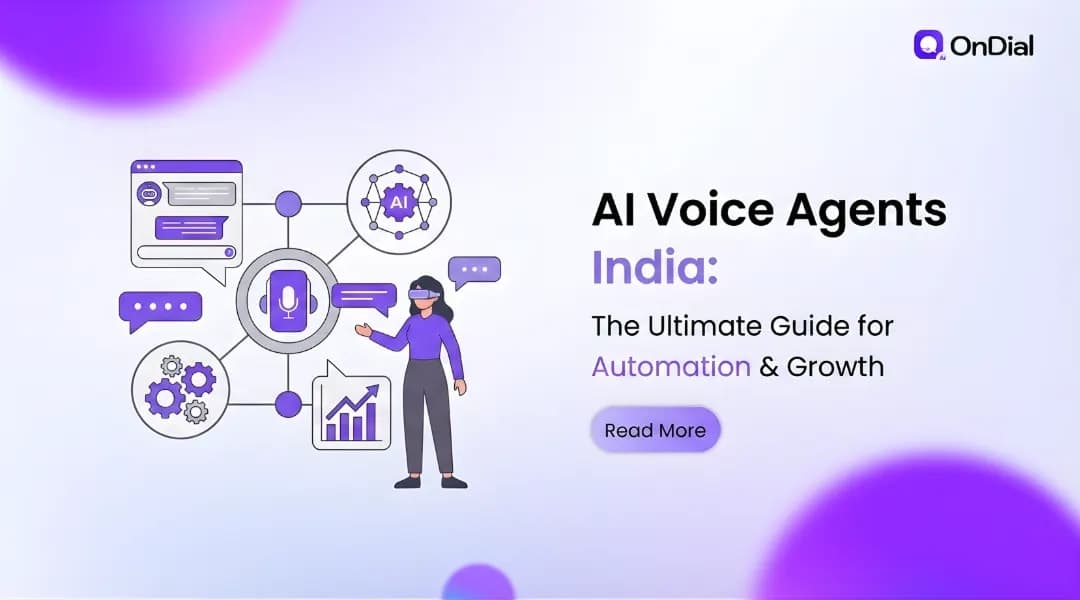
AI voice agents are changing how businesses manage phone conversations. Instead of relying on a human employee to answer every call, businesses can use conversational AI to understand callers, respond naturally, collect information, and complete defined actions.
For Indian businesses, the opportunity is particularly relevant because phone calls remain important across sales, customer service, healthcare, financial services, real estate, education, logistics, and retail. Customers may also communicate in English, Hindi, or regional languages, often switching between languages during the same conversation.
But adopting an AI voice agent is not simply a matter of connecting AI to a phone number. The real value comes from choosing the right use case, connecting the agent to business systems, defining when a human should take over, and measuring whether automation actually improves the customer journey.
This guide explains how AI voice agents work, where businesses can use them, what to evaluate before deployment, and how to approach implementation in India.
What Are AI Voice Agents?
An AI voice agent is a software system that conducts spoken conversations with customers over the phone.
Unlike a traditional IVR that sends callers through fixed options such as "press 1 for sales," an AI voice agent can understand natural language and determine what the caller is trying to accomplish.
A typical conversation can involve several steps:
The customer calls a business number or receives an outbound call.
The AI converts speech into usable information.
The system identifies intent and relevant context.
The agent asks follow-up questions when necessary.
Business systems are queried or updated through integrations.
The AI provides an answer or completes an action.
Complex cases can be transferred to a human agent.
The conversation and outcome can be recorded for analysis.
This makes an AI voice agent more than a voice interface. It becomes a communication layer between the customer and the business processes behind the phone call.
Why AI Voice Agents Matter for Indian Businesses
The business case for voice automation in India is not based on one factor. It comes from several operational challenges that often occur together.
High Call Volumes
Businesses can receive large numbers of calls during campaigns, seasonal periods, product launches, appointment windows, or peak service hours.
Adding human capacity for every temporary increase in demand can be difficult. An AI voice agent can provide additional call handling capacity without requiring a complete hiring cycle.
Customers Expect Faster Responses
A customer calling about a property, appointment, order, loan, insurance policy, or service request usually wants an immediate response.
When calls go unanswered or customers remain in queues, they may abandon the interaction or contact another provider.
AI voice agents can answer routine calls immediately and route conversations according to business rules.
Multilingual Communication
India's customer base is linguistically diverse.
A voice automation strategy therefore needs to consider more than English support. Customers may prefer Hindi or another regional language, and some conversations may include code switching between languages.
The quality of multilingual automation depends on speech recognition, language understanding, voice quality, conversation design, and testing with real customer speech.
Repetitive Phone Work Consumes Staff Time
Many business calls contain repetitive tasks.
Examples include appointment confirmations, lead qualification, order status requests, payment reminders, customer feedback, delivery updates, and basic support questions.
Automating these conversations can allow human employees to spend more time on situations that require judgment, empathy, negotiation, or specialist knowledge.
How AI Voice Agents Work
A practical AI voice workflow usually combines several technologies and business systems.
1. Speech Recognition
The system converts the customer's spoken words into information the AI can process.
This stage needs to handle normal conversational speech, interruptions, accents, background noise, and different speaking styles.
2. Intent Understanding
The AI determines what the caller wants.
For example, a customer might say, "I need to move my appointment to Friday afternoon."
The system needs to understand that the intent is appointment rescheduling rather than simply identifying individual words.
3. Business Logic and Knowledge
The agent needs access to approved information and business rules.
For example, a healthcare appointment agent may need to know available appointment slots, while a retail agent may need access to order status information.
4. System Integration
This is where voice automation becomes operationally useful.
An AI voice agent can connect with systems such as CRM platforms, calendars, order management systems, customer databases, or other business applications through integrations and APIs.
5. Voice Response
The system generates a spoken response based on the conversation context and the action being taken.
The experience should feel conversational rather than like a sequence of prerecorded messages.
6. Human Escalation
Not every call should be automated from beginning to end.
A well-designed system should recognize situations that require human judgment and transfer the conversation with relevant context rather than forcing the customer to repeat everything.
The Most Useful AI Voice Agent Use Cases
The best starting point is usually a specific business problem rather than a general goal of "using AI."
Customer Support
AI voice agents can handle common questions, provide information, collect issue details, and route conversations to the correct team.
This is useful when support teams spend significant time answering repetitive questions.
Sales and Lead Qualification
For businesses that receive inbound enquiries, speed can be important.
An AI voice agent can contact new leads, ask qualification questions, identify relevant requirements, and pass qualified opportunities to sales representatives.
The agent can also support outbound follow-ups so sales teams do not have to manually call every prospect.
Appointment Scheduling
Healthcare providers, real estate companies, education businesses, service providers, and other appointment-driven organizations can use voice automation for booking and rescheduling.
The agent can check availability, collect customer details, confirm the appointment, and trigger follow-up notifications.
Payment and Collection Reminders
Businesses can automate routine reminder calls for invoices, installments, EMIs, subscriptions, or other scheduled payments.
The conversation should be designed carefully, particularly when dealing with sensitive financial information or regulated industries.
Order and Delivery Updates
E-commerce and logistics companies can use voice agents to provide order information, confirm deliveries, collect delivery preferences, and handle basic status questions.
Customer Feedback
After a purchase, appointment, delivery, or service interaction, an AI voice agent can collect structured feedback.
The resulting conversation data can help businesses identify recurring issues and customer sentiment.
Industry Applications in India
AI voice automation can support different workflows depending on the industry.
Healthcare
Healthcare organizations can use voice agents for appointment scheduling, confirmations, reminders, patient follow-ups, and routine administrative enquiries.
For healthcare organizations evaluating this use case, OnDial's AI voice agents for healthcare and medical teams provides an industry-specific example of how these workflows can be structured.
Banking and Financial Services
Potential workflows include customer notifications, loan follow-ups, payment reminders, verification workflows, and routine enquiries.
Financial organizations should place particular emphasis on authentication, data handling, consent, auditability, and escalation processes.
Real Estate
Real estate companies can use voice agents to respond to enquiries, qualify prospects, schedule property visits, and conduct follow-ups.
This can be especially useful when sales teams receive leads outside normal working hours.
Retail and E-commerce
Voice automation can support order confirmations, delivery communication, returns-related enquiries, customer support, and promotional follow-ups.
Education
Education companies can automate course enquiries, admission follow-ups, counselling qualification, demo scheduling, and reminder calls.
Logistics and Transportation
Logistics organizations can use voice automation for delivery updates, customer notifications, scheduling, driver coordination, and routine status enquiries.
What to Look for When Choosing an AI Voice Agent
A polished demo does not necessarily mean a platform will work well in production.
Businesses should evaluate the system against real operational requirements.
Natural Conversation
The agent should understand interruptions, follow-up questions, incomplete sentences, and conversational language.
A system that works only when customers follow a predefined script may create more frustration than it removes.
Language and Accent Handling
Test the system using the actual languages, accents, pronunciation patterns, and code switching common among your customers.
Do not evaluate multilingual capability only from a feature list.
CRM and Business Integrations
Ask how the platform connects with the systems your teams already use.
An agent that can talk but cannot update the CRM, schedule appointments, retrieve customer information, or trigger workflows may have limited operational value.
Human Handoff
Find out what happens when the AI cannot confidently resolve a request.
The transition should preserve relevant context so the human agent can continue the conversation efficiently.
Analytics
Look for call transcripts, outcomes, intent information, escalation data, and other useful conversation metrics.
Analytics allow teams to identify where customers are getting stuck and which workflows need improvement.
Scalability
Consider both normal and peak call volumes.
A solution should be capable of handling growth without forcing the business to redesign the entire calling operation every time demand increases.
Security and Compliance
Security requirements vary by industry and geography.
Before deployment, businesses should review how call recordings, transcripts, customer information, authentication data, and integrations are handled.
AI Voice Agents vs Traditional Call Centers
AI voice agents should not automatically be treated as replacements for human call center teams.
The better comparison is between different types of work.
Business requirement | AI voice agent | Human agent |
Repetitive questions | Strong fit | Suitable but resource intensive |
High concurrent call volume | Strong fit | Requires additional capacity |
Appointment scheduling | Strong fit | Suitable |
Lead qualification | Strong fit | Strong fit for complex leads |
Sensitive or emotional conversations | Limited | Strong fit |
Complex negotiation | Limited | Strong fit |
Routine outbound follow-ups | Strong fit | Resource intensive |
Exceptional cases | Human escalation needed | Strong fit |
Continuous availability | Strong fit | Requires shift coverage |
The strongest operating model is often hybrid.
AI handles predictable conversations and gathers information. Human employees handle exceptions, high-value opportunities, sensitive cases, and decisions that require judgment.
How to Implement AI Voice Agents Successfully
Implementation should begin with a measurable workflow.
Step 1: Select One High-Value Use Case
Do not start by automating every customer call.
Choose a workflow that is frequent, structured, and measurable.
For example, a company might begin with appointment reminders rather than attempting to automate the entire customer support operation.
Step 2: Map the Existing Conversation
Document what currently happens when a customer calls.
Identify common questions, required information, business rules, systems involved, and points where a human must intervene.
Step 3: Define the AI's Responsibilities
Specify exactly what the agent can answer, what actions it can perform, and what it must not do.
This reduces unexpected behavior and makes testing easier.
Step 4: Connect Business Systems
Integrate the AI with the systems required for the workflow.
For example, an appointment agent may need calendar access, while a sales agent may need CRM access.
Step 5: Test With Real Conversation Patterns
Testing should include interruptions, accents, background noise, unexpected questions, silence, language switching, incorrect information, and requests outside the agent's scope.
Step 6: Establish Human Escalation
Create clear escalation conditions.
The agent should know when to stop, explain the transition, and transfer the conversation with relevant information.
Step 7: Measure Business Outcomes
Track metrics such as answer rate, resolution rate, appointment completion, qualified leads, transfer rate, customer satisfaction, and workflow completion.
The goal is not simply to increase the number of automated calls. The goal is to improve the business process.
How to Evaluate an AI Voice Agent Platform
Businesses comparing platforms should evaluate the entire operating model rather than choosing based only on voice quality.
A useful evaluation checklist includes:
What customer problem does the platform solve?
Which languages and accents can it handle reliably?
Can it perform actions inside existing business systems?
How does it handle uncertain requests?
How does human escalation work?
What conversation data and analytics are available?
How does the platform handle sensitive information?
Can teams change conversation flows without rebuilding the system?
How does the platform perform under higher call volumes?
Can the business measure financial or operational outcomes?
A platform should ultimately be judged by production performance, not by how impressive its demo sounds.
For businesses comparing capabilities and deployment options, OnDial AI voice agent platform provides an example of an integrated approach covering inbound and outbound calling, business system integrations, multilingual conversations, analytics, and human handoff.
What AI Voice Agents Cannot Replace
AI voice automation has limitations.
It may struggle with highly ambiguous requests, unusual customer situations, emotionally sensitive conversations, poor audio quality, incomplete information, or workflows that require complex judgment.
That does not make automation ineffective.
It means the workflow needs boundaries.
The strongest deployments use AI where the process is predictable and measurable, then route exceptions to people who can make decisions.
Businesses should also avoid making unsupported assumptions about what an AI system can understand. Actual performance depends on the model, speech technology, conversation design, integrations, language coverage, testing, and the quality of the underlying business data.
The Future of Voice Automation in India
The next stage of voice automation is likely to involve deeper connections between conversation and business action.
Instead of simply answering a question, an AI agent can increasingly be part of a workflow.
A customer asks to reschedule an appointment. The system checks availability, updates the booking, records the interaction, and sends a confirmation.
A sales lead asks about a product. The system qualifies the requirement, captures the information, updates the CRM, and routes a high-intent opportunity to a salesperson.
This shift matters because the value of voice AI is not only the conversation itself. It is what the conversation enables the business to do.
Indian businesses also need to account for multilingual communication, regional accents, customer trust, privacy requirements, and different levels of digital adoption.
That makes implementation quality as important as the underlying AI technology.
Businesses looking for practical examples of call automation can also explore how AI can automate inbound calls to understand how conversational phone systems differ from traditional IVR workflows.
Final Takeaway
AI voice agents in India are most valuable when they solve a clearly defined business problem.
They can answer calls, qualify leads, schedule appointments, manage reminders, support customers, collect information, and connect conversations with business systems.
But successful automation does not come from putting AI in front of every customer interaction.
It comes from identifying the right workflows, designing reliable conversations, integrating the necessary systems, creating clear human escalation paths, and measuring outcomes after deployment.
For companies starting their voice automation journey, the best approach is usually simple: choose one repetitive, high-volume workflow, automate it carefully, measure the results, and expand only when the process proves its value.
Businesses exploring broader AI voice automation capabilities can visit OnDial to see how voice agents can be applied across customer support, sales, healthcare, finance, real estate, retail, logistics, and other business workflows.