Gartner's forecast puts $80 billion in contact center agent labor costs on the chopping block across 2026, attributed to conversational AI. Now set that beside a finding from MIT's NANDA report: 95 percent of generative AI pilots produced no measurable P&L impact at all. Both numbers survived scrutiny, and the distance between them is the exact spot where you are standing. An AI voice agent ROI calculator estimates the financial return of automating phone volume by weighing your current cost per call against projected AI costs, containment rates, and recovered revenue the same variables the ROI case for replacing IVR with AI voice agents breaks down against real deployment benchmarks.
That is the plain definition, and it comes with a caveat most vendors skip. A calculator is a model, and a model inherits every flaw in the five numbers you hand it. I have sat through enough of these business cases at OnDial to know the calculator is rarely where things break. What breaks is nobody in the room noticing which two inputs are quietly wrong. This piece covers the formula, the inputs that move it most, the costs teams routinely forget, what credible research says about both returns and failures, and the scorecard you run after launch to find out whether your forecast held.
What an AI Voice Agent ROI Calculator Actually Does
An AI voice agent ROI calculator turns your current phone operation into a projected savings figure. You supply what you spend today, what share of calls the agent will absorb, and what the platform costs. It returns a percentage and a timeline.
That output has real value. It also represents maybe a third of the work.
The Standard Formula Every Calculator Runs
Strip the interface off any calculator on the market, whether it belongs to CloudTalk, KrispCall, or a spreadsheet your ops lead assembled on a Tuesday afternoon, and the same equation sits underneath. ROI = (Total Benefits minus Total Costs) divided by Total Costs, times 100. Benefits split three ways: labor reduction, revenue rescued from calls that previously went unanswered, and productivity freed up when your team stops doing repetitive work.
Here is the version worth memorizing, since this is the question people actually type into a search bar. To calculate ROI for AI voice agents, subtract total annual costs from total annual benefits, divide by total costs, and multiply by 100. Benefits include labor savings, recovered revenue, and productivity gains. Costs must include platform fees, telephony, integration, QA, and ongoing governance, not just the subscription line.
Nobody argues about the formula. Every argument that matters happens over what you pour into it.
Why the Output Is a Hypothesis, Not a Result
Here is the thing almost nobody in this market will tell you plainly, so I will. Your calculator output is a forecast, and forecasts carry error bars. When you put a 400 percent ROI figure in front of finance, you are not presenting a result. You are asking them to fund a bet.
Teams that get funded already understand this and package it accordingly. They present the figure as a testable claim with a stated confidence range, a measurement plan, and a defined condition under which they would kill the project. Run a four-week pilot on one workflow with measured accuracy, processing time, and cost per decision, and you produce something no projection can imitate. At that point, finance is not weighing a forecast. They are reading a measurement.
The Five Inputs That Decide Your Voice AI Cost Savings
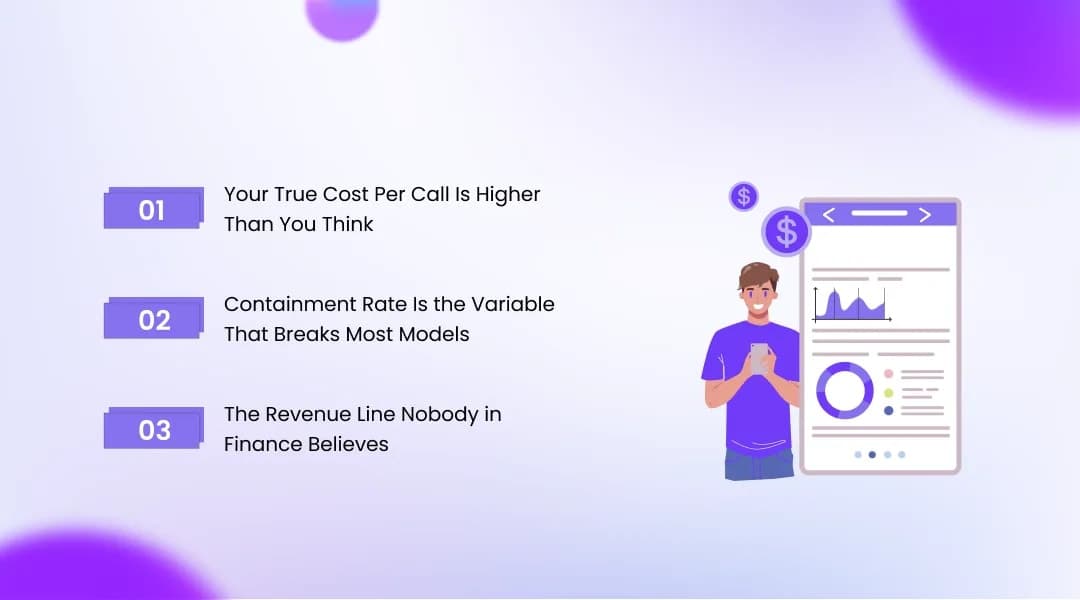
Five numbers carry roughly 90 percent of the weight in any voice AI cost savings model: monthly call volume, average handle time, fully loaded cost per human-handled minute, AI containment rate, and your current missed-call rate. Two of those five are where models quietly go wrong. Let me show you which two, and why.
Your True Cost Per Call Is Higher Than You Think
Most people open payroll, find a salary, and build from there, which is the same trap addressed in depth when you look at how to cut call center costs without losing quality by isolating the true drivers of overhead, from turnover to repeat contacts. It is the single most common modeling error I run into, and research bears it out: organizations underestimate true costs by 40 to 60 percent when working from salary figures alone. Payroll gives you a wage. A wage is not what a call costs you.
Here is what genuinely belongs in your fully loaded cost per call:
Base wage plus benefits, payroll taxes, and paid leave. Depending on your market, this adds another 25 to 35 percent on top of base before anything else enters the picture.
Attrition replacement. Contact center roles turn over at 30 to 45 percent annually, and each replacement runs $5,000 to $10,000 across recruiting, onboarding, and ramp. Treat it as a standing line item rather than an occasional surprise.
Management overhead. Roughly one supervisor per eight to twelve agents, plus the QA specialist reviewing recordings. Their compensation is baked into every call your floor handles, whether your model says so or not.
Occupancy, telephony, and tooling. Seats, licenses, and the phone system itself. Trivial per call, substantial across a year.
Labor accounts for as much as 95 percent of contact center costs, which is exactly why this input deserves more of your attention than any other figure in the model. AI voice agents for call centers and BPOs are purpose-built to address
Containment Rate Is the Variable That Breaks Most Models
Containment rate is the percentage of calls your AI resolves fully without handing off to a human. It swings your ROI figure harder than anything else, and it is also the number people invent most freely. Benchmarks for well-tuned voice agents land between 65 and 80 percent, and I have reviewed plenty of models that plugged in 85 because that is what happened during the demo.
Resist that. Conservative planning assumes 30 to 40 percent automation in year one, with well-run systems climbing to 60 to 75 percent within six to twelve months of steady tuning. Build your case on the year-one figure and let year two be a pleasant surprise. Factor in the escalation penalty too: a contained call that fails costs you the AI triage attempt plus the full human handling, so your blended per-call number always lands worse than your success-case number.
Now a thought that unsettled me the first time I sat with it properly. Containment records that no human picked up. It records nothing about whether the customer left satisfied. A caller can be fully contained and still have hung up in frustration, still have received an answer without a resolution, still have churned the following week. Containment is a lever you pull, not a result you bank.
The Revenue Line Nobody in Finance Believes
Every voice AI deck carries a line about revenue rescued from missed calls. It is usually the largest figure on the slide. In my experience, it is also the first casualty of review.
That line survives only when it is anchored to a counterfactual reach rate your business measured before deployment, pulled from the same warehouse finance already trusts. So ask yourself something uncomfortable: do you know what share of your missed callers dialed back within 24 hours? If the answer is no, your recovered revenue estimate is a guess wearing a suit. Go get the number or drop the line entirely.
How to Calculate Voice AI Payback Period Without Fooling Yourself
Voice AI payback period is the number of months until cumulative net benefit covers your upfront investment. Divide total implementation cost by monthly net benefit, and you have it. Finance often weighs payback above ROI percentage, because a 60 percent return arriving over 30 months is a fundamentally different decision from a 25 percent return arriving in nine.
Total Cost of Ownership, Including the Boring Lines
Per-minute pricing is a single line on an invoice. Total cost of ownership is that invoice plus everything the invoice never mentions. A complete TCO picture spans licenses, usage minutes, speech-to-text and text-to-speech processing, telephony, storage, integrations, monitoring, analytics, QA, and change management — the kind of scope you can review directly across OnDial's voice AI features before you build your own line-item list.
Two lines get skipped with remarkable consistency. Integration is the first: Gartner puts integration pricing at $1,000 to $1,500 per conversational AI agent, with some organizations reporting up to $2,000. Governance is the second, and it is not a one-time expense at all. Set governance at 8 to 12 percent of platform spend on a recurring basis and treat that band as your floor. Operate under HIPAA, or under the EU AI Act Article 50 disclosure obligations, and it climbs from there. Hidden costs absorb 10 to 15 percent of implementation budgets each year and are almost never present in the original projection.
The Ramp Curve Your Model Probably Ignores
Most models assume your human costs fall off a cliff the moment the agent answers its first call. They do not. There is a parallel running period, a retraining period, and a tuning period, and savings arrive gradually across quarters rather than switching on.
Any model that pays out at full strength from day one is inflating your timeline, and finance will find it. A related trap catches otherwise careful teams: if integration eats six months before production, your payback is not 3.6 months from signature; it is 9.6. Put the deployment timeline inside the payback math rather than in a footnote beside it.
Is an AI Voice Agent Really Worth It? What the Voice AI Business Case Data Says
Let me answer this the way I would across a table rather than across a proposal. Often, yes. Not always. And the deciding factor is almost never the technology itself.
The Returns Are Real When Deployment Is Disciplined
The credible research holds up well. A Forrester Consulting Total Economic Impact study recorded three-year ROI between 331 and 391 percent for voice AI adopters, with a composite organization banking $10.3 million in agent labor savings across three years, halving call abandonment, and reaching payback in under six months. That is a named analyst firm with published methodology, not a vendor landing page dressed up as research.
The unit economics track too. Voice AI runs around $0.40 per call against $7 to $12 for a human agent, while legacy rule-based IVR clears less than 35 percent containment. So the comparison is not only AI against your team. It is also AI against the menu tree your callers already resent. IDC found 74 percent of companies deploying AI in customer service reporting positive ROI inside twelve months.
The Failure Rate Is Just as Real
Now the section I would not respect myself for cutting. Boston Consulting Group surveyed 1,800 executives for its AI at Scale research and found only 26 percent of companies generating meaningful financial value from AI investment. Gartner research separately attributes 85 percent of AI project failures directly to poor data quality or an outright absence of usable data.
There is a specific correction worth planning around. A Gartner prediction published in February 2026 forecasts that half the companies cutting customer service staff because of AI will be rehiring by 2027, because stripping humans out entirely degrades experience across the meaningful share of contacts that need judgment and empathy. If your model rests on headcount elimination instead of capacity redeployment, that prediction has your name on it. At OnDial, we would rather tell a prospect their volume does not justify the spend than hand them a model that comes apart in month seven.
The Post-Deployment Scorecard That Proves Your Calculator Right
Here is the claim this whole piece has been walking toward, and it will sound backwards. The most valuable thing an AI voice agent ROI calculator gives you is not the ROI figure. It is the list of assumptions you are now obligated to go verify. The calculator opens measurement. It does not close analysis.
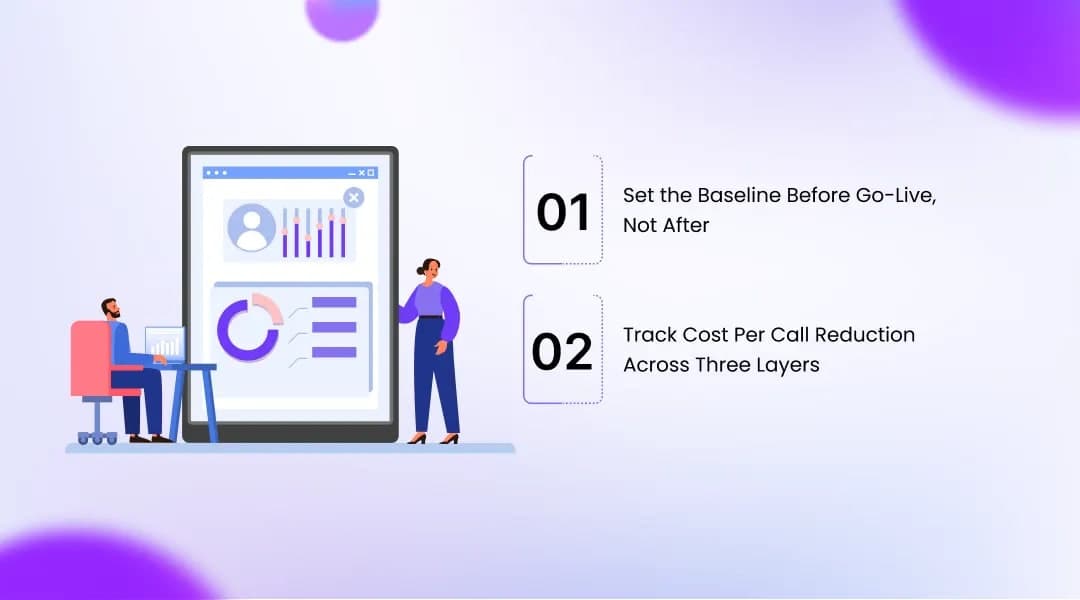
Set the Baseline Before Go-Live, Not After
You cannot demonstrate cost per call reduction against a baseline you never captured. This reads as obvious and gets skipped constantly, usually because the room is impatient to launch. Pull call volume, handle time, and fully loaded agent cost straight from the systems finance and operations already treat as truth, and where the history is noisy, take a trailing three to six month average while documenting anomalies like campaign spikes.
Do all of that before the agent takes call number one. Freeze the figures, timestamp them, and have finance sign off on the baseline as a separate act from approving the spend. That signature outvalues any projection you could build, because it moves the argument about inputs to before deployment instead of during your first quarterly review.
Track Cost Per Call Reduction Across Three Layers
Reporting one ROI number each month is how programs lose credibility slowly and then all at once. Work in three layers instead: operational metrics covering AHT, FCR, deflection, containment, and transfer rate; experience metrics covering CSAT, abandon rate, and post-call NPS; financial metrics covering cost per call reduction, calls per agent per hour, and recovered revenue.
Run it as a weekly readout during pilot and a monthly roll-up with finance present. When a figure drifts from the model, name it immediately and explain the drift. One discipline worth adopting: haircut your pilot economics by 30 to 40 percent when projecting full rollout, then tighten the estimate once you hold a quarter of production data. CFO trust collapses fast when post-approval numbers contradict pre-approval promises, and rebuilding it is close to impossible.
Conclusion
An AI voice agent ROI calculator earns its place the moment you start treating its output as a claim to be tested rather than a headline to be circulated. Three things matter more than whatever percentage it displays: your fully loaded cost per call is likely 40 to 60 percent above the salary you started from, your year-one containment will trail the demo, and your payback clock starts at production rather than at signature. Get those three honest and the model will hold when someone leans on it.
You do not need a larger number. You need one you can defend, measure, and correct in public. That is an entirely different skill, and the framework for it is now in your hands.
If you want a second set of eyes on your inputs before the model goes to finance, that is a conversation OnDial is glad to have. We would rather pressure-test your assumptions and tell you straight whether your call volume and ticket size justify voice AI at all than sell you a projection that unravels in month seven. Bring your baseline data, and we will work through it together.