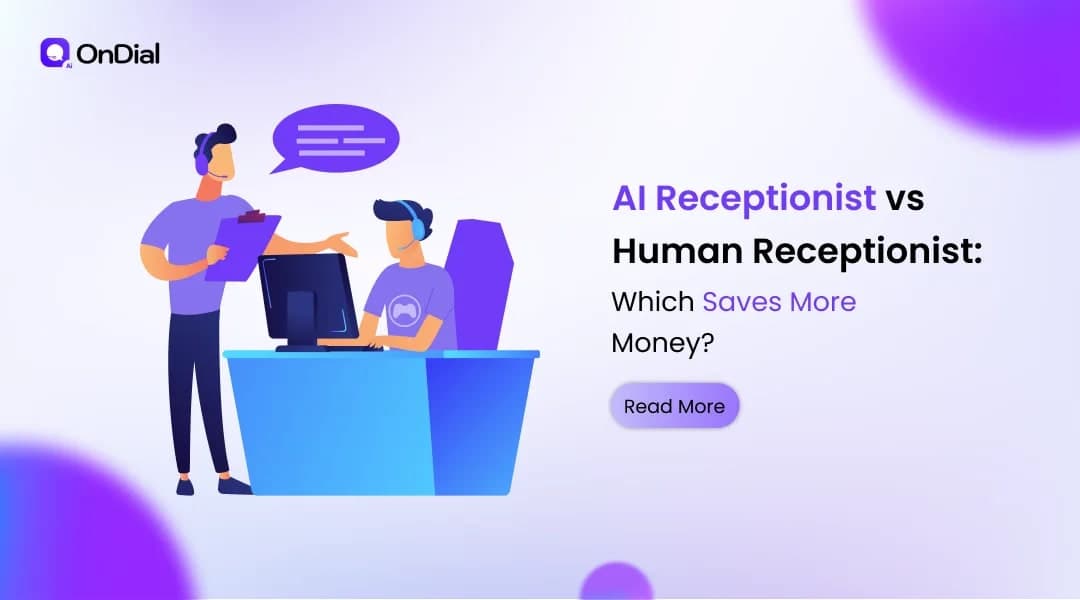
Research from 411 Locals, which monitored phone calls to 85 small businesses across 58 industries for 30 days, found that 62 percent of calls to small businesses go unanswered: 37.8 percent land in voicemail and 24.3 percent get no response at all. Read that again, because it reframes the entire AI receptionist vs human receptionist debate. You are not choosing between two ways to answer the phone. You are choosing between two ways to lose money.
Here is the honest answer up front. An AI receptionist saves more money than a human receptionist for most small and mid-sized businesses, because a fully loaded human hire costs roughly $40,000 to $60,000 a year in the US for about 24 percent of the week in coverage, while AI runs between $25 and $300 a month for all 168 hours. But that gap narrows sharply in markets where labour is cheap, and it collapses entirely if your calls need judgment more than they need speed.
I know you have read four versions of this article already, and every one was written by someone selling something. I build voice AI at OnDial, so I am not pretending to be neutral. What I can do is show you the arithmetic, including the parts that make my own product look worse. By the end you will have a number you calculated yourself, not one I handed you.
The Real Cost of a Human Receptionist (Not the Salary Line)
A human receptionist is a person who answers calls, greets visitors, books appointments, and handles the unscripted moments a script cannot reach. That is the definition. The problem is that almost nobody costs the role correctly, because the salary on the job posting is the smallest part of the bill.
What the Job Posting Hides
The published salary is a starting point, never the total. In the United States, an in-house receptionist typically costs $30,000 to $45,000 a year in salary alone, and once you add payroll taxes, health insurance, and paid time off, you are looking at $40,000 to $60,000 annually, or roughly $3,300 to $5,000 a month before training, turnover, or absence cover. That last clause is where the budget quietly breaks.
Total cost of ownership means every rupee or dollar the role consumes, not just the one on the offer letter. Recruitment time, the two months before a new hire knows your business well enough to answer confidently, the manager hours spent supervising, the vacancy gap when they leave. I have watched a clinic budget a receptionist at one number and discover the real figure was close to double, entirely through costs nobody wrote down.
The Coverage Math Nobody Runs
Here is the part that changes minds. A full-time receptionist works 40 hours a week, but a 40-hour week yields roughly 34 to 36 hours of actual phone availability once you subtract lunch, breaks, admin tasks, and walk-in visitors, which covers about 24 percent of the 168-hour week, and after PTO and sick days, annual effective phone coverage lands near 1,700 to 1,800 hours.
So you are paying full-time money for a quarter of the week. And a human is a linear processor: one call at a time, which means the second caller waits and the third hangs up. That is not a criticism of receptionists, who are often the most competent people in the building. It is just physics.
What an AI Receptionist Actually Costs
An AI receptionist is software that answers your business calls using conversational voice AI, books appointments, qualifies leads, and routes anything it cannot handle to a person — if you want the full breakdown of what an AI phone agent actually does, it works much the same way under the hood. It runs on infrastructure, not payroll. Which means it prices like infrastructure, and that trips up buyers who are used to reading offer letters.
The Three Pricing Models
The category has settled into three shapes, and picking the wrong one is where most of the overspend happens.
Per-minute: You pay for talk time. AI voice agent pricing typically ranges from $0.05 to $1.00 per minute, with managed all-in-one platforms including CRM integrations usually running $0.25 to $0.50 per minute. Good for testing one narrow use case, dangerous once call length drifts upward.
Tiered monthly: A fixed fee with a minute bucket. Budget AI-only options start at $25 to $65 a month, most small businesses pay $109 to $299 a month, and the range tops out near $899. This is the sweet spot for predictable volume.
Flat-rate unlimited: One price, no meter. Rare below the enterprise tier, and worth reading the fair-use clause carefully before you believe the word unlimited.
The Hidden Fees That Break the Budget
This is the part vendors skip, and Reddit does not. Common hidden fees include setup fees of $0 to $500, overage charges, integration fees of $0 to $100 a month, bilingual add-ons, and after-hours premiums. A cheap plan with overages routinely costs more than a mid-tier plan with everything included.
There is a second trap that is subtler. Platforms that require you to bring your own model, voice, and telephony advertise a low base rate but land higher once provider costs stack on top. At OnDial, we publish this breakdown because transparency is genuinely cheaper than churn, and because a client who discovers the real number in month three never trusts anything else you tell them.
Ask one question of every vendor: what is my total bill at my actual monthly minutes, with voice, model, telephony, and integrations included?
The Comparison Nobody Runs: What Happens When Labour Is Cheap
Every article ranking for this query assumes you are hiring in the United States. Which is strange, because the businesses adopting voice AI fastest are not all American.
Running the Same Math in India
PayScale puts the average receptionist salary in India at ₹208,717 in 2026. Add statutory employer contributions, which under EPFO rules means provident fund at 12 percent of basic pay, plus ESI and gratuity accrual, and a realistic loaded cost for a full-time front desk hire lands somewhere in the ₹2.4 to ₹2.8 lakh range annually.
Now price the AI side honestly against that. Published Indian voice AI rates start around ₹3.9 per minute for multilingual agents, with higher-usage tiers cited near ₹2.7 per minute, and flat models around ₹6 per minute. A clinic taking 600 calls a month at two minutes each burns 1,200 minutes, which at ₹5 a minute is ₹6,000 a month, or roughly ₹72,000 a year.
Why the Savings Argument Changes Shape
So the saving is real: roughly ₹1.7 lakh a year, or about 65 to 70 percent. But 65 percent is not 95 percent, and any vendor quoting you 95 percent in an Indian context is quoting American salaries at you and hoping you do not notice.
That honesty matters for a reason beyond ethics. If your saving is 65 percent rather than 95 percent, the decision stops being obvious on cost alone and starts depending on coverage and capture, which is exactly where the real money turns out to be hiding anyway.
The Line Item That Dwarfs Both: What Missed Calls Cost
Ready for the uncomfortable part? Both numbers you have been comparing are probably rounding errors next to the one you have never measured.
The 62 Percent Problem
Return to the 411 Locals finding: 62 percent of calls to small businesses go unanswered, and most callers who hit voicemail hang up and dial the next business on the list. Industry data puts the annual cost at tens of thousands per business, with the worst-hit verticals being home services, legal, and healthcare. Clio's Legal Trends Report puts law firm missed calls at roughly 35 percent, and legal matters are time-sensitive enough that a missed call is usually a lost client, which is exactly why firms are turning to AI voice agents for legal intake calls to catch every prospective client before a competitor does.
The structural point is what makes this fixable. Calls get missed because your staff is doing their actual job: the dentist is with a patient, the plumber is under a sink, the receptionist is on line one. The problem is capacity, not effort.
Speed to Lead Is the Whole Game
Speed to lead is the time between a prospect reaching out and a human or system responding, and it predicts conversion better than almost any other variable. The evidence is not subtle. A Harvard Business Review study led by Professor James Oldroyd at MIT, analysing more than 15,000 leads and 100,000 call attempts, found businesses responding within five minutes were 100 times more likely to make contact and 21 times more likely to qualify the lead than those responding at 30 minutes.
An AI receptionist answers before the first ring completes, at 2 p.m. and at 2 a.m., on ten simultaneous lines. That is not a cost saving. That is a revenue line, and it is usually larger than the entire payroll question you started with.
So Which One Actually Saves More Money?
Does an AI receptionist actually save money? Yes, for most small and mid-sized businesses, and if you are weighing the same question at call-center scale, our full AI call center vs traditional call center comparison runs the identical cost logic against higher volumes. In the US, AI runs $25 to $300 a month against $3,300 to $5,000 a month for a fully loaded human hire, a 90 percent-plus reduction with seven times the coverage hours. In India, the saving is closer to 65 percent. In both markets, captured missed calls are usually worth more than the payroll saving itself.
When AI Wins Outright
Lean AI when your call pattern is predictable, and your losses are structural rather than emotional.
Your calls follow patterns. If 80 percent of callers ask the same five questions or want the same booking, AI handles that at full accuracy every time, with the same qualifying questions logged into HubSpot or your calendar without fail.
You are stuck in the gap. Too many calls to answer yourself, too few to justify a salary. This is where most solo operators and small clinics genuinely live.
Your revenue happens after hours. Evenings, weekends, and holidays are when high-intent callers try you and give up.
When a Human Is Worth Paying For
I would be doing you a disservice if I pretended this was one-sided. Keep the human when the first thirty seconds of the call carry emotional weight: distressed patients, sensitive legal intake, high-value clients who expect to be recognised by voice. AI can be trained to respond appropriately, but it cannot be trained to actually care, and some callers can tell.
Keep the human, too, if the role is not really a phone role. If your receptionist signs for deliveries, manages the office, greets walk-ins, and handles vendor invoices, you are not replacing a call-answering function. You are replacing an operations person, and that math does not work.
The Hybrid Split That Captures Most of the Savings
A hybrid receptionist model uses AI as the first line for routine and after-hours calls, with a warm handoff to a person for anything complex or emotional. This is where I see the best outcomes in practice, and it is also what most of the honest vendors in this category quietly recommend.
The split that works: AI takes overflow, after-hours, and repeat FAQs. Humans take escalations, VIPs, and anything where the caller asks for a person twice. Set that second rule explicitly, because callers hang up when the voice sounds robotic or the greeting is too long, and older callers in particular change how they speak when they suspect a machine, which is why a well-tuned multilingual AI voice agent that adapts naturally to accents and language switches confuses the system far less and keeps abandonment low. An AI receptionist with no exit door is worse than voicemail.
Conclusion
The AI receptionist vs human receptionist question has a cleaner answer than the internet suggests. Three things matter: a human costs far more than the salary line and covers a quarter of the week, AI costs 65 to 95 percent less depending on your labour market, and the missed calls neither of them catches are almost certainly your biggest expense of the three. You do not need anyone's opinion to settle this. Pull your last 90 days of call data, count what went unanswered, and multiply by your average job value.
You now have the maths. Use it.
If that number surprised you, bring it to us. OnDial builds voice AI tuned for real Indian call patterns, languages, and handoff rules, and we will run your actual call volume against a real quote before you commit to anything. OnDial builds voice AI tuned for real Indian call patterns, languages, and handoff rules, and we will run your actual call volume against a real quote before you commit to anything. Book a call and let us test the arithmetic together.