I managed a 200-seat call center in Gurugram for three years. I know exactly what 4 AM escalation calls feel like. I know the math of agent attrition - how you train someone for six weeks, and they leave in four months. I know what it costs when a hot lead goes cold because nobody called back within the hour.
So when someone tells me AI voice agents in India are "the future," I don't get excited. I get specific. Because I've sat through enough vendor demos to know that most of them look incredible on a conference room screen and fall apart the moment a caller from Lucknow says "haan bhai, mera order kab aayega?" in the middle of an English conversation.
But here's the thing. The ones that do work? They're transforming businesses faster than any hiring spree ever could.
This guide is what I wish someone had given me three years ago — an honest breakdown of what AI voice agents actually are, which solutions work in the Indian market, what they cost, and how to avoid the expensive mistakes I've already made so you don't have to.
Let's get into it.
What Are AI Voice Agents?
An AI voice agent is software that conducts phone conversations using artificial intelligence — specifically natural language processing (NLP) and speech recognition — to understand what a caller says, determine what they need, and either resolve the issue or take action without a human agent.
Think of it this way: traditional IVR says "Press 1 for billing." An AI voice agent says, "Hi, I see you have a pending payment of ₹3,200 on your account. Would you like to pay now or set a reminder?"
That gap between routing and resolving? That's the entire value proposition.
Modern AI voice bots in India can initiate outbound calls (for lead qualification, payment reminders, feedback collection), handle inbound queries (order status, appointment booking, complaint logging), and do all of it across multiple languages — Hindi, Tamil, Telugu, Bengali, Marathi, and more, without needing separate bots for each.
Why Indian Businesses Are Rapidly Adopting AI Voice Agents
The Indian market has a unique set of conditions that make it almost perfectly suited for voice AI adoption. I've watched this shift accelerate dramatically over the past two years.
Cost Reduction
The average fully loaded cost of a call center agent in India is ₹18,000–₹25,000 per month. Add recruitment, training, attrition replacement, infrastructure, and management overhead — and your real cost per agent-hour is significantly higher than the salary line suggests. AI call automation in India handles repetitive queries at a fraction of that cost per interaction.
24/7 Availability
India's consumer base doesn't operate on a 9-to-6 schedule. A D2C customer ordering at 11 PM expects support at 11 PM. An insurance policyholder filing a claim on Sunday morning doesn't want to wait until Monday. AI voice agents don't have shifts. They don't take breaks. They don't call in sick during monsoon season.
Regional Language Support
This is the one that separates vendors who understand India from those who don't.
Over 90% of India's internet users prefer content in a language other than English. If your voice support only speaks English, you're alienating the vast majority of your customer base. Multilingual AI voice bots in India that handle Hindi, Hinglish, Tamil, Kannada, and other regional languages aren't a "nice to have." They're the baseline.
(I once ran a pilot where we deployed an English-only AI bot for a client in Rajasthan. The results were so bad we pulled it in eleven days. Lesson learned — expensively.)
Scalability
This is where the math gets compelling. Adding 50 more human agents takes 6–8 weeks of hiring, training, and onboarding. Scaling an AI voice agent to handle 50% more calls takes a configuration change and maybe a capacity upgrade. During Diwali sale spikes, during exam result season for EdTech, during open enrollment for insurance — the ability to scale elastically without a hiring scramble is worth more than most ops leaders realize until they need it desperately.
Key Features of Modern AI Voice Agents
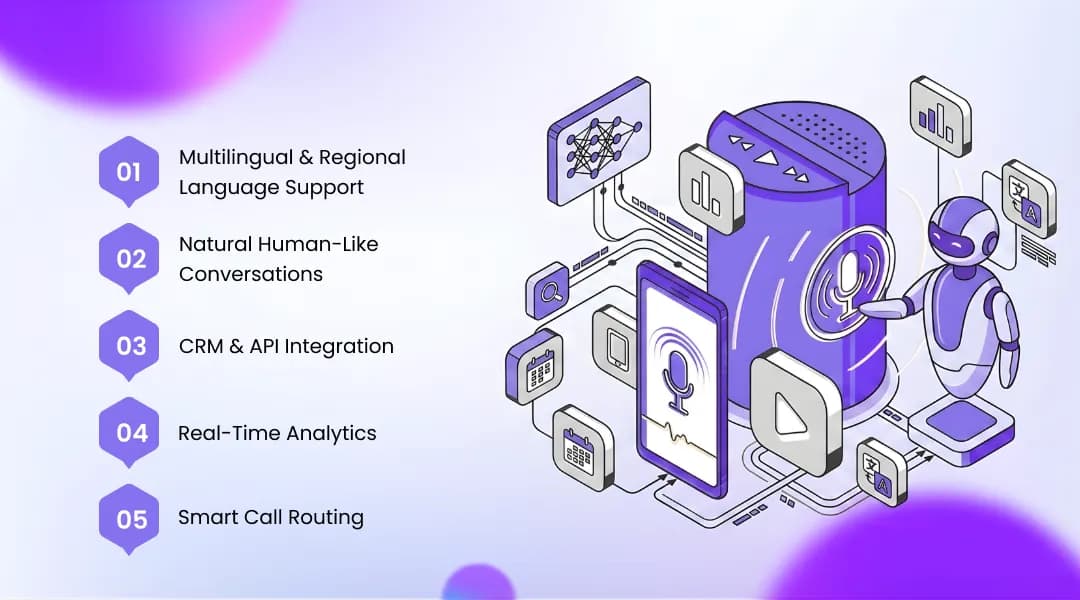
Not all platforms are built equal. Here's what I look for when evaluating AI calling software in India for clients:
Multilingual & Regional Language Support
Can it handle Hindi-English code-switching? Does it understand colloquial phrases, not just textbook language? Can it support Tier 2 and Tier 3 city callers who mix languages mid-sentence? This is non-negotiable for the Indian market.
Natural Human-Like Conversations
The bot should sound like a person, not a Wikipedia article being read aloud. I listen for natural pauses, appropriate interruptions, and the ability to handle "ummm" and "wait, actually..." without breaking.
CRM & API Integration
An AI voice agent that can't access your customer data in real-time is just a talking FAQ. It needs to pull order status from your OMS, check policy details from your CRM, update records after the call — all within the conversation flow.
Real-Time Analytics
Every call should generate data: call duration, resolution rate, sentiment, escalation triggers. If the platform doesn't give you a dashboard you can act on, it's a black box. And black boxes are how you waste budgets.
Smart Call Routing
When the bot reaches the limits of what it can handle — and it will, because no AI resolves everything — it should transfer to a human agent with full context. No "please repeat your issue." No cold transfers. The handoff should feel like passing a baton, not starting the race over.
Top AI Voice Agent Solutions in India (2026)
Leading Platforms Overview
The Indian AI voice agent market has matured significantly. Here's what the landscape looks like:
OnDial — An India-based specialist focused on building tailored, human-centric conversational AI voice bot solutions. Strong multilingual capabilities, transparent pricing, and a consultative partnership approach rather than a one-size-fits-all product. Particularly well-suited for businesses that need custom voice AI workflows — not just an off-the-shelf bot.
Exotel/Ameyo — Established cloud telephony players that have added AI voice capabilities on top of their existing call infrastructure.
Yellow.ai — Enterprise-focused conversational AI platform with multilingual voice and chat capabilities.
Vernacular.ai (now Gnani.ai) — Multilingual voice automation with strong regional language coverage.
MyOperator — Cloud-based call management with AI features, popular among SMBs.
Honest answer: pricing in this space varies wildly. Basic AI telecalling software in India can start at ₹5,000–₹15,000/month for SMBs with limited call volumes. Mid-market solutions with CRM integration, multilingual support, and custom workflows typically range from ₹30,000–₹1,50,000/month. Enterprise deployments with dedicated infrastructure and SLA commitments go well beyond that.
My advice? Don't start with price. Start with what problem you're solving and what volume you're handling. Then ask vendors for transparent, outcome-based pricing - not just "per minute" rates that hide overage charges.
Use Cases Across Industries
Here's where I stop talking theory and show you what I've actually seen work:
E-commerce (Order Updates, Support)
A D2C client processing 12,000 orders/day was burning ₹8 lakhs/month on a team just handling "Where is my order?" calls. We deployed an AI voice bot for lead generation and support that automated 65% of inbound queries. Monthly support costs dropped to ₹2.5 lakhs. The team was redeployed to handle complex complaints — the stuff that actually needs a human.
BFSI (Loan Follow-ups, EMI Reminders)
An NBFC client needed to make 50,000 EMI reminder calls per month. Their human team managed about 15,000. The AI agent handled the rest — in Hindi and English — with a 22% improvement in on-time payment rates.
Healthcare (Appointment Booking)
A multi-location hospital chain reduced no-shows by 35% using automated appointment confirmation and rescheduling calls. The bot called patients 24 hours before their appointment, confirmed or rescheduled, and updated the system in real-time.
Real Estate (Lead Qualification)
Real estate generates leads by the thousands. Most are garbage. An AI calling agent sorted through 3,000+ monthly leads for a Pune-based developer, qualifying the serious ones and scheduling site visits — all before a human sales rep got involved.
Education (Admissions & Follow-ups)
An EdTech company during enrollment season was drowning in inquiry calls. The AI voice agent handled initial screening — course interest, eligibility, fee structure — and routed qualified leads to counselors. Counselor productivity jumped 40% because they stopped wasting time on tire-kickers.
AI Voice Agents vs Traditional Call Centers
Let me put this side by side, because I've operated both.
Factor | Traditional Call Center | AI Voice Agent |
Cost per Interaction | ₹15–₹40 (fully loaded) | ₹1–₹5 |
Scaling Time | 6–8 weeks | Hours to days |
Availability | Shift-dependent | 24/7/365 |
Multilingual Support | Hire-dependent (expensive) | Built-in (dynamic) |
Consistency | Varies by agent mood, training, tenure | Uniform every call |
Complex Problem Resolution | ✅ Strong (empathy, judgment) | ❌ Limited (escalates to humans) |
The takeaway? AI voice agents for sales and support don't replace your call center. They replace the 60–70% of repetitive work that burns out your best agents and costs you the most. The humans then do what only humans can - handle nuance, exercise judgment, show real empathy.
Benefits of Using AI Voice Agents
Concrete outcomes I've measured across client deployments:
Increased Customer Engagement — Response time drops from hours to seconds. Customers who get immediate answers engage more and churn less.
Reduced Operational Costs — Average savings of 40–60% on Tier 1 support costs within the first six months.
Higher Conversion Rates — For outbound use cases (lead qualification, follow-ups), AI voice agents consistently reach 3–4x more contacts than human teams per day.
Faster Response Time — Zero hold time. Zero queue. The bot picks up the call immediately or initiates the outbound call within seconds of a trigger event.
Challenges & Limitations
I'd be lying if I said AI voice agents are perfect. They're not. Here's what you need to know:
Language Nuances
NLP has improved dramatically, but deep dialect variations — the difference between formal Hindi and the way someone in Bhojpur speaks — can still trip up even good models. Always test with real users from your actual customer base, not just internal QA teams who speak textbook Hindi.
Initial Setup Cost
Building a properly integrated AI voice workflow — with CRM connectivity, custom conversation flows, and multilingual support — isn't a weekend project. Expect 4–8 weeks of setup for a mid-complexity deployment. The ROI justifies it, but the upfront investment is real.
Integration Complexity
If your tech stack is a Frankenstein's monster of legacy CRM, custom middleware, and spreadsheets masquerading as databases, the integration will be painful. Factor that into your timeline and budget honestly.
Have you checked what your current tech stack looks like from the outside? Sometimes the biggest obstacle to AI adoption isn't the AI — it's the infrastructure it needs to connect to.
How to Choose the Right AI Voice Agent in India
After evaluating 15+ platforms for clients, here's my checklist:
Key Selection Criteria
Language coverage — Does it support the specific languages and dialects your customers actually speak?
Customization depth — Can you build custom conversation flows, or are you locked into templates?
Integration flexibility — Does it connect with your CRM, ERP, and communication stack?
Pricing transparency — Are there hidden per-minute overages? What happens when volume spikes?
Support model — Is the vendor a partner or a product? Will they help you iterate and optimize post-deployment?
Questions to Ask Vendors
"Can I hear a live demo in Hindi/Tamil/[my customer's language]?"
"What's your average resolution rate for similar use cases?"
"How do you handle mid-conversation language switching?"
"What does onboarding and ongoing optimization look like?"
"Can I talk to three reference clients in my industry?"
Scalability & Customization
A platform that works at 5,000 calls/month but chokes at 50,000 is a problem you'll discover at the worst possible time. Ask for load testing data. Ask what happens during traffic spikes. Companies like OnDial that build tailored solutions are better positioned here than platforms selling a rigid product — because your workflows aren't the same as everyone else's.
Future of AI Voice Agents in India
Hyper-Personalization
The next generation of AI customer service automation in India won't just know who's calling — it'll know why they're likely calling based on recent interactions, purchase history, and behavioral patterns. The conversation will start with context, not questions.
Emotion AI
We're not there yet, but the trajectory is clear: voice AI systems that detect frustration, confusion, or urgency in a caller's tone and adjust their response accordingly. Imagine a bot that senses a customer is upset and proactively offers escalation to a human before being asked.
Voice Commerce Growth
India's voice commerce market is projected to grow significantly through 2027. Ordering products, checking prices, tracking deliveries — all through voice, all in regional languages. Businesses that build voice AI infrastructure now are positioning themselves for a channel that millions of Indian consumers will prefer over typing.
Conclusion
Here's my honest take after 14 years in this space.
AI voice agents in India aren't hype. They're infrastructure. The businesses deploying them now — thoughtfully, with the right vendor, and with clear use cases — are building a cost and experience advantage that will compound every quarter.
But picking the wrong platform, or deploying without understanding your own call flows and customer base, will waste your money and frustrate your customers.
Do the homework. Ask the hard questions. Test with real users. And if you're looking for a partner who builds tailored voice AI solutions — not a one-size-fits-all product — companies like OnDial are worth a serious conversation.
Your customers are calling. The question is whether you'll answer with a person, a phone tree, or an AI agent that actually knows what they need. Choose wisely.