Every year, insurance companies quietly write off a meaningful share of their book not because customers decided they no longer wanted coverage, but because nobody reached them at the right moment to renew. Lapse rates across many personal lines routinely sit between 10 and 25 percent, and a large portion of that churn is involuntary, driven by a missed reminder rather than a genuine decision to walk away. AI voice agents for insurance renewals are changing that equation by making sure every policyholder who is due for renewal actually gets a clear, timely, human-sounding conversation before the deadline passes. The cost of doing nothing is not abstract. A lapsed policy means lost premium, a lost cross-sell opportunity, and the expense of acquiring a replacement customer who may have been retained for the price of a single well-timed call.
The frustrating part is that renewal is one of the most predictable events in the entire insurance lifecycle. You know the date, you know the policyholder, and you know roughly what you want to say to them. Yet most insurers still rely on a patchwork of letters, emails, and overstretched call teams that cannot keep pace with the volume. This blog walks through why renewals leak revenue, why traditional outreach falls short, how AI voice agents close the gap, what results to realistically expect, and what deploying this kind of automation actually involves for an insurance business.
The Hidden Revenue Problem in Insurance Renewals
Renewals are supposed to be the easy money in insurance. The customer is already underwritten, the relationship already exists, and the marginal cost of keeping them is far lower than the cost of winning someone new. Industry data consistently shows that acquiring a new customer can cost five to seven times more than retaining an existing one, which makes every preventable lapse a direct hit to profitability.
The problem is that renewal outreach competes with everything else an insurance operation has to handle. Claims, new business, servicing, and complaints all pull on the same finite staff, and renewals are rarely treated as urgent until the lapse has already happened. By the time anyone notices the policy has gone, the window to save it has closed.
Involuntary churn is the part you can actually fix
Not all churn is created equal. Voluntary churn, where a customer actively shops around and chooses a competitor, is hard to influence and often comes down to price. Involuntary churn, where a customer simply forgets, misses the payment, or never received a reminder they understood, is entirely addressable with better outreach.
A significant slice of total lapses falls into this second category, which means a real portion of lost premium is recoverable with nothing more than reliable, well-timed contact. When you reduce policy lapse rates by attacking involuntary churn first, you capture revenue that was always yours to keep. That is the cleanest return available in the entire retention function, and it requires no change to pricing or product.
Why renewal timing decides the outcome
The single biggest predictor of whether a renewal succeeds is when the policyholder is contacted relative to the renewal date. Reach them too early and the message is forgotten. Reach them too late and they have already lapsed or already bought elsewhere.
[Image suggestion: a timeline graphic showing optimal renewal contact windows mapped against lapse risk]
Effective renewal programs run multiple touches across a defined window, escalating in urgency as the date approaches. Doing that consistently across thousands of policies by hand is exactly where human teams break down, and exactly where insurance renewal call automation earns its place.
Why Traditional Renewal Outreach Falls Short
Most insurers already know renewals matter, so the issue is not awareness. The issue is that the tools used to chase renewals were never built for the scale and timing the job demands. Letters, emails, SMS, and manual call lists each fail in their own specific way, and stacking them together does not solve the underlying coverage gap.
Printed renewal notices and emails suffer from a brutal attention problem. Open rates for renewal emails are often low, and physical mail is frequently unopened or discarded, so the message that was supposed to trigger action never lands. These channels are cheap to send, which creates a false sense of activity, but cheap delivery is worthless if it does not produce a renewal.
Human call teams cannot scale to the volume
Outbound calling is the most effective renewal channel because it allows a real conversation, answers objections in the moment, and can take payment or confirmation on the spot. The trouble is that human calling does not scale economically. A renewal agent might manage 40 to 60 meaningful outbound conversations in a day once you account for no answers, voicemails, and call backs.
When renewal volumes spike at month end or during seasonal peaks, the team simply cannot reach everyone before their dates pass. Hiring more agents to cover the peak leaves you overstaffed in the troughs, and training, attrition, and quality control add further drag. The result is that the highest value channel is rationed to a fraction of the book, and automated renewal reminder calls become impossible to sustain through people alone.
Language and timing barriers compound the gap
In diverse markets, a renewal call only works if it happens in a language the policyholder is comfortable with and at a time they will actually pick up. A single language script delivered during business hours systematically excludes large segments of the customer base, particularly across regional and multilingual populations.
Policyholders who would happily renew in their own language often disengage when contacted in one they find harder to follow. Add the reality that many people are only reachable in the evening or on weekends, and a nine to five human team in one language is structurally incapable of covering the full book. This is precisely the constraint that AI voice agents for insurance renewals remove.
How AI Voice Agents for Insurance Renewals Actually Work
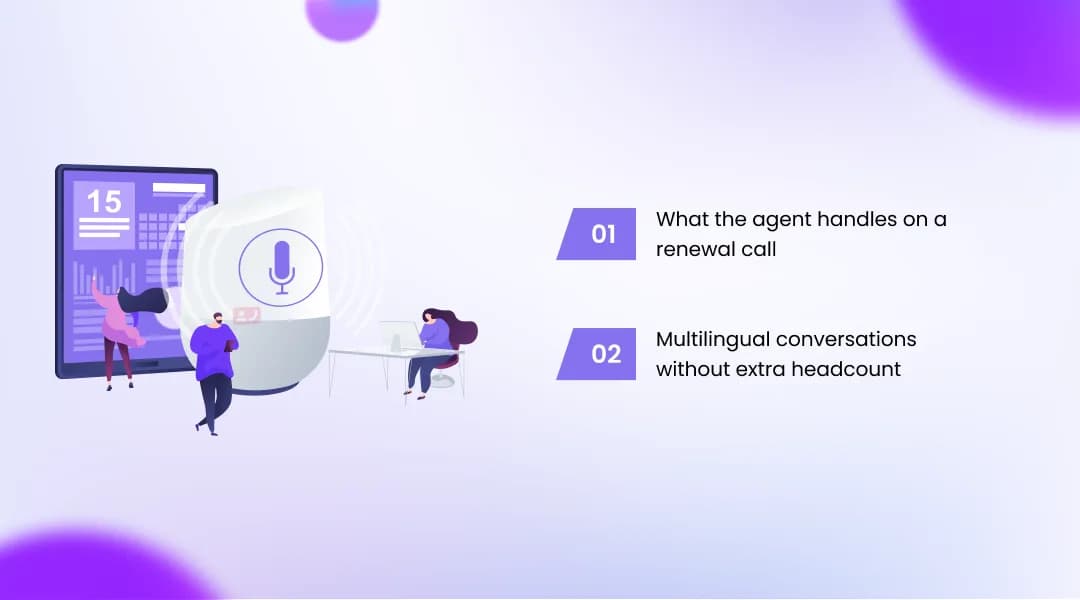
AI voice agents for insurance renewals are autonomous calling systems that hold natural spoken conversations with policyholders, deliver renewal reminders, answer common questions, confirm intent to renew, and route anything complex to a human. They operate like a tireless renewal desk that never sleeps, never gets tired, and can run thousands of conversations at once without dropping quality.
The core mechanism is straightforward to describe even if the engineering behind it is sophisticated. The agent places a call from the renewal list, recognises and understands the policyholder's speech, responds in a natural voice with sub 500 millisecond latency so the conversation feels live rather than robotic, and follows the renewal logic you have defined. Because the response happens in well under a second, the interaction sounds like a genuine call rather than an awkward, laggy bot.
What the agent handles on a renewal call
A well-configured renewal agent does far more than read a script. It manages the full conversational arc of a renewal nudge and adapts to how the policyholder responds. The practical scope of a single agent typically covers the following:
Confirming the policyholder's identity and the specific policy that is due for renewal before discussing any details.
Delivering the renewal date, premium, and any changes in clear, plain language the customer understands.
Answering routine questions about coverage, payment options, and deadlines using the knowledge you have given it.
Capturing the customer's intent, whether that is to renew, to think about it, or to speak with a human advisor.
Scheduling a call back or an appointment with a licensed agent when the conversation needs a human touch.
Logging the outcome and updating your systems so the next touch is informed by what just happened.
Multilingual conversations without extra headcount
The standout advantage of modern voice agents is language coverage that no human team can match cost effectively. A capable platform supports 100 plus languages, which means the same renewal program can run in whatever language each policyholder prefers without staffing separate teams.
For Indian insurers this matters enormously, because a renewal call that switches naturally into the customer's regional language dramatically improves engagement and trust. Platforms built for this market handle 9 Indian languages with 80 plus Indian voice variations, so a policyholder in a tier two city hears a familiar, natural voice rather than a stilted foreign accent. That single factor can meaningfully improve insurance renewal rates among segments that traditional outreach was quietly losing.
The Quantified Business Impact of Automating Renewal Calls
The business case for renewal automation rests on simple arithmetic. You take a recoverable pool of involuntary lapses, apply consistent and timely outreach to all of it rather than a fraction, and convert a measurable share back into retained premium. Even modest improvements compound into large numbers because renewal premium is recurring.
Consider a book where involuntary churn accounts for a recoverable slice of total lapses. If automated calling reaches 100 percent of due policyholders across multiple well-timed touches, and that lifts the renewal rate by even a few percentage points, the retained premium across a full year typically dwarfs the cost of the automation. The exact lift varies by line and market, but the direction is consistent and the payback period is usually short.
Reach, cost, and speed all move at once
Automated renewal reminder calls change three levers simultaneously, which is why the impact is larger than any single channel improvement. Reach expands because the system can call every policyholder rather than the fraction a human team can manage. Cost per conversation falls sharply because you are no longer paying for headcount that sits idle in the troughs and overflows in the peaks.
Speed improves because the entire due list can be worked in parallel rather than sequentially, so nobody waits in a queue while their renewal date slips past. Insurance renewal call automation also runs 24/7, which means evenings and weekends, when many policyholders are actually reachable, are finally covered. Together these levers explain why insurers that automate consistently reduce policy lapse rates rather than just shifting the same lapses around.
Better data on why customers leave
A quieter benefit is the intelligence the system produces. Every conversation is captured, transcribed, and analysed, including the sentiment of the policyholder during the call. Over time this builds a clear picture of why people hesitate, which objections recur, and which segments are most at risk.
That feedback loop lets you refine your renewal messaging and pricing strategy with evidence rather than guesswork. It also surfaces the high-risk policyholders who genuinely need a human advisor, so your most expensive resource is spent where it changes the outcome. Smart analytics turn renewals from a blind chase into a measurable, improvable process.
How OnDial Handles Insurance Renewal Calls Specifically
OnDial is a platform that deploys production-grade AI voice agents for real insurance operations, handling both inbound renewal queries and outbound renewal campaigns across the entire due book. Rather than a generic chatbot bolted onto a phone line, OnDial runs autonomous voice agents designed to carry a complete renewal conversation from greeting to confirmed outcome. It is built for the volume, timing, and language reality that insurance renewals actually demand.
The platform's sub 500 millisecond response latency keeps every renewal call feeling like a natural conversation, which is what keeps policyholders on the line long enough to renew. OnDial supports 100 plus languages, including 9 Indian languages with 80 plus Indian voice variations, so a national insurer can run one renewal program that speaks to every policyholder in their own language. For a market as linguistically varied as India, that capability directly addresses the engagement gap that has long suppressed renewal rates in regional segments.
Built-in qualification, scheduling, and compliance
OnDial does not stop at delivering a reminder. Its agents perform lead qualification and scoring on every conversation, so a policyholder who signals doubt or interest in additional cover is flagged and routed appropriately. When a renewal needs a human advisor, OnDial handles appointment scheduling with calendar integration, booking the call back directly rather than leaving a loose promise.
Compliance is not an afterthought either. OnDial provides GDPR and CCPA compliant data handling, which matters for an industry that processes sensitive personal and financial information at scale. That combination of qualification, scheduling, and compliant data practice is what separates a usable renewal solution from a demo that falls apart in production.
Flexible deployment for any insurance stack
Insurers run very different technology environments, so OnDial offers both API and no code deployment options. A larger carrier with an in-house engineering team can integrate OnDial directly into its policy administration system through the API, while a smaller brokerage can launch renewal campaigns through the no code interface without writing a line of code. Either way, the agents work 24/7 across inbound and outbound calling, so the renewal desk never closes. Because OnDial already serves 20 plus industries, the platform brings patterns proven well beyond insurance to the specific problem of keeping policyholders renewed.
Implementation: What Deploying AI Renewal Calls Involves
Deploying AI voice agents for insurance renewals is far less disruptive than most operations leaders expect, because the renewal use case is well bounded and data rich. You already have the due dates, the policyholder records, and the renewal logic, which means the agent has everything it needs to start working from day one. The project is more about configuration and integration than building something from scratch.
A typical rollout begins with defining the renewal conversation itself. You decide what the agent says, which questions it can answer, when it should confirm a renewal directly, and the exact point at which it should hand off to a human advisor. This is a business conversation about your renewal policy, not a technical one, and it usually takes days rather than months.
A practical rollout sequence
Most successful deployments follow a phased path that proves value quickly before scaling across the full book. The sequence below reflects what a sensible rollout looks like in practice:
Connect the platform to your policy data so the agent knows who is due, when, and at what premium.
Configure the renewal script, the answers to common questions, and the rules for handing off to a human.
Run a pilot on a defined segment of the due book and measure renewal lift against your baseline.
Review the call analytics and sentiment data to refine messaging and objection handling.
Scale to the full book and add additional languages and touchpoints as the results justify them.
Measuring success from the start
Define your success metrics before the pilot, not after. The most important figures are renewal rate against your historical baseline, the share of due policyholders actually reached, the cost per retained policy, and the volume of conversations successfully resolved without human involvement. Tracking these from day one turns the project into an evidence-driven program.
Because the platform captures every call, you get this measurement automatically rather than having to build reporting separately. Insurance renewal call automation done well should show a measurable lift within the first full renewal cycle, which gives you the confidence to expand. The goal throughout is to improve insurance renewal rates while lowering the cost of every retained policy, and good measurement is what proves you are doing both.
Conclusion
The case for automating renewals comes down to three points. First, a meaningful share of lapsed policies are involuntary and fully recoverable with timely, reliable contact, which makes renewal outreach the cleanest retention gain in insurance. Second, traditional channels and human call teams cannot deliver that contact at the scale, timing, and language coverage the book demands. Third, automated renewal reminder calls change reach, cost, and speed at once, which is why insurers that adopt them consistently reduce policy lapse rates and improve insurance renewal rates within a single cycle.
OnDial delivers exactly what this blog has described, with autonomous AI voice agents that carry full renewal conversations at sub 500 millisecond latency, across 100 plus languages including 9 Indian languages with 80 plus Indian voice variations, around the clock. With built-in lead qualification, appointment scheduling, sentiment-aware analytics, GDPR and CCPA compliant data handling, and both API and no code deployment, AI voice agents for insurance renewals on OnDial fit whatever stack and market an insurer operates in. If renewals are leaking revenue you know you should be keeping, start a free trial or schedule a demo with OnDial and see how much of that premium you can recover in your next renewal cycle.