Every insurance company knows the math. A policyholder who lapses costs more to replace than to retain, often five to seven times more according to industry benchmarks. Yet across the insurance sector, renewal lapse rates continue to hover between 10% and 30% depending on the product line, the region, and the quality of the company's renewal outreach. The painful reality is that most of these lapses are not because customers actively decided to leave. They forgot. They missed the reminder email buried in a crowded inbox. They intended to renew but nobody followed up with a phone call at the right moment. The revenue that walks out the door each quarter through passive policy lapses represents one of the largest preventable losses in the insurance business, and the problem is growing as customer attention becomes harder to capture through digital channels alone.
The traditional solution has always been straightforward in theory: call every policyholder approaching renewal, remind them, answer their questions, and close the renewal. In practice, this is where insurance operations break down. The volume of renewal calls required each month overwhelms most teams. Agents prioritize high-value policies and let smaller ones slip. Calls go unattempted, unanswered, or are made too late to influence the decision. Manual dialing is slow, callbacks pile up, and the cost per completed renewal call keeps climbing. This is the exact operational bottleneck that AI voice agents for insurance policy renewal are designed to eliminate, and the results that leading insurance companies are reporting suggest that this technology is no longer experimental. It is becoming essential infrastructure for any carrier or brokerage serious about protecting its renewal book.
This blog breaks down exactly how AI voice agents handle the insurance policy renewal process from start to finish, why they outperform traditional calling operations for this specific use case, what measurable results insurance companies can realistically expect, and how to evaluate whether this approach fits your renewal workflow.
The Hidden Revenue Leak: Why Insurance Policy Lapses Are So Costly
Policy lapses are uniquely expensive in insurance because they attack the most profitable part of the business model. Acquiring a new policyholder involves marketing spend, underwriting costs, agent commissions, and onboarding effort. The first year of a policy is frequently unprofitable or only marginally profitable for the insurer. The real margin comes from renewals, where the acquisition cost has already been absorbed and the administrative cost of maintaining the policy is low. When a policy lapses, the insurer loses not just that year's premium but the entire future stream of renewal premiums that policyholder would have generated. For a company with 100,000 active policies and an average annual premium of $1,200, even a 5% reduction in lapse rate translates to $6 million in recovered annual premium revenue.
The Scale Problem in Renewal Outreach
The core operational challenge is volume. A mid-sized insurance company with 200,000 policies might have 15,000 to 20,000 renewals coming due each month. To call each of these policyholders even once requires a team making hundreds of calls per day, every day, with no gaps. In reality, reaching a policyholder by phone typically requires two to four call attempts across different times of day. That means the actual call volume needed to cover monthly renewals can exceed 60,000 to 80,000 dials per month for a single mid-sized carrier. Most insurance companies do not have the calling infrastructure to handle this volume, so they rely on email reminders and SMS notifications, both of which have response rates that have declined steadily over the past five years. Email open rates for insurance renewal reminders now sit between 15% and 25%, and only a fraction of those who open the email actually complete the renewal action.
Why Policyholders Lapse Even When They Intend to Renew
Research consistently shows that the majority of policy lapses are unintentional. The policyholder did not compare alternatives and choose to leave. They simply did not act in time. The renewal window closed, the grace period expired, and the policy lapsed by default. This is critically important because it means the problem is not customer dissatisfaction or competitive pressure. The problem is operational reach. If you can get a human voice in front of these policyholders at the right moment, with the right information, and with an easy path to complete the renewal, a significant portion of them will renew on the spot. The question is whether you can afford to put a human voice in front of every one of them. For most insurance operations, the honest answer is no, at least not at the scale and consistency required. This is precisely where AI voice agents change the economics.
How AI Voice Agents Handle the Insurance Renewal Call Process
AI voice agents for insurance policy renewal are not robocalls. They are not pre-recorded messages with touch tone menus. They are autonomous conversational agents that place outbound calls, speak naturally with the policyholder, answer questions about their policy, handle common objections, and either complete the renewal or escalate to a human agent when needed. The technology has matured significantly in the last two years, and the best platforms now deliver conversations that policyholders cannot reliably distinguish from a well-trained human agent.
The Anatomy of an AI Renewal Call
A typical AI-powered renewal call follows a structured but flexible conversation flow. The agent introduces itself, confirms the policyholder's identity using verification questions, explains that their policy is approaching renewal, summarizes the key terms and any changes in premium or coverage, and asks whether the policyholder would like to proceed with renewal. If the policyholder has questions about their coverage, payment options, or policy changes, the AI agent answers them using the policy data integrated from the insurer's management system. If the policyholder raises an objection, such as concern about a premium increase, the agent is trained to acknowledge the concern, provide context (such as explaining what the increase covers or what discounts may be available), and guide the conversation toward renewal. If the policyholder needs to speak with a human, the AI agent can transfer the call in real time to a licensed agent, passing along the full conversation context so the human agent picks up exactly where the AI left off.
OnDial's AI voice agents are specifically designed for this kind of structured outbound calling at scale. With sub-500 millisecond response latency, the conversation flows naturally without the awkward pauses that make older automated systems immediately obvious. The platform integrates with insurance CRM and policy management systems through API connections, pulling in the policyholder's name, policy number, coverage details, premium amount, and renewal date so that every call is personalized and data-accurate.
Handling Objections and Complex Scenarios
One of the most common concerns insurance companies raise about AI calling is whether the agent can handle the range of questions and objections that come up in renewal conversations. In practice, renewal calls are more predictable than general customer service calls. The conversation topics cluster around a defined set of areas: premium amount, coverage changes, payment options, multi-policy discounts, claims history impact, and the process for making changes to the policy. A well-configured AI voice agent can handle 80% to 90% of these interactions without human involvement. For the remaining 10% to 20% of calls that involve complex policy changes, disputes, or regulatory-sensitive discussions, the AI agent identifies the need for escalation and transfers to a human agent seamlessly.
The key differentiator is that the AI agent does not guess. When it encounters a question outside its trained scope, it does not fabricate an answer. It acknowledges the question, lets the policyholder know that a specialist can help, and initiates the transfer. This is important for compliance in the insurance industry, where inaccurate information delivered during a renewal call can create regulatory and legal risk.
Why Traditional Renewal Calling Operations Fall Short
To understand why AI voice agents represent such a significant operational upgrade, it helps to look honestly at what happens inside most insurance companies' renewal calling operations today.
The Human Agent Bottleneck
A productive human call centre agent handling renewal calls can typically complete 40 to 60 meaningful conversations per day. This number accounts for the time spent dialing, waiting for pickups, leaving voicemails, documenting call outcomes, and handling post-call administrative tasks. To cover 20,000 renewal calls per month with an average of three attempts per policyholder, an insurance company would need a dedicated team of 30 to 40 agents working full time on nothing but renewals. Most companies cannot justify this headcount, especially for a process where a large percentage of calls go to voicemail or are not answered on the first attempt. The result is that human agents are allocated to renewal calls on a best-effort basis, high-value policies get called first, and thousands of smaller policies receive only automated email or SMS reminders.
Timing and Consistency Gaps
Renewal outcomes are highly sensitive to timing. Calling a policyholder 30 days before renewal produces a different result than calling 7 days before, and calling at 10 AM on a Tuesday produces a different result than calling at 6 PM on a Thursday. Human calling operations struggle to optimize timing because agents work fixed shifts, have variable productivity, and cannot dynamically adjust call schedules based on individual policyholder behavior. An AI voice agent, by contrast, can place calls at any time of day based on the policyholder's historical answer patterns, retry at optimized intervals, and ensure that every renewal in the queue receives the same level of persistent, well-timed outreach regardless of the month's volume.
Cost Per Renewal Call
The fully loaded cost of a human agent handling renewal calls, including salary, benefits, training, technology, supervision, and workspace, typically ranges from $18 to $35 per hour depending on the market. At 50 completed calls per day, that translates to roughly $3.50 to $5.50 per completed renewal conversation. AI voice agents reduce this cost by 60% to 80%, bringing the per-call cost to well under $1.50 for most configurations. For an insurance company making 200,000 renewal calls per year, this cost difference represents hundreds of thousands of dollars in operational savings annually, savings that flow directly to the bottom line or can be reinvested in growth.
Measurable Results: What Insurance Companies Can Expect From AI Renewal Calling
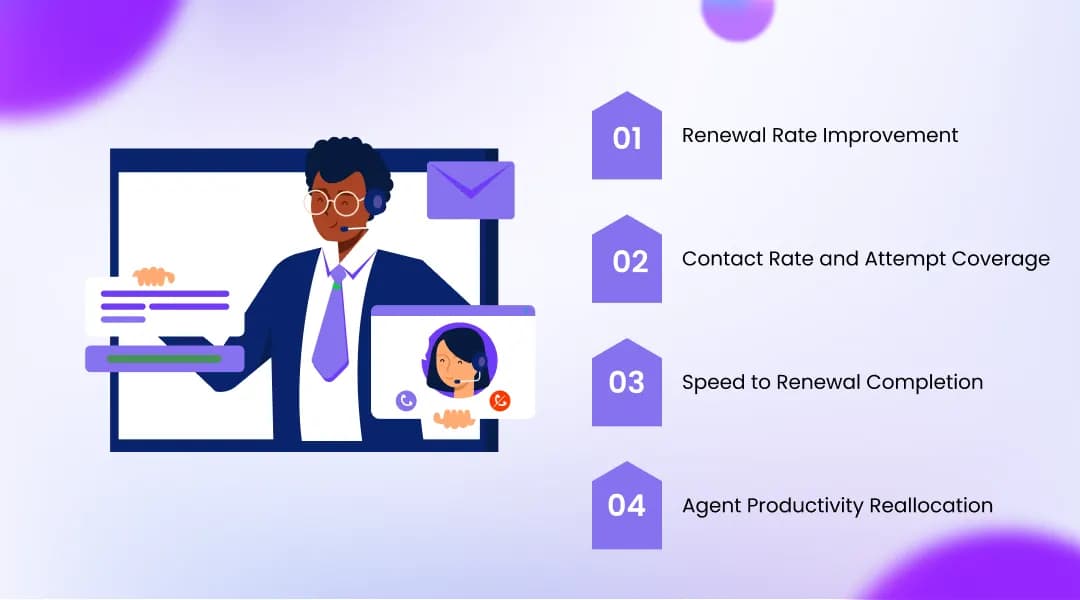
AI voice agents for insurance renewal calling deliver measurable improvements across four key metrics that insurance operations leaders track closely.
Renewal Rate Improvement
Insurance companies that deploy AI voice agents for renewal outreach consistently report renewal rate improvements of 15% to 40% compared to email and SMS-only approaches. The improvement is most dramatic for policy segments that previously received no phone outreach at all, typically lower-premium personal lines policies where the cost of a human call could not be justified. By making phone outreach economically viable for every policy, AI voice agents recover renewals that were previously written off as inevitable lapses.
Contact Rate and Attempt Coverage
AI voice agents eliminate the attempt gap. Every policy approaching renewal receives the configured number of call attempts, at optimized times, without exception. Contact rates (the percentage of policyholders who actually answer and engage in a conversation) typically range from 35% to 55% with AI calling, compared to 20% to 35% with manual dialing operations. The improvement comes from higher attempt volume, better timing optimization, and the AI agent's ability to call back instantly when a previously unavailable number becomes reachable.
Speed to Renewal Completion
When a policyholder is ready to renew, the AI agent can complete the process on the call itself, confirming details and processing the renewal in real time through integration with the insurer's policy management system. This eliminates the delay that occurs when human agents need to send follow-up emails, wait for documents, or schedule second calls. The average time from first AI call attempt to completed renewal is 40% to 60% shorter than traditional manual processes.
Agent Productivity Reallocation
One of the most strategically valuable outcomes is what happens to the human agents who were previously spending their time on routine renewal calls. When AI handles the predictable, high-volume renewal outreach, human agents are freed to focus on complex renewals, upselling additional coverage, handling escalated concerns, and retaining high-value commercial accounts. This is where human expertise delivers the highest return, and AI calling is what makes this reallocation possible. OnDial's platform includes smart analytics and call sentiment tracking that identifies which calls were handled entirely by the AI agent and which were escalated, giving operations managers clear visibility into how work is being distributed between AI and human teams.
How OnDial Powers Insurance Renewal Automation at Scale
OnDial is purpose-built for exactly this kind of high-volume, structured outbound calling operation. Several platform capabilities are specifically relevant to insurance renewal use cases.
Multilingual and Regional Language Support
Insurance companies operating in linguistically diverse markets, particularly in India, face an additional challenge: policyholders expect to be spoken to in their preferred language. OnDial supports over 100 languages and offers 9 Indian languages with more than 80 Indian voice variations. For an insurance company serving customers across Maharashtra, Tamil Nadu, West Bengal, and Gujarat, this means the AI renewal agent speaks to each policyholder in Marathi, Tamil, Bengali, or Gujarati respectively, with natural pronunciation and culturally appropriate phrasing. This linguistic capability is not a cosmetic feature. In markets where a significant portion of policyholders are not comfortable conducting financial transactions in English, the ability to handle the renewal conversation in the customer's native language directly impacts conversion rates.
Compliance-Ready Call Handling
Insurance is a regulated industry, and every customer-facing call must comply with applicable data protection and communication regulations. OnDial's platform is GDPR and CCPA compliant, with data handling practices designed for industries where customer data sensitivity is high. Call recordings, transcripts, and interaction data are stored and processed in accordance with regulatory requirements, and consent management is built into the call flow so that every interaction begins with proper verification and disclosure.
No-Code Deployment for Insurance Teams
Many insurance companies, especially mid-market carriers and large brokerages, do not have internal AI engineering teams. OnDial offers both API integration for companies with development resources and no-code deployment options for teams that want to configure and launch AI calling campaigns without writing code. This means an insurance operations manager can set up a renewal calling campaign, define the conversation flow, connect the policy data source, and start making calls within days rather than months.
Implementation: What Getting Started Actually Looks Like
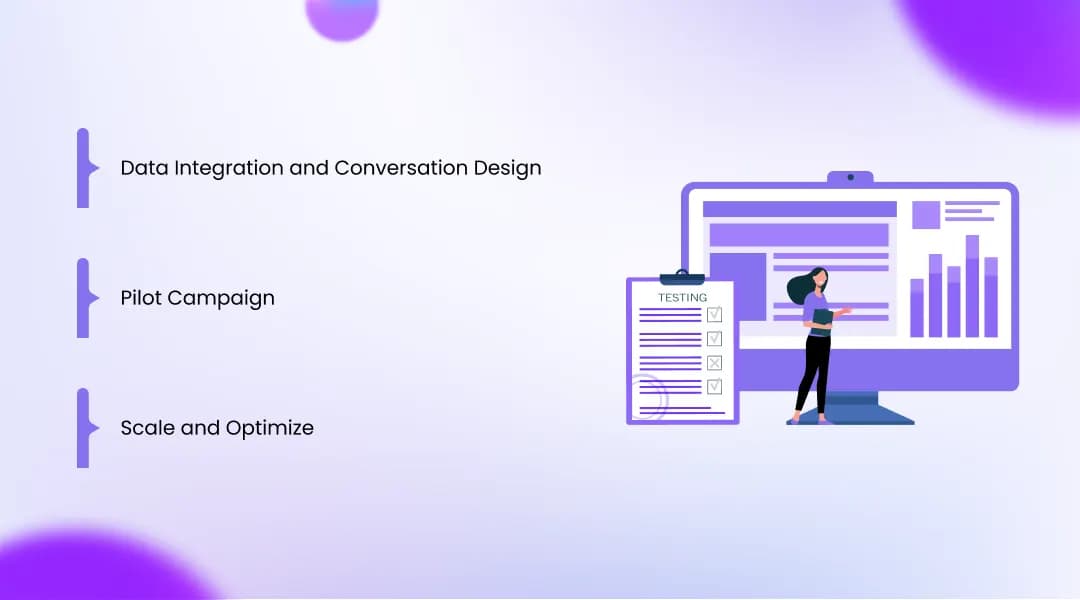
Deploying AI voice agents for insurance renewal calling is not a multiyear digital transformation project. For most insurance companies, the implementation follows a phased approach that delivers measurable results within the first 30 to 60 days.
Phase 1: Data Integration and Conversation Design
The first step is connecting the AI voice agent platform to the insurer's policy management system or CRM. This integration provides the AI agent with access to the data it needs for each call: policyholder name, policy number, coverage type, premium amount, renewal date, payment status, and any relevant account flags. Simultaneously, the renewal conversation flow is designed and configured. This includes the greeting and identification script, the renewal summary, responses to the 15 to 20 most common policyholder questions, objection handling paths, and escalation triggers.
Phase 2: Pilot Campaign
Most insurance companies start with a pilot campaign targeting a specific policy segment, often personal auto or home insurance renewals in a single region. The pilot typically covers 1,000 to 5,000 renewal calls over two to four weeks. During this phase, the team monitors call recordings, reviews conversation quality, measures contact rates and renewal conversion, and refines the conversation flow based on real policyholder interactions. The pilot provides the data needed to project results at full scale and to build the business case for broader deployment.
Phase 3: Scale and Optimize
After the pilot validates performance, the AI calling operation is expanded to cover all renewal segments and regions. Ongoing optimization focuses on call timing, conversation flow refinements, A/B testing of different approaches to premium increase conversations, and integration of new policy data points that improve personalization. OnDial's smart analytics dashboard provides real-time visibility into campaign performance, call outcomes, sentiment scores, and escalation patterns, enabling continuous improvement without manual call review.
Industry Applications Beyond Basic Renewal Reminders
While policy renewal calling is the primary use case covered in this blog, insurance companies that deploy AI voice agents for renewals quickly discover additional applications across the policyholder lifecycle.
Claims Status Updates
After filing a claim, policyholders frequently call to check status. AI voice agents can proactively call policyholders with claims status updates, reducing inbound call volume and improving the customer experience during what is often a stressful time.
Payment Reminder and Collections
For policyholders with overdue premiums, AI voice agents can place payment reminder calls before the policy enters grace period, and follow-up calls for policies at risk of cancellation due to non-payment. These calls are structured to be informative and helpful rather than aggressive, maintaining the customer relationship while protecting the insurer's revenue.
Cross-Sell and Upsell Outreach
When a policyholder renews, the renewal call is a natural opportunity to introduce additional coverage options. AI voice agents can present relevant cross-sell offers, such as adding umbrella coverage to a home insurance renewal or bundling auto and renters insurance, and either complete the upsell or transfer interested policyholders to a licensed agent for more complex conversations.
Customer Satisfaction Surveys
Post-interaction surveys provide valuable data for improving service quality. AI voice agents can conduct brief satisfaction surveys after claims resolution, policy changes, or renewal completion, capturing structured feedback at a scale that manual surveying cannot match.
Conclusion
Policy renewal calling is one of the highest-impact, most immediately deployable applications of AI voice agents in the insurance industry. The business case is straightforward: most policy lapses are preventable with timely, personalized phone outreach, but the volume and cost of that outreach exceeds what traditional human calling operations can deliver consistently. AI voice agents close this gap by making high-quality renewal calls at a scale and cost that transforms the economics of retention. The measurable outcomes, including renewal rate improvements of 15% to 40%, contact rate increases, faster renewal completion times, and the reallocation of human agents to higher-value work, make this one of the clearest ROI cases in insurance operations today.
OnDial delivers exactly what insurance companies need to automate policy renewal calls effectively: sub-500 millisecond response latency for natural conversations, multilingual support including 9 Indian languages with over 80 voice variations for carriers operating across diverse markets, GDPR and CCPA compliant data handling for regulatory confidence, and both API and no-code deployment options that get campaigns live in weeks rather than months. The platform's smart analytics and call sentiment tracking give operations leaders the visibility they need to continuously optimize performance and demonstrate results to leadership.
If your insurance company is losing revenue to preventable policy lapses and your current renewal outreach is not reaching every policyholder with a timely phone call, the gap between where you are and where you could be is exactly what OnDial's AI voice agents are built to close. Schedule a demo or start a free trial with OnDial to see how AI-powered renewal calling performs against your current process with your actual policy data.