Here is a number that should stop you mid-scroll: research cited by Quiq found that brands lose roughly $262 per customer, per year, to traditional IVR, and 51% of consumers say they have abandoned a business entirely after reaching an automated phone menu. Read that again. Half your callers will leave for a competitor, and the receipt never shows up on your phone bill.
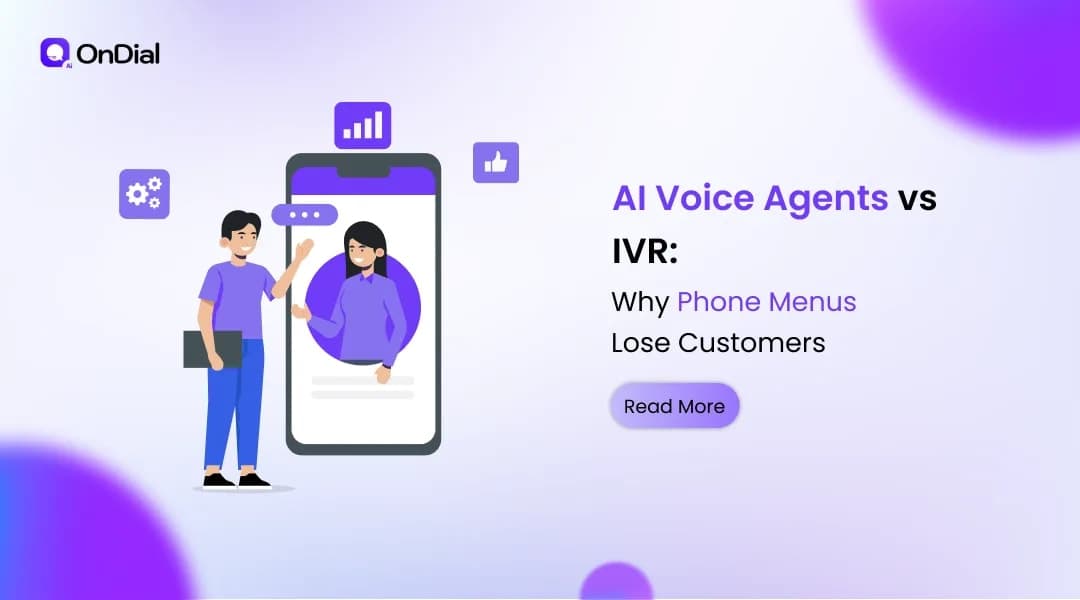
If you have ever felt that your support line is "fine" but your conversions are not, you are not imagining the gap. When people compare AI voice agents vs IVR, the honest difference is this: an IVR makes the caller do the work of routing themselves, while an AI voice agent listens, understands intent, and resolves the request in plain conversation. One asks the customer to adapt to a machine. The other adapts to the customer.
I have sat in on enough call reviews at OnDial to know the pattern. The frustration is rarely about a single bad menu. It is about the quiet, compounding cost of every caller who pressed zero, sighed, and hung up. This article breaks down exactly why menus lose customers, what the data says about resolution and cost, and how to switch without tearing out your existing setup.
What's the Difference Between AI Voice Agents and IVR?
An IVR (Interactive Voice Response) is a touch-tone system that plays recorded menus like "press 1 for sales" and routes the call based on the key you press. An AI voice agent uses natural language understanding (NLU) and a large language model (LLM) to hold a real conversation and complete the task itself.
The Core Paradigm Shift
The simplest way to put it: IVR is a sorting hat, an AI voice agent is a colleague. An IVR routes. It cannot reason, and it cannot act outside its decision tree.
A conversational AI voice agent does something different. It interprets what the caller actually means, asks a clarifying question when needed, and pulls live data from your CRM to finish the job on the call. A caller saying "I need to move my appointment to Thursday" gets it rescheduled, not transferred.
Where the Two Architectures Split
Input method: IVR depends on keypad presses and rigid keywords. AI voice agents accept open, natural speech, including interruptions and changes of mind.
Resolution: IVR mostly hands off to a human. AI voice agents resolve the request end to end, then escalate only the genuinely complex calls.
Adaptability: An IVR menu is fixed until someone re-records it. An AI agent improves as it sees more real conversations.
(If your menu has not been redesigned in a decade, you are not alone. Most have not.)
Why Customers Hate Phone Menus
Most articles tell you customers dislike IVR. Few explain the mechanism, and the mechanism is where the money leaks. People do not leave because menus are annoying in the abstract. They leave inside a very specific window.
The 30-to-60-Second Abandonment Window
Call abandonment data is brutal in its timing. Industry reporting compiled by Ringly notes that the bulk of abandoners are gone in the first 30 to 60 seconds, with more than one in five callers hanging up inside the first minute.
A phone menu spends that exact window making the caller listen, not resolving anything. By the time option four arrives, the customer with a simple question has already decided you are hard to deal with. The menu does not lose the call at the dead end. It loses it at the greeting.
The Emotional Tax Nobody Measures
There is a second cost that never shows on a dashboard. Research on IVR experiences describes callers feeling managed rather than helped, repeating the same information without progress, and reaching a human already annoyed.
That residual frustration follows them to your agent, who now spends longer calming the caller than solving the problem. So the "cost-saving" menu quietly raises your average handle time. A poorly designed IVR does not just lose calls; it makes the calls you keep more expensive.
The Numbers: IVR Containment Rate vs AI Resolution
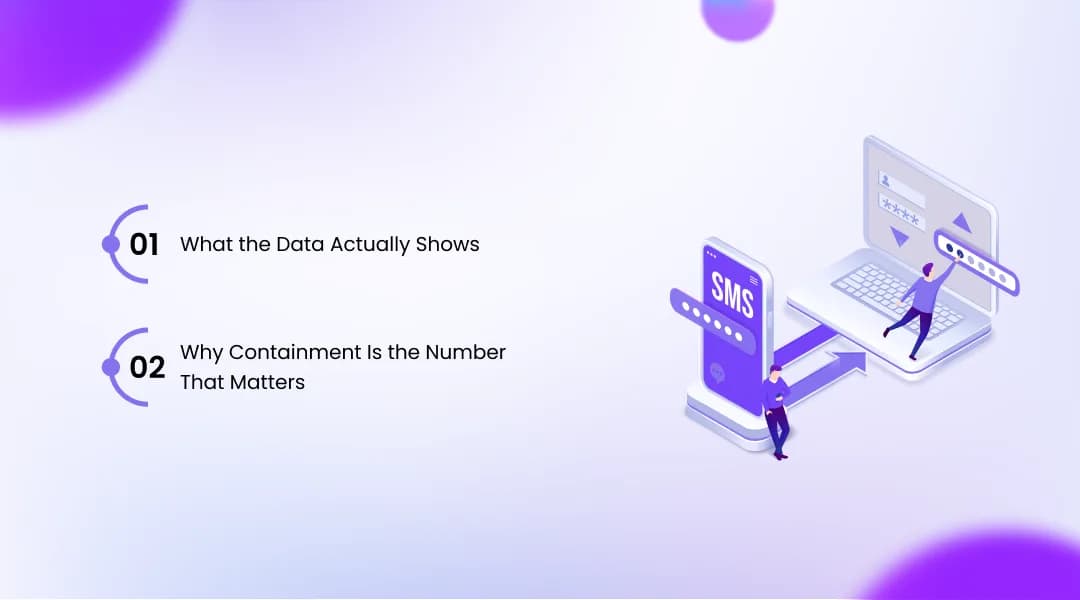
The clearest argument in the AI voice agents vs IVR debate is the resolution gap, and it is not close. Containment rate, the share of calls fully handled without a human, is the metric that exposes it.
What the Data Actually Shows
According to analysis from Techno Tackle, voice AI agents reach about 73% self-service resolution, compared with roughly 32% for chatbots and just 12% for IVR. Average handle time, in the same analysis, drops from four to seven minutes with IVR to under 90 seconds with voice AI. Several platform benchmarks place modern voice agent containment in the 60 to 80% range against legacy IVR's 30 to 40%.
Here is a direct comparison of the two systems on the metrics that decide CSAT and cost:
Metric | Traditional IVR | AI Voice Agent |
Containment / self-service resolution | 12% to 40% | 60% to 80% |
Interaction style | Keypad menus | Natural conversation |
Average handle time | 4 to 7 minutes | Under 90 seconds |
Acts on CRM data live | Rarely | Yes |
Improves over time | No | Yes |
Why Containment Is the Number That Matters
Every point of containment you gain is a call that resolves without an agent and without abandonment. Push containment from 30% to 70%, and you have not trimmed a cost line. You have rebuilt the economics of the whole phone channel.
That is also why "adding a few AI features" to an old phone tree disappoints. The architecture, not the voice, is what caps your containment.
AI Voice Agent Cost vs IVR: What You Actually Pay
The case for keeping IVR is almost always cost. It looks cheap to run. But that initial saving is, as Quiq puts it, an illusion once you count the customers it sends away.
Comparing the True Cost Per Resolved Call
A live agent call costs roughly $5 to $12 on average per Forrester benchmarks cited by Bland AI, while a modern conversational voice agent runs around $0.11 per minute per Retell AI. The honest comparison is not licence fee against licence fee. It is cost per resolved call, and IVR loses there because so many of its calls are abandoned or transferred.
When you account for lost revenue from abandonment, the inflated handle time, and the agents an IVR cannot replace, the cheaper-looking system is usually the more expensive one. The savings on an AI agent show up first in the operating budget and, at higher volumes, in headcount planning.
The ROI Question Most Teams Get Wrong
The mistake is comparing tools instead of outcomes. Ask what each option does to abandonment, containment, and CSAT, then attach revenue to those numbers.
Abandonment: every dropped call is a missed sale or a churned customer, not a neutral event.
Containment: higher containment means the same team handles far more volume.
Escalation quality: calls that do transfer arrive with full context and a calmer caller, which shortens the human's work.
The India Layer: Hinglish, DLT, and UPI in One Call
This is where the generic comparison stops being useful, and where I see the most avoidable mistakes. A voice system built for clean English menus will not survive a real Indian customer call.
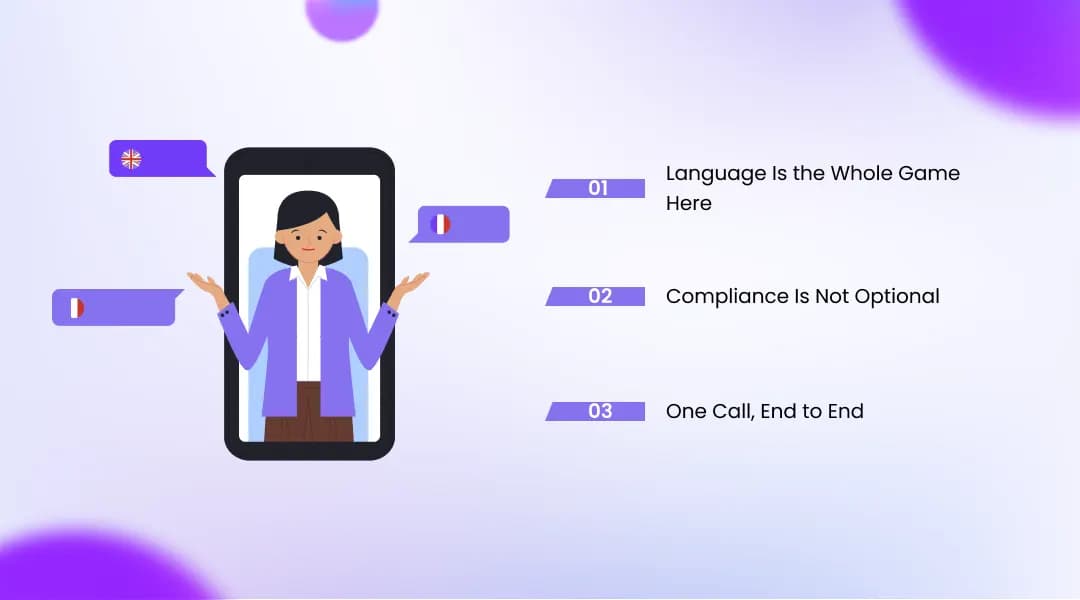
Language Is the Whole Game Here
Indian callers code-switch mid-sentence, sliding between Hindi and English without warning. A traditional IVR cannot follow that, and a multilingual voice AI that only swaps between separate language modes still stumbles on true Hinglish.
A genuinely useful agent handles the code-switching itself and copes with regional accents over noisy telephony lines. In projects I have worked on, this single capability separates a system people actually use from one they shout "agent" at.
Compliance Is Not Optional
Regulation is the quiet deal-breaker. Every business making outbound calls in India must be registered on the TRAI DLT platform, and the DPDP Act governs how you collect and use caller consent and data.
The stakes are concrete. One 2026 compliance guide reported that over 47,000 numbers were disconnected by TRAI's automated detection in Q1 2026, many belonging to legitimate businesses with improper DLT registration. A modern voice agent that bakes DLT-registered routing and DPDP-aligned consent into the flow is not a luxury. It is what keeps your numbers alive.
One Call, End to End
The 2026 reality is a single inbound call where the agent retrieves a policy in Hinglish, explains a renewal, collects the premium over UPI, logs it in the CRM, and sends a WhatsApp confirmation. No human in the loop, no menu maze. That is the bar an IVR was never built to clear.
When Traditional IVR Still Makes Sense
I want to be fair here, because the all-or-nothing pitch is dishonest. IVR is not always the wrong answer.
The Narrow Cases Where IVR Holds Up
If your call volume is very low, your queries fit neatly into three or four fixed categories, and your budget for change is genuinely zero, a simple IVR still functions. It is not good. But it works for that narrow band.
Some predictable, low-stakes routing also does not need conversation. A pure "store hours and location" line is a fine job for a basic menu.
The Honest Limitation of AI Voice Agents
AI voice agents are not magic either, and pretending otherwise erodes trust. Poorly scoped agents can over-promise, dialect coverage still varies, and a badly designed handoff frustrates people just as much as a bad menu.
The fix is phased rollout, not a heroic rip-and-replace. Replace one IVR branch at a time, measure containment and CSAT, and expand only where the data earns it.
Conclusion
When you weigh AI voice agents vs IVR, the verdict is decisive: rigid phone menus lose customers in the first minute, cap your resolution rate near 12 to 40%, and quietly drain revenue, while conversational agents resolve most calls naturally and act on live data. Three things should stay with you. The cost of IVR is the customers it sends away, not the licence fee. Containment is the metric that rebuilds your phone economics. And in India, language and DLT compliance decide whether any of it works.
You do not have to tear anything out to start. At OnDial, we build human-first voice agents that handle Hinglish, stay DLT and DPDP aligned, and let you replace one menu branch at a time so the data, not the hype, guides the rollout. Pick your highest-volume call flow, and let us show you what containment looks like when callers stop pressing zero.