Picture this: a customer calls your business at 11:47 PM on a Sunday. They need to reschedule an appointment. Nobody's at the desk. The phone rings five times and drops.
That customer isn't calling back on Monday. They're calling your competitor.
This is the exact gap an AI voice bot fills and it's not hypothetical. According to Gartner, conversational AI is projected to eliminate $80 billion in contact center labor costs in 2026 alone. The shift from "maybe later" to "already deployed" happened faster than most business leaders anticipated.
I've spent the last four years at OnDial building and deploying voice bots for Indian businesses, and I've watched the technology go from clunky demo to production-grade infrastructure. In this article, I'll walk you through what an AI voice bot actually is, how the technology works beneath the surface, where it delivers measurable value, and what real deployments look like, so you can decide whether it belongs in your operation.
What Is an AI Voice Bot?
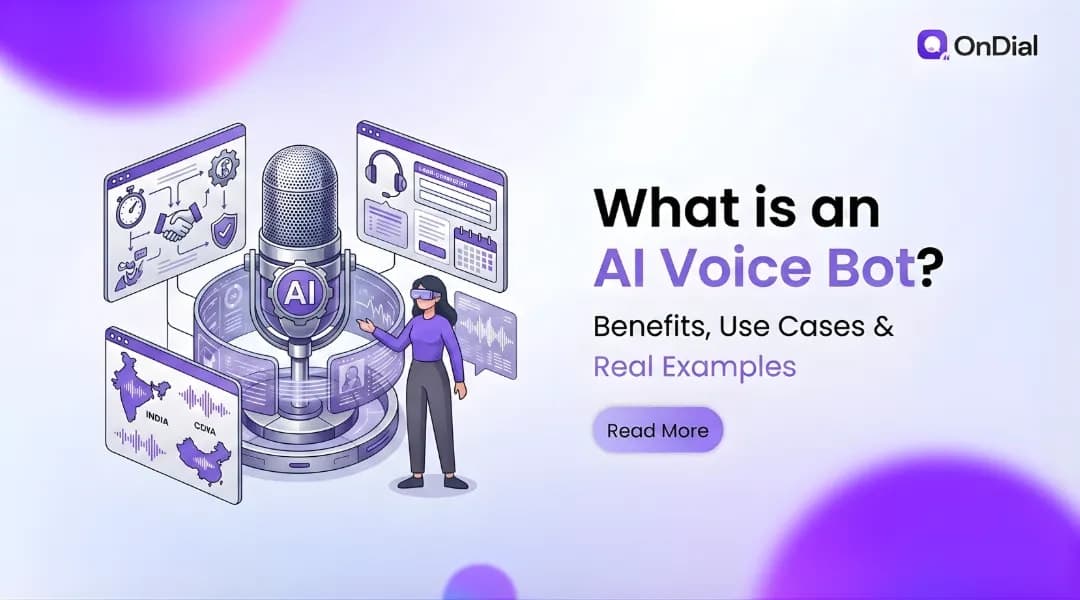
An AI voice bot is software powered by artificial intelligence that conducts real-time voice conversations with humans over phone calls. It uses automatic speech recognition (ASR) to understand spoken language, natural language processing (NLP) to interpret intent, and text-to-speech (TTS) to respond naturally - enabling businesses to automate calls for support, sales, and scheduling without human agents.
That's the textbook version. Here's the version I'd give you over coffee.
An AI voice bot is basically a very patient, very consistent employee who answers every single call, never asks for a break, understands what people actually mean (not just what they say), and speaks the customer's language - literally. At OnDial, we've built bots that switch from English to Hindi to Hinglish mid-sentence because that's how real conversations in India actually work.
The important distinction: this isn't your 2015-era "Press 1 for billing, Press 2 for support" system. Modern AI voice bots hold open-ended conversations. They ask follow-up questions. They remember context. And when they genuinely can't help, they hand the call to a human agent with full context, so the customer never repeats themselves.
How Does an AI Voice Bot Work?
Understanding how AI voice bots handle customer calls requires looking at three layers working in concert, each completing its job in milliseconds.
Layer 1: Listening (ASR)
The bot converts the caller's spoken words into text using automatic speech recognition. Modern ASR engines are trained on thousands of hours of real telephony audio — including noisy backgrounds, accents, and dialect variations. Well-trained Indian voice AI systems now achieve 85–95% intent recognition accuracy, depending on the language.
Layer 2: Thinking (NLP/NLU)
Once speech becomes text, natural language understanding kicks in. The system identifies what the caller wants their intent and extracts key details (dates, names, account numbers). This is where the "intelligence" lives. A customer saying "I want to move my Thursday appointment to next week" and "Can you push my booking?" should trigger the same workflow. Good NLP ensures they do.
Layer 3: Speaking (TTS)
The bot generates a spoken response using text-to-speech synthesis. Today's neural TTS voices sound remarkably natural — no more robot monotone. The best systems match tone and pacing to the conversation's context.
(Here's the part most vendors won't tell you: the real complexity isn't in any single layer. It's in the latency between them. A 3-second pause after a customer finishes speaking feels like an eternity. The systems that win are the ones achieving sub-one-second response times.)
Key Benefits of AI Voice Bots for Businesses
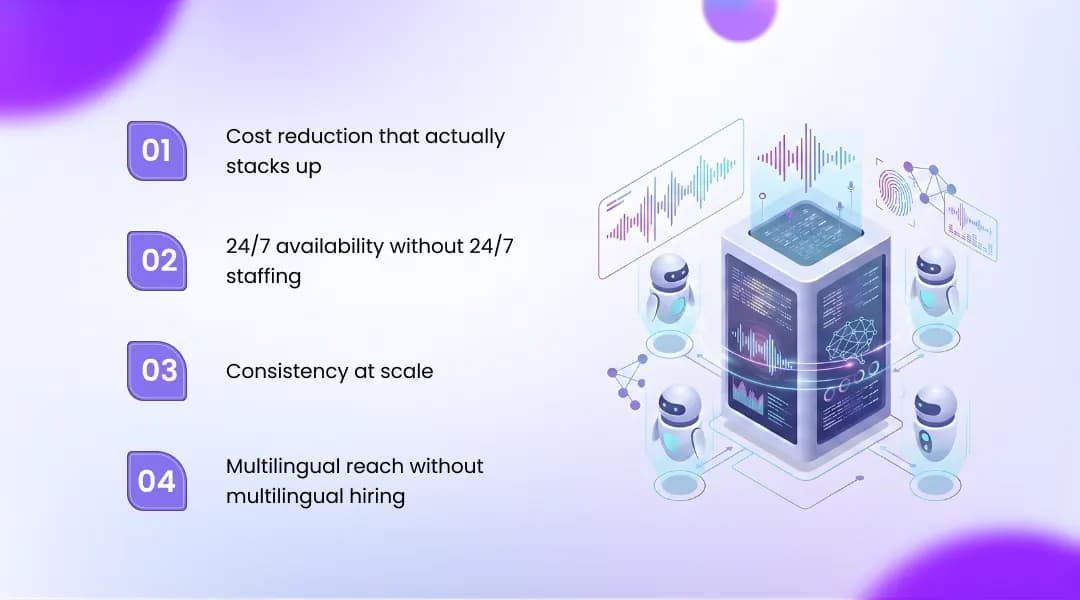
The benefits of AI voice bots for businesses fall into four concrete categories - not vague promises, but measurable outcomes I've seen repeated across deployments.
Cost reduction that actually stacks up
Voice AI costs approximately $0.40 per call, compared to $7–$12 per call for a human agent. That's a 90–95% cost reduction per automated interaction. For a business handling 10,000 calls per month, the math writes itself.
24/7 availability without 24/7 staffing
Your customers don't operate on business hours. An AI voice automation platform like OnDial handles midnight calls, holiday surges, and Diwali-week spikes without you adding a single shift.
Consistency at scale
Human agents have good days and bad days. A voice bot delivers the same quality on call #1 and call #10,000. Every script is followed. Every compliance disclosure is made. Every lead gets qualified the same way.
Multilingual reach without multilingual hiring
In India alone, the voice AI market was valued at $153 million in 2024 and is projected to reach $957 million by 2030. The growth is driven by one reality: India's next 500 million digital users prefer regional languages. A voice bot that speaks Tamil, Telugu, Bengali, and Gujarati lets you reach customers that an English-only call center simply cannot.
Top Use Cases for AI Voice Bots
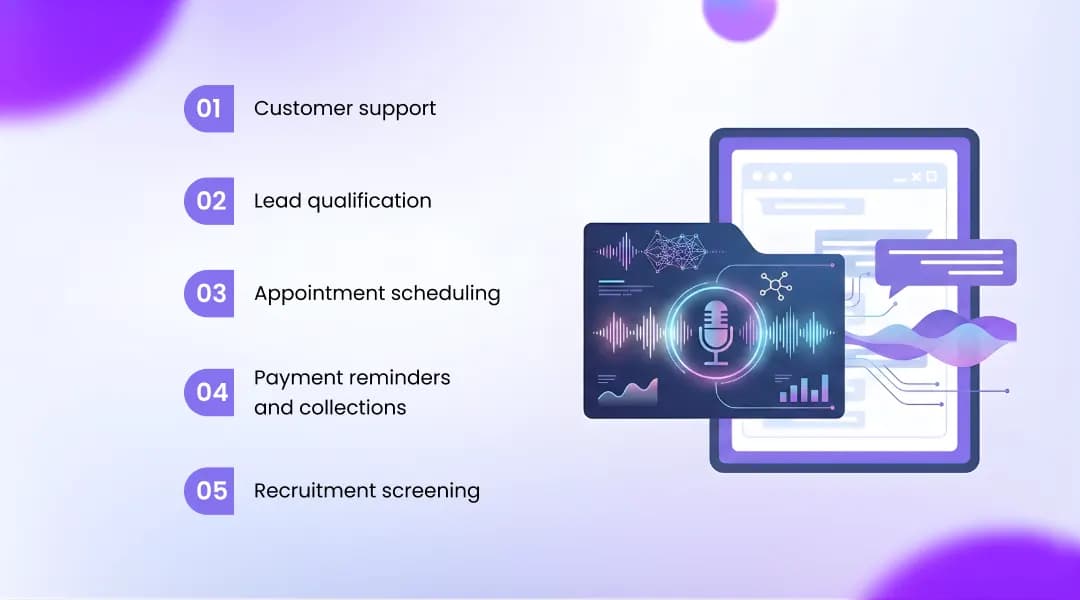
Here's where theory meets practice. These are the use cases I've seen deliver the fastest ROI:
Customer support
Handling FAQs, order status checks, account inquiries, and basic troubleshooting. Customer support accounted for 42.4% of the chatbot market in 2024, and voice automation is following the same trajectory.
Lead qualification
Voice bots call inbound leads within seconds of form submission, ask qualifying questions, score the lead, and route hot prospects to sales reps. Cold leads never waste a rep's time.
Appointment scheduling
Healthcare clinics, salons, financial advisors — any business where booking and rescheduling drive a significant share of call volume. The bot checks availability, confirms the slot, and sends a reminder.
Payment reminders and collections
Particularly effective in BFSI. Bots call customers about upcoming EMI payments, share payment links, and escalate only when needed.
Recruitment screening
This one surprised me. Staffing agencies are replacing first-round phone screens with AI voice interviews and seeing throughput double with 24/7 scheduling and consistent scoring.
AI Voice Bot vs. Traditional IVR: What's the Difference?
If you're still running a traditional IVR, you already know the frustration.
Traditional IVR forces callers through rigid, menu-driven trees. "Press 1. Press 3. Press 0 for an operator." Customers abandon these flows constantly. Drop-off rates are high, resolution rates are low, and every menu branch you add makes the tree harder to maintain.
An AI voice bot replaces that structure with open-ended conversation. The caller says what they need in their own words. The bot understands, responds, and acts. No menus. No button-mashing. No dead ends.
Feature | Traditional IVR | AI Voice Bot |
Interaction | Menu-driven, rigid | Conversational, open-ended |
Language support | Usually 1–2 | 10+ with mid-call switching |
Personalization | None | Context-aware, customer-specific |
Scalability | Add menus = add complexity | Add intents = add capability |
Customer satisfaction | Low (high abandonment) | High (natural conversation) |
The difference isn't incremental. It's structural. Traditional IVR asks customers to adapt to your system. An AI voice bot adapts to your customer.
How to Choose the Right AI Voice Bot for Your Business
Not every voice bot vendor is built for your reality. Here's what I'd evaluate, based on mistakes I've seen businesses make:
Language accuracy over language count
A vendor claiming "40+ languages" means nothing if their Hindi ASR has a 20% word error rate on noisy telephony audio. Ask for accuracy benchmarks on your specific languages and use cases.
Latency matters more than features
If the bot pauses for 3 seconds after every customer sentence, the conversation feels broken. Look for sub-one-second response times.
Integration depth
Can the bot connect to your CRM, scheduling tool, and payment gateway? A voice bot for business that can't take action is just a fancy answering machine.
Human handoff quality
When the bot transfers to a live agent, does it pass the full conversation context? Or does the customer start over? This single detail determines whether your customers feel helped or annoyed.
India-readiness
If you're operating in India, your AI voice automation platform must handle code-switching (English-Hindi-regional mid-sentence), Tier-2/Tier-3 accents, and noisy mobile networks. OnDial is built for precisely this reality.
CONCLUSION
Here's what this comes down to.
An AI voice bot is not a futuristic concept - it's production-grade technology already handles millions of calls across industries worldwide. The global voice AI market is on track to reach $47.5 billion by 2034, and 80% of businesses plan to integrate AI-driven voice technology into customer service by 2026.
Three things to take away: first, modern AI voice bots understand natural speech, respond in real time, and operate in multiple languages, they are fundamentally different from legacy IVR. Second, the ROI is concrete and measurable, with cost-per-call reductions exceeding 90% in most deployments. Third, the businesses winning with voice AI started small - one use case, one language and scaled after proving results.
If you're running a call operation that's stretched thin, handling calls in Indian languages, or losing leads because nobody picks up after hours - OnDial was built for exactly that. Request a demo and hear what your customer calls could sound like with an AI voice bot handling them.