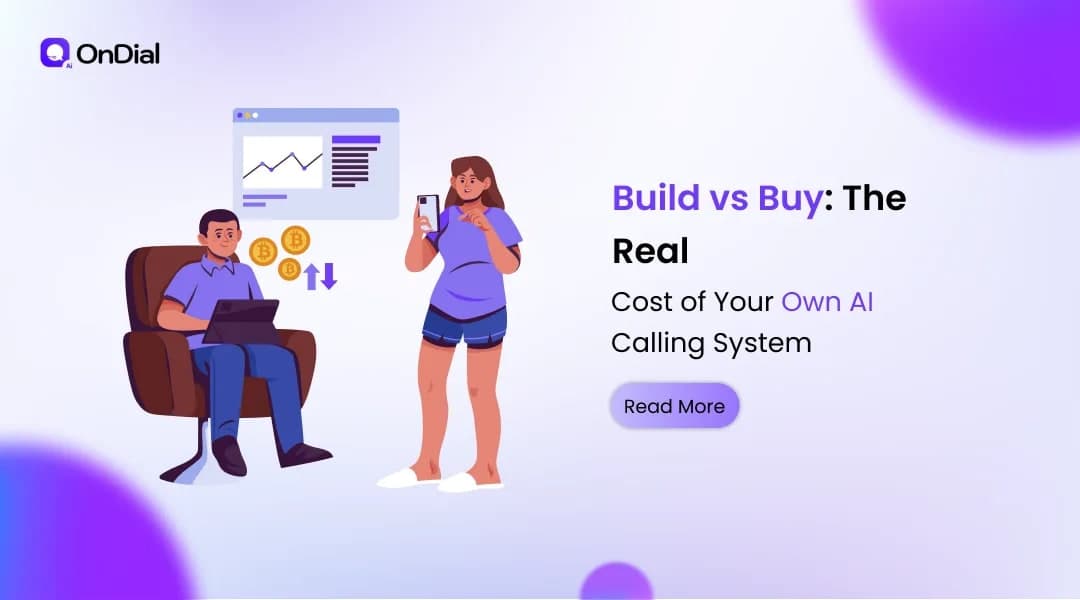
Businesses evaluating AI calling often reach the same decision point:
Should we build our own AI calling system, or should we buy an existing platform?
The answer depends on much more than the initial software cost.
A custom AI calling system can give a company greater control over its architecture, data, integrations, and conversation logic. But building also means taking responsibility for telephony, speech recognition, AI models, orchestration, monitoring, security, maintenance, and ongoing improvements.
Buying an AI calling platform usually reduces the amount of engineering required to get started. Instead of building the voice infrastructure yourself, your team configures an existing platform around its business workflows.
Neither option is automatically cheaper.
The right choice depends on your call volume, technical capabilities, integration requirements, compliance needs, desired customization, and whether AI calling is a core part of your product.
This guide explains the real cost differences between building and buying an AI calling system and provides a practical framework for making the decision.
Build vs Buy AI Calling System: What Does It Mean?
At a high level, there are three approaches.
Build
Your company develops and operates the AI calling technology itself.
That can include:
Telephony infrastructure
Speech-to-text
Large language model integration
Text-to-speech
Conversation orchestration
Call routing
CRM integrations
Analytics
Monitoring
Security controls
Deployment infrastructure
Your team owns the system and is responsible for maintaining it.
Buy
Your company uses a managed AI calling platform.
The platform provides much of the underlying infrastructure, while your team configures:
Conversation flows
Prompts
Business rules
Knowledge
Integrations
Calling campaigns
Escalation logic
The vendor maintains the underlying platform.
Hybrid
A company buys the core AI calling infrastructure and builds custom components around it.
This can include proprietary:
Business logic
CRM workflows
APIs
Data pipelines
Internal tools
Analytics
Custom orchestration
For many businesses, the hybrid model can provide a balance between speed and customization.
What Does It Cost to Build an AI Calling System?
There is no single price for building an AI calling system.
The cost depends primarily on complexity.
A simple internal proof of concept is dramatically different from a production platform handling customer conversations across multiple languages, CRM systems, and business workflows.
The main cost categories are engineering, infrastructure, integrations, quality testing, security, monitoring, and ongoing maintenance.
1. Engineering and Development Cost
The first major cost is the technical team required to build the system.
A production AI calling application may require expertise across:
Backend development
Telephony
AI and LLM integration
Speech processing
API development
Cloud infrastructure
Security
Quality assurance
A prototype can be relatively simple.
A production system is not.
The development team has to make sure the voice experience works reliably when callers:
Interrupt the AI
Speak unexpectedly
Change topics
Speak quickly
Use slang
Switch languages
Provide incomplete information
Ask questions outside the workflow
Request a human
That engineering complexity is one of the biggest differences between a demo and a production AI calling system.
2. Telephony Infrastructure
An AI calling system needs a way to make and receive phone calls.
That means integrating with telephony providers and managing things such as:
Phone numbers
Inbound calling
Outbound calling
Call routing
Carrier connectivity
Call status
Recording
Failover
Regional requirements
Telephony costs continue after the initial development.
A company building the technology still pays for the underlying communication infrastructure based on its usage and provider.
3. Speech-to-Text Costs
When customers speak, the system needs to convert their speech into machine-readable information.
This typically involves a speech-recognition or speech-to-text service.
Costs can vary depending on:
Provider
Language
Audio quality
Usage volume
Processing requirements
For multilingual deployments, testing becomes especially important because language support is not simply a checkbox.
A model may technically support a language but still struggle with:
Accents
Background noise
Names
Local terminology
Code switching
Informal speech
4. Language Model Costs
The AI needs a language model to understand customer requests and determine what to say or do next.
Depending on the architecture, this may involve a commercial model API or a self-hosted model.
Costs are influenced by:
Conversation length
Number of calls
Prompt size
Context size
Model selection
Tool calls
Knowledge retrieval
Output volume
This means that two businesses with the same call volume may have very different AI costs.
A short appointment-confirmation conversation will have different economics from a long sales or support interaction.
5. Text-to-Speech Costs
The AI response needs to be converted back into spoken language.
Text-to-speech costs depend on the provider and voice technology being used.
Businesses should evaluate more than voice quality.
They should also test:
Pronunciation
Speaking speed
Pauses
Numbers
Names
Local terms
Indian languages
Conversational naturalness
A voice that sounds excellent in a product demonstration may behave differently in longer real-world conversations.
6. Integration Costs
Integration is often one of the most underestimated parts of a custom AI calling project.
A voice system becomes much more valuable when it can connect with business software.
For example:
Customer call → AI → CRM → appointment system → confirmation → analytics
Integrations may include:
CRM
Help desk
Calendar
ERP
Payment systems
Customer databases
APIs
Internal software
A well-documented API may be relatively straightforward to integrate.
A legacy system with limited documentation can be significantly more difficult.
This is why the cost of a custom AI calling system should never be estimated solely from the voice technology itself.
7. Monitoring and Observability
Voice AI is a production system.
It needs monitoring.
Businesses need visibility into issues such as:
Failed calls
Latency
Call drops
API failures
Speech-recognition errors
Incorrect responses
Integration failures
Escalation problems
A custom deployment therefore needs logging, monitoring, alerts, dashboards, and operational ownership.
Someone must be responsible when something breaks.
8. Security and Compliance
Security becomes increasingly important as the system handles customer conversations.
Depending on the use case, the platform may process:
Phone numbers
Customer names
Account information
Appointment data
Call recordings
Transcripts
CRM information
The organization may therefore need controls around:
Access permissions
Encryption
Data retention
Authentication
Audit logs
Data deletion
Vendor management
Regulatory requirements
The exact requirements depend on the industry, geography, and use case.
9. Ongoing Maintenance
An AI calling system is not a project that ends when the first version goes live.
Models change.
APIs change.
Telephony providers change.
Customer expectations change.
Conversation flows need improvement.
Businesses therefore need ongoing work across:
Bug fixes
Prompt updates
Conversation tuning
Model evaluation
Integration maintenance
Security updates
Performance monitoring
New use cases
This recurring cost is often left out when companies compare "build" against a vendor subscription.
How Much Does It Cost to Buy an AI Calling System?
Buying shifts the cost structure.
Instead of paying your own engineering team to create and operate the complete infrastructure, you usually pay the vendor through some combination of:
Subscription fees
Usage-based pricing
Per-minute pricing
Per-call pricing
Implementation fees
Integration fees
Enterprise plans
The exact pricing model varies by provider.
That means you should compare total operating cost, not simply the advertised headline rate.
What Is Included When You Buy?
A managed AI calling platform may provide some combination of:
Telephony
Speech recognition
AI processing
Voice synthesis
Conversation orchestration
Call recording
Analytics
Dashboard
Templates
Integrations
Monitoring
Support
The exact package varies by vendor.
Before signing a contract, ask for a clear explanation of what is included and what generates an additional charge.
The Hidden Costs of Buying
Buying does not mean there are no additional costs.
Potential costs can include:
Setup
Some businesses need help designing their first production workflow.
Integration
Custom CRM or business-system integrations may require additional development.
Usage
A platform may charge based on call duration, calls, outcomes, or another usage metric.
Premium capabilities
Advanced voices, analytics, enterprise support, or other features may be available only on higher plans.
Internal ownership
Even with a managed platform, someone inside the business still needs to manage:
Conversation quality
Business rules
Knowledge
Escalation
Reporting
Performance
A managed platform reduces infrastructure ownership.
It does not eliminate operational ownership.
Build vs Buy AI Calling System Cost Comparison
Cost Factor | Build | Buy |
Initial development | High | Lower |
Engineering requirement | High | Lower |
Telephony setup | Your responsibility | Usually platform-managed |
AI model integration | Your responsibility | Usually included |
Speech infrastructure | Your responsibility | Usually included |
Voice infrastructure | Your responsibility | Usually included |
CRM integration | Custom development | Often supported |
Monitoring | Build and maintain | Usually platform-provided |
Security | Your responsibility | Shared with vendor |
Maintenance | Internal team | Vendor + internal workflow team |
Customization | Very high | Platform-dependent |
Time to deployment | Usually longer | Usually faster |
Infrastructure ownership | Full | Limited |
Vendor dependency | Low | Higher |
The table shows the fundamental trade-off.
Build gives you more ownership and flexibility.
Buy gives you more speed and less infrastructure responsibility.
Build vs Buy: Total Cost of Ownership
The initial development cost is only one part of the calculation.
A better approach is to calculate total cost of ownership over 12, 24, or 36 months.
A simple framework is:
Build TCO
Development + infrastructure + integrations + engineering + maintenance + monitoring + security + compliance + telephony + AI usage
Buy TCO
Subscription or usage + implementation + integrations + telephony + internal management + support + additional services
This calculation helps prevent one of the most common mistakes in AI procurement:
Comparing a vendor's monthly price with only the first-year development budget.
The comparison needs to cover the complete operating period.
Example: Small Business
Imagine a small business wants an AI voice agent for:
Lead qualification
Customer inquiries
The company has a small technical team and no previous voice AI infrastructure.
Building may require:
Developer time
Telephony integration
AI integration
Testing
CRM integration
Monitoring
Maintenance
Buying a managed solution could allow the business to configure the workflow without creating the entire underlying stack.
In this situation, buying is often easier to justify because engineering capacity is limited and the AI system is not the company's core technology product.
Example: Enterprise
Now consider an enterprise with:
High call volumes
Multiple internal systems
Dedicated engineering teams
Strict data requirements
Complex business logic
A need for deep customization
The economics can be different.
The organization may have a stronger reason to own parts of the stack or use a hybrid architecture.
However, the enterprise still needs to compare the cost of building and maintaining the infrastructure against the cost of using a managed platform.
When Should You Build an AI Calling System?
Building can make sense when several of the following are true.
AI calling is your product
If voice AI is the actual product you sell, owning the technology may provide strategic value.
You need unusual functionality
A highly specialized use case may not fit an existing platform.
You require deep control
You may need control over:
Models
Infrastructure
Data
Orchestration
Deployment
Business logic
You already have the engineering team
If your organization already has experienced voice, AI, and infrastructure engineers, the cost of building may be more manageable.
Your requirements justify the investment
For some organizations, custom technology provides enough strategic value to justify the additional engineering burden.
When Should You Buy?
Buying is generally attractive when:
You need to launch quickly
A managed platform can remove much of the infrastructure development work.
AI calling is not your core product
If your business sells banking services, healthcare services, real estate, retail products, or another core offering, voice AI may simply be an operational tool.
In that situation, building an entire telephony and AI stack may not be the best use of engineering resources.
You have limited technical resources
A managed system reduces the amount of infrastructure your team needs to create and maintain.
Your use case is already supported
Standard workflows such as:
Lead qualification
Appointment scheduling
Customer support
Reminders
Follow-ups
Notifications
often do not require building an AI calling engine from scratch.
When a Hybrid Approach Makes More Sense
The build-versus-buy decision does not have to be all or nothing.
A company can buy the core voice infrastructure while building the parts that create competitive differentiation.
For example:
Managed voice platform + proprietary CRM logic + internal APIs + custom analytics
This approach can give a business:
Faster implementation
Lower infrastructure burden
Custom workflows
Internal control over business logic
Easier experimentation
For many organizations, this can be a practical middle ground.
AI Calling System Cost in India
Indian businesses need to consider several additional factors when evaluating the economics of AI calling.
Telephony economics
Call rates, number availability, telecom infrastructure, and calling requirements can affect the total cost.
Indian language support
A business serving Indian customers may need to support multiple languages, accents, and code-switching.
Do not estimate language support purely by counting how many languages a vendor lists.
Test real conversations.
Regulatory considerations
The appropriate telecom and data-protection requirements depend on the communication and industry.
For businesses operating in India, regulatory requirements should be considered during architecture and vendor evaluation rather than after deployment.
INR vs foreign-currency pricing
Currency conversion can influence operating costs for Indian companies purchasing services priced in another currency.
The important number is the fully loaded cost in your actual operating currency, not the marketing price shown on a vendor's website.
How to Calculate Your AI Calling Budget
Before choosing build or buy, answer these questions.
1. How many calls will the system handle?
Estimate:
Calls per day
Calls per month
Average call duration
Peak traffic
2. What is the purpose of the calls?
Customer support and appointment reminders may have very different conversation patterns from outbound sales.
3. How much customization is required?
Simple workflows usually require less customization than systems deeply connected to internal software.
4. Which systems need to be integrated?
List every required system before requesting a quote.
5. What languages are required?
Identify the actual languages customers use and test them.
6. What happens when AI fails?
Define human escalation and exception handling.
7. Who will own the system?
For a build, this means technical ownership.
For a buy, it still means someone must own the business workflow and AI quality.
Questions to Ask an AI Calling Vendor
Before buying, ask:
What exactly is included in the per-minute or subscription price?
Do not assume that telephony, LLM usage, speech processing, and analytics are all included.
Are there implementation or integration charges?
Ask specifically about CRM, ERP, calendar, help-desk, and API integrations.
How are overage charges calculated?
Understand what happens when usage exceeds your expected volume.
What happens to recordings and transcripts?
Ask where they are stored, who can access them, and how retention is handled.
Can we transfer calls to human agents?
Human escalation should be part of the evaluation.
How is multilingual performance tested?
Ask for real examples rather than relying only on a language list.
What happens if your platform is unavailable?
Understand redundancy, support, and business-continuity processes.
How to Compare Vendors Fairly
Do not compare platforms using only price per minute.
Instead, create a scorecard covering:
Evaluation Area | Questions |
Cost | What is the fully loaded cost? |
AI quality | Does it handle real conversations reliably? |
Languages | Does it support our customers? |
Integrations | Can it connect with our systems? |
Scalability | Can it handle peak traffic? |
Analytics | Can we measure outcomes? |
Security | How is customer data protected? |
Human handoff | Can complex calls reach agents? |
Support | What help is available during deployment? |
Flexibility | Can workflows be customized? |
This prevents the lowest headline price from automatically becoming the winner.
Build vs Buy: The Decision Framework
Use this simple framework.
Choose Build when:
AI is your product + you need deep control + you have engineering resources + customization is strategically important.
Choose Buy when:
AI is an operational tool + you need faster deployment + the use case is standard + engineering resources are limited.
Choose Hybrid when:
You want managed infrastructure but need proprietary business logic or integrations.
This is a more useful decision model than asking which option is universally cheaper.
What About ROI?
ROI should be calculated from the business outcome, not from AI usage alone.
For example, an AI calling deployment might create value through:
More answered calls
Faster lead response
More qualified leads
More completed appointments
Reduced repetitive workload
Faster customer support
Better follow-up consistency
A company should therefore compare:
AI system cost vs business value created
rather than simply:
AI system cost vs human salary
The second comparison can be misleading because AI and human employees often perform different parts of the workflow.
For a broader view of AI voice economics, see the guide on AI voice agent costs and pricing.
The Cost of Not Automating
There is another side to the calculation.
Businesses sometimes focus entirely on the price of AI without measuring the cost of their current process.
Consider:
Missed calls
Unanswered inquiries
Manual follow-ups
Repetitive administrative work
Slow lead response
Appointment coordination
Customer waiting time
If these problems are already costing the business money, the relevant question becomes:
What does continuing with the current process cost us over the next 12–24 months?
That number should be part of the build-versus-buy analysis.
How OnDial Fits the Buy and Hybrid Model
OnDial provides a managed AI voice platform for businesses that want to automate phone conversations without building the complete voice infrastructure internally.
Businesses can use AI voice workflows for use cases such as:
Customer support
Lead qualification
Appointment scheduling
Follow-ups
Notifications
Sales workflows
Industry-specific calling
OnDial also provides integrations and business-oriented voice workflows so companies can connect AI conversations with their existing processes.
For businesses looking to understand the broader platform model, AI voice agents provide an overview of how conversational voice automation can be used across business workflows.
A Practical Recommendation
For most businesses, the decision should not begin with:
"Can we build this?"
A better question is:
"Does building this create enough strategic value to justify owning the infrastructure?"
If AI calling is simply a tool for handling customer communication, buying can often be the more practical starting point.
If AI calling is the company's competitive product, building may be justified.
And if the business needs a combination of speed and customization, a hybrid model can provide a strong middle ground.
Final Checklist Before Making the Decision
Before choosing build or buy, document:
Monthly call volume
Average call duration
Peak concurrent calls
Required languages
Required integrations
Security requirements
Compliance requirements
Custom workflow requirements
Human escalation requirements
Analytics requirements
Internal engineering capacity
Expected operating period
Then calculate the expected cost over at least 12–24 months.
That gives you a much clearer picture than comparing the first development quote or the first per-minute price you find.
Conclusion
The build vs buy AI calling system decision is fundamentally a decision about ownership, cost, speed, and control.
Building gives your organization more control over the technology stack, but it also makes your company responsible for the infrastructure behind every conversation.
Buying reduces that infrastructure burden and can allow a business to focus on its actual customer workflows.
Neither approach should be selected based only on a headline price.
Calculate the total cost of ownership.
Include engineering.
Include telephony.
Include AI usage.
Include integrations.
Include monitoring.
Include maintenance.
Include security.
Include internal operational time.
Then compare those costs against the business value the system is expected to create.
For most organizations where AI calling is an operational capability rather than the core product, a managed platform or hybrid approach is often the more practical starting point.
The best decision is not the option with the lowest advertised price.
It is the option that delivers the required business outcome at a sustainable total cost.