In an observational study of 85 small businesses across 58 industries, only 37.8 percent of inbound calls were answered by a live person, with about 62 percent going unanswered altogether. Read that again if you run crews. Your marketing budget is buying phone calls that nobody picks up.
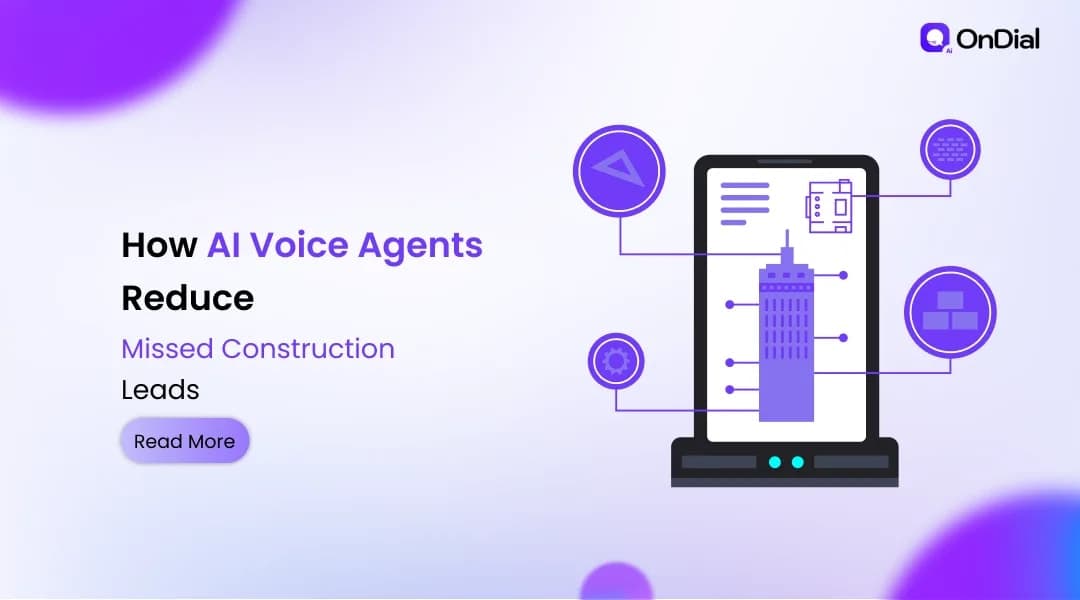
AI voice agents for construction reduce missed leads by answering every inbound call within one ring, capturing project type, location, budget range, and urgency in a natural conversation, booking the site visit against your real calendar, and pushing a structured summary to your CRM before the caller dials the next contractor on their list. That is the whole mechanism, and it works because it removes the one thing a construction business cannot buy more of: someone free to talk at the exact moment the phone rings.
You are probably skeptical. Most contractors I speak with have already tried a shared answering service that could not tell a soffit from a screed, and they are not eager to repeat the experience. Fair enough.
This piece covers what the answer-rate data really says, how the agent handles a live call, the five qualification fields that matter, after-hours coverage, the handoff record that makes the whole thing work, and the boundaries where a well-built agent should refuse to commit.
The Real Cost of Missed Calls on Construction Leads
Missed calls on construction leads are not a marketing problem. It is a coverage problem that marketing budgets quietly subsidise every month.
How do AI voice agents reduce missed construction leads? They answer instantly on every line, hold a two-way conversation instead of playing a menu, collect the project details an estimator needs, offer real calendar slots, and route genuine emergencies to a human within seconds. The result is that after-hours, lunch-hour, and peak-volume calls stop converting into silence.
What the answer-rate data actually shows
The industry-wide answer rate is bad, and the construction-adjacent numbers are worse. A ServiceTitan study analysing over 50,000 contractor phone lines found a 62 percent missed call rate across home service businesses. That is not a rounding error on your pipeline. That is the majority of it.
Voicemail does not rescue those calls either. Hiya's State of the Call research found that 80 percent or more of callers reaching a business voicemail hang up without leaving a message. So the fallback you have been relying on for a decade is functionally a disconnect tone with better manners.
Why construction bleeds worse than most industries
Speed to lead is the elapsed time between an enquiry arriving and someone actually responding to it. The classic research here is unambiguous. A Harvard Business Review study of over 15,000 leads, conducted by Professor James Oldroyd at MIT, found that businesses responding within 5 minutes were 100 times more likely to make contact and 21 times more likely to qualify the lead than those responding at 30 minutes.
Construction inverts that requirement. The hours when homeowners and developers call are exactly the hours your people are on site, in a trench, or halfway up a ladder. Add the staffing pressure the sector already carries, with Associated Builders and Contractors reporting the US construction industry needed to add hundreds of thousands of workers just to keep pace with demand, and phone coverage becomes the first thing to slip.
How an AI Receptionist for Contractors Answers the Phone
An AI receptionist for contractors is a voice agent configured with your trades, service area, project types, and booking calendar with OnDial. It is not an IVR with a friendlier voice, and the difference shows up in the first exchange.
What happens in the first ten seconds
The agent picks up before the second ring and confirms who the caller has reached. It then asks an open question rather than presenting a menu, which lets the caller describe the job in their own words: a leaking flat roof, a kitchen extension, a bid deadline on Thursday. From that single answer, the agent classifies intent and decides which branch of the conversation to run.
Speed here is technical, not cosmetic. Response latency under roughly half a second is what keeps the exchange feeling like a conversation instead of a satellite call. Below that threshold, callers talk normally; above it, they start repeating themselves and hang up.
Where the agent stops and hands off
A well-configured agent knows its job is intake, not closing. It should complete the predictable path on its own and escalate the moment judgment is required. In practice, that means:
Predictable path: quote enquiries, site visit bookings, service area checks, project status questions, and callback requests. The agent finishes these end to end.
Escalation path: emergencies, disputes, anything involving a variation to an existing contract, and callers who explicitly ask for a named person. These transfer or trigger an immediate alert.
Grey zone: unusual scope, unclear urgency, or a caller who sounds like a channel partner rather than a buyer. The agent captures details and flags the record for human review.
The escalation rules matter more than the voice quality. I have seen deployments where the conversational performance was excellent, and the outcome was still poor, purely because everything got escalated and the office ended up doing the same work with extra steps.
Turning Raw Calls Into Construction Lead Qualification
Answering the phone is the easy half. Construction lead qualification is where an agent either earns its place or becomes an expensive voicemail replacement.
The five fields that decide whether a call is worth a truck roll
Lead qualification is the process of confirming a caller's project type, budget range, timeline, and location before a human spends time on them. For contracting work, five fields carry almost all the decision weight:
Project type and scope in plain language: what the caller wants done, captured verbatim rather than forced into a dropdown.
Property location: checked against your service area before anything else, because a beautiful lead 90 minutes outside your radius is not a lead.
Timeline: whether the caller is planning for next spring or has water coming through a ceiling right now.
Budget range or funding status: insurance claim, mortgage drawdown, self-funded, or undecided.
Decision authority: whether the caller can approve the work or is gathering options for someone who can.
Filtering casual enquiries without insulting anyone
Here is the counter-intuitive part. The value of qualification is not mainly in the leads you disqualify. It is in the leads you correctly prioritise, because your estimator finally sees the ready-to-book enquiry at the top of the list instead of buried under eleven price-shoppers.
Tone does the heavy lifting. An agent that asks about budget in the first thirty seconds reads as a gatekeeper, while one that asks after the caller has described their project reads as thorough. (Small thing. Measurably not a small thing.) At OnDial, we tune this ordering per client, because a luxury build enquiry and a subcontractor availability call tolerate very different levels of directness, including teams adopting AI voice agents for call centers and BPOs.
After-Hours Call Answering for Contractors
After-hours call answering for contractors is not a nice extra. It is where the recoverable revenue sits, and it is the easiest deployment to justify because the baseline is zero.
The evening, lunch, and weekend gap
The distribution of inbound calls does not match the working day. ServiceTitan data indicates 35 to 40 percent of inbound calls to home services contractors arrive after business hours, with weekend unanswered-call rates jumping to 41 percent against 18 percent on weekdays. Weekends are when homeowners finally have time to deal with the extension they have been postponing.
This is also why after-hours-only coverage is such a sensible pilot. You are not asking the agent to replace your office manager; you are asking it to occupy a window where the current alternative is nothing. If it fails, you have lost calls that were already lost.
Emergency triage from a live site
Call triage is sorting inbound calls by urgency so emergencies reach a person immediately and routine enquiries wait. The agent listens for urgency markers, structural damage, gas, flooding, exposed wiring, site injury, and breaks its normal flow the moment one appears.
What follows should be a call or SMS to the on-call crew lead within seconds, not a note in a queue. Configure this narrowly. An agent that treats every irritated caller as an emergency will be switched off within a fortnight, and rightly so.
AI Voice Agent CRM Integration and the Handoff Record
This is the section almost every competing article skips, and it is the one that decides whether the deployment survives month three. AI voice agent CRM integration is not a checkbox feature; it is the difference between a captured lead and a captured call.
Writing into the systems your team already opens
The agent must write where your team already looks. For construction, that usually means Procore or Buildertrend for project-side data, ServiceTitan or Jobber for service and scheduling, and Zoho CRM or an equivalent for the sales pipeline. If the record lands somewhere nobody opens, the lead is still lost, just with better documentation.
Two-way is the requirement worth insisting on. The agent should read availability from your live calendar rather than offering slots it cannot honour, and write the completed booking straight back. Double bookings destroy trust faster than a robotic voice ever will. Learn more in Stop Losing Revenue to No-Shows AI Voice.
The follow-up loop most contractors skip
Every call should produce a structured record: caller name, number, project type, location, timeline, budget signal, urgency flag, transcript, and recommended next action. That record is what lets your estimator open the call already knowing what the job is, which is the entire point.
Then there is the loop nobody runs. Review transcripts weekly for the first month and look for the questions callers keep asking that your script does not answer. In our deployments, that single habit produces more improvement than any model upgrade, because it surfaces the vocabulary and objections specific to your trade and your city.
What AI Voice Agents Cannot Do
Any vendor who tells you the agent handles everything is selling you a future support ticket. Trust in this category is built by being specific about the ceiling.
Price, scope and anything legally binding
A properly configured construction agent is deliberately hedged. It captures scope in the caller's own words and states that an estimator will confirm pricing on site. It does not quote a number, does not make warranty promises, and does not commit you to a timeline.
That restraint is a feature. Construction pricing depends on access, substrate conditions, permits and site survey findings that no phone conversation can establish, and an agent that improvises a figure creates a dispute rather than a lead. Regulatory context matters here too. In India, outbound calling and messaging sit under TRAI DLT registration requirements, and consent handling has to be designed in rather than added later.
Noise, accents and the genuinely messy call
Voice recognition on a construction site is a genuinely hard problem. Compressors, traffic, wind on a handset and heavy regional accents all degrade transcription accuracy, and any honest vendor will show you failure examples rather than only the clean demo. Multilingual handling adds another layer, particularly for Indian sites where a single call may switch between Hindi, English and a regional language mid-sentence.
The practical answer is not to pretend the problem away. Build a low confidence threshold that transfers to a human rather than guessing, and accept that a small percentage of calls will always need a person. An agent that recovers 80 percent of a 62 percent loss is transformative to your pipeline even if it never reaches 100.
Conclusion
AI voice agents for construction close the gap between when a lead calls and when anyone is free to answer, and that gap is where most contracting pipelines quietly leak through AI voice agent industry solutions. Three things carry the weight here. The majority of contractor calls go unanswered, and voicemail does not recover them; the first five minutes decide whether the enquiry converts, and the handoff record matters more than the voice.
You now know which windows to measure, what to ask a vendor, and where the honest limits sit. That is enough to run a defensible pilot rather than a leap of faith.
If after-hours and weekend calls are your biggest leak, start there. Bring OnDial your call logs, and we will map where the loss actually sits before we build anything, because we would rather show you the number than sell you a subscription.