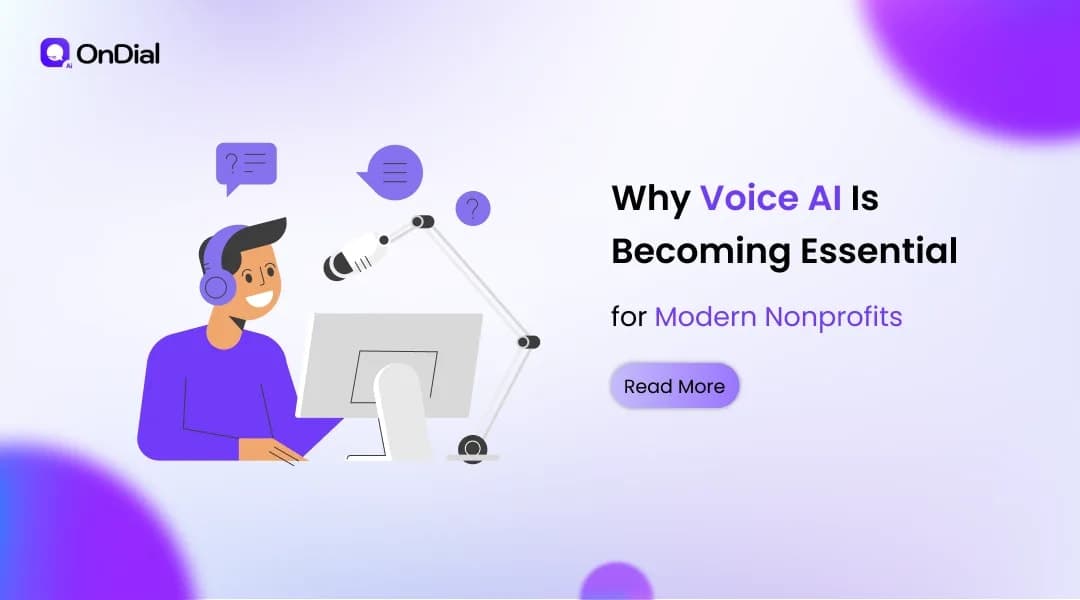
Ninety-two percent of nonprofits now use AI in some form, but only 7% report major improvements in what their teams can actually accomplish. That finding comes from the 2026 Nonprofit AI Adoption Report by Virtuous and Fundraising AI, a benchmark study of 346 organizations, which also found that 81% use AI individually without shared workflows. AI voice agents for non-profit organizations sit directly inside that gap, and it is becoming essential for one specific reason: the phone is still where the highest-value nonprofit conversations happen, and it is the channel small teams are least able to staff. A voice agent that answers every call, in every language your community speaks, at every hour, converts a structural staffing shortage into an operational choice.
If you have already tried an AI writing tool and found it useful but not important, that reaction is fair. Most nonprofit AI adoption so far has made existing tasks slightly faster without changing what the organization can take on. Voice is different because it is the only AI channel that meets a supporter live, with no draft stage and no chance to review before sending.
That difference cuts both ways. Handled carelessly, it damages the relationship you spent years building. Handled well, it recovers gifts, volunteers, and service requests that were previously disappearing into voicemail.
Here is what this guide covers: the capacity gap voice AI genuinely closes, the four functions where it delivers measurable value, what donors actually think about being called by an AI, the compliance rules that apply before your first outbound call, and how to start with one workflow instead of an entire channel.
The Capacity Gap Voice AI for Nonprofits Actually Closes
The nonprofit staffing problem is not really a headcount problem. It is a coverage problem, and coverage is exactly what AI voice agents for nonprofits are built to solve.
Why the Phone Still Carries the Heaviest Load
Email open rates fall, social reach fluctuates, and direct mail arrives days late. The phone remains the channel where a major donor asks a hard question, where a volunteer confirms a shift, and where someone in crisis reaches out. Those calls arrive on nobody's schedule, and a two-person development team cannot be present for all of them.
The cost of a missed call is invisible on your books, which is precisely why it never gets fixed. A recurring donor who calls at 9 pm with a question about a year-end gift, hears voicemail, and does not call back leaves no trace in your CRM. Multiply that across a December appeal and the gap between what you raised and what you could have raised is real but unmeasured.
What the Adoption Numbers Really Say
Voice AI for nonprofits is software that answers and places phone calls in natural spoken conversation, handling donation questions, volunteer scheduling, event reminders, and routine intake without staff on the line. It uses speech recognition and natural language processing to understand what a caller means rather than matching keypad selections. Good implementations connect directly to your donor management system so every conversation writes back to the record, much like how voice AI closes staffing gaps in high-volume follow-up for admissions teams facing the same coverage problem.
The reason most nonprofits sit at what the Virtuous report calls an efficiency plateau is not tool quality. The same study found that 65% of organizations describe their AI use as reactive and individual rather than strategic. Scattered personal use of AI tools produces scattered results, while a voice agent assigned to one clearly defined call type produces a number you can put in a board report.
Where AI Voice Agents for Nonprofits Deliver Real Value
Nonprofit donor engagement automation gets discussed as though it were one thing. It is four different things, and they carry very different risk profiles.
The Four Functions That Justify the Investment
Voice agents handle four nonprofit workloads reliably: inbound donor inquiries about giving and tax receipts, outbound pledge reminders and lapsed donor reactivation, volunteer screening and shift confirmation, and event RSVP with logistics questions. Each is high-volume, low-judgment, and repeatable. Anything requiring emotional discretion should route to a person immediately.
Here is the practical breakdown:
Inbound donor calls. Questions about recurring gift changes, tax receipts, program allocation, and how to give. These follow predictable patterns and represent the clearest immediate win, because every one currently going to voicemail is a live gift at risk.
Outbound reminders and reactivation. Pledge follow-ups, monthly giving card expiry notices, and lapsed donor check-ins. Traditional phone banks required either an expensive third-party call center or weeks of volunteer coordination. This is also the category with the heaviest compliance load, covered below.
Volunteer coordination. Screening interest, confirming availability, sending shift reminders, and routing urgent requests. Voice agents can screen volunteer interest, confirm availability, schedule interviews, and send reminders, which is especially useful for lean teams needing consistent coverage without expanding headcount.
Multilingual intake. Serving communities in the languages they actually speak with a multilingual AI voice agent, without hiring bilingual staff for every language your service area contains.
The Function That Needs a Human Backstop
Helplines and beneficiary intake are where the technology gets genuinely difficult, and where I would counsel restraint. A supporter sharing a heartfelt story or a caller in distress will break a rigid script, and an agent that clings to its original instruction while a person escalates is worse than no agent at all.
At OnDial, we treat this as a design constraint rather than a limitation to work around. The agent's job on a sensitive line is triage and warm handoff: identify who is calling, understand the urgency, and reach a human fast. Anything that resembles counselling, eligibility judgement, or crisis response stays with trained staff, permanently.
Does Voice AI Damage Donor Trust?
This is the objection I hear first from every executive director, and it deserves a direct answer rather than reassurance.
What Donors Actually Say About Automated Outreach
Sector research is more encouraging than most boards expect. Reporting on nonprofit AI trends found that 43% of donors say AI use would have a neutral or positive effect on their giving, though a significant portion express concern when automation appears to replace personal connection. The dividing line is not automation itself. It is whether automation shows up where a relationship was expected.
Nobody minds an AI confirming their event RSVP. Plenty of people mind an AI thanking them for a major gift.
That distinction should govern your deployment map more than any feature comparison. Route the transactional to the agent and protect the relational for your team.
The Disclosure Rule That Protects the Relationship
Transparency is not a compliance box here; it is the mechanism that makes the whole thing work. Evidence suggests that when the AI clearly introduces itself as an assistant calling on behalf of the organization and stays conversational, donor response is strongly positive, with many donors appreciating that the charity is reducing overhead so more of their gift reaches the cause. Attempting to pass an agent off as human is the single fastest way to destroy the trust advantage nonprofits hold over commercial callers.
Write the disclosure into the first ten seconds of every script. Then say what the call is about and offer a route to a person. Donors forgive automation; they do not forgive being deceived by an organization that asks them for money.
Compliance Rules Nonprofits Cannot Skip
Voice AI compliance for nonprofits is where good intentions meet statutory penalties, and it is the least covered topic on this subject.
TCPA, Consent, and the Artificial Voice Standard
Since February 2024, the FCC treats AI-generated and cloned voices as "artificial or prerecorded voice" under the Telephone Consumer Protection Act, which means an AI call is held to the same consent, disclosure, and do-not-call rules as any other robocall. Penalties run from $500 to $1,500 per call with no aggregate cap, and class-action exposure is a larger practical risk than regulator action. That arithmetic turns a careless 10,000-call campaign into an existential event.
Nonprofits do enjoy exemptions from certain telemarketing rules such as the National Do Not Call Registry, but artificial and prerecorded voice regulations still apply, and organizations calling internationally should also understand what TRAI's consent and disclosure rules require for AI calls in markets like India. The practical guardrails are straightforward: call only people with an existing relationship or documented opt-in, have the agent identify itself as AI, honor revocation in any reasonable form, and keep records that prove consent. This is operator guidance and not legal advice, so confirm your specific obligations with counsel before your first outbound campaign.
Data Handling for Sensitive Conversations
Voice conversations contain more than the transcript. They contain vocal patterns, background context, and often disclosures the caller did not plan to make. Sector surveys report that 70% of nonprofit professionals are concerned about data privacy and security with generative AI, while 63% worry about accuracy. Those concerns are reasonable, not reflexive.
Ask vendors three specific questions: is voice data encrypted in transit and at rest, where is it stored and for how long, and can payment details be captured through DTMF keypad entry so card numbers never enter the audio stream. Then close the governance gap that the sector has largely ignored. The 2026 Nonprofit AI Adoption Report found that 47% of nonprofits have no AI governance policy at all. A single page naming approved tools, permitted data, and escalation rules is enough to start.
How to Start Without Wasting Your Budget
The organizations that get value from voice do one thing differently. They start narrow.
Pick One Call Type, Not a Whole Channel
Choose the single call type with the highest volume and the lowest judgement requirement. For most development teams, that is inbound giving questions; for service organizations, it is often appointment or intake scheduling. Build the agent for that one workflow, connect it to your CRM, and run it for six weeks before touching anything else.
This is deliberately unambitious, and that is the point. The 7% of nonprofits reporting genuine capability gains are not the ones who deployed the most AI. They are the ones who documented a workflow, assigned an owner, and measured whether it changed anything.
Measure the Right Things From Day One
Vendor dashboards will show you call counts and handle times, which tell you almost nothing about mission impact. Define your own two or three metrics before launch and hold them steady. Answer rate outside business hours, gifts completed on calls that would previously have gone to voicemail, and staff hours returned to relationship work are all defensible in front of a board.
One honest caveat: the sector-wide return data on voice specifically is still thin. Most published figures come from vendors, including the ones I compete with, and should be treated as directional rather than proven. Your own six-week baseline will be more useful than any case study you read, including this one.
Conclusion
Voice AI for nonprofits is becoming essential not because the technology is impressive, but because the coverage gap it closes has been quietly costing organizations gifts, volunteers, and service requests for years. Three things matter more than anything else you read on this topic. Start with one call type rather than a channel, disclose the AI in the first ten seconds of every call, and write your consent and data rules before your first outbound campaign rather than after.
You do not need an AI strategy to begin. You need one workflow, one owner, and one number you agree to measure.
If you want to pressure-test which of your call types is the right first candidate, the OnDial team runs that assessment with nonprofits directly, including the compliance questions most vendors skip. We would rather tell you a workflow is a bad fit than deploy it.