Voice AI now handles 19 percent of inbound contact center volume, up from 6 percent two years earlier, according to Forrester Wave research, with banking and telecom leading the shift. That is not a projection anymore. That is a measurement, and it moved faster than almost any operations leader planned for. If you are reading this while sitting on a support queue that is one bad month away from breaking, you are not behind; you are exactly on time.
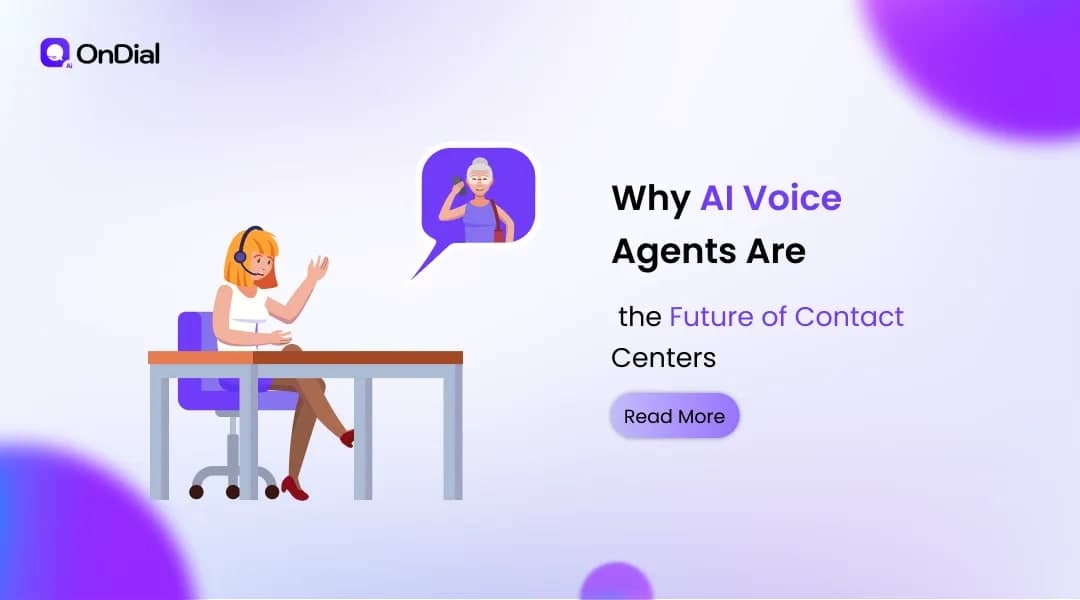
AI voice agents for contact centers are conversational systems that answer calls in natural speech, understand caller intent, complete the task inside your business systems, and escalate to a human when the situation calls for it. They are the future of contact centers because the volume of routine, structured, repetitive calls has always exceeded what human staffing could absorb economically. The technology finally closed that gap without forcing customers through menu trees.
Here is what I have learned building voice AI at OnDial: the companies that succeed with this are not the ones that automate the most calls. They are the ones that decide correctly which calls to automate. This article covers the economics, the technology stack, the use cases that pay back, the escalation design that most deployments get wrong, and the metrics that tell you whether it worked.
Why Contact Center Automation Economics Finally Changed
Contact center automation used to be a trade between cost and quality, and quality usually lost. That trade no longer holds, because the unit economics and the conversational quality improved at the same time. When both variables move together, the decision stops being philosophical and becomes arithmetic.
The cost per resolved call collapsed
Gartner expects conversational AI to cut contact center agent labor costs by 80 billion dollars globally in 2026, with roughly one in ten agent interactions automated, up from 1.6 percent in 2022. That is the authority number every operations leader should have in their board deck. The interesting part is not the total; it is the direction of travel.
Cost per contact is the metric that shifted. A live agent call carries salary, training, attrition, floor space, and supervision overhead. An automated call carries compute and telephony, which fall in price every year rather than rising with wage inflation.
Volume stopped being a staffing problem
McKinsey analysis found that repetitive tier-1 issues make up 50 to 60 percent of contact center volume. Password resets, order status, balance enquiries, and appointment changes are not complex work. They are high-frequency work, and high-frequency work is exactly what voice automation absorbs well.
The operational consequence is elasticity. A festival-season spike, a product recall, or an outage no longer requires a hiring cycle you cannot run in time. In projects I have worked on, this elasticity mattered more to clients than the headline cost saving.
How AI Voice Agents Actually Work in a Contact Center
Featured snippet answer: An AI voice agent for a contact center converts caller speech to text, uses a language model to interpret intent, retrieves or updates data through CRM and backend integrations, then responds in synthesized speech. The full loop runs in under a second, which is what makes the conversation feel natural rather than transactional.
Do AI voice agents actually work outside a controlled demo? Yes, when the intent is scoped and the data source is clean. They fail when either condition is missing.
The four layers of the voice stack
Every production system runs the same four layers, regardless of vendor. Understanding them tells you where a deployment will break before it breaks.
Speech recognition (ASR): Converts audio to text in real time and must handle accents, code-switching, and background noise. In Indian deployments, this layer carries the most risk because callers mix languages inside a single sentence.
Language understanding and reasoning: Interprets what the caller wants and decides the next action. This is where the agent either follows business policy correctly or improvises, which is why guardrails matter more than model size.
Action and integration: Reads and writes to your CRM, order system, or ticketing platform. An agent that can talk but cannot update a record is a more expensive IVR.
Speech synthesis (TTS): Returns the response as natural audio, including interruption handling so callers can talk over the agent the way they do with humans.
Where it connects to your existing systems
CCaaS is the cloud-delivered contact center model that supplies telephony, routing, and AI tooling on subscription rather than on-premise hardware. Learn more in Modern Contact Centers Are Replacing Call Scripts. Most enterprises already run one, whether that is Genesys, NICE CXone, or Five9, and the voice agent sits alongside it rather than replacing it.
The integration that decides success is the CRM link. Effective call center voice AI integrates with CRM platforms, ticketing systems, and knowledge bases so that actions taken during a call update backend systems automatically. Without that link, containment looks good on a dashboard while work quietly piles up somewhere else.
AI Voice Agent Use Cases That Deliver Today
Not every call belongs to an AI voice agent, and pretending otherwise is how pilots die. The use cases that return value share three traits: high frequency, predictable intent, and a clear data source. Everything else should wait.
Inbound: the tier-1 volume that never needed a human
Order status, delivery tracking, balance enquiries, policy questions, appointment booking, and rescheduling are the reliable starting set. These calls have a defined answer that lives in a system of record, which means the agent retrieves rather than reasons. Automating identity verification alone saves human agents roughly 30 to 60 seconds per call, which compounds meaningfully across thousands of interactions.
Availability is the second win. Customers do not stop having problems at closing time, and overnight coverage through human staffing is rarely economical for mid-market operations.
Outbound: reminders, renewals, and follow-ups
Outbound is where voice AI often shows faster payback, because the calls are initiated on your schedule and the script is bounded. Payment reminders, renewal notices, appointment confirmations, delivery updates, and lead follow-up all fit cleanly. The measurable outcome is contact rate and completion rate rather than deflection.
Compliance is tighter here than inbound. In India, outbound automated calling intersects with TRAI DLT registration and consent obligations under the DPDP Act, and those constraints should shape the campaign design from day one.
The Part Nobody Sells You: AI to Human Agent Escalation Is the Architecture
Here is the counter-intuitive part: the quality of your AI voice agent is determined by how well it fails.
Every vendor deck leads with containment. Almost none of them lead with the escalation path, and that is precisely backwards. Escalation is the moment a voice agent transfers a live call to a human along with the full conversation context, and it is the single point where customer trust is either kept or destroyed.
Containment is a vanity metric without resolution
Research cited by Retell AI found that hybrid AI and human models reached an 87 percent resolution rate with customer satisfaction at 8.7 out of 10, while pure AI reached 74 percent resolution and 7.4 satisfaction. A thirteen-point resolution gap is the difference between a support operation that retains customers and one that pushes them toward a competitor through AI voice agent services. Containment counts calls that did not reach a human. Resolution counts problems that actually ended.
I have seen deployments post excellent containment numbers while repeat-contact rates climbed in the background. (That combination is the clearest warning sign in this entire field, and it is usually invisible for about six weeks.) Track both metrics or track neither.
Design the handoff before you design the automation
The handoff needs three things to work: a trigger, a context payload, and a route. The trigger should fire on detected frustration, repeated failure to resolve, or explicit request for a human, and the explicit request should never be blocked. The context payload must carry the transcript and any collected data so the customer never repeats themselves.
This is where community frustration lives, and it is worth taking seriously. Traditional IVR menus fail because they force callers into rigid scripts, which drives frustration and repeat calls. An AI voice agent that traps callers in a smarter loop has simply rebuilt the problem with better audio.
Will AI Voice Agents Replace Human Call Center Agents?
Snippet answer: No. Current evidence shows AI voice agents absorbing routine call volume while human agents move toward complex, emotional, and high-value conversations. Gartner research found that only 20 percent of customer service leaders cut agent headcount because of AI, while 55 percent kept staffing stable. The realistic outcome is role change, not role elimination.
What the staffing data actually shows
The pressure is real, but so is the restraint. A Gartner survey found that 91 percent of customer service and support leaders are under executive pressure to implement AI, while more than 80 percent of organizations plan to expand human agent responsibilities. Those two numbers describe the same strategy from two angles.
Trust is the honest limitation here, and I would rather name it than sell around it. Capgemini research recorded trust in fully autonomous AI agents falling from 43 percent to 27 percent in a single year, and Gartner expects more than 40 percent of agentic AI projects to be cancelled by the end of 2027. Skepticism is not irrational. It is a reasonable response to overpromising.
The roles that grow instead of disappear
Someone has to design conversation flows, review failed calls, tune escalation thresholds, and audit compliance. These are new operational roles, and they are typically filled by experienced agents who understand the call patterns better than anyone else in the building.
Quality assurance also changes shape. Instead of sampling a fraction of calls, teams review every automated interaction, which produces a level of visibility manual QA never had. Learn more in Insurance Companies Automate Policy Renewal Calls With AI.
Voice AI Implementation and ROI: What to Check Before You Deploy
The adoption gap tells the real story of this technology. Gartner CX research found that 64 percent of enterprise CX teams ran an agentic AI pilot this year, but only 27 percent had at least one channel in full production. Most of that gap is not technical. It is governance, data readiness, and unclear success criteria.
Compliance, consent, and data governance
Disclosure is the baseline. Callers should know they are speaking with an automated system, and regulated industries need that disclosure documented rather than assumed. Depending on your market, GDPR, HIPAA, or India's DPDP Act will define retention limits, consent handling, and the lawful basis for processing voice data.
Access control matters as much as disclosure. The agent should reach only the fields it needs, and every read or write should be logged for audit.
The metrics that prove it worked
Pick your baseline before launch, not after. Measure containment rate, first contact resolution (FCR), average handle time (AHT), CSAT, repeat-contact rate within seven days, and cost per resolved contact. Any single metric in isolation can be gamed.
Start narrow. Two or three intents, six weeks of measurement, then expand only if resolution and CSAT both hold. Scope discipline is the strongest predictor of a deployment that survives its first quarter.
Conclusion
AI voice agents for contact centers are the future because they solve a structural problem, not a fashionable one: routine call volume has always exceeded what human staffing can absorb economically. Three things decide whether that future works for you. Automate the intents that are high-frequency and data-backed, design the escalation path before the automation, and measure resolution rather than containment.
You do not need certainty to start. You need a narrow scope, a clean baseline, and an honest escalation design.
At OnDial, we build voice AI around exactly that sequence, starting with a small set of your highest-volume intents and proving resolution before anything scales. If you can name the three calls your team is tired of taking, we can map what automating them would actually look like, including where the handoff should sit and what it should carry.