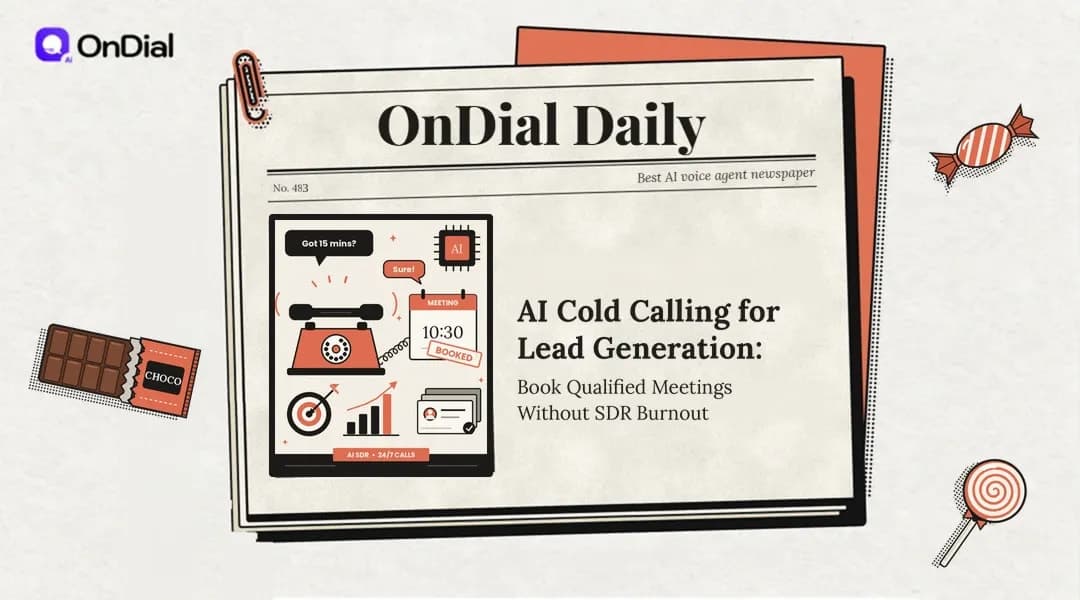
AI cold calling software lets a sales team dial thousands of prospects, qualify them in natural conversation and book meetings straight into a rep's calendar, without asking a human to make 80 dials a day. For most Indian B2B teams, outbound is still the fastest way to build pipeline, yet it is also the activity that burns out sales development reps (SDRs) the quickest.
The result is a familiar loop: reps quit, new hires need weeks of ramp-up, call volume drops and pipeline dries up. Automated cold calling with a voice AI agent breaks that loop. The agent handles the repetitive first conversation, and your human team steps in only when a prospect is genuinely interested.
In this guide, you will learn why manual cold calling wears teams down, how AI outbound lead generation actually works, how objections are handled, what connect-to-meeting benchmarks to track, and what the compliance basics in India look like. By the end, you will know whether AI cold calling fits your sales motion and how to start safely.
Why Manual Cold Calling Burns Out SDRs
Manual cold calling burns out SDRs because the job is built on constant rejection, repetitive dialing and very little rest between conversations. Most dials go unanswered, and many of the answered ones end in a quick "not interested." Even a strong rep spends the majority of the day on voicemails, wrong numbers, gatekeepers and call-backs that never happen.
Three pressures stack up on every outbound team:
Rejection fatigue. Hearing "no" dozens of times a day wears down confidence, and confidence is what makes the next call sound natural.
Admin overload. Researching numbers, logging notes in the CRM and scheduling follow-ups can eat as much time as the calls themselves.
Quota pressure. Targets for dials, connects and meetings leave little room to slow down and personalize.
The business cost is easy to underestimate. When an SDR leaves, you lose their prospect context, their call patterns and the weeks you invested in training. Replacement hiring, onboarding and a slow ramp-up all push your cost per booked meeting higher, while pipeline coverage drops.
There is also a consistency problem. A rep who is tired at 4 pm does not pitch the way they did at 10 am, and two reps will never handle the same objection in exactly the same way. Leads slip through not because the offer is weak, but because the process depends on human energy.
This is the gap that cold call automation is designed to fill. It does not replace your closers or account executives. It takes over the high-volume, low-yield first touch so your people can spend their energy on warm, qualified conversations.
What Is AI Cold Calling?
AI cold calling is the use of a voice AI agent to place outbound calls to prospects who have not spoken to your company before, hold a natural two-way conversation, qualify interest and book a meeting or hand the call to a human. Unlike a basic robocall that plays a recorded message, an AI cold calling software platform listens, understands what the prospect says and responds in real time.
A modern AI outbound lead generation system combines four building blocks:
Speech recognition converts the prospect's words into text, including Indian accents and mixed Hindi-English speech.
A language model decides what to say next based on your script, your offer and the prospect's reply.
Text-to-speech turns that reply into a natural-sounding voice with the right pace and tone.
Telephony and CRM integration places the call, records the outcome and pushes the data into your sales stack.
The difference from older dialers matters. A power dialer only automates the dialing; a human still has to talk. An IVR only follows a fixed menu. An AI voice agent runs the whole first conversation, which is why it can replace the most repetitive part of an SDR's day.
It is also different from an AI call assistant that supports inbound customers. Outbound calling has its own demands: opening a cold conversation in the first few seconds, earning permission to continue and handling resistance politely. If you want a deeper look at how outbound agents are built for revenue, read our guide on AI outbound call agents.
How an AI Agent Dials, Qualifies and Books Meetings
An AI cold calling agent follows a repeatable flow from the first ring to the calendar invite. Here is how that flow works in practice:
Load and prepare the list. You upload leads from your CRM, a spreadsheet or a campaign, with fields such as name, company, role and city. Numbers are checked against your do-not-call list before any dial.
Dial at the right time. The agent calls in permitted calling windows and retries unanswered numbers at different times of day, so you do not rely on a rep remembering to call back.
Open the conversation. In the first few seconds, the agent introduces itself, states why it is calling and asks permission to continue. A short, clear opener keeps more prospects on the line.
Qualify naturally. Instead of reading a form, the agent asks two or three conversational questions about need, role, timeline or budget, and adapts based on the answers.
Handle objections. If the prospect says "send me details" or "not now," the agent responds with a relevant answer and a soft next step rather than hanging up.
Book or transfer. Interested prospects are offered meeting slots from your reps' live calendars. Hot leads can be transferred to a human immediately. See how this works with AI appointment scheduling.
Log everything. The call recording, transcript, outcome tag and next step are pushed to your CRM, so every lead has a clear status.
The key point is that the agent is not guessing. It works from a script and a knowledge base you control, and it can be set to escalate whenever it is unsure. That keeps quality high while the volume scales.
Compared with a human team, the agent can run many calls in parallel, never needs a break and applies the same pitch every time. It also calls back unanswered leads consistently, which is where many manual programs quietly lose opportunities. For a broader view of how this fits a sales stack, see our overview of AI sales calling agents for outbound outreach.
How AI Handles Objections on Cold Calls
Objection handling is where good AI cold calling software separates itself from a simple script reader. Objections are predictable, so they can be mapped, tested and improved over time. The agent recognizes the intent behind the words and picks a response from your approved playbook.
Some common objections and how a well-configured agent responds:
Objection | How the agent responds |
"I'm busy right now" | Acknowledges, offers a specific callback time and confirms it |
"Send me an email" | Agrees, asks one clarifying question so the email is relevant, then confirms the address |
"We already have a vendor" | Asks what they like about it and positions a clear difference without arguing |
"What is the price?" | Gives a range or explains that pricing depends on needs, then offers a short meeting |
"Not interested" | Thanks them politely, asks if it is the timing or the need, and ends respectfully if they decline |
Three principles keep this natural rather than pushy:
Respect the first no. One polite attempt to understand is fine. Repeated pressure damages your brand and can break compliance rules.
Stay inside approved answers. The agent should only share claims you have verified, and it should say it will follow up if a question falls outside its knowledge.
Escalate smartly. When the prospect asks for a person, shows buying intent or raises a complex issue, the call should transfer to a human with a summary.
Every call is recorded and transcribed, so you can review which objections appear most and refine the playbook weekly. That feedback loop is something a human team rarely gets, because most manual calls are never reviewed. Over a few weeks, the agent's openers and rebuttals improve using real conversation data, not guesswork.
Benchmarks: Measuring Connect-to-Meeting Rate
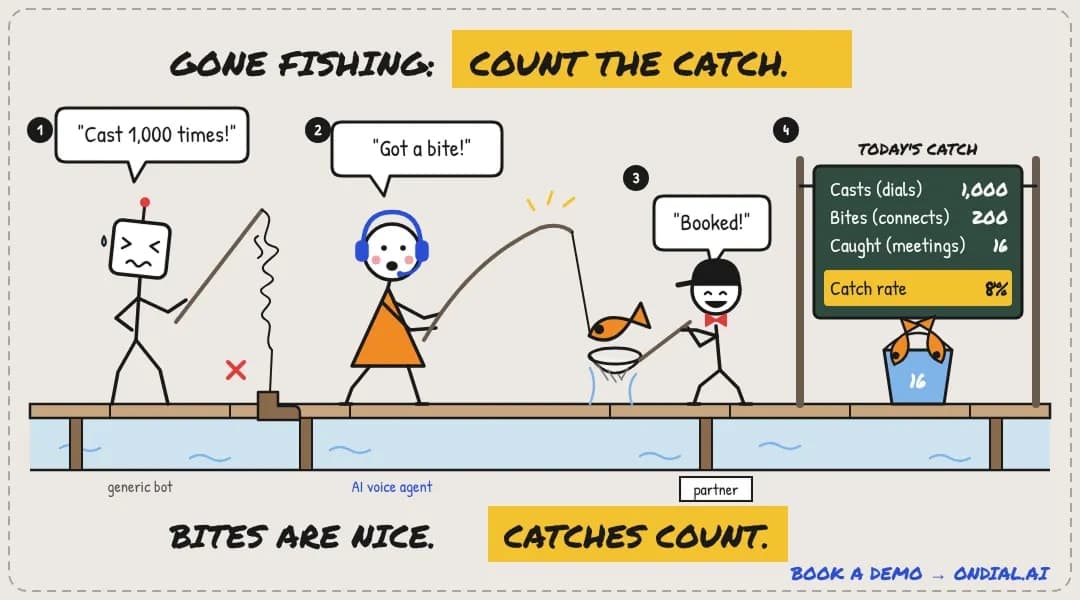
The connect-to-meeting rate is the share of answered calls that end in a booked meeting, and it is the single best number for judging an AI outbound lead generation program. Connect rates and meeting rates vary widely by industry, list quality, offer and calling time, so treat any published average as a starting point and set your own baseline in the first two weeks.
Track these metrics for both your AI agent and your human SDRs:
Metric | How to calculate it | What it tells you |
Connect rate | Answered calls ÷ total dials | List quality and calling windows |
Qualified rate | Qualified leads ÷ connected calls | Script and targeting quality |
Connect-to-meeting rate | Meetings booked ÷ connected calls | Overall conversation effectiveness |
Meeting show rate | Meetings attended ÷ meetings booked | Lead intent and reminder process |
Cost per booked meeting | Total calling cost ÷ meetings booked | Efficiency versus a human team |
Here is a simple, illustrative example. If an agent places 1,000 dials and 200 are answered, the connect rate is 20 percent. If 16 of those connected calls become meetings, the connect-to-meeting rate is 8 percent. Your own numbers will differ, but the method stays the same.
To improve results, change one variable at a time. Test a shorter opener, a different calling window or a sharper qualifying question, then compare results over a meaningful number of calls. Because an AI agent can run thousands of calls, you reach a reliable sample much faster than with a human team, which makes A/B testing of scripts practical.
Also watch quality signals, such as average call length, opt-out requests and complaint rate. A high meeting rate that comes with many complaints is a warning sign, not a success.
AI Cold Calling Compliance Basics in India
AI cold calling in India must follow the same telecom and data rules as any commercial outbound calling, and being compliant is part of doing it well. The main frameworks are TRAI's telecom commercial communications regulations, DLT registration and the Digital Personal Data Protection (DPDP) Act, 2023. Rules and enforcement change, so confirm the current requirements with your telecom provider and legal advisor before launching. This section is general guidance, not legal advice.
The basics most teams should plan for:
Respect the DND preference. Check numbers against the National Customer Preference Register and your internal opt-out list before calling for promotional purposes.
Register on DLT. Telecom operators require registered entities, headers and templates for commercial communication. Read our guide to TRAI DLT rules for AI calling for the details.
Use approved number series. Commercial calls should come from the number types your operator allows for telemarketing, not from ordinary mobile numbers.
Disclose and record responsibly. Tell the prospect that the call may be recorded and, where appropriate, that they are speaking with an AI assistant.
Honor opt-outs immediately. If someone says "do not call me again," the agent should log it and stop contacting them.
Protect personal data. Collect only what you need, store it securely and follow your DPDP obligations on consent, purpose and retention.
A good platform makes these steps part of the workflow: automatic suppression-list checks, calling-window controls, consent and recording notices, and audit trails for every call. When you evaluate vendors, ask how each of these is handled instead of assuming it is built in.
Compliance also protects performance. Numbers flagged as spam lose answer rates, and complaints can lead to blocked numbers. Clean consent practices keep your connect rates healthy over the long run.
AI Agent vs Human SDR: The Hybrid Model That Works
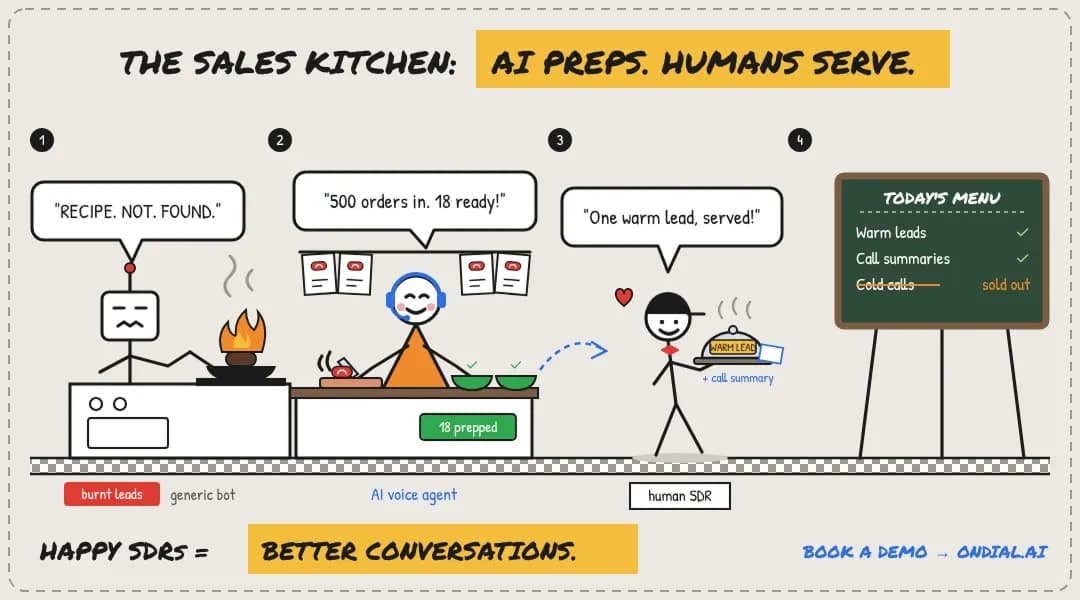
The best results come from a hybrid model in which the AI agent handles volume and first qualification, and human reps handle relationship-building and closing. Each side does what it is best at.
Task | AI agent | Human SDR |
High-volume first-touch dialing | Strong | Limited by hours and energy |
Consistent pitch and compliance | Strong | Varies by rep and day |
Persistent callbacks and retries | Strong | Often missed |
Complex, high-value conversations | Hand off to human | Strong |
Reading emotion and building rapport | Improving | Strong |
In practice, this means your SDRs stop spending their day on cold lists. They receive a calendar full of interested, pre-qualified prospects, along with a transcript and a call summary. That changes the job from grinding through rejection to having better conversations, which is one of the most effective ways to reduce burnout and attrition.
How to Get Started in Four Steps
Pick one use case. Start with a clear segment, such as inactive leads, event attendees or a single product line.
Write a short script and playbook. Define the opener, three qualifying questions, your top objections and the handoff rules.
Run a pilot. Call a limited list, review recordings daily and improve the script weekly.
Scale what works. Expand to more segments and languages once your connect-to-meeting rate and complaint rate are stable.
OnDial is built for Indian businesses, with voice agents that support multiple languages, CRM integration and compliance controls. If you want to see how AI cold calling would work for your own leads, you can book a demo and test it on a real campaign.
Conclusion
Manual cold calling will always have a place, but asking humans to carry the full weight of high-volume outbound is what drives burnout, churn and inconsistent results. AI cold calling software gives your team a better division of labor: the agent dials, qualifies and books, and your reps focus on real conversations that close.
Start small, stay compliant and measure everything. Ready to see it on your own leads? Book a demo with OnDial and turn cold lists into booked meetings.