I want to tell you about the worst quarter of my career.
I was Director of Customer Experience at a mid-large insurance company in Bengaluru. We had 500 agents. A well-documented IVR. A training program I'd spent eighteen months building. And a CSAT score that was falling off a cliff.
The numbers told a story I didn't want to hear. Average hold time had crept past three minutes. First call resolution was stuck at 58 percent. Agent attrition was running at 40 percent annually, which meant I was perpetually training replacements who hadn't mastered the product before their predecessors had even finished their notice periods. And the worst part? We were spending more money every quarter to deliver a worse experience.
I remember sitting in a review meeting, staring at the call abandonment chart, and having a thought that still shapes everything I do: we aren't failing because our people are bad. We're failing because we're asking humans to do a machine's job, and then wondering why neither the humans nor the customers are happy.
That realization launched me into a three-year journey of deploying, testing, iterating, and sometimes failing with conversational AI for business. I've now consulted for 30+ companies across India. I've seen what works. I've seen what doesn't. And I've learned that the question is no longer whether voice AI agents will reshape customer support. The question is whether you'll be the company that deploys them strategically or the company that gets left behind by competitors who did.
This is the honest, experience-driven guide I wish someone had handed me before I started.
What is Conversational AI for Business?
Definition & Core Components
Conversational AI for business refers to artificial intelligence systems that enable real, natural language interactions between a company and its customers, whether through text, voice, or both. In the context of customer support, it typically means AI that can hold spoken phone conversations: listening to what a customer says, understanding what they mean, and responding with relevant, accurate information or actions.
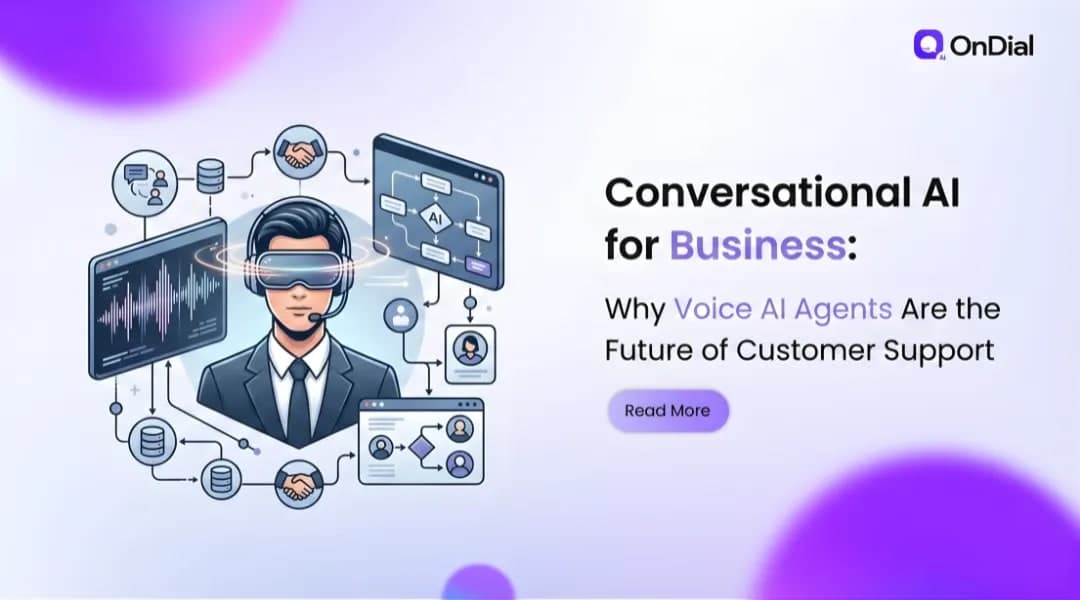
The core components are straightforward. Automatic speech recognition (ASR) converts spoken language into text. Natural language processing (NLP) and natural language understanding (NLU) interpret the meaning and intent behind that text. A dialogue management engine tracks context across the conversation. And text-to-speech (TTS) generates natural-sounding voice responses. Together, these systems create something that feels less like calling a machine and more like calling a very competent, very patient colleague.
Difference Between Chatbots vs Voice AI Agents
This distinction matters more than most people realize, and getting it wrong leads to bad purchasing decisions.
A chatbot is a text-based interface, typically embedded on a website or messaging app. It handles typed queries. Some are rule-based (keyword matching), some use AI (intent recognition). They're useful, but they operate in a channel that many customer segments, particularly in India, don't prefer.
A voice AI agent operates on the phone. It conducts spoken conversations. It handles the channel where the highest-stakes customer interactions still happen: complaints, sales inquiries, urgent service requests, payment disputes. In India, where over 90 percent of internet users prefer content in a language other than English and where voice remains the dominant interaction mode for hundreds of millions, the distinction between a chatbot and a voice AI agent isn't academic. It's strategic.
What Are Voice AI Agents?
How Voice AI Works
Here's the simplest way I explain it to the CXOs I consult for:
Your customer calls. The AI listens to what they say (speech recognition). It figures out what they mean (language understanding). It decides what to do about it (dialogue management). And it responds in natural, human-sounding speech (voice synthesis). All of this happens in under a second, and the system maintains context throughout the conversation, so the customer doesn't have to repeat themselves every thirty seconds.
That's it. No magic. Just four systems working together very, very fast.
Technologies Behind It (NLP, ASR, TTS)
For the technically curious:
ASR (Automatic Speech Recognition) converts audio input into text. Modern ASR handles accents, background noise, mid-sentence corrections, and the messy reality of how people actually talk (versus how textbooks suggest they should).
NLP/NLU (Natural Language Processing / Understanding) is the brain. It determines intent ("the caller wants to check their claim status"), extracts entities ("claim number 44218, filed on March 3"), and maps the request to the right action in the system.
TTS (Text-to-Speech) generates the response. Today's neural TTS engines produce speech with natural pacing, intonation, and emotional tone. The best implementations are difficult to distinguish from a human agent reading a well-written script.
The orchestration layer ties all three together, maintaining conversational state, handling interruptions, managing turn-taking, and deciding when to escalate to a human. This is where the difference between a good voice AI and a frustrating one becomes apparent.
Why Voice AI Agents Are the Future of Customer Support
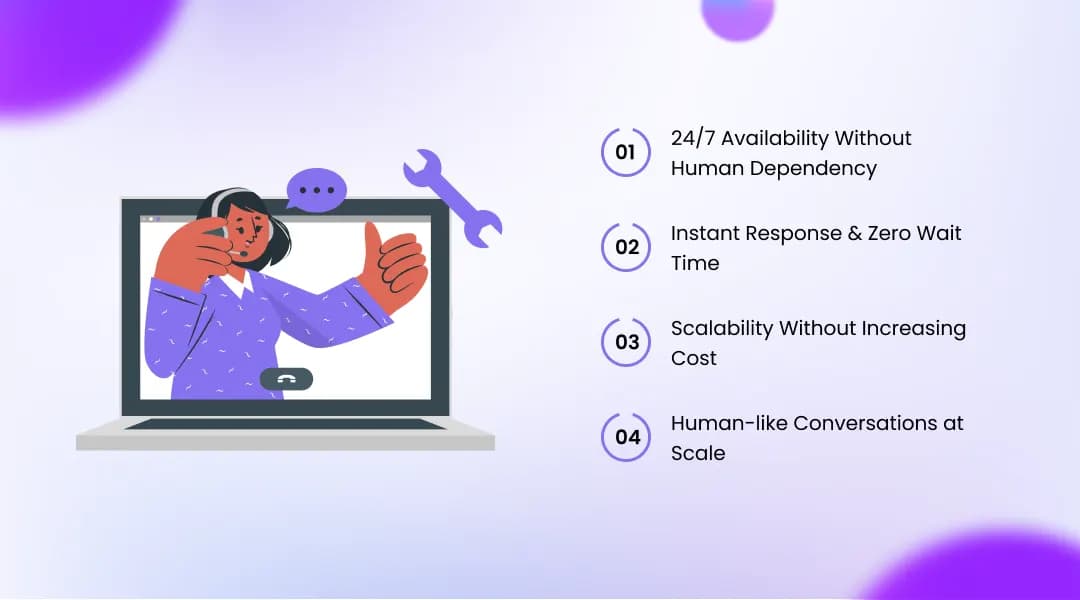
I don't use the word "future" casually. I use it because I've watched the trajectory over five years and the direction is unambiguous.
24/7 Availability Without Human Dependency
Your customers don't operate on your schedule. A policyholder filing a claim at 11 PM on a Saturday doesn't want to wait until Monday morning. A D2C customer with a delivery issue at 6 AM during a holiday weekend expects help now. 24/7 AI customer support solutions handle every call, every hour, every day, without overtime, shift scheduling, or the quality degradation that comes with exhausted late-night agents.
When I deployed round-the-clock voice AI for my insurance company, we discovered something I hadn't expected: 23 percent of our total call volume was coming in outside business hours. We had been ignoring nearly a quarter of our customers' attempts to reach us. For years.
Instant Response & Zero Wait Time
Hold time is the silent killer of customer satisfaction. Every second a customer waits, their goodwill erodes. Real-time AI call handling eliminates hold time entirely. The bot picks up on the first ring. No queue. No "your call is important to us" while smooth jazz plays for four minutes.
I tracked this metric obsessively during my first deployment. Our average speed of answer dropped from 2 minutes 40 seconds to 3 seconds. Not 3 minutes. Three. Seconds. The impact on customer sentiment was immediate and measurable.
Scalability Without Increasing Cost
This is the argument that wins boardroom approval. Scaling a human support team for a Diwali sale spike, an enrollment season surge, or a product recall means hiring, training, onboarding, and managing temporary staff, only to downsize when the spike passes. AI customer support automation scales to handle 10x your normal volume with a configuration change, not a recruitment drive.
One telecom client I worked with handled 3.5x their normal call volume during a tariff plan migration without adding a single agent. The AI managed 72 percent of inbound queries autonomously. The human team focused exclusively on complex complaints and escalations. Nobody burned out. Nobody quit.
Human-like Conversations at Scale
Let me address the elephant in the room. "But my customers will know it's a bot and hate it."
Maybe in 2019. Not in 2026.
Modern voice AI agents for customer support use neural voice models that sound natural. They pause appropriately. They handle interruptions. They understand when someone says "actually wait, that's not what I meant" and adjust. They're not perfect, but they're dramatically better than the robotic, menu-driven systems most people associate with "automated phone support."
The real question isn't whether the bot sounds human. It's whether it solves the customer's problem faster and more consistently than your current system. In my experience, for 60 to 70 percent of typical support queries, it does.
Key Benefits of Voice AI in Customer Support
These aren't theoretical projections. These are outcomes I've measured across client deployments.
Cost Reduction in Call Centers
The math is brutal and simple. The fully loaded cost of a human-handled call in India runs ₹15 to ₹40. An AI-handled call costs ₹1 to ₹5. For a company processing 10,000 calls per day where 60 percent are repetitive Tier 1 queries, the annual savings from deploying an AI voice bot for customer service run into crores. One BFSI client I worked with saved ₹58 lakhs in the first year of deployment. Not projected savings. Actual, audited, line-item savings.
Improved Customer Experience (CX)
Zero hold time. No menu labyrinths. Conversations that start with context ("Hi Priya, I see you called yesterday about your policy renewal. Would you like to continue that conversation?"). Customers who get their problem resolved in 90 seconds instead of being transferred three times over fifteen minutes rate the experience higher. Consistently. I've seen CSAT improvements of 15 to 22 points within 90 days of deployment across four different client engagements.
Multilingual Support (Especially for India Market)
This is the factor that separates platforms built for India from those adapted for India after the fact.
India's customer base speaks Hindi, Tamil, Telugu, Kannada, Bengali, Marathi, Gujarati, and dozens of other languages. And critically, most urban and semi-urban callers speak Hinglish, the fluid blend of Hindi and English that shifts mid-sentence without warning. A conversational AI voice bot India deployment that handles only English is serving a fraction of the addressable audience.
Platforms like OnDial build their conversational AI voice bot solutions with deep Indian language capabilities because they understand that multilingual isn't a feature checkbox. It's the baseline for serving Indian customers.
(I once deployed an English-only voice bot for a client in Madhya Pradesh. The resolution rate was 18 percent. We added Hindi and Hinglish support. It jumped to 64 percent in three weeks. Same bot. Same call flows. Different language. That's how much it matters.)
Increased First Call Resolution (FCR)
When the AI can access your CRM, order management system, policy database, or ticketing platform in real time, it resolves queries on the first call instead of promising a callback. FCR rates for AI-handled calls in my deployments consistently run 15 to 25 percentage points higher than human-agent FCR for the same query types. The reason is simple: the bot doesn't need to put the customer on hold while it looks something up. It already has the data.
Real-World Use Cases
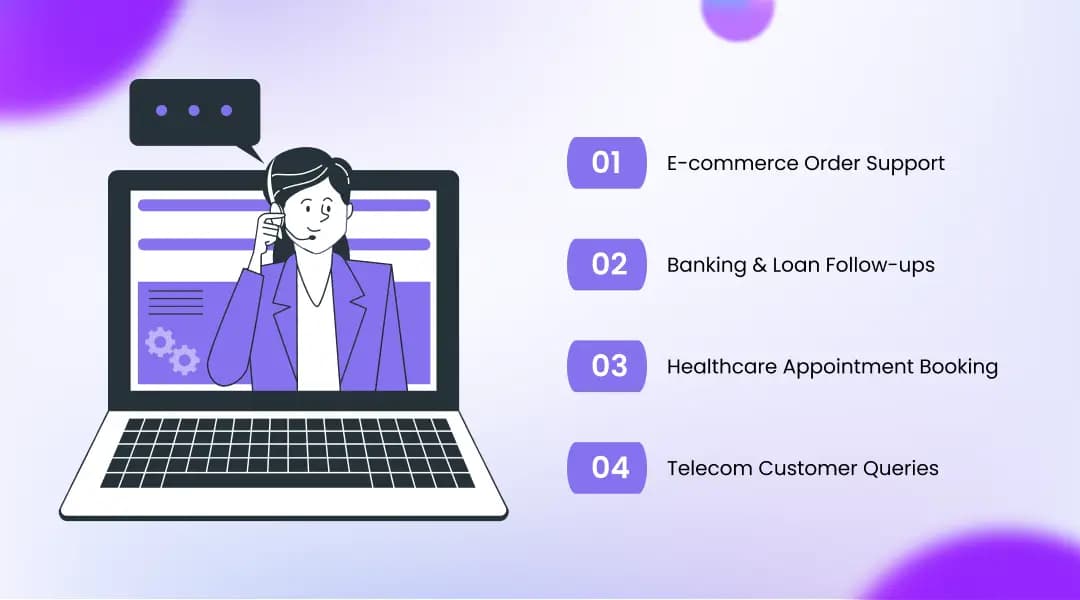
Theory is comfortable. Results are what matter. Here's what I've actually seen work.
E-commerce Order Support
A D2C fashion brand processing 14,000 daily orders was spending ₹9 lakhs per month on a support team whose primary job was answering "Where is my order?" calls. We deployed a voice AI agent integrated with their order management system. It handled 68 percent of inbound queries autonomously, in Hindi and English. Monthly support costs dropped to ₹3.2 lakhs. The human team was redeployed to handle complex returns and VIP customer escalations.
Banking & Loan Follow-ups
An NBFC client needed to make 55,000 outbound EMI reminder calls per month. Their human team was managing roughly 18,000. The AI calling agent for business handled the full volume in Hindi, English, and Marathi, delivering personalized reminders with payment links via SMS during the call. On-time payment rates improved 24 percent.
Healthcare Appointment Booking
A multi-specialty hospital chain with 12 locations automated appointment confirmations across three languages. The bot called patients 24 hours before their appointment: confirm, reschedule, or cancel. It updated the scheduling system in real time. No-show rates fell 33 percent, which, for a healthcare operation running on tight margins, translated directly to recovered revenue and better resource utilization.
Telecom Customer Queries
A regional telecom provider handling 80,000 monthly inbound calls deployed voice AI for plan inquiries, balance checks, and recharge assistance. The AI resolved 61 percent of calls without human intervention. Average handle time for the remaining human-handled calls dropped because agents received full context from the AI's conversation summary. Customer effort score improved by 28 percent.
Have you calculated what your missed calls and slow follow-ups are costing you every month? Not in abstract "customer satisfaction" terms, but in actual rupees?
Conversational AI vs Traditional Support Systems
Human Agents vs AI Agents
Factor | Human Agents | Voice AI Agents |
Availability | Shift-dependent | 24/7/365 |
Cost per Interaction | ₹15 to ₹40 | ₹1 to ₹5 |
Consistency | Varies by agent mood, training, tenure | Uniform every call |
Scalability | Weeks (hire, train, onboard) | Hours to days |
Multilingual | Requires hiring language-specific agents | Dynamic, handles code-switching |
Complex Problem Solving | Strong (empathy, judgment, creativity) | Limited (escalates to humans) |
Emotional Intelligence | High | Improving, but not there yet |
The comparison isn't about replacement. It's about allocation. AI handles the 60 to 70 percent of repetitive, data-driven queries that burn out your best agents. Humans handle the 30 to 40 percent that require judgment, empathy, and creative problem-solving. Both get better at their jobs when they're doing the right work.
AI + Human Hybrid Model
The most effective customer support operations I've seen in 2025 and 2026 aren't all-AI or all-human. They're hybrid. The AI handles initial contact, qualification, and resolution for straightforward queries. When it encounters something it can't resolve, it transfers to a human agent with full context: who the caller is, what they've said, what they need, and what's already been attempted. The agent picks up informed and ready to help, not starting from scratch.
This model consistently delivers 40 to 55 percent cost reduction with a simultaneous 15 to 20 point CSAT improvement. That combination (saving money while improving experience) is rare in business, and it's why the AI + human hybrid is becoming the standard operating model for forward-thinking support organizations.
Challenges & Limitations of Voice AI
I'd be dishonest if I presented voice AI as flawless. It isn't. Here's what you need to account for:
Understanding Complex Queries
Voice AI excels at well-defined, pattern-based interactions: status checks, appointment scheduling, payment reminders, FAQ resolution. It struggles with multi-layered, emotionally charged, or deeply ambiguous queries. A customer explaining a complicated billing dispute while simultaneously venting frustration about a previous bad experience will likely need a human. The key is designing your system to recognize these moments and escalate gracefully, not stubbornly attempting to handle what it cannot.
Data Privacy Concerns
Voice AI processes sensitive customer data: names, account numbers, financial details, health information. Particularly in BFSI and healthcare, data handling must comply with relevant regulations. Ask your vendor about encryption, data residency, retention policies, and access controls. If they can't give you clear, specific answers, that's a red flag, not a negotiation point.
Integration with Existing Systems
If your tech stack is a patchwork of legacy CRM, homegrown middleware, and spreadsheets pretending to be databases, the integration will be more complex than the vendor's demo suggested. Factor realistic timelines and engineering effort into your deployment plan. The AI is only as good as the data it can access, and accessing that data requires clean, reliable connections to your backend systems.
Honest question: do you know what your current tech stack looks like from a voice AI integration perspective? Because sometimes the biggest obstacle isn't the AI. It's the infrastructure it needs to plug into.
Future Trends in Voice AI
Hyper-Personalization
The next generation of voice AI customer service solutions won't just know who's calling. They'll anticipate why the person is calling, using recent interaction history, browsing behavior, purchase patterns, and predictive models to begin every conversation with context rather than questions. "Hi Rajeev, I noticed your claim from last week is still under review. Would you like an update?" That's not science fiction. That's where the best platforms are heading right now.
Emotion Detection in Voice AI
Voice carries emotional information that text doesn't. Pitch, pace, volume, pause patterns all signal frustration, confusion, urgency, or satisfaction. Emotion-aware voice AI, systems that detect a caller's emotional state and adjust their tone, pacing, and escalation behavior accordingly, is still early but the trajectory is clear. Imagine a bot that senses mounting frustration and proactively offers, "I can see this is getting complicated. Let me connect you with a specialist who can help right away." That's the kind of empathetic automation that changes perception of what bots can do.
AI Agents with Memory & Context Awareness
Current voice AI systems treat most calls as isolated events. The future is AI that remembers: your previous interactions, your preferences, your unresolved issues, and your communication style. An AI agent that recalls your last three conversations and picks up where things left off, that's not just convenient. It's the kind of experience that builds loyalty.
How to Choose the Right Voice AI Solution
After evaluating dozens of platforms and deploying across 30+ companies, here's my distilled framework:
Key Features to Look For
Language depth, not just language count. Don't accept "we support 10 languages" at face value. Test with real callers speaking the way your actual customers speak, including code-switching, colloquialisms, and dialect variations. This is especially critical for India.
Real-time backend integration. The bot must access your CRM, OMS, policy system, or ticketing platform live during the conversation. Without this, it's a talking FAQ page, not a resolution tool.
Analytics and optimization tools. Every call should generate actionable data: intent distribution, resolution rates, sentiment patterns, escalation triggers. You need a dashboard that helps you improve, not just monitor.
Custom workflow capability. Your business isn't a template. Your call flows shouldn't be either. Prioritize platforms, like OnDial, that build tailored solutions to match your specific workflows rather than forcing you into their standard configuration.
Transparent pricing. Hidden per-minute overages, opaque "enterprise pricing," and surprise setup fees are common in this space. Work with vendors who tell you exactly what you're paying for and what return to expect.
Questions to Ask Vendors
Before committing to any conversational AI platform for support, ask these directly:
"Can I hear a live demo in my customers' primary language, including code-switching?"
"What is your average resolution rate for use cases similar to mine?"
"How do you handle calls that exceed the AI's capabilities?"
"What does onboarding look like, and who supports us after go-live?"
"Can I speak with three reference clients in my industry?"
The vendor's willingness to answer these openly, and their ability to provide real reference clients, tells you more about their reliability than any sales deck.
Conclusion
I'll be direct about what I've learned in 15 years of running and consulting on customer support operations.
The companies that are winning the customer experience battle right now aren't the ones with the biggest support teams. They're the ones with the smartest allocation of human and AI resources. They're using conversational AI for business to handle the 60 to 70 percent of calls that are repetitive, data-driven, and perfectly suited for automation, and freeing their best human agents to handle the interactions that actually require human judgment, empathy, and creativity.
The future of customer support automation isn't about replacing people. It's about building a system where AI and humans each do what they do best. The AI handles volume, speed, consistency, and availability. The humans handle nuance, emotion, complexity, and trust-building.
Every month you wait, your competitors are answering calls you're missing, following up on leads you're losing, and delivering experiences your customers will eventually expect from you, too.
The technology is ready. The economics are clear. The only question left is whether you'll deploy it thoughtfully or get forced into it reactively.
I know which one I'd choose.