I spent three years defending our IVR system. Three years telling my CEO it was "good enough." Three years watching call abandonment rates creep higher while I kept tweaking menu trees like rearranging furniture in a burning building.
Then one Thursday afternoon, I sat in a quarterly review meeting in Hyderabad and stared at a number on a slide that changed everything: 34% of our inbound callers were hanging up before reaching an agent. Not because our agents were bad. Because our IVR was making people work so hard to reach them that a third of our customers gave up entirely.
That was the moment I stopped defending the system and started replacing it.
If you're reading this, you're probably somewhere on that same arc - maybe still defending, maybe already questioning, maybe actively searching for something better. Wherever you are, this article is the briefing I wish I'd had before I started the journey from legacy IVR to a conversational AI voice bot. No vendor hype. No buzzword salad. Just what the technology actually is, how it works under the hood, why it's fundamentally different from what you have now, and how to evaluate whether the switch makes sense for your business.
What is a Conversational AI Voice Bot?
In plain language: a conversational AI voice bot is software that talks with your customers on the phone the way a human would - listening to what they say, understanding what they mean, and responding naturally.
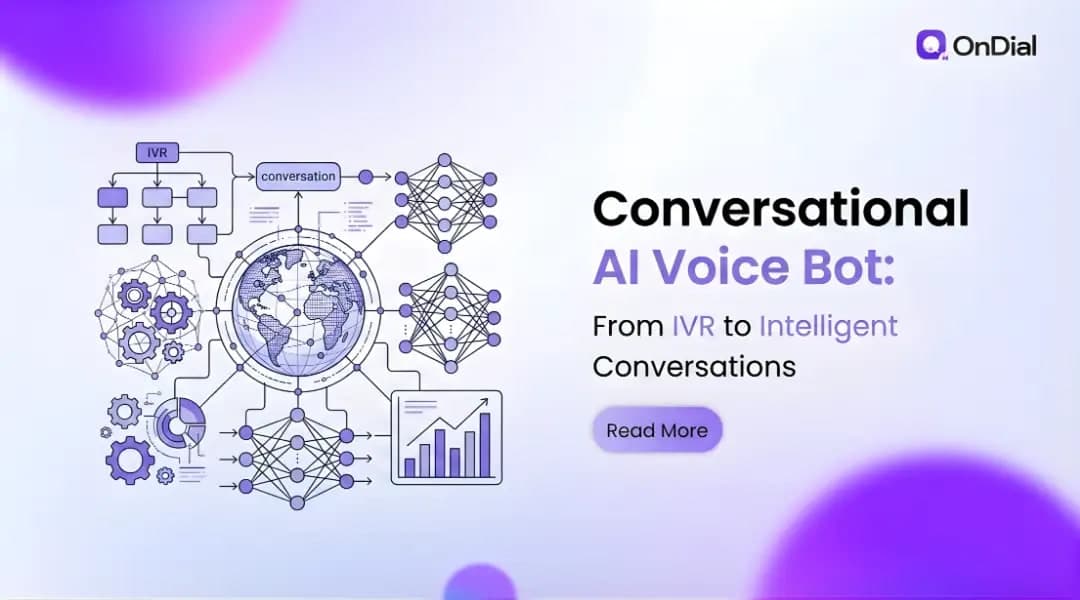
Technically, it's a system built on three pillars: automatic speech recognition (ASR) to convert spoken language into text, natural language processing (NLP) to interpret meaning and intent from that text, and text-to-speech (TTS) to generate spoken responses in real-time. The whole thing is wrapped in a dialogue management layer that tracks context across the conversation — remembering what was said thirty seconds ago and connecting it to what's being asked now.
How It Differs From Basic Voice Systems
Here's the distinction that matters: traditional voice systems (including IVR) are reactive routing tools. They hear a keyword or a button press and send you somewhere. A conversational AI voice bot is a resolution engine. It doesn't just route your call, it understands your problem, pulls relevant data, and attempts to solve it.
That shift from routing to resolving? That's not an incremental improvement. That's a different category of technology entirely.
How Traditional IVR Systems Work
I need to be fair to IVR for a moment. When it was introduced, it was genuinely useful. It gave businesses a way to handle call volume without hiring proportionally. It sorted calls. It deflected simple queries. For its era, it worked.
But "for its era" is doing a lot of heavy lifting in that sentence.
Menu-Based Navigation
IVR operates on a fixed decision tree. The caller hears pre-recorded prompts - "Press 1 for account balance. Press 2 for recent transactions. Press 3 for something that probably isn't what you actually need." — and navigates by keypad or basic speech commands. The logic is rigid, linear, and assumes the caller's problem fits neatly into the menu.
User Frustration Points
It rarely does. How many times have you been three menus deep into an IVR, realized none of the options match your issue, and pressed "0" repeatedly hoping for a human? That's not a design flaw. It's an architectural limitation. The system can only handle what it was explicitly programmed for.
Drop-offs & Missed Calls
Industry benchmarks consistently show IVR abandonment rates between 25–35%. Think about that number. If a third of the people walking into your store turned around and left before speaking to anyone, you'd call it a crisis. But in telephony, it's been normalized. That normalization is exactly the problem.
IVR vs Conversational AI Voice Bots
Let me put this comparison in a format that's hard to argue with:
Factor | Traditional IVR | Conversational AI Voice Bot |
Interaction Model | Button presses / rigid voice commands | Natural, open-ended conversation |
Understanding | Keyword matching | Intent recognition via NLP |
Personalization | None — treats every caller identically | CRM-integrated, caller-aware |
Language Support | Pre-recorded per language (expensive) | Dynamic multilingual, handles code-switching |
Resolution Capability | Routes to agent | Resolves OR routes with full context |
Speed to Resolution | 3–5 menu levels before reaching help | Direct engagement from first second |
Scalability | Add lines + agents | Handle more concurrent calls, no new hires |
Customer Satisfaction | Low — high abandonment, high frustration | Measurably higher CSAT and lower drop-offs |
The pattern is stark. IVR vs conversational AI isn't a close comparison anymore. One was designed to manage call flow. The other was designed to solve customer problems.
How Conversational AI Voice Bots Work
Let me pull back the curtain on what's actually happening when a caller talks to an intelligent voice bot. Four systems are working in concert, in real-time:
Speech Recognition (ASR)
The caller speaks. Automatic Speech Recognition converts that speech into text — not just word by word, but with contextual awareness. Modern ASR handles accents, background noise, and the way people actually talk (incomplete sentences, filler words, mid-thought corrections).
Natural Language Processing (NLP)
The text hits the NLP layer. This is the brain. It determines intent ("the caller wants to know their order status"), extracts entities ("order number 4428, placed on March 12"), and maps the request to an appropriate action. Good NLP handles ambiguity — "I want to change my plan" could mean a billing change, a flight change, or an insurance plan change depending on context.
Text-to-Speech (TTS)
Once the system determines the right response, TTS generates spoken output. Modern TTS doesn't sound like a robot reading a Wikipedia article. It uses neural voice models with natural pacing, intonation, and emotional tone. The best implementations are nearly indistinguishable from a human agent reading a script.
Real-Time Response System
All of this — listen, understand, decide, speak — happens in under a second. The dialogue manager maintains conversational context across multiple turns, so the bot remembers what was discussed ten seconds ago without asking the caller to repeat themselves. That continuity is what makes it feel like a conversation, not an interrogation.
Key Benefits of Conversational AI Voice Bots
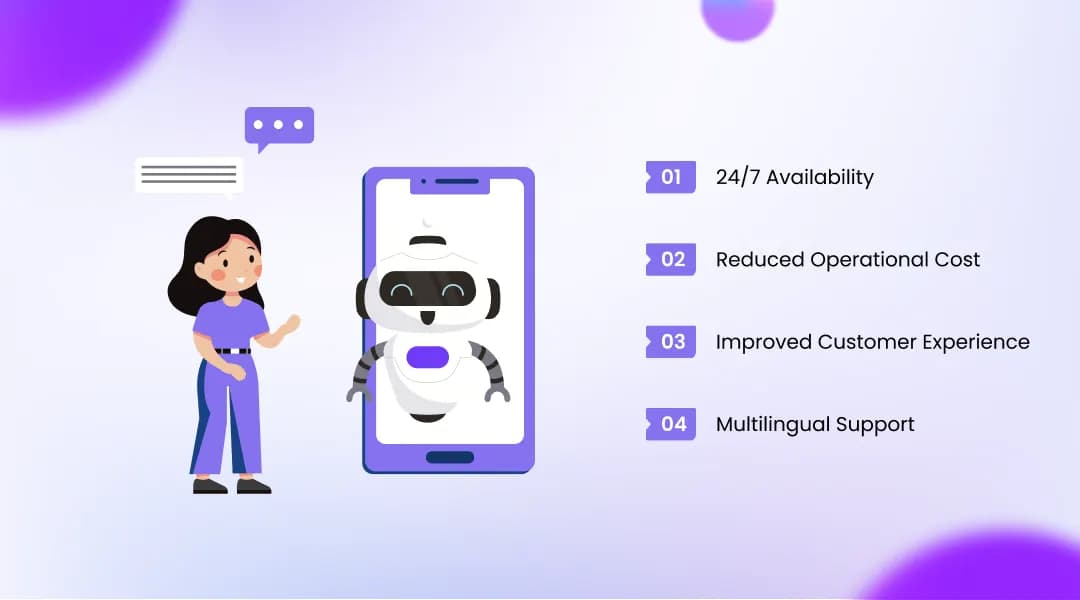
I've deployed these systems for 20+ clients. Here's what I've actually measured — not what a slide deck promises:
24/7 Availability
Obvious but critical. Your customers don't care that it's 2 AM or Diwali or that half your team called in sick. The bot picks up. Every time. Every call.
Reduced Operational Cost
The average fully loaded cost per agent-handled call in India runs ₹15–₹40. An AI voice bot for customer support handles the same interaction for ₹1–₹5. For a company processing 10,000 calls/day where 60% are Tier 1 queries, the annual savings are staggering.
Improved Customer Experience
Zero hold time. No menus to navigate. The caller states their problem and gets help immediately. I've seen clients post 15–20 point improvements in CSAT within three months of deployment.
Multilingual Support
This is where the Indian market separates the serious platforms from the pretenders. India has 22 official languages and hundreds of dialects. Your customer in Chennai speaks differently from your customer in Jaipur. A conversational AI voice bot India deployment that only handles English is serving maybe 10–12% of your caller base well.
The platforms that work here — companies like OnDial — handle Hindi, Tamil, Telugu, Marathi, Bengali, Kannada, and critically, Hinglish: the natural Hindi-English blend that most urban Indian callers actually speak. Not as separate language modes you switch between, but as a fluid, code-switching-aware conversation.
Tell me honestly: does your current IVR do that? Does it even come close?
Real-World Use Cases Across Industries
E-commerce (Order Tracking)
A D2C fashion brand I worked with was spending ₹6.5 lakhs/month answering "Where is my order?" calls. We deployed an AI voice bot integrated with their OMS. It handled 70% of those queries autonomously — caller says order number, bot pulls live tracking, delivers an update in Hindi or English. Support costs dropped to ₹2.1 lakhs/month.
BFSI (Loan & EMI Reminders)
An NBFC client needed 40,000 outbound EMI reminder calls monthly. Human agents were managing about 12,000. The AI calling agent handled the balance — in Hindi, English, and Marathi — and on-time payment rates improved by 18%.
Healthcare (Appointment Booking)
A hospital network in South India automated appointment confirmation calls. Patients received a call 24 hours before their appointment: confirm, reschedule, or cancel. No-show rates dropped 32%. The system updated the hospital's scheduling software in real-time.
EdTech (Lead Qualification)
During an enrollment season, an EdTech client was receiving 5,000+ daily inquiry calls. The bot handled initial qualification — course interest, eligibility, budget — and transferred warm leads to human counselors. Counselor conversion rates improved by 35% because they stopped burning time on unqualified calls.
Why Businesses Are Replacing IVR with AI Voice Bots
Better Engagement
An AI phone bot that greets a caller by name, knows their last interaction, and starts with context isn't just more efficient — it signals to the customer that they matter. That emotional signal drives loyalty in ways that "Press 1 for billing" never will.
Higher Conversion Rates
For outbound use cases — lead follow-up, payment reminders, renewal campaigns — AI voice bots reach 3–4x more contacts per day than human teams. More contacts, faster follow-up, higher conversion. The math isn't complicated.
Lower Call Abandonment
When callers don't have to navigate menus or wait on hold, they stay on the line. One insurance client saw call abandonment drop from 28% to under 6% within 60 days of deploying AI call automation software.
Features to Look for in an AI Voice Bot Solution
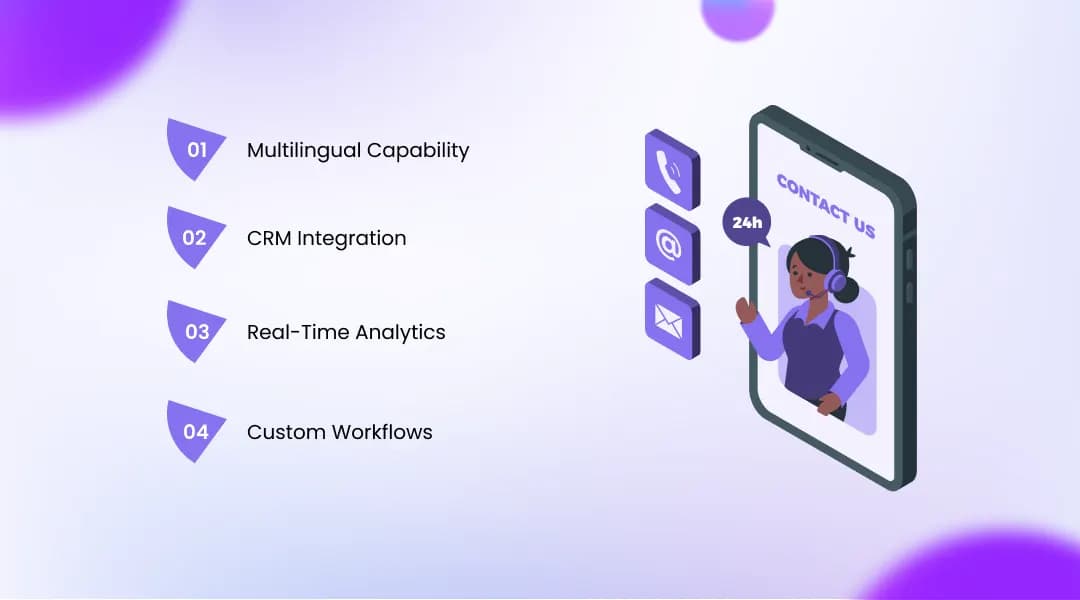
After evaluating dozens of platforms, here's what I tell every client to prioritize:
Multilingual Capability
Not "we support 8 languages" on a marketing page. Actual, tested, fluid multilingual handling — including code-switching between Hindi and English. Ask for a live demo in the language your customers actually speak. If the vendor hesitates, walk away.
CRM Integration
An AI voice bot that can't pull customer data in real-time is a talking FAQ page. It needs to connect to your CRM, OMS, or backend systems so it can personalize every interaction based on who's calling and what they need.
Real-Time Analytics
Every call should produce actionable data: resolution rates, sentiment analysis, common intents, escalation triggers. If the platform doesn't give you a dashboard that helps you improve, it's a black box — and black boxes are how budgets get wasted.
Custom Workflows
Your business isn't a template. Your call flows shouldn't be either. Look for platforms — like OnDial - that build tailored conversational AI voice bot solutions to match your specific workflows, not the other way around. If the vendor says "here's our standard setup," ask them what happens when your needs don't match it.
Future of Voice AI in Customer Support
Hyper-Personalization
The next wave of voice AI for customer service won't just know who's calling — it'll predict why they're calling based on recent activity, purchase history, and behavioral signals. The conversation will begin with context, not questions.
Emotion Detection
Still early, but the trajectory is real: voice AI systems that detect stress, frustration, or confusion in a caller's tone and adapt accordingly — slowing down, simplifying language, or proactively offering human escalation.
AI-Human Collaboration
The future isn't bots replacing agents. It's bots handling the 60–70% of calls that are repetitive and draining, freeing human agents to focus on the complex, emotionally nuanced interactions that require judgment and empathy. The best CX teams in 2026 won't be all-human or all-AI. They'll be both, working together.
Conclusion
I spent a long time on the IVR side of this story. I know how hard it is to admit that the system you built, defended, and optimized isn't working anymore. That admission feels like failure.
It isn't.
Recognizing that your customers have outgrown your phone system is the first strategic decision in building something better. A conversational AI voice bot doesn't erase the work you've done — it builds on the operational understanding you already have and adds a technology layer that your IVR was never designed to deliver.
The shift from IVR to intelligent conversations isn't a trend. It's a correction. The phone experience should have always been this good. The technology just finally caught up.
If you're ready to start that transition, begin with a clear use case, a vendor who builds for your workflows, and the willingness to test with real customers in real languages. That's where the conversation starts.