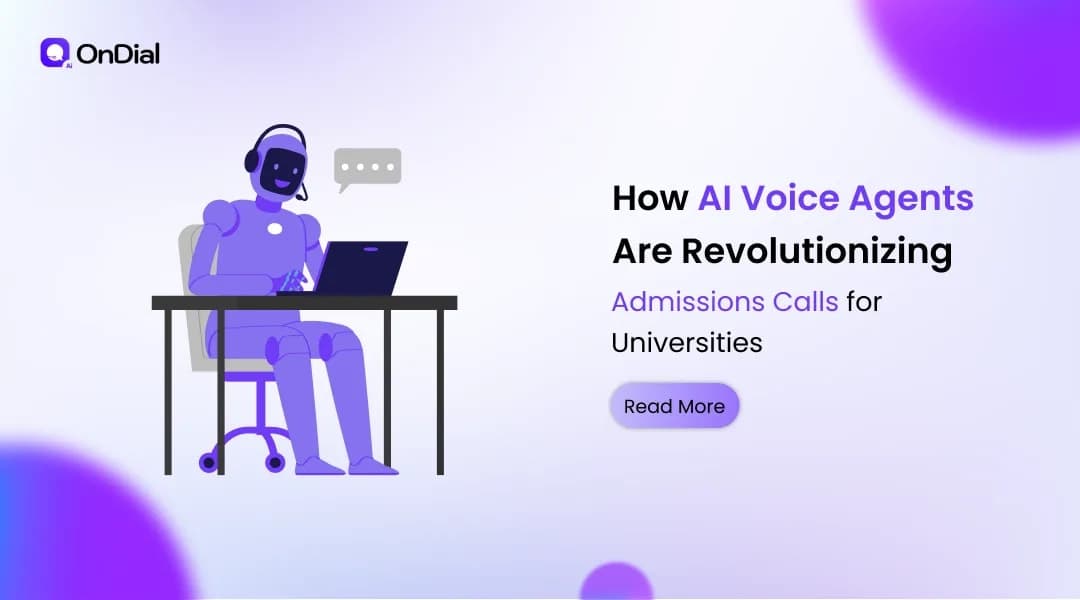
Georgia State University reduced its summer melt rate by 21.4% after deploying an AI-powered assistant for admissions outreach. That single stat reshaped how I think about student communication. If you run admissions at a university, you already know the feeling: phones ringing nonstop during peak season, parents asking the same five questions, students emailing because nobody picked up. AI voice agents for university admissions are not a futuristic concept anymore. They are software systems that answer inbound calls, make outbound follow-up calls, verify application details, schedule counseling sessions, and respond to student inquiries in natural, conversational language, all without a human picking up the phone.
At OnDial, I’ve watched institutions go from overwhelmed to organized by rethinking one process: how they handle phone calls. And most of the time, the biggest surprise is how many of those calls were identical. This article breaks down exactly how AI voice agents work in admissions, what results real universities have achieved, and how to evaluate whether your institution is ready for one.
What AI Voice Agents Actually Do in University Admissions
An AI voice agent is a software system that conducts real-time, two-way phone conversations using speech recognition, natural language processing, and text-to-speech technology. It is not an IVR menu. It is not a robocall. It listens, understands context, and responds dynamically.
Inbound Call Handling: The 24/7 Front Desk
When a prospective student calls your admissions office at 10 PM, an AI voice agent picks up. It pulls data from your student information system and answers questions about application deadlines, fee structures, required documents, and program eligibility. If the question is too complex, it transfers the call to a human counselor and logs the interaction for follow-up.
This is the part that matters most to students. They do not want to navigate a phone tree. They do not want to leave a voicemail. Research from the EDUCAUSE 2025 AI Landscape Report notes that adding a single phone call to the recruitment process increases enrollment acceptance by 9%. Every missed call during peak season is a potential enrollment lost.
Outbound Engagement: Proactive Student Outreach
AI voice agents also initiate calls. They remind admitted students about missing documents, upcoming orientation deadlines, tuition payment windows, and scholarship applications. This proactive outreach is where the real enrollment impact happens, because students who fall through the cracks between acceptance and enrollment are the ones you lose to summer melt.
(Here’s a thought most admissions leaders don’t voice aloud: your competition isn’t just other universities. It’s inertia. Students who get confused by paperwork simply don’t show up.)
Why Admissions Teams Are Overwhelmed (And How Voice AI Fixes It)
Before I recommend any technology to an institution, I ask one question: what exactly is breaking? In admissions, the answer is almost always the same four things.
The Volume Problem During Peak Season
A mid-sized university can receive 15,000 or more inquiries during a single enrollment cycle. Most admissions teams have 8 to 15 staff members. The math doesn’t work. One EdTech company I worked with reduced support call wait times by over 70% after deploying voice automation, not because they fired anyone, but because repetitive queries were handled automatically. The human team finally had bandwidth for meaningful conversations.
Have you ever counted how many times your front desk answers “What’s the last date to submit my application?” in a single week?
The Consistency Problem Across Staff
Human counselors have good days and bad days. They get tired. They occasionally give slightly different answers about the same policy. An AI voice agent delivers the same accurate response at 3 AM that it delivers at 3 PM. For institutions managing admissions across multiple campuses or departments, this consistency is not a luxury. It is an operational requirement.
AI voice agents do not replace admissions counselors. They handle the repeatable layer of communication so that counselors can focus on complex, high-value conversations: scholarship negotiations, program fit discussions, and the kind of personal guidance that actually influences a student’s decision.
How AI Voice Agents Improve Enrollment Yield

Most universities don’t need more leads. They need to convert the leads they already have. That distinction is critical.
Reducing Summer Melt With Automated Follow-Ups
Summer melt is the phenomenon where students who accept admission simply don’t enroll by fall. At Georgia State University, summer melt rates had climbed to nearly 19% before they deployed an AI chatbot called Pounce. The treatment group in their randomized controlled trial saw a 3.3 percentage point increase in enrollment and a 21.4% lower summer melt rate compared to the control group, according to research published through Brookings.
An AI voice agent takes this further than text-based chatbots. Voice calls feel more personal. They command attention in a way that text messages and emails do not. For first-generation college students who may not have family members guiding them through the enrollment process, a friendly voice walking them through their next steps can be the difference between showing up and dropping off.
Capturing Leads That Would Otherwise Disappear
Here is a number that should concern every admissions director. CollegeVine’s AI Recruiter, deployed across more than 95 partner institutions, has facilitated over 500,000 conversations with prospective students. The reason that number is so high is simple: those conversations happen at scale, around the clock, without requiring a human to initiate each one.
At OnDial, we’ve seen similar patterns. When institutions respond to an inquiry within minutes instead of hours, conversion rates shift noticeably. Speed is not just a convenience factor. It is a competitive advantage.
What to Look for in an AI Voice Agent Platform for Higher Education

Not every voice AI solution is built for education. The stakes are different here. You’re dealing with student data privacy regulations, multilingual requirements, and integration with legacy systems that may not have been updated in years. Should you actually invest in one? Yes, but only if the platform fits your specific operational reality.
CRM and SIS Integration
An AI voice agent is only as good as the data it can access. If it cannot pull real-time application status from your student information system or log interactions back into your CRM, it becomes just another disconnected tool. Look for platforms that offer native integration with systems like Salesforce, Slate, Ellucian, or whichever SIS your institution runs. The ability to sync student profiles in real time is what makes voice agents feel intelligent rather than scripted.
Multilingual and Regional Support
Universities recruit globally. A prospective student calling from Gujarat should be able to speak in their preferred language and still get accurate, helpful responses. Modern voice AI platforms support dozens of languages without requiring separate teams for each one. This is particularly relevant for Indian institutions processing tens of thousands of applications across multiple regional languages.
I’ll be direct about one limitation: AI voice agents still struggle with heavy regional accents in noisy environments. The technology is improving rapidly, but it is not perfect. Any vendor who tells you otherwise is overselling. At OnDial, we believe in transparency about where the technology excels and where human backup is still necessary.
Real Results: Universities Already Using AI Voice Agents
Theory is useful. Results are better. Let me walk through two examples that illustrate different scales of implementation.
Georgia State University and the Pounce Effect
Georgia State’s experience remains the most well-documented case study in AI-assisted admissions. Their chatbot Pounce exchanged over 200,000 messages with incoming students, with less than 1% requiring human follow-up. The 21.4% reduction in summer melt translated directly into more students showing up on day one. This wasn’t just a technology win. It was an equity win: first-generation students and students from lower-income backgrounds benefited the most, because they were the ones most likely to get lost in the paperwork maze.
How Indian Institutions Are Scaling Admissions
The challenge in India is sheer volume. One registrar at a prominent Indian university described receiving 47,000 applications for 2,800 seats, with a team of just 15 people. AI agents helped process 30% of initial verifications in under an hour. At OnDial, we’ve built voice AI solutions for exactly this kind of scenario: high volume, repetitive queries, and a need for consistency across languages and time zones. The institutions we’ve worked with report that their admissions staff spend significantly less time on routine calls and more time on the conversations that actually require human judgment.
The pattern is consistent across geographies. Voice AI does not eliminate the need for human staff. It eliminates the bottleneck that prevents human staff from doing their best work.
Conclusion
AI voice agents for university admissions solve a specific, measurable problem: too many calls, too few staff, and too many students falling through the cracks between interest and enrollment. The data is clear: institutions using AI-assisted communication see lower summer melt, faster response times, and higher enrollment yield. The technology is not about replacing your admissions team. It is about giving them the capacity to do what they were hired to do: build relationships and guide students through one of the most important decisions of their lives.
If your admissions office is drowning in repetitive calls every enrollment season, it might be time to explore how a voice AI solution fits your workflow. At OnDial, we build tailored voice AI systems designed around how your institution actually operates, not a generic template. Start a conversation with us at ondial.ai and see what changes when every call gets answered.