Gartner projects that conversational AI will cut contact center labor costs by $80 billion in 2026. That single number explains the flood you are feeling right now. More than 200 platforms claim to sell the best voice AI, and every demo sounds flawless. When you set out to evaluate AI voice agent vendors, the real problem is noise, not a shortage of options.
Here is the short version. To evaluate AI voice agent vendors well, you score each one against the same checklist: voice quality, security and compliance, integration depth, true cost, and proof in production. You ignore the polished demo and test the system on your own calls instead. The vendor with the best presentation is rarely the one that survives your busiest Monday.
If you feel overwhelmed or quietly skeptical, that is the correct starting position. This market rewards confident sales decks, not honest ones. This guide gives you a repeatable buyer's checklist, the questions that actually matter, the red flags to catch early, and the India-specific compliance details most global guides skip entirely. By the end, you will own a scorecard you can defend in any budget meeting.
Why Evaluation Beats the Demo Every Time
The vendor with the most impressive demo is often the one you regret most. That is not cynicism. It is a pattern that shows up in losing evaluations again and again. A demo is a controlled stage where the vendor picks the script, the accent, and the easy questions.
The Demo Is a Performance, Not the Product
A vendor demo proves that the system can work once, under perfect conditions, with someone who built it driving. Your callers will not cooperate that way.
They interrupt. They mumble. They call from a noisy auto-rickshaw at peak hour.
The gap between works in a demo and works in production is where most projects quietly fail. A clear evaluation process closes that gap by forcing every vendor through the same real-world tests. In voice AI projects we have delivered at OnDial, the systems that survive are the ones tested against messy, live audio early.
What Is Actually at Stake When You Choose Wrong
The cost of a bad choice is rarely just the subscription fee. Switching vendors after go-live means re-integrating systems, retraining staff, and rebuilding call flows from scratch. Most teams discover the mismatch six months in, one broken edge case at a time.
The pressure to move fast is real and documented. According to a 2026 Gartner survey cited by CallBotics, 91% of customer service and support leaders are under executive pressure to implement AI. That pressure pushes buyers toward whoever demos best, which is exactly the trap a disciplined evaluation is built to avoid.
The Core Voice AI Vendor Checklist
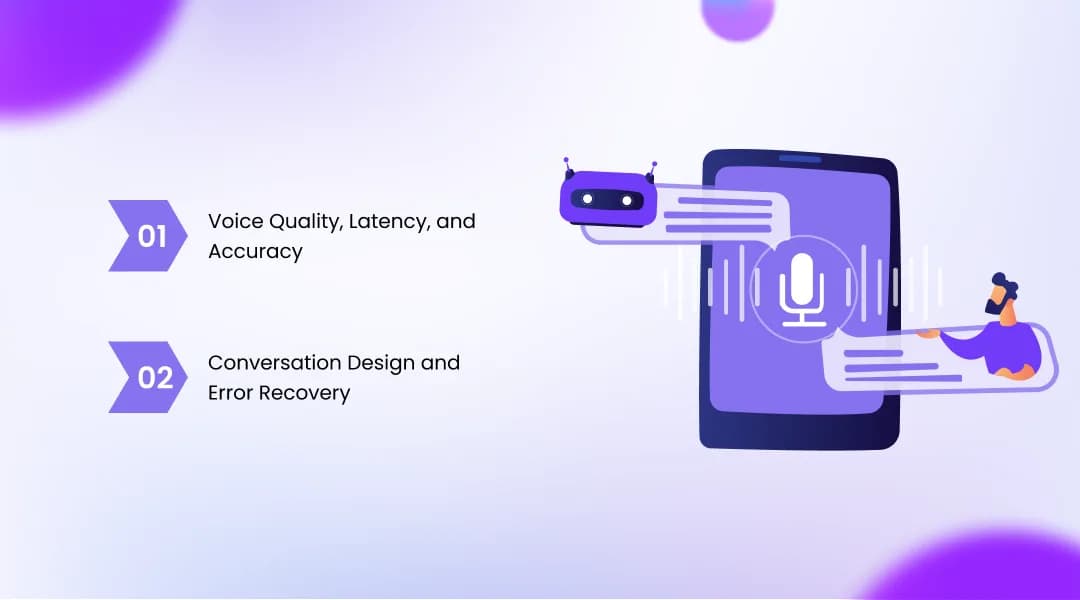
A voice AI vendor checklist turns a vague feeling into a defensible score. Score every vendor on the same dimensions, on a simple one-to-five scale, then compare totals. Copy the scorecard into a spreadsheet before your first call, so the last demo cannot bias your final decision.
Featured answer: To evaluate AI voice agent vendors, score each one on voice quality, latency, security and compliance, integration depth, total cost of ownership, and production proof. Apply the same rubric to every vendor, test on your real calls, and weight the criteria by your own business priorities before you compare totals.
Voice Quality, Latency, and Accuracy
Latency is the gap between a caller finishing their sentence and the agent starting its reply. It is the single most human-or-robotic signal in any voice system. Anything above 800 milliseconds sounds dead on the line, while sub-400 millisecond responses feel alive and natural.
Speech recognition matters just as much as response speed. Ask each vendor a specific question:
Accuracy on your accents: What is the ASR accuracy on Indian English, Hindi, and your regional languages, not on clean American audio.
Interruption handling: How does the agent manage barge-in, overlapping speech, and unclear input without freezing or talking over the caller.
Real-world conditions: Clean-audio benchmarks can degrade sharply with background noise, so insist on numbers from realistic environments.
Conversation Design and Error Recovery
Most teams over-index on whether the voice sounds human and under-index on what happens when a call goes sideways. Error recovery is where good agents separate from scripted ones. A strong agent recovers gracefully from an unexpected answer instead of dumping the caller into a dead-end fallback.
Watch how the system behaves when it does not understand. Does it ask a clarifying question, hold context across turns, and complete the task? Or does it loop, repeat itself, and force the caller to start over. (Run this test yourself during a live call, not from a slide.) The agents that handle the unexpected are the ones worth shortlisting.
Security and Compliance: The Non-Negotiables
Compliance can remove a vendor before pricing or features ever matter. Voice AI sits in a sensitive spot in your stack, because callers speak freely. In one breath a customer might share a card number, an Aadhaar detail, or a health fact, and that audio moves through carriers, speech-to-text, models, and logs.
Featured answer: Ask voice AI vendors for an active SOC 2 Type II report, written data residency terms, and explicit confirmation that your call data will never be used to train their models. For Indian businesses, also confirm DPDP Act 2023 readiness and TRAI DLT registration for any outbound calling.
Certifications and Honest Data Handling
A single "Are you SOC 2 certified?" question is never enough. Security-conscious vendors give detailed, specific answers and provide documentation on request. Vague reassurance like "we take security seriously" without evidence is itself a warning sign.
Push every vendor to show evidence, not logos. Request the actual SOC 2 Type II report under NDA, and ask where call recordings and transcripts are stored and for how long. Get contractual language barring your data from model training, because that single clause protects your customers long after the contract is signed.
India-Specific Compliance: DPDP Act and TRAI DLT
Most global buyer guides skip the rules that actually govern Indian deployments. The DPDP Act 2023 sets out consent, purpose limitation, and data principal rights that any voice AI handling Indian customer data must respect. Ask the vendor how consent is captured and how a customer can withdraw it.
For outbound and promotional calling, TRAI DLT registration is not optional. Any vendor running outbound campaigns in India must operate within the DLT framework and honor consent registries. At OnDial, building for Indian regulatory reality from day one is part of how we approach every deployment, because retrofitting compliance later is painful and expensive.
Integration, Scalability, and Data Ownership
A voice agent that cannot reach your systems creates more work, not less. Integration capability decides whether the agent can read live data and complete a task, or just talk politely while a human cleans up afterward. This is where many promising pilots stall.
How Well Does It Fit Your Existing Stack
Your real stack is a mix of modern tools and older systems nobody wants to touch. Some were built last year and some were built a decade ago. Ask whether the vendor connects through direct API calls, browser-based execution, or both, since most enterprises genuinely need both.
The deeper test is whether integration is read-only or truly bidirectional. An agent that checks a calendar but cannot book the slot is a demo, not a solution. Confirm that the agent can write confirmed actions back into your CRM or scheduling system in real time, and ask what happens when a connected system goes down.
Who Owns Your Data When the Contract Ends
Data portability tells you how the relationship ends before it even begins, which is why vendors dodge this question hardest. You want clean answers on ownership and exit. Walk through these points with every vendor:
Data ownership: Confirm in writing that you own all recordings, transcripts, and analytics generated by your calls.
Self-service export: Verify you can export your data yourself, in a standard format, without paying a ransom or filing a ticket.
Exit terms: Negotiate a clear exit clause and avoid proprietary phone numbers that trap you on the platform.
The True Cost: Pricing and Total Cost of Ownership
The advertised price is only the beginning of the real bill. The cheapest vendor is often the most expensive one you will ever sign. Hidden costs in integration, support tiers, and professional services routinely dwarf the per-minute rate that won the deal.
Pricing Models and Hidden Costs
Voice AI pricing usually comes as pay-per-minute, per-seat, per-call, or enterprise contracts. The headline number rarely reflects the final monthly invoice. Per-minute pricing in particular often excludes token costs, telephony charges, and orchestration fees that surface only after launch.
Ask the awkward money questions early. How many internal staff are required during implementation versus steady state? What professional services are mandatory rather than optional, and what are contract minimums, early termination fees, and price jumps at higher volume tiers. The honest vendors answer plainly, and that honesty is itself a signal of trust.
Build vs Buy: Should You Really Do It Yourself
Total cost of ownership is every cost across the full contract, not just the rate on the pricing page. Build a twelve-month forecast that includes baseline, peak, and seasonal-spike call volumes, then add a buffer. Calculate it in INR against your own traffic, not the vendor's sample numbers.
So should you build it yourself? For most mid-market teams, buying from a specialized partner reaches production far faster than building in-house, while keeping control of customer data. Building makes sense only when voice is your core product and you have the engineering depth to own latency, compliance, and uptime forever. Be honest about which one you are.
The Proof of Concept and the Red Flags
Everything above stays theoretical until you run a live test. A proof of concept is a limited live trial of a vendor on your real calls before full commitment. It is the single most reliable predictor of production success, and the step buyers skip most often.
Running a POC That Proves Something
A valid POC uses real inbound call volume, not simulated traffic and not a pre-recorded walkthrough. Define success before it starts, so nobody moves the goalposts later. Set a clear resolution-rate target, a handle-time target, and a satisfaction floor, then run on one high-volume use case for at least 30 days.
Bring the right people into the room. Your front-desk staff, an operations lead, and your IT contact will each spot different failure modes. Reject synthetic demos and insist on testing against the messy reality your callers will actually create.
Red Flags in Vendor Conversations
Certain behaviors during the sales process predict the production experience with unnerving accuracy. None of these alone should rule a vendor out, but three stacked together should end the conversation. Watch for these signs:
Vague pricing: A vendor who cannot give a clear cost range is hiding something or has not done the work.
Black-box claims: Refusing to explain how the system works, or dodging the data-portability question, signals lock-in.
Certifications without proof: Any vendor citing SOC 2 or HIPAA should hand you the report, not just the badge.
Demo-only confidence: A vendor who resists a live POC on your real calls is protecting a weakness.
Ask yourself one question before you sign anything: would this vendor survive your worst Monday? If you cannot answer with evidence from a real test, you are not ready to commit.
Conclusion
Learning how to evaluate AI voice agent vendors comes down to three habits. Score every vendor against the same checklist instead of trusting the demo. Treat security, India-specific DPDP and TRAI compliance, and data ownership as non-negotiable. Prove everything with a real proof of concept before you sign.
You are no longer the buyer who gets dazzled by a slick presentation. You have a repeatable scorecard, the right questions, and a clear sense of the red flags that end conversations early. That clarity is what turns a risky purchase into a confident, defensible decision.
When you are ready to test these criteria against a real system built for Indian businesses, OnDial welcomes the scrutiny. We believe transparency and partnership are how good voice AI gets chosen, so bring your checklist and your hardest questions, and put us through your worst Monday.