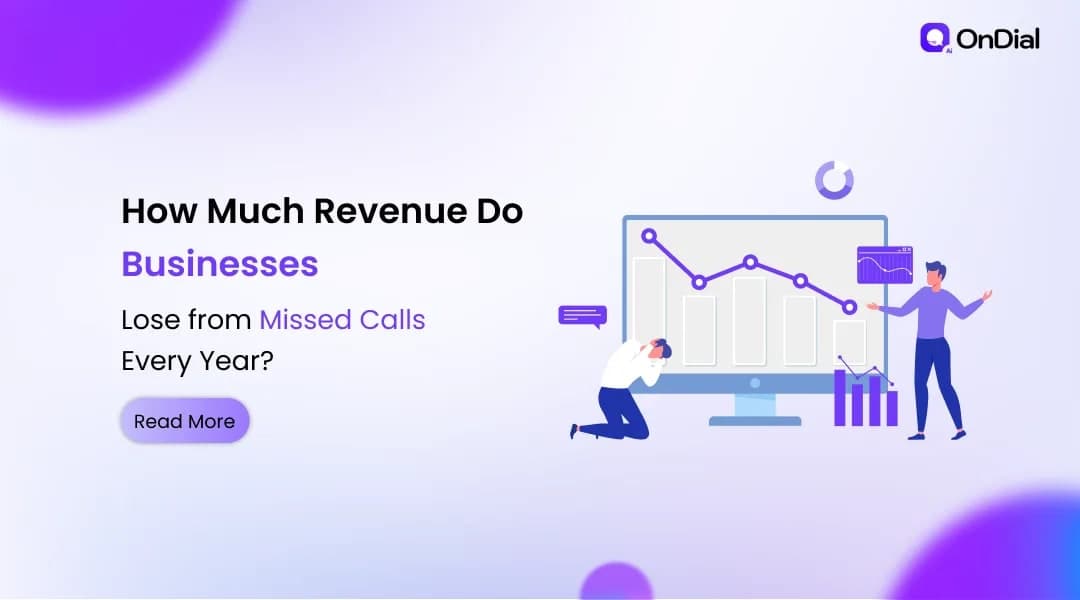
A missed business call looks like a small operational problem. One employee is busy, another is away from the desk, the phone rings after hours, or several customers call at the same time.
The financial impact can be much larger than the missed conversation itself.
When a potential customer calls your business, they have already taken an important step. They searched for a provider, decided to make contact, and chose the phone instead of continuing to browse. If nobody answers, that intent can disappear within minutes.
For businesses that depend on inbound calls, the important question is not simply how many calls are missed. It is how much revenue those unanswered calls represent.
This article explains how to calculate missed call revenue loss, where businesses lose the most opportunities, why voicemail is often an incomplete recovery strategy, and how AI voice agents can help capture calls without requiring a larger front desk team.
Why Missed Calls Create a Revenue Problem
A missed call does not automatically equal a lost sale. Some callers may have been asking a general question, checking business hours, or calling about an existing order.
Others, however, are ready to buy, book, enquire, or request immediate assistance.
That distinction matters because the value of a missed call depends on what the caller intended to do.
A real estate enquiry can represent a high-value future transaction. A healthcare call can become a recurring patient relationship. A home service call can become an urgent booking. An e-commerce call may involve a purchase that the customer makes elsewhere when they cannot get an answer.
The existing OnDial page being revised makes a useful point about the scale of this problem, but its central topic overlaps heavily with several other OnDial articles covering the same $126,000 estimate, missed-call behaviour, voicemail, and AI voice solutions.
A stronger article should therefore focus less on repeating one industry-wide number and more on showing businesses how to calculate their own exposure.
How to Calculate Revenue Lost From Missed Calls
The most useful missed-call calculation starts with your own call data.
You need four numbers:
Monthly inbound calls
Monthly missed calls
Average customer value
Inbound conversion rate
The basic calculation is:
Missed calls × average customer value × estimated conversion rate = potential monthly revenue exposure
For an annual estimate:
Missed calls × average customer value × estimated conversion rate × 12 = potential annual revenue exposure
This is an estimate, not a guaranteed revenue figure. Not every caller would have purchased, so applying your actual conversion rate produces a more realistic model than treating every missed call as a lost customer.
Example: A Service Business
Suppose a service company receives 600 inbound calls each month.
If 20% are missed, that means:
600 × 20% = 120 missed calls
Assume the business has an average customer value of ₹8,000 and normally converts 25% of qualified inbound callers.
The estimated monthly revenue exposure becomes:
120 × ₹8,000 × 25% = ₹240,000
The annualised exposure would be:
₹240,000 × 12 = ₹2.88 million
That does not mean the company will definitely recover ₹2.88 million by answering every call. It means the business has enough potential value in its missed-call volume to justify investigating the problem.
That distinction is important when building a business case for call automation.
The Cost of a Missed Call Goes Beyond One Sale
The first transaction is only one part of the equation.
A new customer can generate repeat purchases, referrals, upgrades, additional services, or long-term contracts. Losing the first interaction can therefore reduce future revenue that never appears in your missed-call report.
Customer Lifetime Value
Consider a clinic that receives a call from a new patient.
The initial appointment might be worth ₹2,000. But if that patient returns several times over the next few years, the actual commercial value of that relationship is considerably higher.
The same principle applies to:
Insurance customers who renew policies
Real estate customers who purchase or rent multiple properties
Automotive customers who return for servicing
Retail customers who make repeat purchases
B2B customers who expand their contracts
Healthcare patients who continue treatment
A missed first interaction can therefore become a customer lifetime value problem rather than a single-sale problem.
Marketing Spend Is Also at Risk
Businesses spend money to generate phone calls.
A customer might discover a company through search, paid advertising, social media, a directory, a referral, or an existing website page. When that customer finally calls and nobody answers, the business may lose both the opportunity and part of the marketing investment that created it.
This is why call-answering performance should be considered alongside lead-generation metrics.
If marketing generates 500 calls but the sales team answers only 350, looking only at the 350 answered calls gives an incomplete picture of campaign performance.
Which Businesses Are Most Exposed to Missed Call Revenue Loss?
Missed calls matter across industries, but the financial impact is especially significant when phone enquiries have high commercial intent.
Real Estate
Property enquiries often involve substantial transaction values.
A buyer or tenant may call about property availability, pricing, financing, location, or a viewing. If the call goes unanswered, the prospect can immediately contact another agent.
For real estate teams, the problem is not limited to answering the call. The caller also needs to be qualified, recorded, and moved toward the next step.
OnDial's AI voice agents for real estate are designed around this type of workflow, including property enquiries, lead qualification, viewing appointments, follow-ups, and tenant support.
Healthcare
Healthcare calls can involve appointment requests, rescheduling, insurance questions, prescription-related enquiries, and general patient support.
A missed call can create both a lost acquisition opportunity and additional administrative work when the patient eventually tries to reach the organisation again.
For healthcare providers, automation should therefore focus on appropriate workflows rather than simply trying to replace reception staff.
Home Services
Plumbing, electrical, HVAC, appliance repair, cleaning, and similar businesses are particularly dependent on fast response times.
The customer often has a problem that needs attention now.
If the business does not answer, the caller has little reason to wait. They can simply search for another provider.
Automotive
Automotive businesses receive calls for service appointments, repair estimates, test drives, parts availability, vehicle enquiries, and follow-ups.
During busy periods, employees may be physically serving customers while new callers are waiting.
An automated first response can capture the caller's reason, collect essential information, and route the interaction appropriately.
Retail and E-commerce
Retail businesses can experience call spikes during promotions, holidays, product launches, and delivery periods.
Customers may call because they cannot find an answer online or want confirmation before purchasing.
When those calls are missed repeatedly, the business can lose sales while simultaneously increasing pressure on customer support teams.
Why Businesses Miss Calls in the First Place
Most missed calls are not caused by employees deliberately ignoring customers.
They are usually caused by capacity gaps.
Employees Are Already Handling Another Customer
A representative can answer only one conversation at a time.
When several calls arrive together, some customers inevitably wait, abandon the call, or try again later.
Calls Arrive Outside Business Hours
Customers do not necessarily follow your operating schedule.
They may search for a business in the evening, on weekends, or during holidays. If your phone system stops being useful when the office closes, those enquiries have nowhere to go.
Lunch and Shift Changes Create Coverage Gaps
Even well-staffed teams have predictable periods where fewer employees are available.
Lunch breaks, shift changes, meetings, field work, and internal tasks can all create temporary gaps.
Peak Demand Is Difficult to Staff For
Hiring enough employees to handle the busiest five minutes of the day can be inefficient for the remaining hours.
Businesses therefore need a way to handle temporary spikes without permanently increasing staffing costs.
Why Voicemail Is Not a Complete Recovery Strategy
Voicemail has a legitimate role, but it should not be treated as equivalent to answering a customer in real time.
The caller still has to decide whether to leave a message.
They then have to wait for a callback.
Your employee has to listen to the message, understand the request, find the right information, and return the call.
That creates multiple opportunities for the customer to lose interest.
The existing OnDial research also highlights the importance of response speed and the high intent associated with phone enquiries.
A better approach is to capture the conversation while the customer is already engaged.
How AI Voice Agents Reduce Missed Call Revenue Loss
An AI voice agent can answer an inbound call, understand the caller's intent, collect information, provide approved answers, perform supported actions, and transfer the conversation to a human when necessary.
The important difference is that the system is not simply answering the phone.
It is designed to move the conversation toward an outcome.
For example, an inbound call can follow this sequence:
The customer calls the business.
The AI voice agent answers immediately.
The agent identifies the reason for the call.
It asks the required qualifying questions.
It checks relevant information or systems.
It completes an available action.
It records the interaction.
It transfers the caller when human judgement is required.
OnDial describes this workflow as a combination of natural-language conversation, business-system integrations, automated actions, CRM updates, confirmations, analytics, and contextual human handoff.
This changes the objective from "answer every call" to "capture and process every viable opportunity."
Turning a Missed Call Into a Business Action
Answering the call is only the first step.
The real value comes from what happens during the conversation.
Appointment Booking
If the caller wants an appointment, an AI agent can gather the necessary information and connect the request to an available scheduling workflow.
This removes the need for the customer to wait for a callback simply to find a suitable time.
For businesses where appointment conversion is important, the process is explained in more detail in OnDial's guide to AI appointment scheduling.
Lead Qualification
Not every caller should be transferred directly to sales.
An AI voice agent can collect information such as location, budget, service requirement, timeline, or product interest before routing the lead.
The sales team then receives a more structured opportunity rather than an unexplained missed call.
Customer Support
Many inbound calls are repetitive.
Customers may ask about order status, business hours, availability, delivery information, account processes, or other frequently requested information.
Automating appropriate questions gives human agents more time for conversations that genuinely require judgement.
Human Escalation
A useful AI voice system should not attempt to handle everything.
Some conversations need a person.
The right approach is to define escalation rules and transfer the call with the relevant context so the customer does not have to start the conversation again.
Measure the Problem Before Automating It
Businesses should not start with the assumption that every call needs AI.
Start with the data.
Track:
Total inbound calls
Answered calls
Missed calls
Abandoned calls
After-hours calls
Average call duration
Call-to-lead conversion
Lead-to-customer conversion
Revenue per converted call
Callback time
Calls requiring human escalation
Then identify when and why calls are being missed.
A business might discover that most missed calls happen after 6 PM. Another might find that the real problem is Monday morning volume. A third might discover that employees are spending too much time answering repetitive questions.
Each situation requires a different workflow.
A Practical 30-Day Missed Call Recovery Plan
Week 1: Establish the Baseline
Export your call records and calculate your answer rate.
Identify your busiest hours, missed-call percentage, after-hours volume, and the average commercial value of inbound calls.
Week 2: Categorise the Calls
Review a representative sample of calls and group them by intent.
Common categories include sales enquiries, appointments, support, order status, pricing, complaints, and general information.
Week 3: Automate the Highest-Value Workflows
Start with one or two predictable workflows.
For example, a healthcare provider might begin with appointment requests. A real estate company might start with property enquiries and lead qualification.
Avoid automating every possible conversation on day one.
Week 4: Compare Business Outcomes
Measure the same indicators you collected during the baseline period.
Look at answer rate, qualified leads, appointments, transfers, abandoned calls, and revenue generated from previously uncovered periods.
The goal is not simply to demonstrate that an AI system answered more calls.
The goal is to determine whether more valuable customer conversations became completed business outcomes.
When AI Voice Automation Makes Sense
AI voice automation is most useful when the business has meaningful call volume, predictable conversation patterns, clear workflows, or significant after-hours demand.
It can be particularly valuable when:
Calls are frequently missed during peak periods
Customers expect immediate responses
Employees spend significant time answering repetitive questions
Appointments can be booked through defined rules
Leads can be qualified using standard questions
Customers call outside normal business hours
Multiple languages are required
The business needs consistent call handling across locations
It may be less suitable when every conversation requires highly specialised judgement or when call volume is too low to justify automation.
The objective should always be better customer coverage and measurable business value, not automation for its own sake.
The Business Case for Fixing Missed Calls
The strongest business case does not begin with an AI feature list.
It begins with the value of the calls already reaching your business.
If you generate hundreds of inbound calls every month, some percentage will inevitably go unanswered unless you have enough capacity to cover every demand spike and operating hour.
That creates a gap between leads generated and leads actually handled.
Closing that gap can involve additional staff, better routing, improved scheduling, callback systems, or AI voice automation. The right solution depends on the business.
For companies that need continuous phone coverage, an AI Voice Agent solution can combine call answering with qualification, scheduling, CRM updates, escalation, and analytics.
The important thing is to measure the opportunity first.
Final Takeaway
Missed calls are easy to overlook because the lost customer is invisible.
You can see the calls your team answers. You can see the leads that enter your CRM. What you usually cannot see is the person who called once, received no answer, and immediately moved to another business.
That is why missed call revenue loss should be measured as part of the complete customer acquisition process.
Start with your own numbers. Count the missed calls, estimate the value of a converted customer, apply your actual conversion rate, and identify when your biggest coverage gaps occur.
Then decide how those gaps should be fixed.
For some businesses, better staffing and routing will be enough. For others, an AI voice agent can provide the always-on coverage needed to answer calls, qualify opportunities, schedule appointments, handle routine requests, and involve human employees when the conversation requires them.
The objective is simple: turn more of the demand you already generate into conversations, and turn more of those conversations into measurable business outcomes.
Learn more about how OnDial AI voice agents can support inbound and outbound customer conversations, workflows, and business operations.