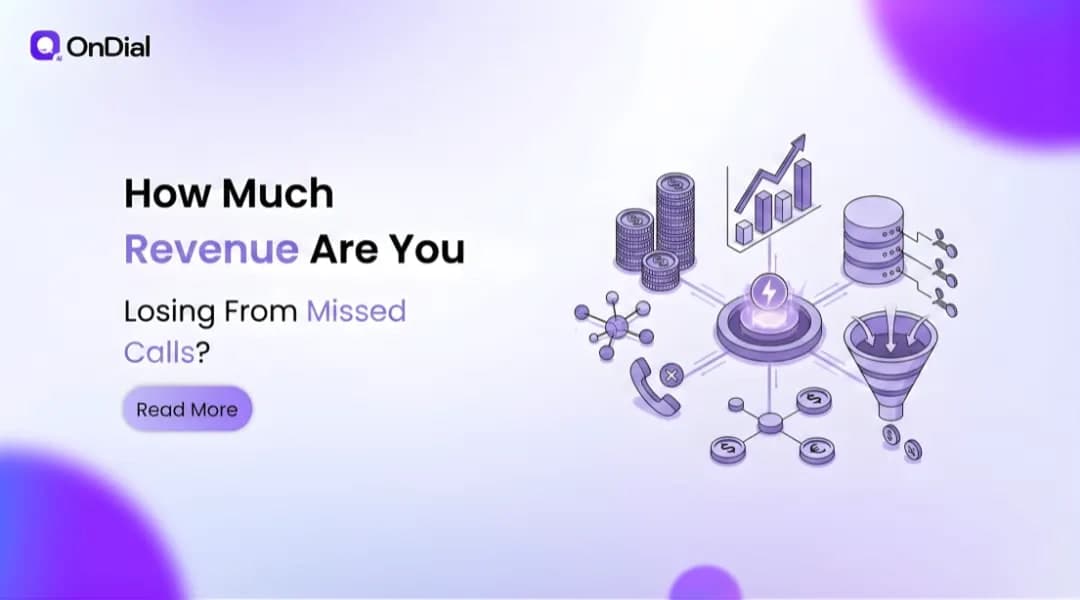
Small businesses lose an average of $126,000 per year to missed calls. That figure comes from industry data aggregated across hundreds of businesses, and it's the one that tends to land like a punch in the gut when I share it with business owners for the first time.
Most owners I've spoken with have a version of the same response: "That can't apply to me. We only miss a few calls here and there." That reaction is understandable. And it's costing them.
The missed call revenue loss problem is insidious precisely because each individual missed call feels small. A single unanswered ring during lunch. A call that slipped through on a busy Saturday. But the data doesn't care about your intentions. According to a study by 411 Locals that monitored 85 businesses across 58 industries, only 37.8% of incoming calls are answered by a live person. That means the average business is handing more than six out of every ten inbound calls to dead air or voicemail.
At OnDial, we've worked with businesses across industries to understand where their communication breaks down. The missed call issue appears in almost every conversation we have. What this article will show you is: the precise formula for calculating your own losses, where those losses are deepest by industry, why voicemail is not the safety net you think it is, and how AI voice technology is the specific mechanism that closes this revenue gap permanently.
Why Callers Don't Come Back: The 85% Rule
Here is the number that changes the entire conversation about missed calls.
85% of callers who don't reach a live person will never call back. That figure, cited by PATLive and corroborated across multiple industry studies, means that for every ten callers who hit your voicemail, only one or two will give you a second chance. The other eight or nine are already dialing your competitor.
This is not a customer loyalty problem. It's a behavioral reality. When someone picks up the phone to call a business, they are at peak buying intent. They have a problem right now. They want a solution right now. A voicemail greeting tells them, instantly and involuntarily, that you are not available to solve their problem. So they move on.
Why Modern Buyers Don't Wait
The expectation for immediate response has been permanently recalibrated. Customers can get same-day grocery delivery, instant streaming, and 24-hour customer chat. Your phone line operates on a different standard at your own risk.
Industry research is consistent on this point: 62% of callers who don't reach a business will contact a competitor instead. They don't wait to hear back. They don't send a follow-up email. They open Google and call the next listing.
The Voicemail Illusion
Many business owners assume voicemail catches what the phone misses. It does not. According to industry data, 80% of callers who reach voicemail hang up without leaving a message. Among younger demographics - the buyers making the most purchase decisions right now - that number climbs even higher. 67% of people admit they ignore voicemails entirely, even from known contacts.
Voicemail is not a backup system. It's where leads go to disappear.
Missed Call Rate by Industry: Where the Biggest Losses Hide
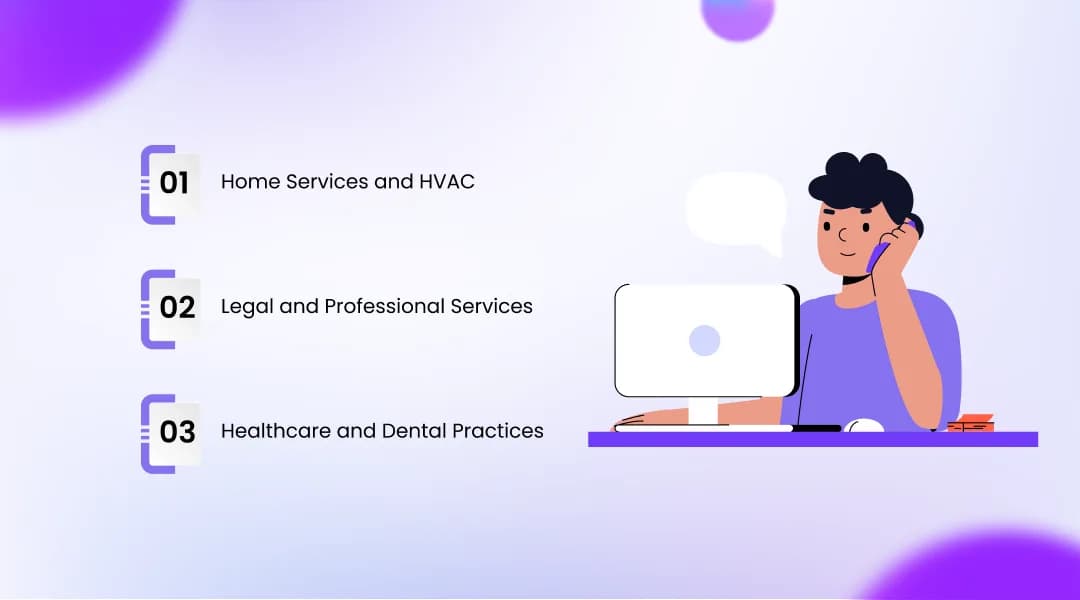
Not all missed call revenue loss is equal. Your industry determines both how often calls are missed and how much each missed call is worth.
Home Services and HVAC
According to Invoca's research, home service businesses miss around 27% of their inbound calls, with each missed call representing an average of $1,200 in lost revenue. For HVAC businesses specifically, the damage peaks during extreme weather - exactly when call volume is highest and every technician is already dispatched.
Consider what that means practically. An HVAC company that misses five calls during a summer heatwave, at $1,200 per missed call, has lost $6,000 in a single afternoon. The customers who couldn't get through aren't waiting until Monday. They are cooling down in a competitor's truck.
Legal and Professional Services
Law firms miss approximately 35% of incoming calls, according to Clio's Legal Trends Report. In legal services, the cost per missed call is among the highest of any industry - a single missed call from a personal injury prospect can represent a case worth thousands in fees. The lifetime value of one missed legal client, when factoring in referrals and repeat consultations, can run into the tens of thousands.
The urgency factor in legal services is extreme. Someone calling about a recent accident, an arrest, or a custody situation is not going to leave a voicemail and wait 48 hours. They will call the next firm on their list.
Healthcare and Dental Practices
Dental offices miss between 20% and 38% of incoming calls, primarily because front desk staff are occupied with check-ins and in-office patients. According to data from Patient Prism, each missed new-patient call represents approximately $850 in lifetime patient value. A practice that misses just ten new-patient calls per month is quietly losing over $100,000 annually, not from any failure of clinical care, but from a phone that went unanswered.
Healthcare is also the industry where missed calls have consequences that extend beyond revenue. A patient who can't reach their provider goes elsewhere - and takes their health history, their referrals, and their family members with them.
The Full Revenue Leak: It Goes Way Beyond the First Call

This is where I see the biggest blind spot in how businesses think about missed call revenue loss. They calculate the immediate sale value of the call they missed. They stop there. That is a significant underestimate.
Lost Marketing Spend: You Paid to Generate That Call
Every inbound call to your business was generated by something: a Google Ad, an SEO ranking, a social post, a referral program, a listing fee. When that call goes unanswered, you don't just lose the sale. You lose the entire marketing investment that produced the lead.
If you're spending $3,000 per month on paid search to drive 100 calls, and 60 of those calls go unanswered, you've effectively wasted $1,800 of your ad budget. Every month. According to BIA/Kelsey research, phone calls convert at 10 to 15 times the rate of web form leads. That makes a missed phone call one of the most expensive marketing failures a business can have.
The Lifetime Value Multiplier
The first call is rarely the full picture of what a customer is worth. Across service industries, the lifetime earnings from a single retained customer can range from $5,000 to $15,000, according to industry benchmarks. A hair salon that misses a booking call doesn't lose $75. It loses five years of appointments, product purchases, and tip income from a customer who would have stayed loyal if someone had simply answered the phone.
The formula here matters. I've seen it expressed across multiple research studies as:
Monthly missed calls x Average customer lifetime value x 12 x 0.85 (non-callback rate) = Annual revenue exposure
Run that calculation with your own numbers. Most business owners go quiet when they do.
The Referral Chain You Never See
Lost customers don't just take their own money elsewhere. They take their network too. Industry research suggests each lost customer typically represents 2 to 3 additional referrals that will never materialize. In local markets - where word of mouth drives a disproportionate share of new business - this compounding effect is significant.
Negative experiences also generate reviews. A customer who couldn't reach you doesn't always move on silently. Sometimes they leave a one-star Google review explaining they "called twice and no one ever answered." That review influences every future customer who searches for your business.
How to Calculate Your Own Missed Call Revenue Loss
A clear formula: missed call revenue loss is not an industry average. It's a number you can derive precisely for your own business. Here is how.
Start with your average monthly call volume. Multiply by your missed call rate (if you don't know it, use 40-62% as a conservative industry estimate). Multiply by your close rate on answered calls. Multiply by your average transaction value. Multiply by 12 for annual impact. Then multiply by 0.85 to account for non-callbacks.
Example: A dental practice receives 200 calls per month. They miss 35%, or 70 calls. Their close rate on answered calls is 40%, and their average new patient value is $850. That is 70 x 0.40 x $850 x 12 x 0.85 = $242,340 in annual revenue exposure.
(That is not a typo. Run it yourself with your own numbers.)
Does Voicemail Actually Save You?
Here's a counter-intuitive claim: voicemail does not protect your revenue. It makes you feel like it might, which is actually worse.
The psychological comfort of hearing "you have 3 new voicemails" is real. The revenue saved from those voicemails is not. As established earlier, 80% of callers don't leave messages. Of the 20% who do, many are duplicate calls, spam, or existing clients - not the high-intent new prospects who represent your growth opportunity.
There is a second problem with voicemail that rarely gets discussed. Returning calls the next day is too late. Industry research shows lead conversion rates drop by 80% after the first hour of an inquiry going unanswered. By the time your staff listens to a voicemail and calls back the following morning, the caller has already contracted with someone else, attended an appointment elsewhere, or simply lost interest.
Voicemail is a relic of a time when customers had no other options. Today, they have unlimited options. And they use them.
How an AI Voice Assistant Closes the Revenue Gap
Here's what I've observed working with businesses through OnDial: the conversation about missed calls almost always ends with the same question. "So what do we actually do about it?"
The answer is not hiring more front desk staff. A full-time receptionist costs $36,000 to $41,000 per year in base salary alone - and only covers business hours. Two-shift coverage to handle after-hours and weekend calls can run $150,000 or more annually. That's a significant overhead commitment for a problem that has a more targeted solution.
An AI voice assistant - a conversational AI built specifically for business phone handling - answers every inbound call, at any hour, without hold times, without missed calls during peak volume, and without the overhead of full staffing.
What Conversational AI Actually Does on a Call
An AI voice assistant is not a phone tree. It is a natural language system that understands spoken requests, responds in a conversational tone, and takes action: booking appointments, routing urgent calls to the right person, answering frequently asked questions, capturing lead details, and logging outcomes directly into your CRM or calendar.
At OnDial, our voice AI platform is designed around one principle: every caller should feel heard, helped, and moved forward - whether it's 2 PM or 2 AM. The system handles the high-volume routine interactions that eat up staff time, while routing genuinely complex situations to a human immediately. It's not replacing your team. It's making sure no call ever falls through before your team even knows it came in.
Natural language processing allows the AI to understand varied phrasing, industry-specific terminology, and even caller emotion. Unlike legacy IVR systems that force callers through rigid menus, a well-built conversational AI voice platform creates an interaction that feels direct and responsive.
Real Business Outcomes From Always-On Coverage
The results from businesses that implement AI answering solutions are measurable. AI phone answering systems have been shown to reduce missed calls by up to 75%, with 41% of businesses eliminating missed calls entirely, according to SchedulingKit's 2026 aggregated data. Talkdesk reported that JK Moving Services improved their first-call resolution rate by 41% and scaled revenue by 74%, despite a 650% surge in call volume over two years.
Businesses with 24/7 phone coverage also report improved customer retention rates. When customers know they can always reach you - including on evenings, weekends, and holidays - their confidence in your reliability increases. In service industries, that confidence is often the difference between a one-time transaction and a loyal client who refers others.
The ROI calculation is straightforward. If an AI voice platform recovers even 20% of your previously missed calls, and your average transaction value is $500, the return on investment typically arrives within the first few months of deployment.
Conclusion
The missed call revenue loss problem is not abstract. It's a specific number, unique to your business, that you can calculate today using your call volume, your close rate, and your average transaction value. And in almost every case I've seen, that number is larger than the business owner expected.
Three things are true for nearly every service business dealing with this issue. First, the majority of callers won't try again - so the revenue is gone the moment the call goes unanswered. Second, voicemail is not a fallback; it's a dead end for most high-intent leads. Third, the solution exists and is affordable - AI voice technology has made 24/7 coverage accessible at a cost that pays for itself within months, not years.
You now have the data, the formula, and the framework to quantify what you've been losing and to act on it with confidence.
If you want to see how conversational AI voice technology can close this gap in your specific business, OnDial builds tailored AI voice assistant solutions designed around your real-world communication challenges - not off-the-shelf scripts. Explore how a voice AI platform built for your industry and your customers can turn your unanswered calls into captured revenue at OnDial.