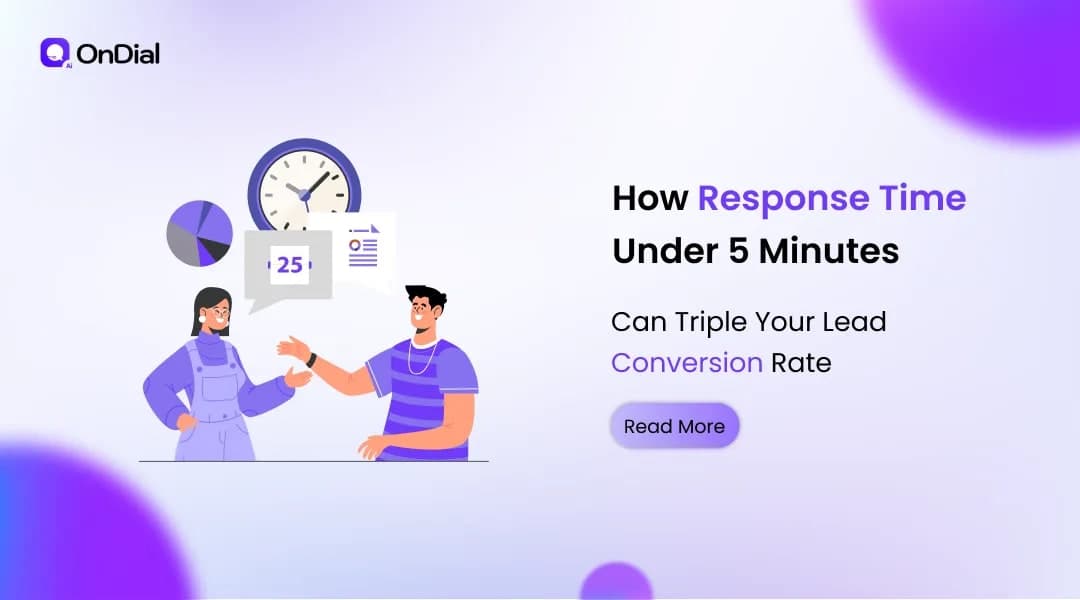
Here is a number that should stop you mid-scroll: businesses that respond to leads within 5 minutes are 21 times more likely to qualify that lead than those who wait just 30 minutes. That finding, from a joint MIT and InsideSales.com study of over 15,000 leads, is one of the most replicated results in sales research. And yet, the average business still takes over 42 hours to make first contact. If you have ever felt the frustration of spending money on ads, SEO, and marketing only to watch your pipeline leak, your lead response time is likely the culprit. This is not a minor optimization. It is the single highest-impact change most sales teams can make.
In this article, I will walk you through the data behind the 5-minute rule, explain why most companies fail at it despite knowing better, and share the specific strategies, including AI voice technology, that we use at OnDial to help businesses close that gap for good.
The 5-Minute Window: Why Lead Response Time Is Your Biggest Revenue Lever
The Data Behind the 5-Minute Rule
Lead response time is the duration between a prospect's inquiry and your team's first meaningful contact. It sounds simple. The impact is anything but.
Research from Harvard Business Review, analyzing 2,241 U.S. companies, confirmed that firms reaching leads within one hour were 7 times more likely to qualify them than those waiting even one hour longer. But the real inflection point sits much earlier. The MIT Lead Response Management Study, led by Dr. James Oldroyd, found that contacting a lead within 5 minutes makes you 100 times more likely to connect compared to waiting 30 minutes.
That is not a gradual decline. It is a cliff.
Why 78% of Deals Go to the First Responder
A Lead Connect survey revealed that 78% of customers buy from the first company that responds to their inquiry. Not the cheapest company. Not the most qualified. The first one to pick up the phone or reply to the message. In competitive markets, being second means being invisible.
I have personally seen this play out with OnDial clients. A mid-size insurance firm we worked with was generating 200 qualified leads per month but converting fewer than 15. Their average response time? Over 6 hours. After implementing an AI voice assistant that responded within 60 seconds, their monthly conversions jumped to 41 within the first quarter. Same leads. Same team. Faster response.
What Happens to Conversion Rates After 5 Minutes
The Conversion Decay Curve
The relationship between response time and conversion is not linear. It is exponential decay. Velocify's analysis of 3.5 million leads found that calling within 1 minute produces a 391% lift in conversions compared to calling at the 2-minute mark. By the 5-minute mark, qualification odds have already dropped by 80%, according to the Harvard Business Review.
Here is the progression that keeps sales leaders awake at night: respond in under a minute and you are at peak conversion potential; wait 5 minutes and you have lost most of that advantage; wait 30 minutes and your odds of even reaching the person drop by 100x. After one hour, you are 60 times less likely to qualify the lead than if you had responded within that first hour.
The Cost of Waiting: Revenue Left on the Table
An Optifai Pipeline Study of 939 B2B companies (Q2 2025 to Q1 2026) quantified this precisely. Leads contacted in under 5 minutes achieved a 32% close rate, which is 2.6 times higher than the 12% close rate for leads contacted after 24 hours. For a company generating 200 leads a month at a $2,000 average customer value, the revenue difference between a 60-second response and a 24-hour response is roughly $51,000 per month.
That is not a rounding error. That is your growth budget evaporating.
Why Most Businesses Still Fail at Speed to Lead
The Shocking Industry Averages
If the data is so clear, why do most companies still respond slowly? A 2026 Blazeo benchmark study across 573 businesses found that 74% miss the five-minute response window entirely. Only 7% of companies respond within 5 minutes of a form submission, according to the Lead Response Management Study. And here is the part that genuinely surprised me: 63% of companies never respond at all, per recent data from a RevenueHero study.
Read that again. More than half of all leads that businesses pay to generate are simply ignored.
The Real Bottlenecks Holding Teams Back
The problem is rarely lazy sales reps. In projects I have worked on at OnDial, the bottleneck almost always sits upstream. Lead routing takes too long because it requires manual assignment, which adds 5 to 15 minutes of dead time. CRM enrichment queues create invisible delays. Leads arriving outside business hours, on weekends, or at night go completely cold before anyone sees them.
(Here is something nobody talks about: the average time for a personalized email response is nearly 12 hours. Blaming your SDR team for slow response when your system takes half a day to route a lead is like blaming a pilot for a delayed flight caused by ground crew.)
How Fast Lead Response Builds Trust and Closes Deals
The Psychology of Immediate Response
Speed is not just a sales tactic. It is a trust signal. Neuroscience research shows that people are most receptive to new information within the first few minutes of forming an intent. When someone fills out a contact form, they are in an active decision-making state. Their problem feels urgent. Their attention is focused. A fast response meets them in that moment and says, without words: "We take you seriously."
A delayed response communicates the opposite. Behavioral economists call this primacy bias: first impressions shape expectations. If a prospect's first experience with your business is silence, they assume slow service, poor organization, and a frustrating customer experience.
Speed as a Competitive Differentiator
Have you ever submitted a form on a company's website and then opened three competitor tabs while waiting? Your prospects do the same thing. Every minute you wait, your competitors gain ground. Speed to lead is not about urgency for urgency's sake. It is about being present when the buyer is ready to act.
According to Salesforce's State of Sales Report, 64% of consumers now expect real-time responses when reaching out to a business. That number is up from 58% in 2023. AI chatbots and instant messaging have reset baseline expectations. Responding in an hour no longer feels fast. It feels late.
Practical Strategies to Respond to Leads in Under 5 Minutes
Automate the First Touch
The most impactful change you can make is removing manual steps from your initial lead response. Set up automated acknowledgment messages that trigger the moment a lead enters your system. Not a generic "we received your message" template. Something specific, contextual, and useful that confirms what they asked about and tells them exactly what happens next.
This buys goodwill while your team mobilizes. The first touch does not need to be a full sales conversation. It needs to be proof that someone is paying attention.
Implement Intelligent Lead Routing
Manual lead assignment is the silent killer of response time. Automated routing assigns incoming leads to the right rep instantly based on territory, availability, product line, or lead score. Companies with a defined SLA respond within 15 minutes at nearly twice the rate of those without one: 54.9% versus 29.5%, according to the Blazeo 2026 Speed-to-Lead Benchmark Report.
Set tiered response targets by lead type. A demo request from a pricing page needs a response in under 3 minutes. A whitepaper download can wait 30 minutes. Not all leads deserve the same urgency, but all need fast responses.
Build a Multi-Channel Follow-Up Sequence
Most leads do not answer on the first call. That is fine. What matters is persistence with structure. The average sales rep gives up after 1.3 attempts. Top performers make 6 to 8 attempts in the first 48 hours across phone, text, and email. SMS alone has a 98% open rate with a median read time under 3 minutes, making it one of the most effective channels for that critical first contact.
How AI Voice Assistants Solve the Response Time Problem

Why Human Teams Cannot Do This Alone
Here is an honest truth that I have learned building voice AI solutions at OnDial: no human team can consistently respond to every lead within 60 seconds, 24 hours a day, 365 days a year. It is not a motivation problem. It is a physics problem. Reps are in meetings. Leads arrive at 11 PM on a Saturday. Call volume spikes unpredictably.
Gartner projects that 40% of enterprise applications will feature task-specific AI agents by 2026. The reason is practical: AI voice agents respond within seconds, qualify leads using structured logic, and route warm prospects to human reps for the conversation that actually closes the deal.
What Modern AI Voice Technology Actually Does
An AI voice assistant for lead response is not a robotic menu system. Modern conversational AI uses natural language processing to hold real, adaptive conversations. It answers inbound calls, asks qualifying questions (budget, timeline, need), scores the lead in real time, and logs everything to your CRM. When the lead is qualified, it routes them to a human closer, often via a warm transfer with full context.
At OnDial, we build these systems to sound human, respond instantly, and work around the clock. The goal is not to replace your sales team. It is to make sure no lead ever goes unanswered while your reps focus on the conversations that matter most.
The Results Speak for Themselves
Businesses using AI voice agents for lead response report consistent sub-60-second response times, 100% of the time. Compare that to the industry average of 42 hours. Studies show that companies deploying AI-powered lead response see up to 65% to 90% reductions in operational costs for routine interactions, while simultaneously improving contact rates and conversion.
This is not a future prediction. This is happening right now across industries.
Measuring and Tracking Your Lead Response Performance
Key Metrics to Monitor
You cannot improve what you do not measure. Track these five metrics to understand your speed-to-lead performance: average time to first response (target: under 5 minutes for high-intent leads), response rate within your SLA (target: 95%+ compliance), contact success rate by attempt number, conversion rate by response time bucket (0 to 5 minutes, 5 to 15 minutes, 15 to 60 minutes, 1+ hours), and rep performance variance.
How to Audit Your Current Response Time
Pull a sample of 50 recent leads from your CRM. Calculate the time between form submission and first contact attempt. If your average exceeds 5 minutes, you are in the majority, and you are leaving substantial revenue on the table. Segment by lead source and by rep to uncover where the specific bottlenecks sit.
Build dashboards that show these metrics in real time. When reps can see their own speed stats, they compete to improve them. When leadership can see the revenue correlation by response time bucket, investment in automation becomes an obvious decision.
Conclusion
Lead response time under 5 minutes is not a nice-to-have metric. It is the single most impactful lever for tripling your lead conversion rate, backed by over a decade of replicated research. The data is consistent: respond within 5 minutes and you are 21x more likely to qualify the lead; wait 30 minutes and your odds of even connecting drop by 100x; and 78% of deals go to the first responder.
Three things matter most: automate your first touch so no lead waits, implement intelligent routing so the right rep responds instantly, and deploy AI voice technology to cover the hours, channels, and volume your team cannot.
If you are spending money generating leads but losing them to slow follow-up, the fix is not more leads. It is a faster response. At OnDial, we build AI voice assistants specifically designed to respond to every lead within seconds, qualify them through natural conversation, and hand them to your team ready to close. If you want to see what that looks like for your business, start a conversation with us at ondial.ai and experience the difference a sub-60-second response makes.
Speed is the new currency of sales. The businesses winning today are not smarter or better funded. They are simply faster.