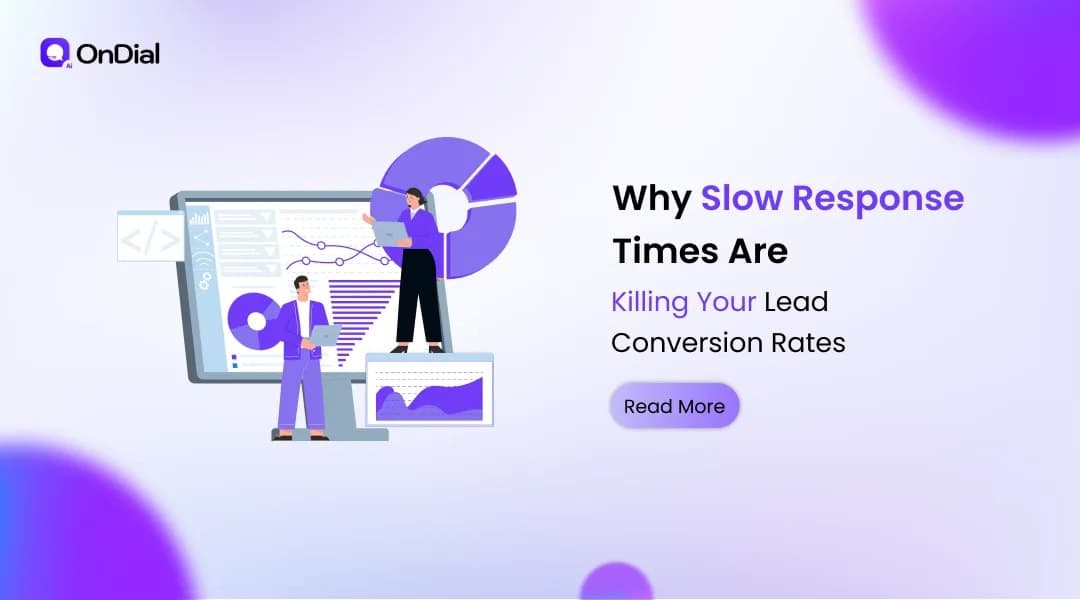
Here is a number that should make every sales leader uncomfortable: 78% of buyers choose the vendor that responds first, according to Lead Connect research. Not the vendor with the best product. Not the cheapest option. The first one to pick up the phone.
I've spent years working with businesses that pour serious money into ad campaigns, SEO, and content marketing, only to watch qualified leads evaporate because nobody responded fast enough. It is the most expensive silence in business. And at OnDial, we see it constantly: companies generating strong inbound interest, then letting that interest decay into nothing because their lead response time stretches from minutes into hours, and sometimes into days.
Here is what you will learn in this article: why response speed has become the single most important conversion variable, what the research actually proves about timing windows, how slow responses damage your brand in ways you cannot measure, and what practical steps (including AI voice technology) can close the gap permanently.
Revenue You Never See
The cruelest part of slow response times is that the lost revenue is invisible. You never see the deals that died in your inbox. Your CRM does not flag the leads that called a competitor while waiting for your callback.
According to the MIT and InsideSales.com study published in Harvard Business Review, the average business takes 47 hours to respond to web leads. Not 47 minutes. Hours. That same research found that 63% of companies never respond at all.
Think about what that means. You are paying for every single lead through your ad spend, your SEO investment, your content marketing budget. Then you are letting the majority of those leads walk out the door because you simply did not show up on time.
The Competitor Advantage You Hand Over
Every unanswered lead is a gift to your competitors. This is not an exaggeration. When a potential customer fills out your demo request form and hears nothing for four hours, they have already submitted the same request to two or three other companies. The business that calls back first wins 78% of the time.
(Think of it this way: you are essentially funding your competitor's pipeline with your own marketing dollars.)
I have seen this pattern play out across industries, from SaaS to real estate to financial services. The companies that consistently outperform their competitors on lead conversion share one trait. They have eliminated the gap between "lead submitted" and "first meaningful contact."
Why Speed to Lead Matters More Than Ever in 2026
The Amazon-ification of B2B Buyers
The expectations that buyers bring to B2B interactions have fundamentally changed. Millennials now make up 73% of all B2B buying decisions, and they grew up expecting instant responses. The line between B2B and B2C expectations has disappeared.
Speed to lead is the elapsed time between a prospect's inquiry and your first outbound contact. It is measured in minutes, not hours. Every additional minute of delay erodes your odds of qualifying that prospect.
Your buyers do not separate their consumer self from their professional self. When someone fills out a demo request at 9:15 AM, they expect the same responsiveness they get when ordering from Amazon at 9:15 PM. Miss that window, and you are not just slow. You are irrelevant.
Intent Decay Is Real (and Faster Than You Think)
Neuroscience research confirms what salespeople have always intuited: people are most receptive to new information within the first few minutes of forming an intent. After about 20 minutes, distractions take over. The prospect starts a new task, opens a new browser tab, answers a Slack message.
But here is the part most articles miss. The damage is not just attention loss. It is trust loss. Behavioral economists call this primacy bias: the first impression shapes all future expectations. If a prospect's first experience with your business is silence, they assume everything else will be slow too. Slow support. Slow onboarding. Slow results.
That assumption is nearly impossible to reverse.
What the Data Says About Lead Response Time and Conversions
The Five-Minute Rule
The foundational research on lead response time comes from Dr. James Oldroyd at MIT, published in Harvard Business Review. The study analyzed roughly 15,000 leads and 100,000 call attempts. The findings were definitive:
Responding within five minutes makes you 21 times more likely to qualify a lead compared to waiting 30 minutes
Calling within one minute yields 391% more conversions, according to Velocify's analysis of 3.5 million leads
After the first hour, the odds of even making contact with a lead drop by 10 times
Companies responding within one hour are seven times more likely to qualify leads than those waiting even two hours
The "five-minute rule" is the most cited benchmark in sales operations. But the real insight is even simpler: faster is always better, and the decay curve is not linear. It is exponential. The difference between one minute and five minutes matters far less than the difference between five minutes and thirty minutes.
The 47-Hour Problem
If five minutes is the benchmark, the average performance across industries is staggering. The Harvard Business Review study of 2,241 US companies found that the average lead response time was 42 hours. More recent data from a RevenueHero study of 1,000+ companies puts it at over 29 hours, with 63% of companies never responding at all.
Why is the gap so wide? In my experience at OnDial, it usually comes down to three factors: manual routing processes that add hours of dead time, after-hours leads that sit untouched until Monday morning, and CRM workflows that prioritize data entry over speed.
The top 10% of companies in 2026 average a response time of 3.2 minutes. The bottom 25% average 47+ hours. That gap has increased by 34% since 2024, meaning the best are getting faster while everyone else falls further behind.
Are you in the top 10%, or are you handing deals to someone who is?
How Slow Response Times Damage Your Brand
First Impressions Are Permanent
Here is something that rarely appears in conversion rate discussions: brand damage. When your response time is measured in hours instead of minutes, you are not just losing one deal. You are creating a permanent negative impression of your company.
Lead conversion rate is the percentage of leads that become paying customers, and it is directly tied to perceived responsiveness. A prospect who waits three hours for a callback will not just choose a competitor for this purchase. They will remember your silence. They will tell colleagues. They will leave a review. The cost compounds in ways your analytics dashboard never captures.
Trust Erodes Before the Conversation Starts
I have had business owners tell me, "But when we do connect, our close rate is great." And that is exactly the point. The problem is not your pitch. The problem is that you never get the chance to deliver it.
The InsideSales.com data shows that phone callbacks within five minutes of a web form submission achieve 72% contact rates. At 30 minutes, that drops to 28%. By the time most companies respond, the lead does not even remember submitting the form.
(Let that sink in. Your lead has literally forgotten about you.)
Trust is not built during the sales conversation. It starts the moment someone clicks "Submit" on your contact form. Every minute of silence after that click is a message: "You are not a priority."
How AI Voice Agents Solve the Response Time Problem
Why Automation Alone Is Not Enough
Most businesses have tried to fix response time with automation: auto-reply emails, chatbot pop-ups, drip sequences. These help, but they solve the wrong problem. A generic "We received your inquiry" email does not build trust. It confirms that a machine registered your existence.
What prospects want is a conversation. They want to feel heard. They want their specific question addressed, not a template.
This is where AI voice assistants change the equation entirely. Unlike email autoresponders, a voice AI agent actually talks to your leads. It listens, responds conversationally, handles follow-up questions, and adapts in real time.
Voice AI as Your Always-On First Responder
At OnDial, we build conversational AI solutions designed for exactly this scenario. An AI voice agent can contact a new lead within 60 seconds of form submission, 24 hours a day, 365 days a year. No lead sits unanswered at 2 AM on a Sunday. No prospect waits through a team meeting on Monday morning.
Here is what a well-designed voice AI platform does in practice:
Responds to inbound leads in under 60 seconds across every channel
Asks qualifying questions (budget, timeline, decision authority, urgency)
Books appointments directly into your CRM or calendar
Routes qualified leads to the right human team member for a warm handoff
Logs full transcripts, summaries, and qualification scores automatically
Current voice AI systems respond in 200 to 400 milliseconds, which is indistinguishable from human conversation speed. The per-minute cost ranges from $0.05 to $0.12, representing a 60 to 85% reduction in qualification costs compared to human-only models.
The goal is not to replace your sales team. It is to make sure your sales team never misses the window.
Building a Lead Response System That Actually Works
Routing and Prioritization
Speed without structure creates chaos. Responding in two minutes means nothing if the lead gets routed to the wrong rep or falls into a generic queue. Here is what a functional lead response system looks like:
Hot leads (demo requests, pricing inquiries, "talk to sales" clicks) need sub-five-minute response. These are high-intent signals that decay fastest. An AI voice agent should handle the instant callback while simultaneously routing to the best available human rep.
Warm leads (content downloads, webinar registrations, free trial signups) need response within 30 minutes. Automated nurture sequences work here, but the first touchpoint should still feel personal.
Informational leads (blog subscribers, resource downloads) can follow a longer nurture timeline, but even here, the first acknowledgment should be immediate.
Not all leads need the same speed. But all leads need a fast first response. The distinction is in what happens after that first contact.
Measurement and Accountability
You cannot improve what you do not measure. Track lead response time by source, by rep, and by time of day. Segment by median response time, not just average. If nine leads get responses in three minutes but one sits for 72 hours, your average looks terrible but your median tells a different story. You need both metrics.
Set clear SLAs (service level agreements) for each lead category. Review them weekly. Make response time a visible metric on your sales dashboard, not a buried report that nobody opens.
The companies pulling ahead in 2026 are not debating whether lead response time matters. They are executing on the data while competitors are still reading about it.
Conclusion
Slow lead response time is not a minor operational inefficiency. It is the single largest source of wasted marketing spend for most businesses. The research is clear: respond within five minutes or lose 21 times more opportunities. Respond within 60 seconds and your conversion rates can increase by 391%.
The three takeaways that matter most: first, every minute of delay costs you exponentially more qualified leads. Second, buyer expectations in 2026 demand instant, conversational responses, not template emails. Third, AI voice technology has made sub-60-second response times achievable at a fraction of the cost of expanding your human team.
At OnDial, we help businesses build voice AI systems that respond to every lead instantly, qualify prospects through natural conversation, and route the right opportunities to your team while they are still warm. If your current response time is measured in hours, let's talk about getting it down to seconds. Visit ondial.ai to see how conversational AI can close the gap between your marketing investment and your actual revenue.
Speed is not everything in sales. But without speed, nothing else gets a chance to matter.