I want to talk about the ₹14 lakhs.
Not the ₹14 lakhs we spent. The ₹14 lakhs we were losing. Every month. In qualified pipeline. From our own inbound funnel.
I was Head of Revenue at a Series A SaaS company in Bangalore. We were spending aggressively on paid search and LinkedIn ads. The campaigns were working. Leads were coming in. Demo request forms were getting filled. On paper, everything looked healthy.
Then I ran an audit that ruined my week.
The average time between a prospect submitting a demo request and our sales team calling them back was 4 hours and 22 minutes. Four hours. In a market where studies consistently show that responding within 5 minutes makes you 21 times more likely to qualify a lead. We weren't slow by accident. We were slow because our sales team was already on calls, or in meetings, or triaging a queue of follow-ups that grew faster than they could work through it.
Every hour of delay was a prospect who cooled off, researched a competitor, or simply forgot why they'd been interested. I did the math on lost pipeline. ₹14 lakhs per month. Not from bad marketing. Not from a bad product. From a phone channel that couldn't keep up with the demand our marketing was generating.
That was the moment I stopped treating our phone system as infrastructure and started treating it as a revenue problem. And that's when AI voice assistants for business moved from my "interesting but later" list to my "fix this now or we're bleeding out" list.
This guide is what I learned through 20+ deployments since then. Not theory. Not vendor talking points. The operational, revenue-level truth about what happens when you turn your phone channel from a conversion bottleneck into a conversion engine.
What Are AI Voice Assistants?
Definition
An AI voice assistant is software that conducts real, spoken conversations with callers using artificial intelligence. It listens to what a person says, understands what they mean, and responds in natural speech, all while taking action: qualifying a lead, answering a question, booking an appointment, processing a request, or routing to a human when needed.
It's not a recording. It's not a menu. It's a conversation that happens to be powered by AI.
How They Work (NLP, Speech Recognition)
Three core technologies make this possible:
Automatic Speech Recognition (ASR) converts spoken language into text, handling accents, background noise, filler words, and the messy way people actually talk.
Natural Language Processing (NLP) interprets the meaning behind those words. When someone says "I filled out a form yesterday but nobody called me back," the AI extracts intent (follow-up request), emotion (frustration), and context (yesterday's submission).
Text-to-Speech (TTS) generates natural-sounding voice responses with appropriate pacing, tone, and inflection. Modern neural TTS sounds remarkably close to a human reading a well-crafted script.
Difference Between IVR vs AI Voice Bots
This matters more than most people think. Traditional IVR says, "Press 1 for sales. Press 2 for support. Press 3 to slowly lose your patience." It routes calls through fixed menus. It doesn't solve problems. It sorts them.
An AI call answering system says, "Hi Rohit, I see you requested a demo of our enterprise plan yesterday. Would you like to schedule that now?" It knows who's calling. It knows why. And it acts.
One manages call flow. The other creates value from every call. That distinction is the entire point of this article.
Why Businesses Are Switching to AI Call Assistants
The shift isn't driven by curiosity about AI. It's driven by pain.
24/7 Availability
Your customers don't call during business hours because it's convenient for them. They call when they have a need. A prospect browsing your website at 10:30 PM who clicks "Call Now" expects someone to pick up. An AI voice assistant picks up every call. First ring. Every time. No shift schedules. No overtime.
When I deployed 24/7 AI call handling for a real estate client, we found that 31 percent of their lead calls came in after 7 PM. For years, those calls had gone to voicemail. Fewer than 10 percent were ever returned.
Instant Response
Speed to lead isn't a marketing buzzword. It's a mathematical reality. The difference between calling a prospect back in 30 seconds versus 30 minutes is often the difference between winning and losing the deal. AI call automation eliminates the delay entirely. The AI answers the moment the phone rings or initiates an outbound call within seconds of a form submission.
Cost Reduction
A full-time receptionist in India costs ₹15,000 to ₹25,000 per month and handles one call at a time during business hours only. An AI voice assistant handles hundreds of concurrent calls, 24 hours a day, for a fraction of that cost per interaction. For SMBs and startups where every rupee matters, the economics are compelling.
Scalability
Your call volume isn't constant. It spikes during campaigns, festivals, product launches, and enrollment seasons. Scaling a human team for those spikes means hiring, training, and managing temporary staff. AI customer support automation scales with a configuration change, not a recruitment drive.
How AI Voice Assistants Increase Conversions
This is the section where I stop describing the problem and show you the machine that fixes it.
Lead Qualification in Real Time
The AI doesn't just answer the phone. It asks the right questions. Budget. Timeline. Decision-making authority. Specific needs. It scores the lead based on your criteria and routes hot prospects to your closers instantly. Cold inquiries get nurtured automatically. No human time wasted on conversations that were never going to convert.
Personalized Conversations
Connected to your CRM, the AI knows who's calling. It knows what they browsed, what they downloaded, what form they filled out, and when. "Hi Anjali, you were looking at our professional plan earlier today. Would you like me to walk you through the pricing?" That's not a generic greeting. That's a conversion trigger.
Faster Response = Higher Intent Capture
Intent is perishable. The moment a prospect fills out a form or clicks "call me," their interest is at its peak. Every minute of delay lets that interest decay. AI voice assistants for business capture intent at its highest point by responding instantly, before the prospect has time to open a competitor's tab.
I measured this across six deployments. Leads contacted within 60 seconds of form submission converted at 3.2x the rate of leads contacted after 30 minutes. Same leads. Same product. Same sales team. The only variable was speed.
Appointment Booking Automation
For service businesses, the conversion event isn't a sale. It's a booked appointment: a demo, a consultation, a site visit, a medical checkup. AI voice assistants check availability, book the slot, send confirmations, and call back 24 hours before to confirm or reschedule. The entire booking funnel happens without a human touching it.
Here's a question that should keep you up at night: how many people called your business this week, didn't get through, and never called back?
Key Features of AI Voice Assistants
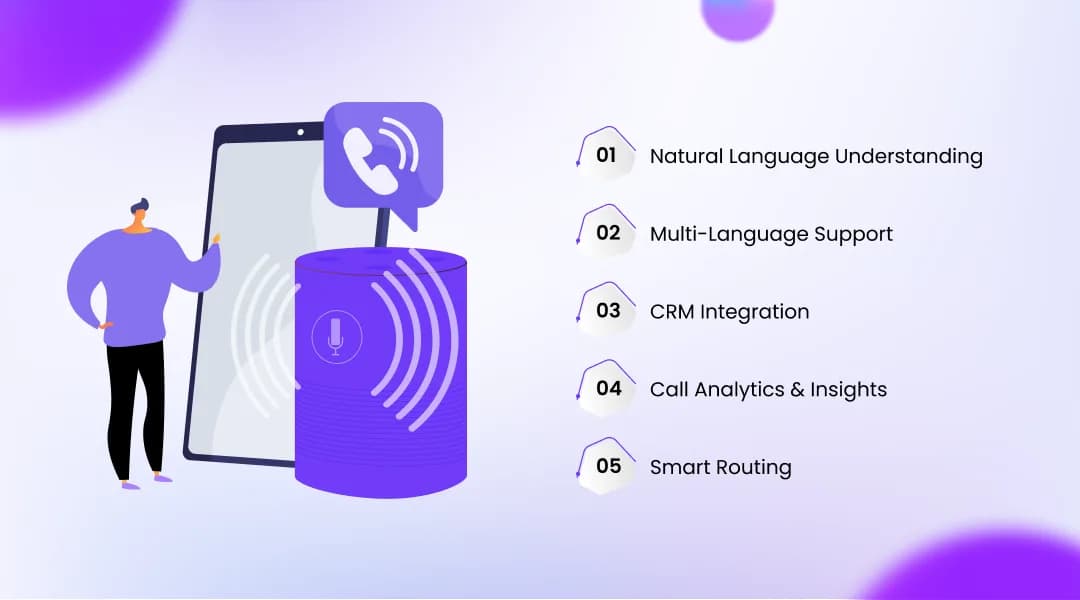
Not every AI voice assistant drives conversions. Here's what separates the ones that do from the ones that just talk:
Natural Language Understanding
The bot must understand real speech. When a caller says "haan bhai, kal jo enquiry ki thi uska kya status hai?" the system needs to parse intent, extract context, and respond appropriately. Keyword matching won't cut it. Genuine natural language understanding is the baseline.
Multi-Language Support
For Indian businesses, this is non-negotiable. Over 90 percent of India's internet users prefer a language other than English. A conversational AI voice bot that only handles English is ignoring the majority of your potential callers.
The platforms that work in India handle Hindi, Tamil, Telugu, Marathi, Bengali, Kannada, and, critically, Hinglish: the natural blend that most urban callers actually use. Companies like OnDial build with deep Indian language capabilities because they understand this market isn't one language. It's many.
CRM Integration
An AI assistant that can't access customer data in real time is a talking FAQ page. It needs to pull order status, check appointment availability, update lead records, and log call outcomes, all within the conversation. Without backend integration, you have a novelty, not a business tool.
Call Analytics & Insights
Every call should produce actionable data: conversion rates, intent distribution, peak call times, drop-off triggers, sentiment patterns. If your platform doesn't give you a dashboard that helps you improve, you're operating blind.
Smart Routing
When the AI reaches its limits, and it will because no AI handles everything, it must transfer to a human agent with full context. Caller identity, conversation summary, intent, qualification score. The agent picks up informed and ready, not starting the conversation over from scratch.
Use Cases Across Industries
Let me show you what I've seen work across 20+ deployments:
E-commerce (Order Queries)
A D2C skincare brand fielding 7,500 daily calls, with 65 percent being "where is my order?" and return requests, deployed an AI voice bot for lead generation and support. The bot handled those queries autonomously in Hindi and English. Agent workload dropped 58 percent. Monthly support costs fell from ₹6.4 lakhs to ₹2.1 lakhs. The freed-up team focused on VIP customers and complex complaints.
Real Estate (Lead Capture)
Speed is everything in real estate. A Pune-based developer was generating 3,500 monthly inquiries from digital ads. Their sales team could call back roughly 1,100. The rest went cold. We deployed an AI voice assistant that called every inquiry within 45 seconds of form submission, asked qualifying questions (budget, BHK preference, timeline), and booked site visits for qualified leads. Sales conversions increased 41 percent.
Healthcare (Appointment Booking)
A chain of diagnostic centers automated appointment confirmations across Hindi, English, and Marathi. The bot called patients 24 hours before appointments, confirmed or rescheduled, and updated the scheduling system in real time. No-show rates fell 34 percent. Front desk staff were redeployed from phone duty to in-clinic patient experience.
Local Businesses (Missed Call Handling)
A dental clinic in Hyderabad was missing 40 percent of calls during consultation hours because the receptionist was busy with walk-in patients. An AI call assistant picked up every missed call within 10 seconds, answered common questions (hours, pricing, insurance), and booked appointments. Monthly new patient bookings increased 28 percent without a single additional marketing rupee spent.
SaaS (Demo Scheduling)
An HR-tech startup processing 800 monthly demo requests was following up manually. Average response time: 3 hours. We deployed AI to call every demo request within 60 seconds, confirm interest, ask qualifying questions, and book the demo directly into the sales team's calendar. Demo show-up rates improved 45 percent because prospects were contacted while their intent was still fresh.
AI Voice Assistants vs Human Agents
Speed
An AI responds in seconds. A human team responds when someone is available. For inbound leads, that gap is measured in conversions lost.
Cost
Factor | Human Agent | AI Voice Assistant |
Cost per Call | ₹15 to ₹40 (fully loaded) | ₹1 to ₹5 |
Availability | Shift-based | 24/7/365 |
Concurrent Calls | 1 per agent | Hundreds |
Consistency | Varies by training, mood, tenure | Uniform every interaction |
Scalability | Weeks (hire, train, onboard) | Hours |
Efficiency
AI handles repetitive, pattern-based queries faster and more consistently than humans. Humans handle complex, emotionally nuanced, or judgment-intensive interactions better than AI. This isn't a contest. It's a division of labor.
Hybrid Approach (Best Strategy)
The smartest businesses I work with don't choose AI or humans. They deploy both. AI handles the 60 to 70 percent of calls that are routine, data-driven, and time-sensitive. Humans handle the 30 to 40 percent that require empathy, creative problem-solving, or authority to make exceptions.
The result is that agents do more meaningful work, customers get faster service, costs go down, and satisfaction goes up. Simultaneously.
How to Implement AI Voice Assistants in Your Business
Step-by-Step Setup
Step 1: Audit your call data. Pull your last 90 days of call records. Identify the top 8 to 10 query types by volume. Calculate your current response time, resolution rate, and missed call percentage. This baseline tells you exactly where the AI will deliver the most impact.
Step 2: Define your conversion events. What counts as a "conversion" for your business? A booked demo? A scheduled appointment? A qualified lead passed to sales? A resolved support query? Be specific. The AI needs to be optimized for outcomes, not just conversations.
Step 3: Choose the right platform. More on this below.
Step 4: Design conversation flows. Map the ideal conversation for each of your top query types. Include qualification questions, branching logic, escalation triggers, and CRM update actions. This is where most implementations succeed or fail.
Step 5: Deploy, measure, and optimize. Go live with your highest-volume use case first. Measure resolution rate, conversion rate, and escalation percentage. Optimize weekly for the first month. Then shift to monthly reviews.
Choosing the Right Tool
Look for five things: multilingual support for your actual customer base, real-time CRM integration, transparent pricing without hidden per-minute overages, custom workflow capability (not rigid templates), and a vendor who treats deployment as the beginning of a partnership rather than the end of a sale.
Integration Tips
Start narrow. Don't try to automate everything on day one. Pick your highest-volume, most repetitive call type and prove the model there first. Success in one use case builds organizational confidence for expansion.
Best AI Voice Assistant Tools: What to Look For
The Indian AI voice assistant market has matured considerably. When evaluating platforms, here's what matters most:
Depth of language support. Not "we support Hindi" on a marketing page. Tested, fluid handling of Hindi, Hinglish, and regional languages with real callers speaking the way your customers actually speak. Always request a live demo in your customer's language.
Customization vs templates. Your call workflows are specific to your business. A platform that forces you into pre-built templates will underperform one that adapts to your operations. Companies like OnDial build tailored AI voice solutions specifically because one-size-fits-all doesn't work.
Backend connectivity. Can the platform talk to your CRM, OMS, booking system, or payment gateway in real time during the conversation? If not, it's a standalone toy.
Pricing transparency. Ask about per-minute rates, overage charges, setup fees, and what happens when volume spikes. Vague pricing is a red flag.
Post-deployment support. The vendor's job doesn't end at go-live. The real value of AI call assistant software is built through ongoing optimization: reviewing performance data, updating conversation flows, training new intents. A vendor who disappears after launch isn't a partner. They're a liability.
Challenges & Limitations
I'd be dishonest if I said AI voice assistants are perfect. They aren't.
Complex Queries
AI excels at structured, pattern-based interactions. It struggles with multi-layered, emotionally charged, or deeply ambiguous problems. A customer explaining a complicated billing dispute while simultaneously expressing frustration about three previous bad experiences needs a human. The key is designing your system to recognize these moments and escalate gracefully.
Human Touch Limitations
AI can detect frustration from tone and word choice. It cannot truly empathize. For interactions that require genuine emotional connection, a sensitive insurance claim, a medical concern, a customer who feels unheard, human agents remain essential. The goal isn't to eliminate humans. It's to stop asking them to do work that AI handles better.
Setup & Training
Building a properly integrated AI voice workflow isn't instant. Expect 3 to 6 weeks for a mid-complexity deployment. The conversation design, CRM integration, multilingual configuration, and testing all take real effort. The ROI justifies it, but the upfront investment in time and attention is real.
Be honest with yourself: do you know what your top 10 call types are, and what percentage of your total volume they represent? Because if you can't answer that question, you're not ready to deploy AI. You're ready to audit.
Future of AI Voice Technology
Hyper-Personalization
The next generation of voice AI for sales conversion won't just know who's calling. It will predict why they're calling based on recent behavior: pages visited, forms started but not submitted, cart items abandoned. The conversation will begin with context, not questions.
Emotion Detection
Voice carries emotional data that text doesn't. Pitch, pace, volume, pause patterns. AI systems that detect and respond to a caller's emotional state in real time, adjusting tone and escalation behavior accordingly, are moving from research into production. Imagine a bot that senses rising frustration and proactively says, "I can hear this has been difficult. Let me connect you with someone who can help right away."
Voice Commerce Growth
India's voice commerce market is growing rapidly. Ordering products, checking prices, tracking deliveries, and making payments through voice, all in regional languages. Businesses that build voice AI infrastructure now are positioning themselves for a customer base that will increasingly prefer speaking over typing.
Conclusion
Here's what 12 years of revenue operations have taught me about the phone channel:
Most businesses treat calls as operational overhead. Something to be managed. Routed. Survived. The companies winning right now treat calls as their highest-intent touchpoint, the moment when a prospect or customer is actively reaching out, and they've built systems to make every one of those moments count.
AI voice assistants aren't about replacing your team. They're about making sure every call, every lead, every customer inquiry gets the response it deserves, at the speed it demands, in the language it requires.
The businesses I work with that have made this shift aren't just cutting costs. They're converting more. Retaining more. Growing faster. Because their phone channel finally works the way it always should have.
If your current system is still letting calls ring out, go to voicemail, or get followed up hours later, the math on what you're losing is worse than you think.
Run the audit. Do the math. And then decide whether you want to keep leaking revenue or start capturing it.