One study of more than 130,000 calls across 45 service businesses found that 74% went unanswered during normal working hours, according to Murf. Not after hours. During the day, when the phone was supposed to be covered.
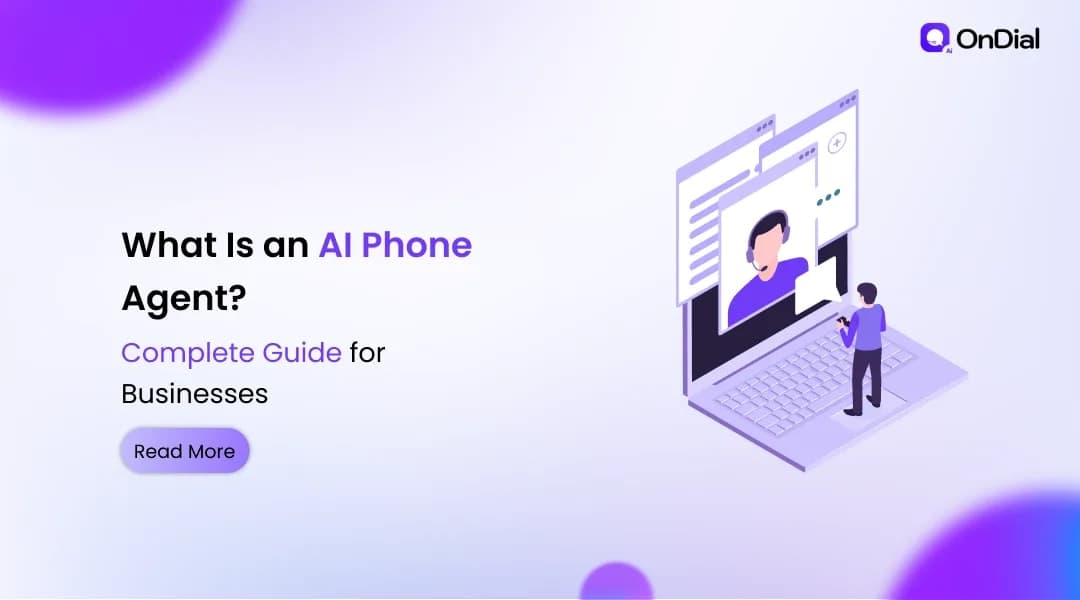
That number is the whole reason this technology exists. If you run a business, every one of those unanswered calls is a booking that slipped away or a customer who called your competitor next. An AI phone agent is software that picks up the phone, holds a real conversation in natural language, and completes the task the caller wanted, without a human on your end. It listens, understands what is being asked, pulls answers from your systems, and either resolves the call or hands it to a person when it should.
I lead voice AI work at OnDial, and I have watched teams go from missing a third of their calls to answering every single one within a week. This guide is the honest version. Here is what an AI phone agent actually is, how it works under the hood, what it costs, whether it really sounds human, and how to tell if it fits your business before you spend a rupee or a dollar.
What Is an AI Phone Agent, Exactly?
An AI phone agent is a conversational voice system that answers or places phone calls, understands open-ended speech, and takes real action such as booking an appointment or updating a record, especially when powered by a multilingual AI voice agent that can communicate naturally with customers across different languages. It replaces the rigid phone menu with something closer to a trained employee.
That definition matters because the term gets muddied by marketing. So let me draw the lines clearly before we go deeper.
AI Phone Agent vs IVR: Why This Isn't "Press 1 for Sales"
We have all been trapped in a menu maze. Press 1 for billing, press 2 for support, press 0 in the vain hope of reaching a human.
That system is called IVR (Interactive Voice Response), and it is a fixed decision tree. It only recognizes the buttons you press or a handful of scripted commands. An AI phone agent has no tree. It runs on natural language processing (NLP) and a large language model (LLM), so a caller can say "I got locked out of my account" or "I can't log in," and the agent understands both as the same problem. The caller never navigates a menu. They just talk, and the agent responds in context.
The difference in practice is enormous. An IVR routes, while an AI phone agent resolves, and our guide on AI phone agents vs IVR systems explains why modern conversational AI consistently outperforms traditional menu-based calling. One sends the caller somewhere else, and the other actually finishes the job.
The Terms People Mix Up: Voice Agent, Virtual Receptionist, Chatbot
"AI phone agent," "AI voice agent," and "AI virtual receptionist" mostly point at the same thing: an AI system that handles voice calls. The naming shifts by vendor and use case, not by underlying technology.
A chatbot is a different animal, though. Chatbots handle text on your website or WhatsApp, turn by turn, with seconds of delay between messages. A voice agent handles live audio in real time, which is a much harder engineering problem because it has to manage interruptions, pauses, and turn-taking the way people do. That real-time constraint is exactly why voice AI took longer to get right than text chat.
How Do AI Phone Agents Work?
Understanding how AI phone agents work takes the mystery out of the buying decision, especially when you understand the speech recognition, language models, and automation behind every conversation. There is no magic here. Just four pieces working together in under a second, looping for the length of the call.
The Four-Part Stack Behind Every Call
Every capable AI phone agent strings together the same four components. Miss one and you get a fancy voicemail instead of an agent.
Speech-to-text (STT): The moment a caller speaks, the system transcribes their words in real time. This is the agent's ears.
Language understanding (LLM): A large language model reads the transcript, works out intent, remembers what was said earlier in the call, and decides what to do next. This is the brain.
Action and retrieval: The agent looks up real answers from your knowledge base, CRM such as Salesforce or HubSpot, or booking system, often using retrieval-augmented generation (RAG) to stay accurate, then executes tasks like creating an appointment. These are the hands.
Text-to-speech (TTS): The agent replies in a natural voice, and the loop starts again. This is the mouth.
In projects at OnDial, the retrieval layer is where most of the real value hides. An agent that can only chat is a novelty. An agent wired into your calendar and customer records is a team member.
Why Latency Is the Whole Game
Here is the part vendors rarely explain to buyers. The single biggest factor in whether a caller believes they are talking to a person is not the voice. It is speed.
Get the full round trip under roughly 600 milliseconds and callers stop noticing the AI, according to benchmarks from platforms like Retell. Cross above it and people start saying "hello? hello?" into the silence. That gap is the difference between a call that feels natural and one that feels broken, and it is the first thing I would test in any demo.
What Can an AI Phone Agent Do for Your Business?
The real AI phone agent benefits show up in two places: calls you were losing, and hours your team was burning on repetitive work. Let me show you both, with numbers.
Everyday Use Cases That Pay for Themselves
An AI phone agent handles the calls that make up the bulk of most businesses' volume, including appointment booking, order status, pricing questions, lead qualification, and after-hours inquiries, making AI voice agents for sales and lead generation a practical solution for converting more conversations into qualified opportunities.
Consider a home services company. A roofing contractor who deployed voice AI went from missing 64 calls a month to capturing all but two, per a case documented by NextPhone. Those recovered conversations turned into eight extra quotes and two additional closed projects, adding around $36,000 in monthly revenue against a tool cost of a few hundred. The agent did not sell harder. It simply answered the phone the contractor could not reach while up a ladder.
Have you added up what your own missed calls are actually worth?
The Numbers: Cost, ROI, and Missed-Call Recovery
Now for AI phone agent cost, since most guides bury it. In 2026, platforms typically charge between $0.05 and $1.00 per minute, with most real deployments landing around $0.10 to $0.25 per minute all in, according to Murf. A routine four-minute call runs roughly $0.28 to $0.60 by AI, compared with $3 to $7 for a US-based human agent.
The return follows from there. A Forrester Total Economic Impact analysis modeled enterprise deployments hitting 331% to 391% ROI over three years, with payback in about three months. On the macro scale, Gartner projects that conversational AI will cut contact center labor costs by $80 billion in 2026, not by firing agents, but by absorbing the call volume that would otherwise overwhelm them.
Return on investment here is straightforward: automation handles the repetitive volume, and your people handle the calls that need a human. The market reflects that logic, growing from $2.4 billion in 2024 toward a projected $47.5 billion by 2034, per Market.us figures cited by Ringly.
Do AI Phone Agents Really Sound Human?
Short answer: yes, more than you would expect, and that is exactly why you should also know where the illusion breaks. In controlled listening tests for English and major languages, evaluators in 2026 struggle to reliably tell AI speech from human speech more than half the time. This is the question buyers ask most, so it deserves an honest answer rather than a sales pitch.
Where the Voice Holds Up, and Where It Slips
Modern TTS voices are genuinely convincing on routine calls. The cadence is smooth, the tone is warm, and callers frequently assume they are speaking with a receptionist.
The seams show under stress. Voice models still carry an even rhythm that lacks the mid-word stress humans use on emotional content. AI agents also tend to over-acknowledge, saying "I understand" or "got it" before every answer in a way people rarely do. And when you throw an unexpected question at a weaker agent, it either handles it cleanly or falls back to "let me transfer you," which is the giveaway.
The Honest Limitations Nobody Sells You
I would rather you deploy this well than deploy it blind. So here is the nuance the glossy pages skip.
Callers do not universally want AI. Research compiled by AInora found that for complex or emotional issues, 73% of people still prefer a human. The same data found that wait time, not the AI-versus-human question, is the biggest frustration for 84% of callers, which is the real argument for automation. Background noise and overlapping speech also degrade accuracy sharply, so an agent that aces a quiet demo can stumble on a real call from a busy street. A well-designed agent knows its limits and escalates gracefully. That graceful handoff is not a nice-to-have. It is the feature that separates a helpful agent from an infuriating one.
How to Choose the Right AI Phone Agent
Knowing how to choose an AI phone agent is less about feature checklists and more about outcomes and fit. The wrong tool leads to low adoption and wasted budget. Here is the practical filter.
A Practical Evaluation Checklist
Score any platform you are considering against a few criteria that actually predict real-world success, not demo-day polish.
Latency under load: Does it stay near 600 milliseconds when many calls come in at once, not just in a solo test?
Integration depth: Can it write to your CRM, calendar, and booking system natively, or does everything need custom engineering?
Escalation quality: When it transfers to a human, does the caller have to repeat themselves, or does the agent pass full context?
Noise handling: How does accuracy hold up with background sound and interruptions?
Transparent pricing: Is the per-minute cost clear, or hidden behind enterprise minimums and multi-year contracts?
Define your use cases before you buy, and train the agent on your own historical calls so it sounds like your team from day one. That single habit separates smooth rollouts from stalled ones.
Compliance You Can't Skip (India and Global)
This is where a lot of businesses get caught, and it is the part almost no ranking guide covers properly. Voice automation sits on top of regulation, and the rules differ by geography.
In India, outbound calling intersects with TRAI DLT (Distributed Ledger Technology) registration for commercial communications, and customer data handling falls under the DPDP Act (Digital Personal Data Protection). Globally, you may face the TCPA in the US, HIPAA for healthcare data, the EU AI Act's transparency requirements, and a growing list of state disclosure laws in places like California and Illinois that require the agent to identify itself as AI early in the call. At OnDial, we treat consent management and clear AI disclosure as non-negotiable, because a compliant deployment is the only kind worth building. Skipping this step does not save time. It just moves the cost to a worse day.
Conclusion
An AI phone agent is no longer a futuristic gadget. It is a working system that answers every call, resolves routine requests, and hands the hard ones to your team, and the three things worth remembering are these: it replaces the hated phone menu with real conversation, it pays for itself mainly by recovering calls you were already losing, and it only works well when the escalation and compliance are handled properly.
You started this guide wondering if this was just a fancy robocall. Now you can tell the difference between a demo and a deployment, and you know the questions to ask before you commit. That clarity is the whole point.
If you want to hear what a natural, compliant voice agent would sound like answering your specific calls, that is exactly what we build at OnDial. Bring us your busiest, most-missed call type, and we will show you honestly whether an AI phone agent is the right move for it.