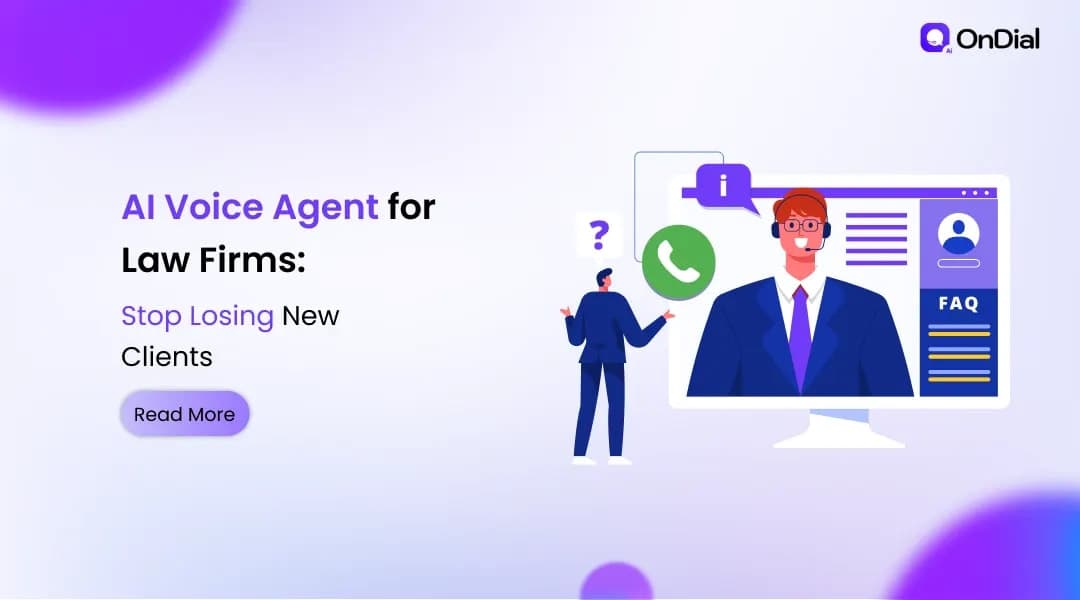
Someone facing a possible arrest, a car accident, or a custody battle does not calmly research attorneys and wait for a callback. They pick up the phone in a moment of crisis, and they keep dialing firms until a real person answers. Research on legal client intake shows that law firms miss roughly 35 percent of incoming calls during business hours, and that figure climbs to 60 percent or higher after hours and on weekends, which is precisely when many legal emergencies happen. An AI voice agent for law firms closes this gap by answering every one of those calls instantly, at any hour, and carrying the conversation far enough to qualify the matter and book the consultation before the caller ever thinks about the next firm on their list, making AI voice agents for legal services an essential solution for modern firms.
The scale of the leak is staggering when you look at the whole industry. Studies estimate that around 195 million calls go unanswered across the legal sector each year, translating into roughly 13 million lost potential clients and enormous lost revenue that most firms never see because a missed call leaves no trace in the system. This blog breaks down what those missed intake calls actually cost you, why traditional answering services and human intake teams keep failing, how an AI voice agent captures every client from the first ring, when a human attorney should take over, the measurable impact on your intake conversion, and what it takes to deploy this in your firm.
What missed intake calls really cost your firm
The true cost of a missed intake call is not the call; it is the entire case behind it. A single new client inquiry in personal injury can represent a contingency fee worth thousands or tens of thousands, and in family law, criminal defense, or immigration, the lifetime value of that client and their referrals runs even higher. When you reframe a missed ring as a lost case rather than a missed conversation, the math becomes impossible to justify. Most firms underestimate this loss precisely because law firm missed calls are silent, invisible on every report, and leave no record in the CRM.
The problem compounds because legal demand does not respect office hours. Roughly 60 percent of after-hours and weekend calls come from first-time callers, which means these are not existing clients with routine questions; they are new business walking in the door and finding the lights off. A prospective client in distress at 9 in the evening is not going to wait until Monday; they are going to hire whoever answers tonight. This is why after-hours coverage is not a convenience feature for a law firm; it is a direct driver of caseload and revenue.
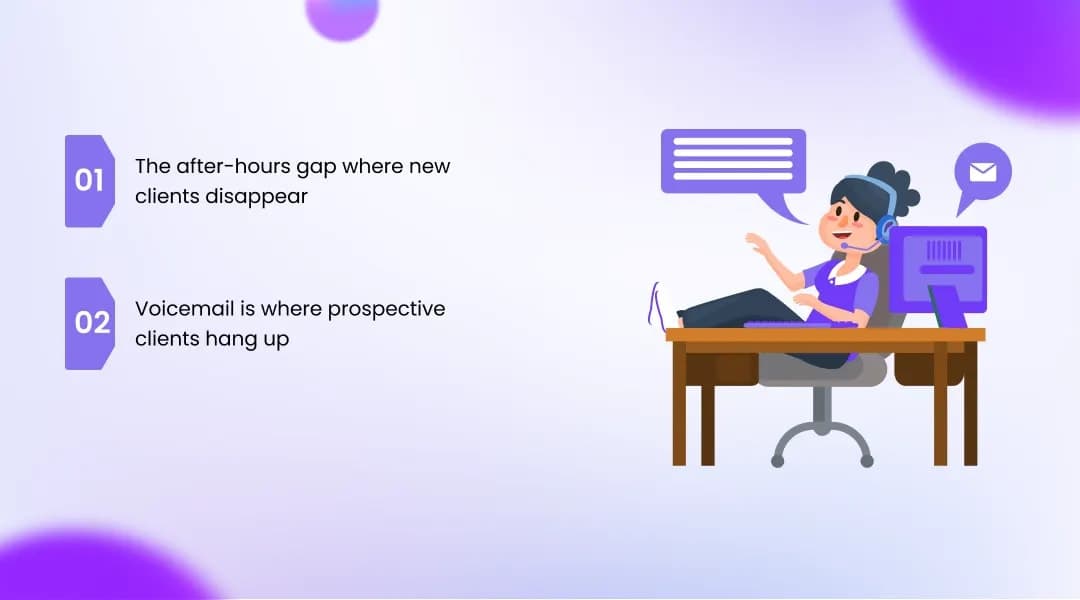
The after-hours gap where new clients disappear
Firms without after-hours coverage are effectively invisible for a huge portion of the calendar. Accidents, arrests, and family emergencies do not follow a Monday to Friday schedule, so a firm that only answers during business hours is unreachable for roughly 30 percent of the year, plus every evening. During each of those windows, the phone still rings, and every unanswered ring is a case that never enters your pipeline. The callers who reach a firm during these gaps are disproportionately the highest intent prospects, because urgent legal problems are what make people call at odd hours in the first place.
Voicemail is where prospective clients hang up
Voicemail is no longer a safety net; it is where intake goes to die. Around 85 percent of callers who reach voicemail never leave a message, and of those who do not reach a live person on the first attempt, roughly 85 percent will not call back at all. A stressed prospective client who hits an automated message hears one thing: that this firm cannot help them right now, and they immediately dial the next result on their search page. This is the moment where your marketing spend evaporates, because you paid to make that phone ring and then no one was there to answer it.
Why traditional intake solutions fail law firms
Most firms already sense they are losing clients, and most have tried to fix it with a receptionist, an answering service, or stricter callback rules. These fixes fail not because anyone is careless but because the underlying model cannot match how modern legal clients behave. Understanding why the traditional approach breaks down is the first step toward real law firm client intake automation that actually holds up under volume.
Answering services take messages, not cases
A traditional answering service answers the phone, but it cannot do the one thing intake actually requires, which is to qualify the matter. The operators have no legal training, so they cannot run a basic conflict check, ask whether the caller is within the statute of limitations, or determine whether the matter falls inside your practice areas. They take a name and a number, and by the time an attorney calls back hours later, the prospective client has usually already retained someone else. This turns your answering service into an expensive voicemail with a human voice, capturing contact details while the actual case walks out the door.
A human intake team cannot beat the speed to lead math
Even a great in-house intake specialist runs into hard limits. A dedicated intake hire costs tens of thousands of dollars a year plus benefits, works a nine-to-five schedule while legal crises do not, takes vacation, and can only handle one call at a time. When two prospective clients call at once, one gets answered, and the other is lost to a busy signal or a hold that they abandon within seconds. Law firm client intake automation matters here because speed to lead is a math problem, and no human team of realistic size can answer every call within the five-minute window that decides conversion, which is why AI customer support automation has become a competitive advantage across service businesses.
The data on that window is unambiguous. Leads contacted within five minutes are up to 21 times more likely to convert than leads contacted after thirty minutes, and roughly 78 percent of clients hire the first firm that responds. In legal intake, the first attorney to have a live conversation with a prospective client is the one who almost always earns the case, which means every minute of delay is a measurable drop in your win rate on that lead. A human bottleneck at the front of your intake process is the single largest constraint on how many of your paid leads become paying clients.
How an AI voice agent for law firms captures every client
An AI voice agent for law firms is a software agent that answers, qualifies, and routes intake calls automatically, without a human on the line for the first contact. It picks up on the first ring every time, holds a natural spoken conversation, gathers the details your firm needs, and either books the consultation itself or hands a fully qualified prospect to your team. Because it is software rather than a single person, it answers an unlimited number of calls simultaneously, which structurally eliminates both the after-hours gap and the busy signal in one move. This is where a platform like OnDial reshapes the problem, deploying production-grade AI voice agents that respond in under 500 milliseconds, fast enough that the caller never feels they are talking to a machine.
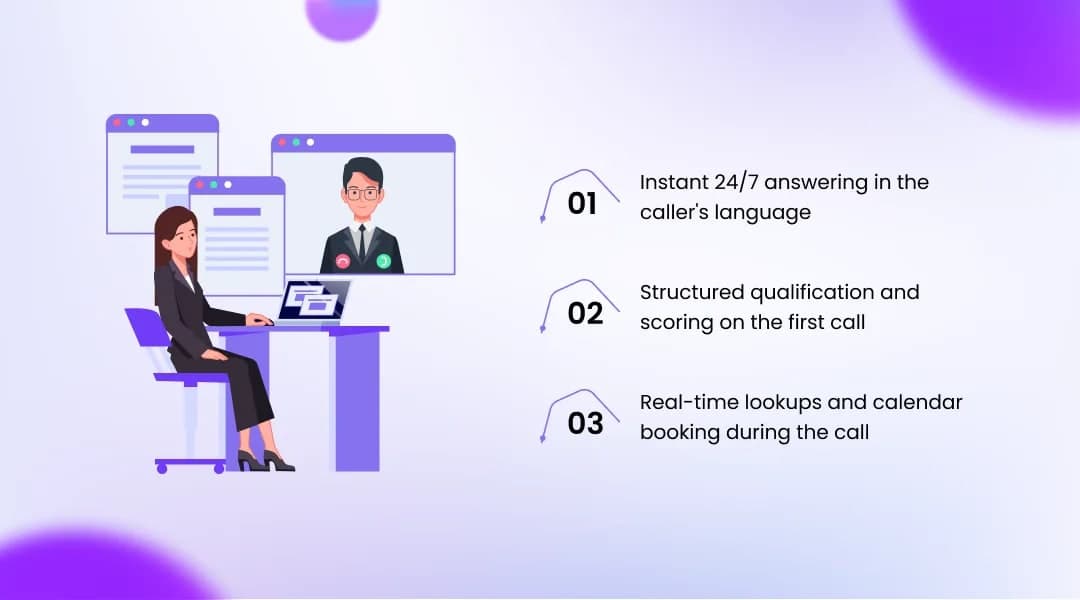
Instant 24/7 answering in the caller's language
The foundation of AI legal intake is simply being there. A well-built AI voice agent answers every call instantly, at 2 in the afternoon or midnight, on a holiday or during a courtroom rush, with the same calm and consistency each time. OnDial provides a genuine 24/7 legal answering service that never sends a distressed prospective client to voicemail, so the evening and weekend inquiries that used to leak away now enter your intake pipeline in real time. Because the agent speaks over 100 languages, including 9 Indian languages with more than 80 Indian voice variations, a firm serving a multilingual client base can meet every caller in the language they are most comfortable using, which for many callers is the difference between trusting the firm and hanging up.
Structured qualification and scoring on the first call
An AI voice agent qualifies legal leads by running a structured intake conversation during the call, capturing the practice area, the nature of the matter, key dates, jurisdiction, and urgency, then scoring the lead against your firm's criteria. This means that by the time a human at your firm gets involved, they are not starting cold; they are opening a conversation with a prospect whose matter and fit are already understood. OnDial handles this lead qualification and scoring automatically and writes the structured intake straight into your existing systems, so your attorneys and paralegals spend their limited hours only on matters worth pursuing. This is the core of law firm client intake automation, because it moves human effort away from triage and toward genuine legal work.
Real-time lookups and calendar booking during the call
A modern AI voice agent does not just talk; it acts, demonstrating the same intelligent capabilities explained in our guide to AI voice agents for customer support. Through real-time API calls made during the live conversation, the agent can check information while the caller is still on the line, such as whether a requested consultation slot is open, whether the caller already exists in your system, or what your intake policy is for a given matter type. OnDial's agents perform these real-time lookups mid-call and can schedule the consultation directly, checking live calendar availability and locking in a confirmed slot before the caller hangs up. This removes the callback delay where a large share of consultations are lost, turning a midnight inquiry into a confirmed appointment without anyone at the firm lifting a finger.
Knowing when a human attorney should take over
The mark of a mature AI voice agent is that it knows its own limits. Intake is a perfect fit for automation, but the moment a conversation moves toward legal advice, a delicate emotional situation, or a complex judgment call, a human needs to step in. A well-designed AI legal intake agent recognizes that boundary and crosses it cleanly, which is what separates a genuine intake asset from a smarter answering machine.
OnDial supports live human transfer mid-call, so the agent hands the conversation to an available attorney or intake specialist the instant the situation calls for it, passing along the full context of what has already been discussed so the client never has to repeat their story. On top of this, OnDial's sentiment-triggered escalation tracks the caller's tone in real time and automatically routes the call to a human when it detects rising distress or frustration, so a person in genuine crisis is never left talking to software a moment longer than helps them. The agent also handles interruptions naturally, so when an anxious caller talks over it, backtracks, or changes direction mid-sentence, the conversation stays smooth rather than breaking down.
This combination matters enormously in legal intake specifically, because the people calling are often frightened, angry, or grieving. An agent that can absorb an emotional, non-linear conversation, capture the facts that matter, and escalate to a human at exactly the right second delivers a client experience that most understaffed intake desks cannot match. The result is that every caller feels heard, the routine matters are handled at scale, and your human team is reserved for the conversations where their judgment genuinely changes the outcome.
The measurable impact on your intake conversion
The business case for AI intake in a law firm rests on a chain of realistic, compounding numbers rather than one dramatic claim. When you move from a next-day or same-hour response to a response within seconds, you recover the exact leads that speed-to-lead research says you were losing to faster competitors. The gains stack, and each one is measurable on its own.
Here is where the impact concentrates:
Response coverage moves from partial to complete, because every call is answered within seconds at any hour, recovering the after-hours and weekend inquiries that previously went straight to voicemail and never called back.
Booked consultations increase, because the agent schedules the appointment during the first call instead of promising a callback, removing the delay where a large share of consultations are lost.
Attorney and paralegal productivity rises sharply, because staff stops spending hours on cold triage and unqualified callers and instead works only on matters that have already been qualified and scored.
Speed to first contact drops from minutes or hours to seconds, and since roughly 78 percent of clients hire the first firm that responds, this alone shifts a meaningful share of contested leads in your favor.
Marketing return on investment climbs, because every dollar spent generating a call now reaches a live, capable intake agent instead of an unanswered line, so fewer paid leads are wasted at the final step.
None of these gains require you to grow your team. A single OnDial deployment handles thousands of simultaneous conversations, which means a firm can absorb a sudden spike in calls, from a viral case, a new advertising push, or a local news event, without hiring a correspondingly larger intake staff. The unit economics change fundamentally when your intake capacity is no longer tied to headcount, because the cost of answering the next call does not rise the way it does with human hires. For a firm losing even a handful of qualified calls a week at a typical case value, closing that gap often pays for the entire system many times over.
Implementation, compliance, and getting started
Deploying an AI voice agent for law firms is far simpler than most managing partners expect, and it does not require ripping out your existing systems. The goal is to sit the agent in front of your current intake process so it answers first, qualifies, and then routes to your people and your software, rather than replacing anything you already rely on. Good implementation is about fitting the agent to your practice areas and intake questions, not forcing your firm to adapt to rigid software.
No code setup or full API control
OnDial offers both a 100 percent no-code deployment path for teams that want to configure and launch without engineering help, and a full API path for firms that want deeper custom integration with their case management and CRM systems, supported by its advanced AI voice agent features. In practice, a solo practitioner or small firm can set up qualifying questions, practice area logic, and calendar booking through a configuration interface, while a larger firm can wire the agent directly into its intake stack and matter database. OnDial's integrations are flexible and enterprise-ready, connecting with your existing CRM and business software so that every qualified intake flows automatically into the systems your team already uses.
Compliance and data handling
Compliance is a top concern in legal intake, because these conversations involve sensitive personal information from the very first sentence. OnDial handles data in a manner that is GDPR and CCPA compliant, with the controls that regulated conversations require built into the platform rather than bolted on afterward. For firms operating in India or serving Indian clients, the platform's strong handling of Hinglish and natural code-switching between Hindi and English means intake conversations feel local and trustworthy, which directly affects whether a caller stays on the line long enough to become a client.
One consistent agent across every channel
Prospective clients rarely stay on a single channel; they call, then message on WhatsApp, then check your website, and they expect the firm to remember them. OnDial provides omnichannel support where one agent maintains the same context across voice, WhatsApp, SMS, web chat, and email, so a caller who spoke to the agent last night and then messages this morning does not have to start over. This continuity keeps a lead warm across the entire decision window, which in legal matters can stretch across several days as the client decides whether to retain counsel. The prospect experiences one consistent, informed point of contact rather than a series of disconnected touchpoints that each begin from zero.
Conclusion
Three points define the case for AI intake in a law firm. First, the cost of missed and slow-answered calls is enormous and invisible, because firms miss roughly 35 percent of calls during business hours and 60 percent or more after hours, and the loss never appears on any report. Second, traditional answering services and human intake teams cannot fix this, because they take messages instead of qualifying cases and cannot beat the speed-to-lead math that decides conversion. Third, an AI voice agent for law firms removes those limits by answering every call in seconds, qualifying and scoring the matter, booking the consultation, and handing off to a human attorney at exactly the right moment.
OnDial delivers precisely this, with responses in under 500 milliseconds, a genuine 24/7 legal answering service, real-time lookups and calendar booking during the call, automatic qualification and scoring, live human transfer and sentiment-triggered escalation, strong Hinglish and regional Indian language support, flexible integration with your existing case management and CRM systems, and omnichannel continuity across voice, WhatsApp, and web. Whether you run a solo practice or a large firm, OnDial deploys through either a no-code setup or a full API integration, with GDPR and CCPA-compliant data handling built in. If you want to stop losing prospective clients to voicemail and faster competitors, book a demo with OnDial or start a free trial and let an AI voice agent answer the next intake call that would otherwise have gone unanswered.