A homeowner's water heater gives out at 8:40 on a Thursday night, and they call the first three plumbers on their screen. The one who picks up gets the job, and the other two never learn they lost it. An after hours answering service exists to make sure you are the one who picks up, whether the answer comes from a person, an automatic text or an AI voice agent.
Most owners underestimate this problem because a missed call leaves almost no trace. There's no angry email and no bad review, just a number in the call log that nobody had time to return. The lost revenue only shows up later as a slow month that nobody can quite explain.
What Is an After Hours Answering Service?
An after hours answering service is any system that answers or responds to your business calls when your team can't, usually evenings, weekends, holidays and busy stretches during the day. It can be a team of human operators, an automated text sent to the caller, an AI voice agent that holds a real conversation, or a mix of all three. The goal is the same in every case: nobody who calls you ends up talking to silence.
The setups differ a lot in what they can actually do. A human answering service routes your calls to operators who greet callers, take messages and follow a script you approve. A missed-call text back sends an SMS within seconds of an unanswered ring, inviting the caller to reply by text. An AI voice agent (sometimes called a virtual receptionist) picks up the call itself, answers questions, qualifies the caller and can book appointments straight into your calendar.
It's worth separating two problems that look alike. After-hours calls arrive when you're closed, while missed calls during open hours happen because everyone is on another line, on a job site or with a client. These overflow calls often cost just as much, and the same tools cover both, which is why most providers sell them together.
How Much Revenue Leaks Through Missed and After-Hours Calls
Your revenue leak equals the calls you miss, multiplied by the share that were real leads, multiplied by how often those leads would have bought, multiplied by your average job value. That chain matters because each link can be measured. In its Lead Conversion Benchmarks Report published in July 2026, Invoca analyzed more than 70 million calls across 10 industries and found that only 56% of calls to businesses were answered by a person.
The same report found that 38% of answered calls were genuine leads, and 42% of those leads converted during the call itself. Put differently, a meaningful slice of every ringing phone is a customer ready to buy right now. When that call goes unanswered, the purchase doesn't wait for you.
What Callers Do When Nobody Picks Up
Most callers move on quickly, and many never come back. A September 2025 CallRail survey of 1,000 US consumers found that 78% had taken their business elsewhere after failing to reach a company by phone. In the same survey, 82% said they would call a competitor if a business didn't answer, and 21% said they immediately dial another business.
Businesses rarely close the gap on their own, either. Quo analyzed 16.7 million missed calls on its business phone platform over three months in 2026 and found that 69% got no callback within 48 hours. Healthcare did best in that dataset, yet even there only 41% of missed calls were returned.
Which Missed-Call Statistics You Can Trust
Two figures dominate this topic online, and both deserve a closer look. The claim that 62% of small business calls go unanswered comes from a 2016 study by the marketing firm 411 Locals, which tracked 85 businesses for 30 days, and many articles misdate it as recent research. The equally popular line that 80% of callers refuse to leave voicemail traces back to a 2014 trade-magazine item that credited Forbes without naming a study, while CallRail's 2025 survey found that 42% of consumers say they do leave a voicemail.
None of this means missed calls are harmless. It means you should build your business case on current, sourced numbers, and better still, on your own call logs. Thirty days of your data will tell you more than any industry average.
A Worked Example: Estimating Your Monthly Leak
You can estimate your own leak in five minutes with a simple calculation. The table below uses a hypothetical home services company receiving 400 calls a month and applies the benchmark ratios from the Invoca report. Swap in your own call volume, answer rate and average ticket to get your number.
Step | Assumption | Result |
Inbound calls per month | Your phone system's total | 400 |
Calls not answered by a person | 44% (Invoca 2026 cross-industry average) | 176 |
Missed calls that were real leads | 38% of missed calls | about 67 |
Leads that would have converted | 42% close rate | about 28 jobs |
Revenue at risk | $350 average ticket | about $9,800 per month |
Treat this as an upper estimate rather than a forecast. The 44% unanswered figure includes misdials and very short calls, and Invoca's answer rate rises to 65% once calls under 15 seconds are filtered out. Even if the real figure is half of this example, most service businesses would notice that money.
Why Voicemail and Next-Morning Callbacks Don't Close the Gap
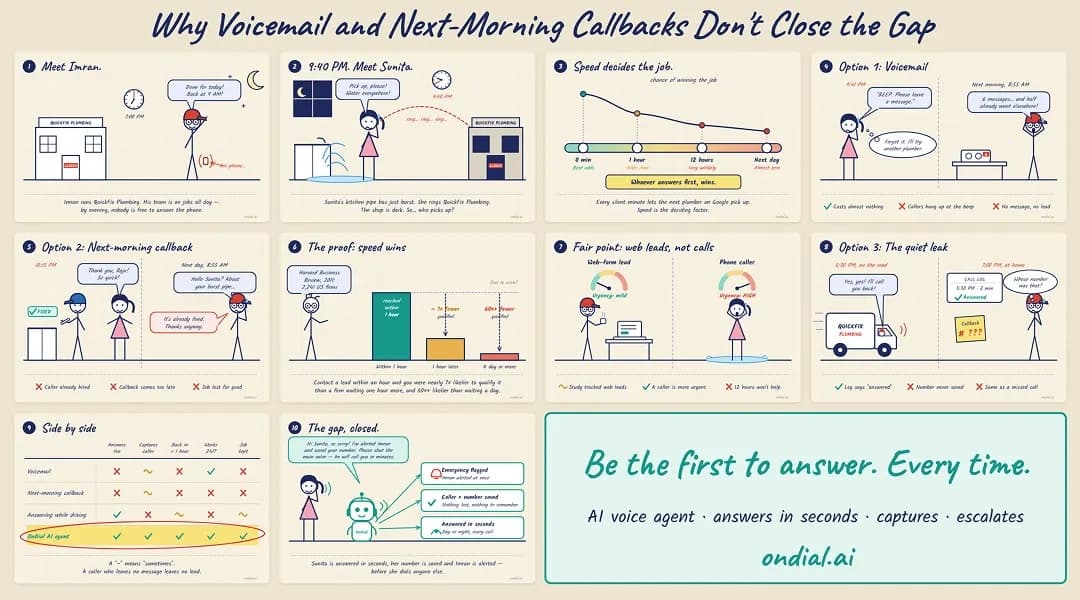
Voicemail fails as a safety net because many callers won't leave a message, and the ones who do have often hired someone else before you call back. Speed is the deciding factor. A 2011 Harvard Business Review audit of 2,241 US companies found that firms trying to contact a lead within an hour were nearly seven times as likely to qualify it as firms that waited even one hour longer, and more than 60 times as likely as firms that waited a day or more.
That study tracked web leads rather than phone calls, so it isn't a perfect match. Still, a caller with a leaking pipe or a cracked tooth is more urgent than someone filling in a contact form, not less. If a delay of one hour hurts a web lead, a delay of twelve hours is unlikely to help a caller.
There's also a quieter leak that doesn't show up as a missed call at all. A technician answers while driving, promises to call back and forgets to write down the number. The call log marks it as answered, but the outcome is the same as a ring that nobody picked up.
How Automated Missed-Call and After-Hours Answering Works
Automated answering works as a chain: your phone system detects an unanswered or after-hours call, hands it to an answering layer, and that layer captures, qualifies and routes the caller before writing everything back to your tools. Each step is simple on its own. The value comes from linking them so nothing depends on someone remembering to follow up.
Trigger. Call forwarding rules decide when the system steps in, such as no answer after four rings, a busy line, or any call outside your set business hours.
Answer. An AI voice agent greets the caller with your business name. Speech recognition turns the caller's words into text, a language model decides what to say, and speech synthesis speaks the reply. In a text-only setup, an SMS goes out instead.
Understand and qualify. The agent works out why the person is calling (new booking, existing customer, emergency, spam) and asks the qualifying questions you defined, such as service type, location and timing.
Act. It checks live calendar availability, books a slot and sends a confirmation text, or creates a lead record when booking isn't appropriate.
Escalate. Calls that match your emergency rules are transferred to an on-call person, ideally with a short summary so the caller doesn't have to repeat themselves.
Log. A transcript, summary and recording (where the caller has been told about recording) go into your CRM, and your team gets a notification.
Follow up. If the caller hangs up early or doesn't book, an SMS sequence picks up where the call left off.
How natural the voice side feels depends mostly on response delay and on how well the agent was configured with your services, prices and rules. In most implementations, the first week involves listening to transcripts and tightening answers. That tuning is normal, and skipping it is one of the main reasons people decide AI answering "doesn't work."
Auto-Answer, Qualify and Book While You Sleep
An automated answering setup earns its keep when it does more than take a message: it answers on the first ring, asks the questions your best receptionist would ask, and puts a confirmed slot on your calendar. Message-taking only moves the work to tomorrow morning. Booking finishes the job while the caller is still motivated.
Qualifying Callers Without Sounding Scripted
Good qualification feels like a helpful conversation, not an interrogation. Picture a dental clinic at 9:15 pm: the agent asks whether the caller is a new or existing patient, what's bothering them, and whether they're in pain right now. Three questions in, it knows whether to offer tomorrow's first emergency slot, a routine cleaning next week, or a transfer to the on-call dentist.
The same pattern works across trades and professional services. A pest control company might ask about the type of pest and property size, while a law firm might ask about the practice area and whether a deadline is involved. Write down the questions your team already asks on the phone, and that becomes your qualification script.
Booking Straight Into Your Calendar
Direct calendar booking removes the step where most after-hours leads die. The agent reads your real availability, offers two or three times, books the one the caller picks and sends a confirmation text with the details. If they need to reschedule, the same system can handle it without anyone in the office touching it.
This is where speed to lead turns into actual revenue rather than a nice metric. A caller who leaves with a confirmed appointment has much less reason to keep dialing competitors. Curious how that hand-off from an unanswered ring to a confirmed slot plays out step by step? Our walkthrough on Missed call to booked appointment traces the full journey.
Routing Real Emergencies to a Person
Any business automating its phones needs clear rules for which calls should reach a human immediately. A burst pipe, a gas smell, a patient with facial swelling or a client who has just been arrested shouldn't wait for a morning callback. Define those triggers in plain words, name who is on call, and decide how the transfer happens.
Callers also want to know a person is reachable. A Gartner survey of 3,566 customers, published in August 2026, found that 87% consider it essential for companies using generative AI in customer service to offer a way to reach a human agent. A visible human option makes callers more willing to use the automated path, not less.
Missed Call Text Back and SMS Follow-Up
A missed-call text back is an automatic SMS sent to a caller seconds after their call goes unanswered, and it keeps the conversation alive when nobody can talk. It's the cheapest layer of coverage and a sensible place to start. Many callers will still glance at a text even after they've started dialing someone else.
Text alone has a weakness, though. It asks the caller to do the work of typing out their problem, and a stressed caller may not bother. Pair it with voice answering where you can, and use two-way SMS for confirmations, links and follow-up rather than as your only response.
Three Text Templates You Can Adapt
Short, specific messages tend to work better than generic ones because they tell the caller exactly what to do next. Each template below names the business, gives one clear action and includes an opt-out line. Keep messages close to 160 characters where possible, since longer texts are split into multiple segments.
After hours: "Hi, it's Northside Plumbing. Sorry we missed you. If water is leaking now, reply URGENT and our on-call tech will call you. To book a visit: [link]. Reply STOP to opt out."
Busy during the day: "Bright Smile Dental here. We're with patients and saw your call. Reply with what you need (new visit, reschedule or a question) and we'll answer within 15 minutes."
Caller hung up mid-call: "Thanks for calling Oak Street Fitness. Looks like we got cut off. Want to finish booking your intro session? Reply YES and we'll send three open times."
Only promise a reply time your team can actually keep. If you say 15 minutes, someone (or something) has to answer within 15 minutes. A broken promise in the first text does more damage than no text at all.
A Follow-Up Cadence That Doesn't Feel Pushy
A light, time-boxed sequence usually recovers more callers than a single text, without annoying anyone. The rhythm below works for most service businesses, and it respects quiet hours by holding late-night messages until morning. After the final message, stop and log the lead as unresponsive.
Send the first text within a minute of the missed call.
If there's no reply, send one reminder an hour later during the day, or at opening time the next morning if the call came in overnight.
Send a final, low-pressure message about 24 hours after the call with a direct booking link.
Stop messaging and record the outcome in your CRM so your team can see the full history.
Comparing Your Options for Out of Hours Phone Answering

The four main options are voicemail, missed-call text back, a live human answering service and an AI voice agent, and they differ most in whether they can take action or only take a message. Cost matters, but capability matters more. A cheap option that books nothing can end up more expensive than one that books jobs.
Option | Answers live? | Can qualify and book? | Typical pricing model | Best for | Main weakness |
Voicemail | No | No | Usually included with your phone plan | Very low call volume | Many callers hang up without a message |
Missed-call text back | No (responds by SMS) | Partly, through links and replies | Flat monthly software fee in many cases | A low-cost first layer | Relies on the caller replying |
Human answering service | Yes | Depends on script and system access | Per minute, per call or monthly bundle | Calls needing a human voice and judgment | Often limited to message-taking; cost rises with volume |
AI voice agent | Yes | Yes, when connected to calendar and CRM | Per minute or flat plan, depending on provider | High call volume, after-hours and overflow | Needs setup, tuning and clear handoff rules |
Many businesses end up with a hybrid. An AI voice agent answers first, texts handle confirmations and follow-up, and a person takes the escalated calls. That mix covers the hours you can't staff without asking callers to settle for a voicemail beep.
Real Recovery-Rate Examples: What Winning Back Calls Is Worth
Your recovery rate is the share of missed or after-hours lead calls you re-engage, and every point of it is worth real money once you multiply it by your close rate and average ticket. Measure it like this: recovery rate equals re-engaged lead calls divided by total missed lead calls, multiplied by 100. Re-engaged means the caller replied, booked or spoke with you after the initial miss.
Start with your baseline before you change anything. Quo's 2026 dataset suggests that, across its platform, only 31% of missed calls get any callback within 48 hours, so many businesses are recovering far less than they assume. The table below carries forward the worked example from earlier (about 67 missed lead calls a month, a 42% close rate and a $350 average ticket) to show what different recovery rates are worth.
Recovery rate | Re-engaged leads per month | Booked jobs (42% close) | Monthly revenue recovered |
10% | about 7 | about 3 | about $985 |
25% | about 17 | about 7 | about $2,460 |
40% | about 27 | about 11 | about $3,940 |
60% | about 40 | about 17 | about $5,910 |
These figures are illustrative, built from benchmark ratios rather than from any single business's results. Your actual recovery rate depends on your industry, how urgent your callers' needs are, and whether calls are answered live or chased afterward. Run your own numbers for 30 days before and 30 days after you switch coverage on, and you'll have a result you can trust.
Compliance Checks Before You Switch It On
Before automated texts or AI voices reach your customers, check four rule sets: business texting registration, consent for automated calls, call-recording consent and data handling where you operate. Rules vary by country and change often. Treat the points below as a starting checklist, not legal advice.
Texting registration in the US. Major US carriers require businesses sending application-to-person texts from standard 10-digit numbers to register their brand and messaging use cases (known as A2P 10DLC registration), and unregistered traffic can be blocked.
Texting registration in India. Under TRAI's Telecom Commercial Communications Customer Preference Regulations, 2018, businesses sending commercial SMS must register as an entity on a DLT platform, register their sender headers and pre-approve message templates, and messages that don't match are filtered out.
AI voices on outbound calls. In February 2024, the US Federal Communications Commission ruled that AI-generated voices count as "artificial" under the Telephone Consumer Protection Act, so outbound AI calls generally need prior express consent. Answering an inbound call is a different situation from placing an automated callback, so check how your setup handles return calls.
Call recording. Roughly a dozen US states, including California, Florida and Pennsylvania, require consent from everyone on the call before recording. Announcing that calls may be recorded at the start of every call is the safest default.
AI disclosure. Telling callers they're speaking with an automated assistant builds trust and keeps you ahead of disclosure rules that are still evolving in several regions.
What Automated Call Answering Can't Do
Automated answering can't replace human judgment, empathy or on-site diagnosis, and it will only be as accurate as the information you give it. Knowing the limits up front helps you design around them. It also keeps you from promising callers something the system can't deliver.
It can't diagnose a problem it can't see. An agent can collect symptoms and book a visit, but it shouldn't quote a firm price for a repair nobody has inspected.
It handles emotionally heavy calls poorly. A grieving family calling a funeral home or a client in a legal crisis needs a person, and your rules should send those calls to one.
It repeats whatever you taught it. If your price list or service area changes and nobody updates the agent, it will confidently give out old information.
Speech recognition can stumble on heavy background noise, poor connections and some accents or languages, depending on the provider.
Some callers simply won't talk to a machine. In CallRail's 2025 survey, 52% of consumers said AI assistants after hours signal better service, which also means a large share don't feel that way.
It doesn't create capacity. If you book 30 extra jobs a month that your crew can't handle, you've traded a lead problem for a reputation problem.
Who Should Use After-Hours Call Coverage (and Who Shouldn't)
Automated after-hours coverage pays off fastest when a single booked job is worth far more than the monthly cost and callers have urgent or time-sensitive needs. Home services, dental and medical clinics, veterinary practices, legal intake, property management, auto repair and salons all fit that pattern. The common thread is that the caller usually hires whoever responds first.
It isn't for everyone. If you get two or three calls a week, a well-managed voicemail and a prompt callback may be all you need. If most of your demand arrives during business hours, full 24/7 call answering may be more than you need, and overflow coverage at peak times could do the job for less.
Pricing usually follows one of three models: per minute of call time, per call handled, or a flat monthly plan with a usage allowance. Ask any provider how they bill transferred calls, spam calls and SMS, because those details change the real cost more than the headline rate. The aim is to capture leads after hours without hiring a night shift, so compare the total against what even a few recovered jobs are worth.
When you compare providers, look for one that handles voice answering, SMS follow-up, calendar booking and CRM updates in one place, so you aren't stitching four tools together. Ask to hear recordings of real calls rather than a polished demo. You can review what OnDial offers for this kind of inbound call work on the OnDial services page.
How to Set Up After-Hours and Missed-Call Coverage in 7 Steps
You can set up automated after-hours and missed-call coverage in seven steps, starting with your own call data and ending with a weekly review. Most of the effort goes into steps two and three, where you decide what the system should say and when it should hand off. The technical connections are usually the easy part.
Pull 30 days of call logs. Count missed calls by hour and day of week, and note how many came from repeat callers who tried more than once.
List what callers ask. Write down your top ten caller questions, your services, approved price ranges, service area and hours. This becomes the agent's knowledge base.
Write your handoff rules. Define what counts as an emergency, who is on call each night, and how a live transfer should work.
Choose your answering layer. Decide between text-back, AI voice, a human service or a hybrid, based on your volume and how urgent your calls tend to be.
Connect your tools. Link your calendar and CRM, then set forwarding rules such as "no answer after four rings" and "all calls outside business hours."
Handle compliance and test. Complete texting registration, add recording and AI disclosures, then run at least 20 test calls covering emergencies, hang-ups, background noise and unusual requests.
Launch in stages and review weekly. Start with after-hours calls only, read transcripts every week, and expand to daytime overflow once you trust the answers.
Mistakes That Quietly Lower Your Recovery Rate
The mistakes that most often drag down recovery rates are setup gaps rather than technology failures. They come from small choices that nobody revisits after launch. Watch for these patterns in your first month.
Sending a generic "we'll call you back" text with no booking link or next step.
Letting text replies sit unread because nobody owns the inbox.
Forgetting to update the agent when prices, hours or services change.
Hiding the option to reach a person, which pushes frustrated callers to hang up.
Texting people at 2 am instead of holding messages until morning.
Skipping the weekly transcript review, so the same wrong answer repeats for months.
Never measuring the before-and-after recovery rate, which makes the investment impossible to judge.
Stop Paying for Calls Nobody Answers
Most unanswered calls from prospects are leads you already paid to attract, which makes closing the gap one of the quickest revenue fixes available to a typical service business. You don't need a night shift to do it. You need coverage that answers, qualifies, books and hands off the calls that need a person.
Start with your own numbers. Pull last month's missed calls, run them through the worked example above, and see what a 25% or 40% recovery rate would mean for you. Then Talk to us about your call volume, your busiest hours and the questions your callers ask most, and we can walk through how OnDial's AI voice agents would handle them.