Forty percent of calls to hotel front desks go unanswered. That number comes directly from Canary Technologies, whose research team studied call patterns across hundreds of properties. Every one of those missed calls is a guest who needed something: a reservation, a question about parking, a room upgrade, a late checkout. And every unanswered ring is revenue walking out the door, often straight to an OTA that charges 15-25% commission for the same booking.
If you manage a hotel and that stat made your stomach drop, you are not alone. I have spent years working with businesses on AI voice technology at OnDial, and the pattern is always the same: properties know their phones are a problem, but they assume the fix requires more staff they cannot afford. It does not. AI call agents for hotels are changing that equation entirely, and in this guide, I will walk you through exactly how they work, what they can realistically do, and how to evaluate whether voice AI is right for your property.
How AI Call Agents Actually Work in Hotels
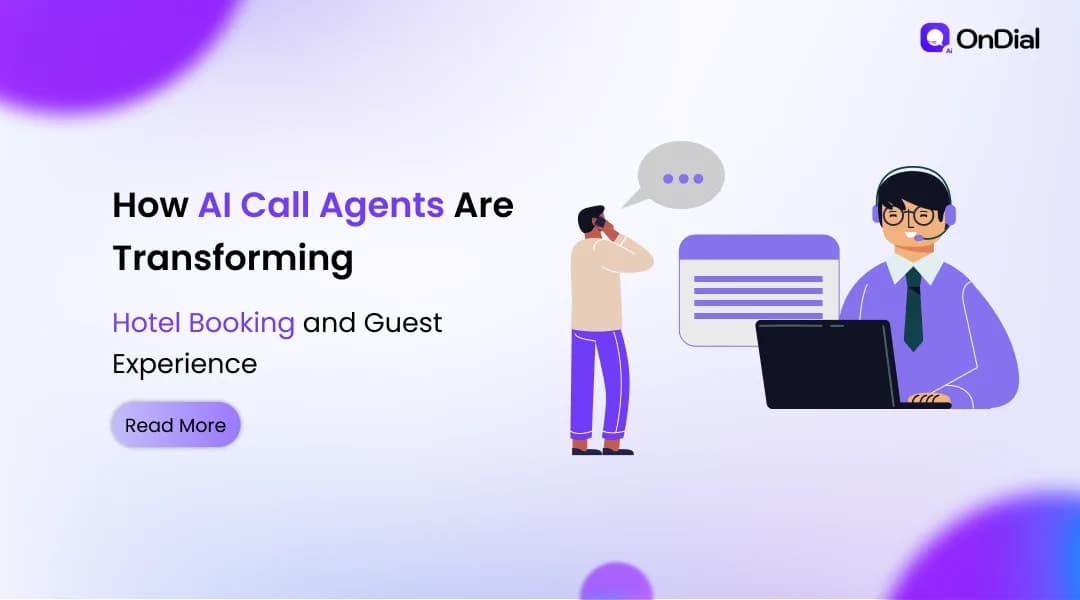
An AI call agent is a voice-based software system that answers phone calls, understands spoken language, and takes action: quoting rates, checking availability, completing reservations, answering common questions, and routing complex issues to human staff. It is not a chatbot. It is not a phone tree. It is a conversational voice system that sounds and behaves like a trained receptionist.
Understanding Natural Language Processing in Hospitality
The technology behind these agents is natural language processing, or NLP. NLP allows the system to interpret what a caller means, not just the words they say. When a guest says, "Do you have anything available next weekend with a view?", the agent parses that into a structured query: dates, room type preference, and availability check, then responds with real options pulled live from the hotel's property management system.
This is a meaningful distinction. Older systems required callers to navigate rigid menus. NLP-powered voice agents let people speak naturally, in their own language, and get accurate answers in seconds.
The Difference Between AI Voice Agents and Old IVR Systems
If your property still uses an IVR (Interactive Voice Response) phone tree, you already know the problem. "Press 1 for reservations. Press 2 for the front desk. Press 3 to repeat these options." Guests hate it. They hang up. They book on Expedia instead.
Modern AI voice agents in 2026 detect the caller's language within seconds and respond in kind. There is no menu. There is no hold music. The guest speaks, the agent listens, and the conversation moves forward. That shift, from menu navigation to natural conversation, is why hotels are replacing IVR systems at an accelerating pace.
Why Hotels Are Losing Revenue Without AI Voice Assistants
The financial case for voice AI is not theoretical. It is arithmetic.
The Missed Call Problem
Picture a 50-room boutique hotel at 3 PM on a Friday. The front desk is managing check-ins. The phone is ringing. A potential guest calling to book a weekend stay gets voicemail, hangs up, and books elsewhere. According to a Canary Technologies study, this happens with roughly 40% of inbound calls at many properties.
That is not a service gap. That is a revenue leak.
AI call agents answer every call, instantly, at any hour. A guest calling at 2 AM from a different time zone gets the same quality of service as someone calling at noon. No hold times. No voicemail. No lost bookings.
OTA Commissions and the Direct Booking Opportunity
Here is a question worth sitting with: how much of your annual revenue goes to OTA commissions?
For many hotels, the answer is painful. Booking platforms charge 15-25% per reservation. When a guest calls your hotel directly but gets no answer, they often end up booking through those same platforms. You pay commission on a guest who tried to come to you for free.
AI voice agents for direct booking recovery are one of the fastest-returning investments a hotel can make. Every call answered directly, converted to a reservation without an intermediary, is pure margin. In projects I have worked on at OnDial, we have seen how voice AI turns the phone from a liability into a direct revenue channel.
How AI Voice Assistants Handle Hotel Bookings End to End
From Inquiry to Confirmation in One Call
A well-integrated AI call agent can handle a complete reservation in a single conversation. It checks live availability from the PMS, quotes current rates, describes room types, explains cancellation policies, collects guest details, processes payment through PCI DSS-compliant systems, and sends a confirmation via email or SMS. The guest never waits. The front desk never gets interrupted.
How do AI call agents actually work in hotels? An AI call agent connects to the hotel's property management system, answers inbound calls using natural language processing, handles bookings and guest inquiries conversationally, and escalates complex requests to human staff, all without menus, hold times, or voicemail.
This is not a future scenario. HotelPlanner's AI voice system, for example, was already handling 10,000 calls per day and has been trained on over 8 million recorded customer interactions. The technology is production-grade.
Multilingual Support Without Extra Staff
International guests are a significant revenue source for most hotels. But staffing a multilingual front desk is expensive and logistically difficult. AI voice agents speak 30 or more languages fluently and can detect a caller's language within the first few seconds of conversation, then switch automatically.
No "Press 2 for Spanish." No language barrier. Just a guest speaking their native language and getting accurate help immediately. For properties that serve diverse international travelers, this alone can justify the investment.
Improving Hotel Guest Experience with AI Beyond the Booking
Voice AI does not stop once the reservation is confirmed. (And honestly, this is where it gets interesting.)
In-Stay Support and Concierge Services
Guests call the front desk constantly during their stay. What is the Wi-Fi password? Can I get a late checkout? Where is the nearest pharmacy? Is the pool open? These are repetitive, predictable questions, and they consume enormous amounts of staff time.
AI call agents handle these instantly, freeing human staff to focus on complex, high-touch interactions: resolving a billing dispute, helping a guest plan a special anniversary dinner, managing an unexpected maintenance issue. According to a Canary Technologies global survey of over 400 hotel IT professionals, 82% of hotels are expanding their AI use in 2026, driven in large part by the operational relief these systems provide.
Personalized Upselling That Feels Natural
Here is where a good voice AI system earns back its cost several times over. When an AI agent has access to guest data, booking history, preferences, and real-time availability, it can suggest relevant upgrades during the booking call itself. A room with a better view. A breakfast package. An early check-in.
According to Roommaster, hotels using AI for personalized guest engagement have seen a 74% increase in upsell success rates. The key word there is "personalized." A generic pitch feels pushy. A recommendation based on a returning guest's actual preferences feels like good service.
What Hotels Should Look for When Choosing an AI Voice Platform
Not every voice AI product is built for hospitality. I have seen too many hotels get burned by general-purpose tools that cannot handle the nuances of hotel operations. Here is what actually matters.
PMS Integration and Data Security
The AI agent is only as useful as the data it can access. If it cannot pull live availability and pricing from your property management system, it is just a fancy answering machine. Before evaluating any vendor, test whether their agent can quote a specific room type, for a specific date, at the correct rate. Then change a parameter and see if it updates.
Payment processing must comply with PCI DSS standards. Guest data handling must meet applicable privacy regulations, including GDPR for European travelers. These are non-negotiable requirements, not premium features.
Evaluating Voice Quality and Vendor Reliability
Ask for a live demo call. Not a recording. Not a curated example. Call the system yourself and try to confuse it. Ask a question in a different language mid-conversation. Interrupt it. Change your request halfway through. A system that handles those situations gracefully is ready for real guests. One that stumbles is not.
Also ask about uptime guarantees and call handling under load. Your busiest day is when you need the system most, and that is exactly when fragile systems fail.
Will AI Call Agents Replace Hotel Front Desk Staff?
No. And this is important to say plainly.
AI call agents handle the predictable, repetitive work that keeps human staff tethered to the phone. They free your team to do what people do best: read a room, empathize with a frustrated guest, create a memorable moment. The best implementations I have seen treat AI as a way to make human staff better at their jobs, not a way to eliminate those jobs.
Most hotels reassign staff after deploying voice AI, not remove them. The front desk person who used to spend three hours a day on routine calls now spends that time on the lobby floor, interacting with guests face to face. That is not a loss. That is an upgrade.
Conclusion
AI call agents for hotels are not a future concept. They are a present-tense operational tool that answers every call, captures direct bookings, speaks your guests' language, and frees your team to deliver the hospitality that earns loyalty and reviews. The three things worth remembering: voice AI pays for itself through recovered direct bookings and reduced OTA commissions; the technology is mature enough for production use today, with multilingual support and PMS integration as standard; and the best implementations enhance your human staff rather than replace them.
If you are exploring how voice AI can work for your specific property, that is exactly the kind of challenge we help solve at OnDial. We build tailored voice AI solutions grounded in how hotels actually operate, not how a pitch deck says they should. Reach out at OnDial and let's talk through what a pilot would look like for your property.
AI call agents give hotels a practical way to answer every guest call, increase direct revenue, and deliver better service without adding headcount. The properties adopting this technology now are building a compounding advantage in guest satisfaction and operational efficiency.