Up to 40% of hotel phone calls go unanswered, according to data from Canary Technologies and multiple hospitality industry reports. That is not a minor operational hiccup. That is revenue disappearing every single day, one voicemail at a time.
I've spoken with hotel operators who know exactly what this feels like. The front desk is juggling check-ins during the afternoon rush, housekeeping needs coordination, and meanwhile, the phone rings six times and goes to voicemail. The caller? A family ready to book a four-night stay. They hang up, open a search engine, and book with the competitor down the road. Hotels using AI voice agents for hotel reservations are reporting 80% fewer missed calls and guest satisfaction scores jumping by 27%, according to Dialzara's industry research.
If you manage a property and that scenario gives you a sinking feeling, you're not alone. The good news: the technology to fix this is no longer experimental or out of reach. In this article, I'll walk you through exactly how hotels and resorts are using AI voice agents to handle reservation calls around the clock, the measurable results they're getting, and what to look for if you're evaluating this for your own property.
What Are AI Voice Agents for Hotel Reservations?
How AI Voice Technology Works in Hospitality
An AI voice agent is a software-powered virtual receptionist that answers phone calls, understands what the caller needs using natural language processing (NLP), and responds in real time with a human-sounding voice. It is not a chatbot. It is not a phone tree. It is a conversational system that can check live room availability, quote rates, process bookings, answer property-specific questions, and hand off to a human team member when the situation calls for it.
Here is what makes the current generation different from the clunky automated systems of five years ago. Modern voice AI platforms connect directly to a hotel's Property Management System (PMS) through API integrations. That means when a guest calls at midnight asking about availability for a king room next Friday, the agent pulls real-time data from the same system your front desk uses. No guessing. No stale information.
Response latency on well-built systems now sits under 500 milliseconds. Guests are not waiting through awkward pauses or stilted robotic replies. The conversation flows naturally, with the AI handling interruptions, topic changes, and follow-up questions the way a trained reservationist would.
The Difference Between Voice AI and Traditional IVR Phone Trees
Let's be direct: IVR phone trees are the reason so many callers hang up before reaching anyone. "Press 1 for reservations, press 2 for the front desk, press 3 for..." Most guests press zero or just abandon the call entirely.
AI voice agents eliminate that friction. Instead of forcing callers through a menu structure, they let the guest speak naturally. "I'd like to book a room for two nights starting Saturday" is all it takes. The agent understands the intent, queries the PMS, and responds with options.
(Here is something most hotel tech articles skip over: the real competitive advantage is not speed alone. It is the fact that AI voice agents collect structured data from every single call, giving you analytics on booking patterns, common questions, and missed opportunities that you never had visibility into before.)
How Hotels and Resorts Use AI Voice Agents Across the Guest Journey
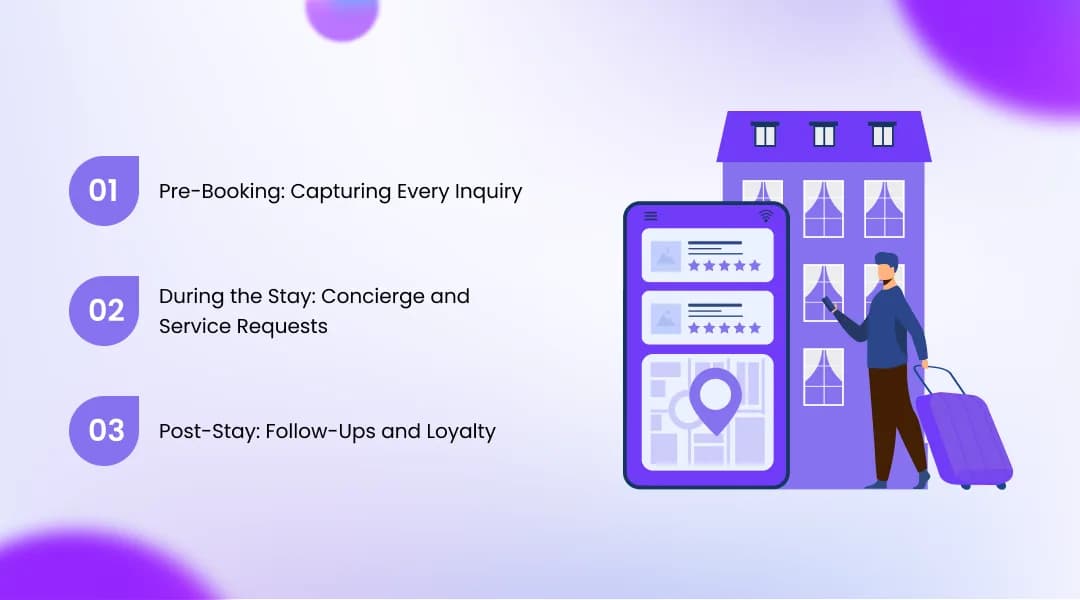
Pre-Booking: Capturing Every Inquiry
This is where the revenue impact is most immediate. A reservation inquiry that arrives at 11 PM on a Wednesday or during the Sunday morning rush no longer goes to voicemail. The AI agent picks up on the first ring, every time.
Properties like the Trapp Family Lodge and Resort saw a 30% reduction in call volume reaching the front desk after deploying AI, with response times dropping to just 30 seconds. HotelPlanner's AI booking assistant handles over 10,000 interactions daily across more than one million properties and generated over 150,000 pounds in revenue during its first month alone.
What does a typical pre-booking interaction look like? The guest calls, asks about availability for specific dates, and the AI checks live inventory. It quotes the rate, explains cancellation terms, mentions a current promotion for a room upgrade, and either completes the booking or sends a confirmation link via SMS. All without a single staff member being involved.
During the Stay: Concierge and Service Requests
AI voice agents are not limited to reservations. Hotels and resorts are extending their use to in-stay guest services: room service orders, spa appointment bookings, late checkout requests, pool hours, restaurant recommendations, and directions to local attractions.
Resorts World Las Vegas deployed SoundHound's Amelia AI platform, and their agent "RED" handles hundreds of thousands of guest inquiries annually. The system resolves requests in real time, from room service to reservation modifications, while staff focuses on high-touch, in-person interactions that actually require a human presence.
Have you ever called a hotel front desk to ask what time the pool closes, only to wait on hold for three minutes? That is exactly the kind of interaction AI handles better and faster than any staffed phone line.
Post-Stay: Follow-Ups and Loyalty
Some properties are beginning to use voice AI for outbound calls as well: post-stay satisfaction checks, loyalty program enrollment, and re-engagement campaigns for past guests. This is still an emerging use case, but it signals where the technology is heading. Every touchpoint becomes an opportunity to build loyalty without adding headcount.
Real Results: What Properties Are Seeing After Deployment
Revenue Recovery and Direct Booking Growth
The numbers across the industry tell a consistent story. Golden Nugget's AI assistant manages 34% of all reservation calls, completing over 300 bookings per week. Hotels using AI voice agents report 25% higher ancillary revenue from consistent upselling during calls.
One data point worth pausing on: Zendesk research found that 93% of callers who reach voicemail never call back. Every missed call is not a deferred booking. It is a lost booking. When AI answers every call, properties recover revenue they did not even realize they were losing.
The cost comparison is stark. According to an ICMI Benchmark Report, the average cost per call for a human agent is $5.50, while an AI agent handles the same call for roughly $0.65. For a property fielding 200 calls a day, the math becomes impossible to ignore.
Operational Savings and Staff Relief
This is not about replacing your front desk team. I want to be clear about that, because it is the first concern I hear from every hotel operator. It is about removing repetitive, low-value calls from their plate so they can focus on the guests standing right in front of them.
Hotels using platforms like Aiello's AVA report a 43% drop in front desk call volume. Staff burnout decreases. Service quality for in-person interactions improves. Seasonal hiring pressure eases because the AI absorbs call spikes without any additional staffing.
According to AInora's data, 29% of hotels with 50 or more rooms are already using AI for phone-based guest services. The median time to ROI breakeven for businesses deploying voice AI agents is 3.2 months, based on Forrester TEI studies. This is not a five-year payback investment. It is a quick win.
Key Features to Look for in a Hotel AI Voice Agent
PMS Integration and Multilingual Support
Not every voice AI solution is built for hospitality. The single most important capability to evaluate is deep PMS integration. The agent must connect to your existing Property Management System, whether that is Oracle Opera, Mews, Cloudbeds, or another platform, and pull live availability, pricing, and guest profile data in real time.
Multilingual support is the second non-negotiable, especially for resorts and properties serving international travelers. The best platforms now support automatic language detection, switching mid-conversation without any manual input from the caller. Riviera's system, for example, detects the guest's language within the first few words and adjusts instantly.
Modern AI voice agents can handle approximately 95% of typical hotel booking scenarios, including room selection, date modifications, special requests, and amenity upselling.
Escalation Logic and Brand Voice Customization
No AI should be a black box that traps callers. The best systems include configurable escalation rules: if a caller is a VIP, if the request involves a billing dispute, or if the AI detects frustration, the call transfers to a human team member with full conversation context and transcript already attached.
Brand voice customization matters more than most hotel operators initially think. Your AI receptionist should sound like your property, not like a generic tech demo. Leading platforms let you customize tone, pacing, accent, and even the specific language used for greetings, upsell prompts, and closing statements.
(A detail I've noticed too many evaluation guides overlook: ask vendors about their call analytics dashboard. The insights you get from AI-handled calls, most common questions, peak call times, booking conversion rates by time of day, are often more valuable than the call handling itself.)
Should Your Hotel Actually Invest in Voice AI Right Now?
This is the honest question, and it deserves an honest answer. Not every property needs this today.
If your hotel consistently answers every call within three rings, has 24/7 front desk staffing, serves a primarily domestic guest base, and sees low phone booking volume, the urgency is lower. You may benefit more from a chat-based AI solution first.
But if any of the following sound familiar, voice AI is worth serious evaluation right now: you miss calls during peak check-in hours, you do not staff phones overnight, you serve international guests who speak multiple languages, you are paying OTA commissions on bookings that could have been direct, or your front desk team is stretched thin and burning out.
Deloitte's Travel Industry Outlook reports that over 70% of hotel executives are now prioritizing AI investment, and voice technology leads the pack. The AI in hospitality market is projected to reach $58.56 billion by 2029, according to The Business Research Company. This is not a niche experiment. It is a structural shift in how hotels operate.
The properties that move early are building a data advantage: every call their AI handles generates insights into guest preferences, booking patterns, and service gaps that inform better decision-making across the entire operation.
Conclusion
AI voice agents for hotel reservations are solving three problems at once: missed calls that bleed revenue, overstretched front desk teams, and inconsistent service quality outside business hours. The technology is mature, the ROI timeline is measured in months, and properties of every size are seeing measurable gains in direct bookings, guest satisfaction, and operational efficiency.
The question is no longer whether voice AI works for hotels. It is whether your property can afford to keep sending callers to voicemail while competitors capture those bookings around the clock.
At OnDial, we build tailored AI voice solutions designed for exactly this challenge. If you want to explore what a custom voice agent could look like for your property, with real PMS integration, multilingual support, and a voice that actually sounds like your brand, start a conversation with us at OnDial. No generic demos. Just a real discussion about your operation and what is possible.