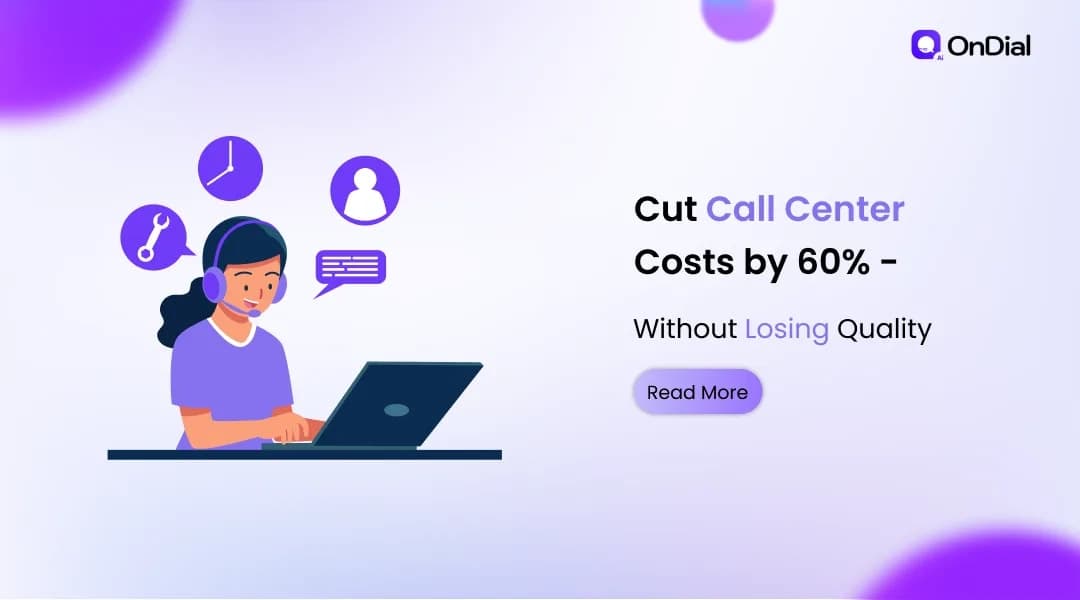
Gartner projects that conversational AI will reduce contact center labor costs by $80 billion in 2026. That number is staggering. And yet, most businesses I've seen still approach cost reduction the same way they did a decade ago - slash headcount, freeze training budgets, defer technology upgrades. Then they watch handle times increase, quality scores drop, and customers start calling back more often. The result? They spend more fixing the damage than they ever saved.
Here is the uncomfortable truth: you cannot reduce call center costs without losing quality by cutting people and hoping for the best. That approach has never worked. But there is a version of this that does work - and it's the one built around AI voice technology, smarter processes, and a clear understanding of where your money is actually going.
At OnDial, we have worked with businesses across industries to deploy conversational AI and voice AI platforms that bring real, measurable cost reduction without sacrificing the customer experience. In this guide, you'll learn exactly which strategies move the needle, what the data says, and how to build a plan that works for your business specifically.
What Does It Actually Cost to Run a Call Center?
Before you can reduce call center costs, you need to see all of them. Most organizations are only looking at half the picture.
The Visible Costs Everyone Tracks
The obvious line items - agent salaries, software subscriptions, telephony infrastructure, and facility overhead - account for the bulk of the budget. Labor alone represents 60-70% of total call center expenses in most operations, according to industry benchmarks. Add supervisors, quality assurance teams, and workforce management staff, and you're looking at a significant payroll obligation before a single call is answered.
Technology costs are the second-largest category. Legacy on-premises systems carry high maintenance fees. Licensing costs for CRMs, IVR systems, and separate quality monitoring tools create what analysts call "SaaS sprawl" - a slow bleed that goes unnoticed until someone audits the tech stack.
The Hidden Costs That Drain Your Budget Silently
Here is where things get expensive. Agent turnover in the call center industry runs at 30-45% annually (Gartner). Each replacement costs between $2,000 and $10,000 per hire when you factor in recruitment, onboarding, and lost productivity during ramp-up time. A center with 100 agents and 35% turnover is spending up to $350,000 per year just to stay fully staffed.
Repeat calls are another silent drain. Every time a customer calls back about the same issue, your cost-per-resolution doubles. Poor First Call Resolution (FCR) is not just a quality problem - it is a cost problem. And most teams are not measuring it aggressively enough.
(Here is a question worth sitting with: if you tallied every dollar spent on repeat contacts, turnover replacement, and idle staffing last quarter, what would that number look like?)
How Conversational AI Reduces Call Center Costs
This is the section most cost guides skip entirely. They mention "automation" as a bullet point and move on. I want to be specific.
What Is AI Voice Automation in a Call Center?
AI voice automation in a call center is the deployment of AI-powered voice agents that handle customer calls through natural language understanding (NLU) and automatic speech recognition (ASR), without requiring a human agent. Unlike legacy IVR systems that force callers through rigid menus, a modern conversational AI voice agent understands open-ended speech, resolves intent, takes action, and escalates with full context when a human is needed.
The key word is "resolves." Not deflects. Not transfers. Resolves.
The Real Math: AI Cost Per Call vs. Human Cost Per Call
The average cost of an inbound call is $7.16, which is 42% more expensive than a web chat interaction (ContactBabel's US Contact Center Decision-Makers' Guide). AI voice agents handle the same interaction for under $1 per resolution. That is not a rounding difference - that is a structural shift in unit economics.
At OnDial, I've personally seen mid-market businesses reduce their cost per contact by over 60% in the first six months after deploying a tailored AI voice assistant - while simultaneously seeing CSAT scores hold steady or improve. The reason quality holds is the key insight: AI does not replace empathy. It handles everything that does not require it.
When Swisscom rebuilt its customer-facing AI voice agent using conversational AI technology, the company cut operational costs by 50% while its Net Promoter Score (NPS) improved, not declined. That is the outcome that the old playbook cannot produce.
Proven Strategies to Reduce Call Center Costs Without Losing Quality
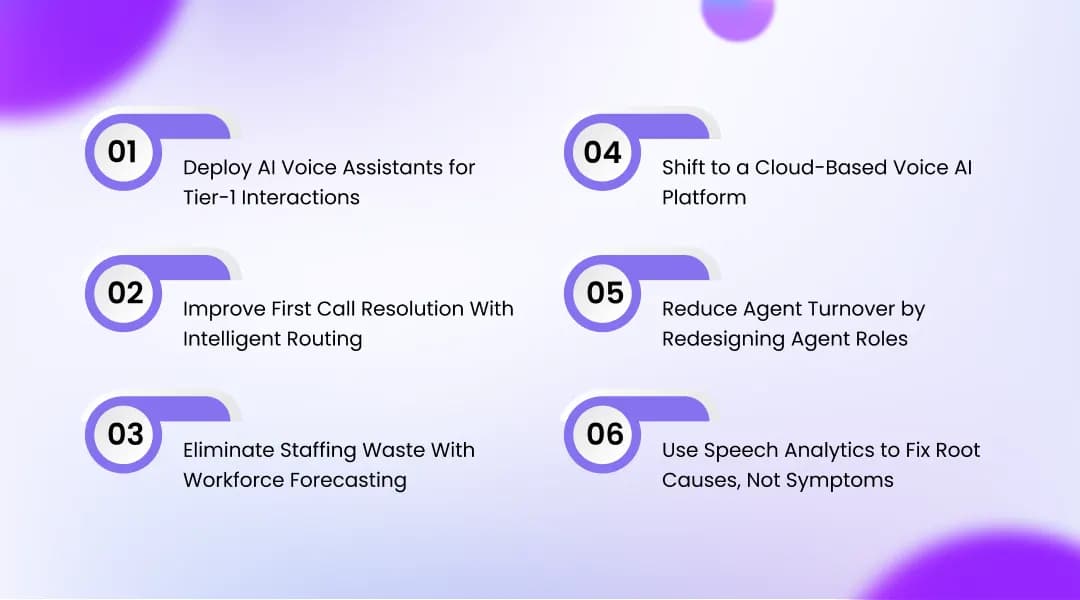
Strategy 1: Deploy AI Voice Assistants for Tier-1 Interactions
The fastest path to reducing call center costs is automating the interactions that do not need a human to begin with. Password resets. Order status checks. Appointment confirmations. Billing balance inquiries. These interactions are high-volume, low-complexity, and expensive to staff for.
AI voice assistants can handle 20-80% of inbound call volume for these Tier-1 tasks, operating 24/7 without overtime, shift differentials, or holiday pay. A real-world example: In early 2026, National Insurance Corp reduced its call center staff from 200 to 60 specialized agents by automating 80% of inbound policy inquiries. Annual savings reached $9.78 million, with a payback period of just 3.2 months.
The discipline here is intentional design. The AI should handle what it can genuinely resolve - not what it can merely contain. Containment without resolution is what gives automation a bad name. Resolution is what builds trust.
Strategy 2: Improve First Call Resolution With Intelligent Routing
Every 1% increase in FCR correlates to a 1% increase in Customer Satisfaction Score (CSAT). That relationship is not coincidental - it is structural. When customers get the right answer on the first call, they do not call back. Repeat contacts are one of the most expensive patterns in any call center.
Intelligent routing powered by conversational AI uses natural language understanding to route calls based on customer intent, sentiment, and interaction history - not just availability. This means the right person, or the right AI agent, handles the right call from the start. Businesses using AI-powered routing have reported a 60% drop in wait times and a 25% increase in customer satisfaction scores.
At OnDial, our voice AI platforms are built to integrate routing logic with CRM data so that when a call does escalate to a human agent, the agent already has full context. No repeated explanations. No wasted minutes. That is how you improve FCR without adding headcount.
Strategy 3: Eliminate Staffing Waste With Workforce Forecasting
Overstaffing during quiet periods and scrambling with overtime during peak times - this is one of the most predictable waste patterns in the industry, and one of the most fixable.
Workforce management (WFM) tools that use historical call volume data and predictive analytics can align staffing precisely with actual demand. According to McKinsey, organizations using predictive analytics in contact centers achieve up to a 30% improvement in workforce efficiency and a 20% reduction in average wait times.
The practical application is not complicated. If your data shows Mondays generate 40% higher inbound volume after a weekend, your scheduling should reflect that. Most centers are still scheduling by gut. Stop scheduling by gut.
Strategy 4: Shift to a Cloud-Based Voice AI Platform
Traditional call centers require $50,000-$200,000 in physical hardware infrastructure. Cloud-based voice AI solutions cut that to $25,000-$50,000, with the added benefit of pay-as-you-go pricing, remote agent enablement, and zero on-premises maintenance overhead.
Beyond infrastructure savings, shifting to remote operations saves approximately $11,000 per employee annually in real estate costs alone. For a 500-agent center, that is $5.5 million per year in overhead that disappears from the budget.
A voice AI platform built for the cloud also scales instantly. Seasonal demand spikes that previously required emergency hiring can be absorbed by AI agents at no incremental cost per interaction. This is the model OnDial designs for clients - tailored, cloud-native voice AI solutions that scale with the business rather than ahead of it.
Strategy 5: Reduce Agent Turnover by Redesigning Agent Roles
Here is a counter-intuitive point: you reduce call center costs by investing more deliberately in the agents who remain.
When AI voice assistants handle Tier-1 volume, your human agents spend the entire day on complex, high-stakes interactions - the ones that require judgment, empathy, and domain expertise. That is a fundamentally more engaging job. Agent satisfaction improves. Burnout decreases. Turnover falls.
At 30-45% annual turnover, each replacement costs $10,000-$20,000. Cutting turnover from 40% to 20% in a 100-agent center saves $2-4 million per year. No new technology required. Just a better job design enabled by the technology you already have.
Pair this with speech analytics to give agents instant, specific coaching feedback rather than generic monthly reviews. Agents who receive targeted feedback improve faster and stay longer.
Strategy 6: Use Speech Analytics to Fix Root Causes, Not Symptoms
Most cost reduction efforts target the effect - high call volume, long handle times - without ever asking why. Why are customers calling about the same billing issue 10,000 times a month? Is it a product problem? A documentation failure? A confusing checkout flow?
Speech analytics powered by AI can analyze 100% of calls in real time and surface the patterns that drive repeat contacts. That is a capability legacy QA teams monitoring 2-3% of calls could never achieve.
When you fix the root cause - clearer documentation, better confirmation emails, a corrected product flow - you reduce inbound volume. Permanently. Not through containment. Through elimination. Prevention beats correction every time.
Conclusion
Reducing call center costs without losing quality is not a trade-off problem. It is a design problem. The three most important takeaways from everything above: first, your biggest cost drivers are usually hidden (turnover, repeat contacts, idle staffing) - not the obvious line items. Second, AI voice assistants reduce cost at the point of interaction, handling high-volume Tier-1 calls for a fraction of the cost of a human agent. Third, quality improves when human agents are deployed on work that genuinely requires human intelligence.
You now have a clear picture of where the money goes and exactly which levers to pull.
At OnDial, we specialize in building tailored AI voice solutions that solve exactly this challenge - for businesses across industries who need measurable cost reduction without compromising the customer relationships they've worked hard to build. If you're ready to see what a purpose-built conversational AI voice platform looks like for your specific operations, we'd welcome the conversation.