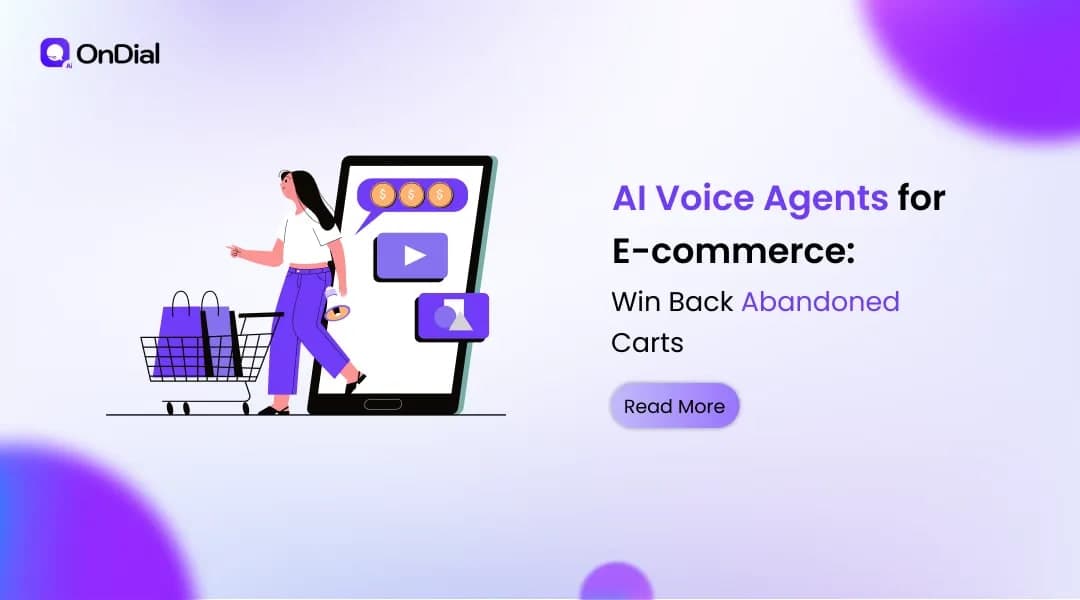
Cart abandonment is one of the most persistent revenue problems in e-commerce. Baymard Institute's latest compiled benchmark puts the average documented online shopping cart abandonment rate at 70.22 percent across 50 studies.
That does not mean every abandoned cart represents a lost sale. Some shoppers are browsing, comparing products, checking prices, or simply not ready to buy. Others leave because they have a specific question about delivery, payment, product fit, returns, or checkout.
The important distinction is intent.
An e-commerce brand does not need to contact every abandoned-cart shopper. It needs to identify the shoppers with meaningful purchase intent and give them a useful reason to complete the transaction.
This is where AI voice agents can add another recovery channel alongside email, SMS, retargeting, and on-site messaging. Instead of sending another reminder, a voice agent can have a two-way conversation, understand the shopper's hesitation, answer approved questions, and guide the customer back to checkout.
For retailers operating across India and international markets, the opportunity becomes broader. Voice can support regional languages, COD confirmation, payment follow-up, delivery questions, and customer retention while connecting the conversation back to existing business systems.
Why Abandoned Carts Are Difficult to Recover
A shopper can abandon a cart for dozens of reasons, and the reason is not always visible in analytics.
A customer may have reached checkout and discovered unexpected shipping costs. Another may have wanted to confirm whether a product would arrive before a particular date. Someone else may have encountered a failed payment or decided to compare the same product on another website.
Baymard's research also shows that a meaningful portion of abandonment comes from shoppers who are simply browsing or not yet ready to purchase.
That creates an important limitation for automated recovery.
A system that treats every abandoned cart as a sales opportunity can waste money and damage customer experience. A better system evaluates cart value, customer history, purchase intent, previous interactions, consent, and the likely reason for abandonment before deciding whether a call is appropriate.
What AI Voice Agents Change in Cart Recovery
Traditional recovery campaigns mainly deliver a message.
An email might remind the shopper about the products. An SMS message might provide a checkout link. A retargeting campaign might show the same product again.
An AI voice agent adds a conversation layer.
The customer can explain what stopped the purchase, and the agent can respond according to the business's approved rules. If the issue is delivery, the agent can provide available information. If the customer is unsure about a return policy, the agent can explain the relevant policy. If payment failed, the agent can guide the shopper toward the available payment path.
For e-commerce brands, this makes AI voice agents for retail and e-commerce useful beyond a single abandoned-cart campaign.
The objective is not to replace every existing recovery channel. It is to add a conversational channel where a conversation can resolve friction faster than another static message.
How an AI Voice Agent Recovers an Abandoned Cart
A practical implementation usually begins with an event from the e-commerce platform.
The event can contain information such as the customer identifier, phone number where appropriate, cart value, products, checkout status, previous orders, preferred language, and other data the business is permitted to process.
The voice platform then applies eligibility rules before placing a call.
Step 1: Detect the Abandoned Cart
The first step is identifying when a cart qualifies as abandoned.
The business should define an appropriate inactivity period instead of treating every temporary checkout interruption as abandonment. A shopper who closes a browser for two minutes may still be actively purchasing.
The trigger can come from an e-commerce platform, CRM, customer data platform, webhook, or custom application.
Step 2: Qualify the Cart Before Calling
Not every cart should receive a phone call.
A sensible qualification layer can consider:
Cart value
Product category
Customer purchase history
New versus returning customer
Previous communication preferences
Customer location and local time
Consent and suppression status
Previous recovery attempts
Whether a phone number is available for a permitted purpose
For example, a retailer may decide that high-value carts receive voice outreach while lower-value carts continue through email and SMS.
This approach keeps voice focused on situations where a conversation can create enough incremental value to justify the contact.
Step 3: Personalize the Conversation
Once a cart qualifies, the agent can use the information available to it.
The opening should be clear about why the customer is being contacted. The agent can reference the shopping journey without sounding like a generic sales script.
For example, instead of repeatedly saying that a cart is waiting, the conversation can ask whether the shopper encountered an issue while checking out.
The difference is important.
The goal is to discover friction, not simply repeat the existence of the cart.
Step 4: Identify the Customer's Objection
The agent should be trained around the objections that matter to the business.
Common examples include:
Delivery timing
Shipping charges
Product availability
Product specifications
Size or compatibility
Return and exchange policies
Payment problems
Coupon or promotion questions
COD availability
Product comparison
Need for human assistance
The agent should only provide information that exists in the approved knowledge base or connected systems.
If the customer asks something outside the agent's authority, the conversation can move to a human representative instead of producing an uncertain answer.
Step 5: Take the Next Action
A successful recovery conversation should end with an action.
That action might be sending a checkout link, confirming that the customer will complete the purchase, arranging a callback, transferring the customer to a human agent, or recording that the shopper is no longer interested.
This is where voice automation becomes more useful than a simple outbound dialer.
The system can connect the conversation to the rest of the workflow instead of treating the call as an isolated event.
Why Voice Should Complement Email and SMS
E-commerce brands do not need to choose one recovery channel.
Email remains useful for customers who prefer asynchronous communication. SMS is useful for short reminders and direct links. Retargeting can keep products visible across other digital touchpoints.
Voice is most useful when the customer may have a question that needs an answer.
A strong recovery workflow can therefore use different channels for different levels of intent.
For example, a retailer might use email for broad recovery, SMS for a quick checkout reminder, and voice for selected high-value carts where the expected value of a conversation is higher.
This creates a layered recovery strategy rather than forcing every customer into the same communication path.
OnDial's article about how AI voice agents improve user experience also highlights the broader role of conversational voice across customer interactions, including e-commerce support.
The India E-commerce Opportunity
India adds several practical considerations to abandoned-cart recovery.
Customers may interact with brands in English, Hindi, Hinglish, Gujarati, Tamil, Telugu, Bengali, Marathi, or other regional languages. A voice workflow that cannot handle the customer's preferred language can create friction instead of removing it.
Payment behavior also varies significantly between customer segments.
Some shoppers prefer UPI or cards, while others use cash on delivery. A recovery workflow can therefore be designed around payment intent, failed transactions, COD confirmation, and other purchase-stage events.
However, businesses should not assume that an abandoned cart automatically gives them unrestricted permission to make promotional calls.
India's commercial communication environment is governed by TRAI rules, including DLT requirements and designated numbering frameworks. TRAI has also continued updating the framework around service, transactional, and promotional voice communications.
Businesses should therefore validate their specific calling use case, consent model, number series, templates, suppression requirements, and other applicable obligations before launching a campaign.
Using Voice Without Training Customers to Wait for Discounts
One of the biggest mistakes in cart recovery is automatically offering a discount.
If every abandoned cart receives a coupon, customers can learn that abandoning the cart is part of the purchasing process.
A better voice workflow first determines the reason for hesitation.
If the customer needs delivery information, answer the delivery question. If the customer has a payment problem, help with the payment path. If the customer is comparing products, provide the approved product information.
Only use incentives when the business has deliberately configured them as part of the recovery strategy.
Discounts should have clear eligibility rules, margin limits, expiry conditions, and approval logic.
The purpose of conversational recovery is to remove unnecessary friction, not automatically reduce the product price.
Connecting Cart Recovery With CRM and E-commerce Systems
The call itself is only one part of the workflow.
After the conversation, the business should know what happened.
Useful CRM fields can include:
Call outcome
Customer intent
Abandonment reason
Product or cart value
Recovery status
Offer provided
Customer sentiment
Follow-up requirement
Human escalation status
Purchase completed or not
This information can then support future customer interactions.
For example, a shopper who says delivery time was the problem can be routed into a relevant follow-up workflow. A customer who reports a product issue can be transferred to support. A customer who explicitly declines contact can be suppressed from future outreach.
The result is a feedback loop instead of a collection of disconnected calls.
How to Measure AI Voice Cart Recovery
The number of calls completed is not the primary business metric.
E-commerce teams should measure whether the calls create incremental revenue.
Important metrics include:
Contact Rate
How many eligible customers answer the call?
This helps determine whether the calling window, number configuration, customer segment, and channel strategy are appropriate.
Conversation Completion Rate
How many connected calls reach a meaningful outcome?
A short call that ends immediately may not have the same value as a conversation that identifies and resolves a purchase objection.
Recovery Rate
How many eligible abandoned carts result in completed purchases after the recovery workflow?
This should be measured against a clearly defined attribution window.
Incremental Revenue
Revenue is more useful than raw recovery counts.
A controlled test can compare customers who receive voice recovery against a comparable group that follows the existing recovery journey.
Cost per Recovered Order
Calculate the total campaign cost against recovered incremental orders.
This gives the business a practical way to compare voice with existing recovery channels.
Customer Experience
Recovery should not be measured only through sales.
Track complaints, opt-outs, call duration, escalation rates, sentiment, and customer feedback. A campaign that recovers additional orders but creates substantial customer dissatisfaction may not be sustainable.
When AI Voice Recovery Is Not the Right Choice
Voice is not appropriate for every abandoned cart.
Low-value carts may not justify the economics of a phone interaction. A shopper who was only browsing may find an unexpected call intrusive. Customers without the appropriate consent or contact permission should not simply be added to a calling campaign.
Timing also matters.
A business should consider the customer's local time, previous contact frequency, purchase context, and communication preferences before initiating outreach.
The best strategy is selective.
Use automation to identify where voice has a strong business case, rather than calling everyone simply because the technology makes high-volume calling possible.
A Practical Implementation Framework
For an e-commerce company starting from scratch, the rollout can be kept focused.
Phase 1: Select One Customer Segment
Start with a clearly defined group, such as high-value abandoned carts or returning customers.
Do not launch across the entire customer database immediately.
Phase 2: Define Approved Conversation Paths
Document the questions the agent can answer, the actions it can take, the incentives it can provide, and the situations that require human transfer.
Phase 3: Connect the Required Systems
Connect the e-commerce platform, customer records, product information, communication system, and CRM or analytics platform needed to track outcomes.
Phase 4: Establish Compliance Controls
Build consent checks, suppression rules, contact windows, disclosure requirements, and regional communication rules into the workflow before production calling begins.
Phase 5: Run a Controlled Test
Compare voice recovery with the existing process.
Measure incremental purchases, revenue, cost per recovered order, contact rates, opt-outs, and customer feedback.
Phase 6: Expand Based on Evidence
If the data shows that certain products, customer segments, or cart values respond well to voice, expand those segments first.
This makes the programme measurable and limits unnecessary contact.
Where E-commerce Voice Automation Can Go Next
Abandoned cart recovery is only one moment in the e-commerce customer journey.
The same conversational infrastructure can support order confirmation, failed payment follow-up, delivery communication, returns, customer support, product questions, post-purchase feedback, loyalty outreach, and reactivation.
That means the long-term value of an AI voice agent may come from connecting multiple customer journeys rather than operating a single recovery campaign.
For businesses looking at the broader opportunity, AI voice agents for e-commerce can support multiple revenue and customer experience workflows beyond abandoned carts.
Final Takeaway
Abandoned carts are not all equal.
Some represent low-intent browsing. Others represent customers who were ready to buy but encountered one unresolved problem.
AI voice agents are most valuable in the second category.
A well-designed recovery system identifies high-intent opportunities, contacts customers through an appropriate channel, understands the reason for hesitation, provides approved information, completes the next action, and records the outcome.
For Indian e-commerce businesses, multilingual communication and local payment behavior make conversational recovery particularly relevant, but compliance must be designed into the workflow from the beginning. TRAI's current commercial communication framework and India's data protection requirements should be reviewed against the exact campaign model before calls are launched.
The strongest approach is not to replace email or SMS.
It is to give each channel a specific role and use voice when a real conversation can create additional value.
With the right customer segments, timing, conversation design, integrations, measurement, and safeguards, AI voice can become a measurable part of an e-commerce recovery strategy rather than another automated message competing for attention.
For businesses evaluating the technology, OnDial's AI voice agent platform provides the broader infrastructure for automated inbound and outbound conversations, multilingual interactions, CRM connectivity, analytics, and human escalation.