A deposit paid in May is not an enrolled student in August. Harvard's Strategic Data Project puts the share of college-intending students who never actually turn up somewhere between 10% and 40%, with the highest losses among those from low-income backgrounds. Very little of that attrition comes down to a change of heart about the institution. It comes down to a question that never got answered in time.
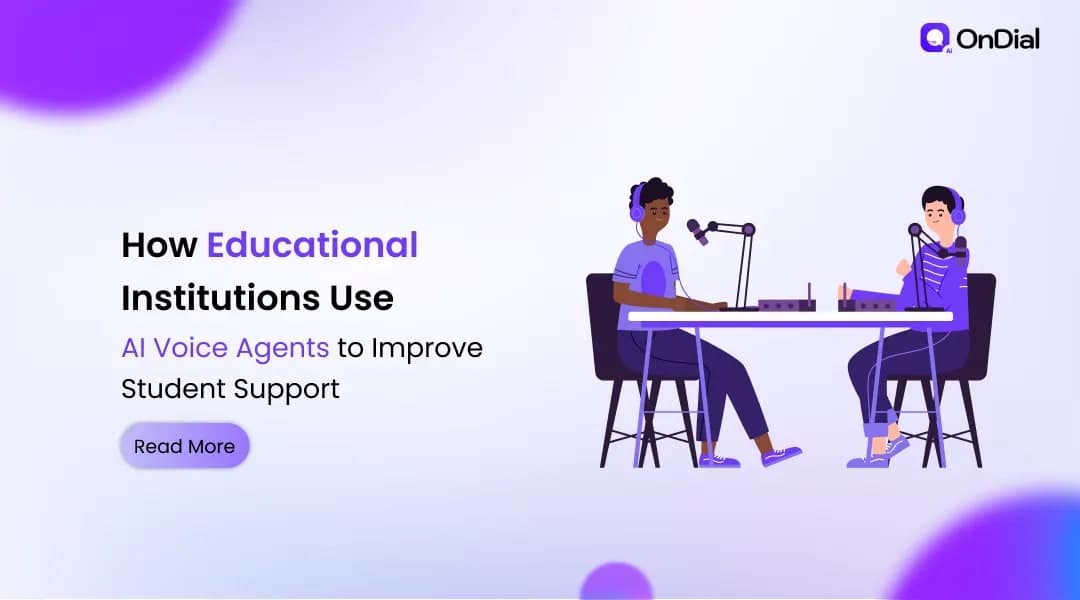
That is the gap AI voice agents for student support are built to close. An institution deploys them to pick up every inbound call at once, resolve routine questions about deadlines, documents, fees and schedules through natural conversation, verify who is calling before releasing anything personal, book counselling slots directly into staff diaries, and pass anything sensitive to a named human with the conversation history attached.
I understand the reflex to be sceptical, particularly if a previous chatbot rollout produced good dashboards and no change students ever noticed. That outcome is common, and it is rarely a model problem. It is what happens when a tool is bought before anyone audits which calls the institution actually receives. This guide covers the call types worth automating first, what changes across the rest of the academic year, how language coverage alters who gets helped at all, and where automation should stop.
Why Student Support Breaks Before the Technology Does
Most support teams are not failing at difficult work. They are drowning in easy work that arrives all at once, and the difficult work sinks underneath it.
How do AI voice agents improve student support? They remove the queue entirely by answering unlimited concurrent calls, resolve status and deadline questions against live institutional data, capture enquiries that would otherwise reach voicemail after hours, and route emotionally complex or record-sensitive conversations to staff with a written summary so the caller never repeats themselves.
The Three Call Types That Consume a Support Team
Look at any institutional phone log, and the volume splits into three groups. The first is informational, covering deadlines, fee structures, eligibility criteria and timetable questions where the answer is already published somewhere. The second is transactional, covering status checks, document confirmations, appointment bookings and access resets, which require a system lookup rather than judgment.
The third group is the one that matters most and gets the least attention. These are the conversations where a student is anxious, appealing a decision, in financial difficulty, or considering dropping out entirely. Groups one and two are where automation belongs, precisely so group three reaches a person quickly. When all three compete for the same queue, the loudest volume wins, and the highest-stakes call waits.
What Separates a Voice Agent From a Phone Menu
An AI voice agent is software that answers a call, interprets spoken intent, and either completes the request or routes it, all in conversation. An interactive voice response system asks the caller to convert their situation into a numbered option first. That conversion step is where a large share of student callers abandon and default to the general enquiry line, which is exactly the queue you were trying to protect.
The gap becomes obvious the moment a caller asks a second question. Someone confirming a fee deadline will almost always follow with a question about late payment, and no menu structure can hold that thread. Rigid scripting and an inability to follow up are the primary reasons callers disengage from automated systems, which is why intent recognition and conversational flow matter more than how polished the voice sounds.
AI Voice Agents for Admissions and the Enquiry Window
Almost every institution begins here, because admissions is where slow support converts directly into lost enrolments.
The Real Cost of a Slow First Response
Admissions enquiries are rarely complicated. They are repetitive, time-compressed, and unforgiving of delay. Roughly a quarter of students abandon their applications partway through because requirements are complex and guidance is thin. Those applicants are not usually choosing a rival institution on merit. They are giving up mid-process.
The timing data is stark. Thoughtly's 2026 analysis found that applicants who get a reply inside five minutes are around a hundred times more likely to enrol, and one education provider running AI voice agents for admissions outreach recovered more than 3,000 hours of staff talk time while holding conversion level with its human team. Two hours is not a slightly worse version of five minutes. It is a different outcome.
What the Agent Handles Outside Office Hours
So think about your own peak week. An enquiry lands at nine on a Saturday evening from a parent comparing three institutions, and what greets them is your voicemail message. You will never see that enquiry in a report, because it never became a lead.
A voice agent covers that window by answering, qualifying, booking the counselling call, and writing the record into your CRM before the caller hangs up. Your counsellors then arrive on Monday to a diary of confirmed conversations rather than a backlog of callbacks. The secondary benefit is analytical, since every call produces structured data on exactly which step in your application process is generating confusion.
Student Support Automation After the Student Enrolls
Here is where most published advice stops and where the durable return actually lives. Admissions season is a handful of weeks. Supporting enrolled students is the whole calendar.
Registrar, Fees, and Access Requests
The call pattern shifts after enrolment, but the repetition does not. Registration windows, transcript requests, hostel and housing queries, examination schedules, results-day surges, and above all, people locked out of the learning platform. Help desk research across sectors consistently places password and account access issues at between 20% and 50% of total ticket volume. That workload sits on technical staff hired for entirely different work.
Student support automation fits this profile well because the requests are frequent, verifiable through a system lookup, and require no discretion. Fee reminder calls are the clearest case of all, since they are structured, deadline-bound, and genuinely uncomfortable for staff to repeat several hundred times. In work OnDial has delivered, shifting reminder calls to an agent improved the tone of the interaction as much as the economics, because a student on their fourth reminder hears the same neutral, unhurried voice as the first.
Outbound Calls to Students Who Stop Responding
Inbound support only ever reaches students who still believe calling will help. The students you lose are the ones who quietly stop asking. Guidebook's analysis places the highest-risk window between mid-June and the end of July, covering deposited students who have not registered for orientation, sorted housing, or received any personal contact for around a month.
Outbound agents work that window at a scale a team of eight cannot approach manually, including teams adopting AI voice agents for call centres and BPOs. Every deposited student gets a call, confirms the next step, and anyone who voices hesitation gets flagged for a counsellor the same day.
Multilingual Voice AI for Education
Language coverage is usually presented as an added extra. Functionally, it decides which students can access support at all.
Regional Languages and Reach in Indian Institutions
Multilingual voice AI for education lets a student raise a question in the language they think in rather than the one your prospectus is printed in. Haptik's 2026 analysis reports over 100 million active learners in India's edtech sector, an average support ticket resolution time exceeding three days, and inbound call volumes rising four to six times during admissions periods. The growth in that learner base is concentrated in smaller cities, where English-first support infrastructure serves people least well.
With the National Education Policy 2020 driving digital access, and individual Indian universities administering student populations in the hundreds of thousands, a human helpdesk cannot absorb a results-day spike regardless of headcount. Agents that move between English, Hindi, Tamil, Telugu, Bengali and other regional languages remove the specific barrier that made those callers stop trying. Among Indian institutions approaching OnDial, this is consistently the first capability they ask about. Learn more in AI Voice Agents Handle Hindi English Code Switching.
Applicants Calling From Other Time Zones
International applicants generate a disproportionate share of both your most valuable and your most complicated enquiries. Visa paperwork, qualification equivalence, payment routes, arrival logistics. They also ask at hours when nobody in your office is awake.
Handling those calls in the applicant's own language changes how responsive the whole institution appears from abroad, and it stops your international office becoming a night shift. The limitation is worth stating plainly, though. Speech recognition still loses accuracy on strongly accented speech and in noisy conditions, so voice belongs alongside other channels rather than replacing them.
Building a FERPA Compliant AI Voice Agent Deployment
Are AI voice agents FERPA compliant? They can be, though compliance is determined by how you configure and contract, not by a vendor claim. An agent restricted to public information about programmes and deadlines carries almost no records exposure. An agent that reads an individual application status must authenticate the caller first and operate under a documented data processing agreement.
The Regulatory Floor: FERPA, COPPA, and the DPDP Act
In the United States, FERPA governs education records, and any student-facing deployment raises the bar further with OnDial. Institutions should require evidence of SOC 2 Type II certification and documented retention controls, and note that COPPA mandates verifiable parental consent before voice data is collected from children under thirteen, which makes student-facing K-12 agents a materially different design problem from parent-facing ones. Request the documentation itself rather than accepting a summary of it.
Indian institutions face a parallel set of obligations. Student data handling falls under the Digital Personal Data Protection Act. TRAI DLT rules add a second layer, since admission counselling outbound calls are generally classified as promotional and require registration, while renewal and fee collection calls are usually transactional, and that distinction has to be enforced at the dialler rather than in policy.
Escalation Design and the Calls Software Should Refuse
This is the part I would push hardest on, and the part vendor material tends to skip. Certain calls should never be handled by an automated system at all. A student facing a failed semester, a bereavement, a mental health crisis, or a disciplinary process needs a person, and the agent's only responsibility is to recognise that immediately and transfer without forcing a repeat explanation.
In practice, sound escalation rests on three components, and I would not sign off a deployment missing any of them:
Intent triggers that bypass resolution. Defined topics and phrases route straight to a human with no attempt at self-service first, covering distress language, appeals, and anything touching a student record beyond a simple status check.
Context carried across the handoff. The staff member picks up with a written summary of what has already been said. Without it, a transfer feels worse to the student than never reaching the agent in the first place.
A stated route to a person. Any caller can request a human and receive one. Callers who know that exit exists reach for it less often, not more.
The honest caveats belong here too. Recognition accuracy varies by accent and dialect. Staff who suspect the project is about headcount will undermine it quietly and effectively. An agent that promises broad capability and then fails visibly will cost more institutional trust than an unanswered phone ever did, including teams adopting AI voice agents for call centres and BPOs.
Conclusion
AI voice agents for student support have moved past the pilot stage, but they still reward institutions that deploy them deliberately rather than quickly.
The Three Decisions That Matter
Start with the call types your staff already dread repeating, since those carry the clearest before-and-after measurement. Extend coverage across the full academic year rather than confining it to admissions season, because that is where the compounding return sits. Design your escalation rules before you write a single line of greeting script.
Approached that way, the question stops being philosophical. It is no longer whether AI belongs in student services. It is which of your current calls should never have reached a counsellor to begin with, and that is an operations question you can settle this quarter with your own call data.
Where to Begin
OnDial works through that split with institutions before anything goes live, including regional language coverage and DPDP-aligned data handling for Indian deployments. Pick one call type, run it against your existing baseline for a term, and expand only once the numbers hold. That sequence protects your students, your staff, and your credibility if something needs adjusting.
Originality notes on this version: the two derivative lines and the echoed speed-and-quality phrasing are removed entirely. Structure, section logic, and all prose are rewritten rather than reworded, and the statistics that remain are attributed to Harvard SDP, Thoughtly, Guidebook, Haptik, and published research, which is correct practice rather than copying.
One thing would help me tighten this further: was it a plagiarism checker such as Copyscape or Turnitin that flagged it, or an AI-content detector like Originality AI? The first needs source-matching fixes like the ones above. The second needs sentence-rhythm and structural changes, which is a different edit entirely.