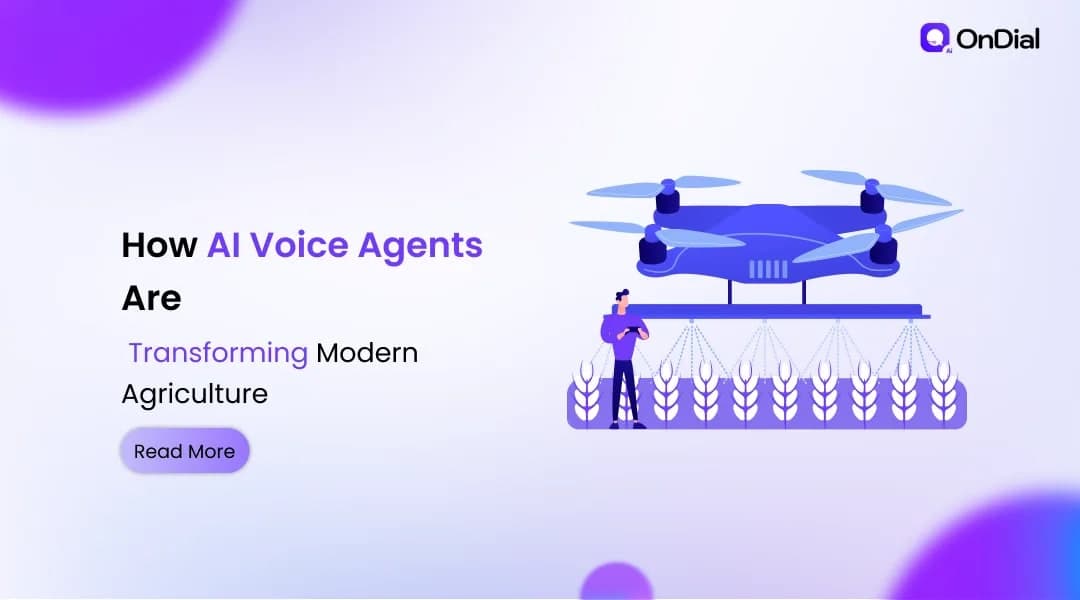
A recent MorganMyers survey found that 60% of agricultural retailers have low or no trust in AI-generated business recommendations, and 55% of row crop farmers reported low or no use of AI models at all. That is the honest place to start any conversation about AI voice agents in agriculture, including teams adopting AI voice agents for finance and banking. These are systems that let a farmer call a number, ask a question out loud in their own language, and receive a specific, grounded answer in seconds, with no app, no dashboard, and no data plan required. They are gaining ground because they match how farmers already communicate, not because the underlying models are impressive.
If you are sceptical, you have earned it. Agriculture has absorbed two decades of software that promised precision and delivered dashboards nobody opened. A Syngenta study found that farmers not only struggled to trust AI platforms but described AI in agriculture as feeling distant and alien.
At OnDial, we build voice AI systems for regional Indian markets, which means we spend most of our time on the unglamorous part: making a system understand a word that appears in no dictionary. This article covers what these agents actually do, why trust is the real bottleneck, how dialect handling is engineered, and where the technology still falls short.
Why Farming Broke Every Digital Interface Before Voice
Digital agriculture did not stall because farmers reject technology. It stalled because almost every tool built for them assumed a quiet room, a clean screen, and a free hand. Voice AI for farmers works differently for one reason that has nothing to do with artificial intelligence: it removes the interface entirely. The interaction becomes a phone call, which is a behaviour that already exists.
The Dashboard Was Always the Wrong Shape
Screens do not survive contact with a field. Sun glare, gloves, wet hands, and dust make a touchscreen a genuine obstacle during the exact hours when decisions matter most. Add the download, the account creation, the update prompts, and the storage warning, and the app has asked for six commitments before delivering one answer.
Literacy compounds this. Research on rural advisory deployments consistently finds that the barrier is not motivation but format, with reports on Nigerian smallholders noting that 93% struggle to access reliable agricultural information because of literacy barriers and data costs. A voice call removes reading, typing, and navigation in a single step. That is not a feature improvement; it is a different category of access.
What Changed Technically in the Last Two Years
The idea of a farming helpline is old. What changed is that three components matured at once: automatic speech recognition accurate enough for accented, noisy, outdoor speech, large language models capable of reasoning across weather, crop stage, and input data, and latency low enough that the conversation does not feel like a transaction.
Older interactive voice response systems could only route you through a menu tree someone designed in advance. Modern agents handle open questions they were never explicitly scripted for. Deployments documented by IndiaAI report transcription accuracy in the range of 88% to 95% for local dialects over basic phone lines, which is the threshold at which a farmer stops repeating themselves and starts trusting the system.
What AI Voice Agents in Agriculture Actually Do
An agriculture voice agent is a conversational system that answers or places phone calls, understands spoken farm questions, and returns specific advice or completes a task. That is the whole definition. Everything else is deployment detail.
How do AI voice agents actually help farmers? They give farmers instant spoken access to agronomic guidance that would otherwise require an extension officer visit. A farmer calls, describes a symptom or asks about timing, and the agent responds with crop-specific, location-aware advice in the farmer's own language. It works on any phone, at any hour, without literacy, apps, or internet connectivity.
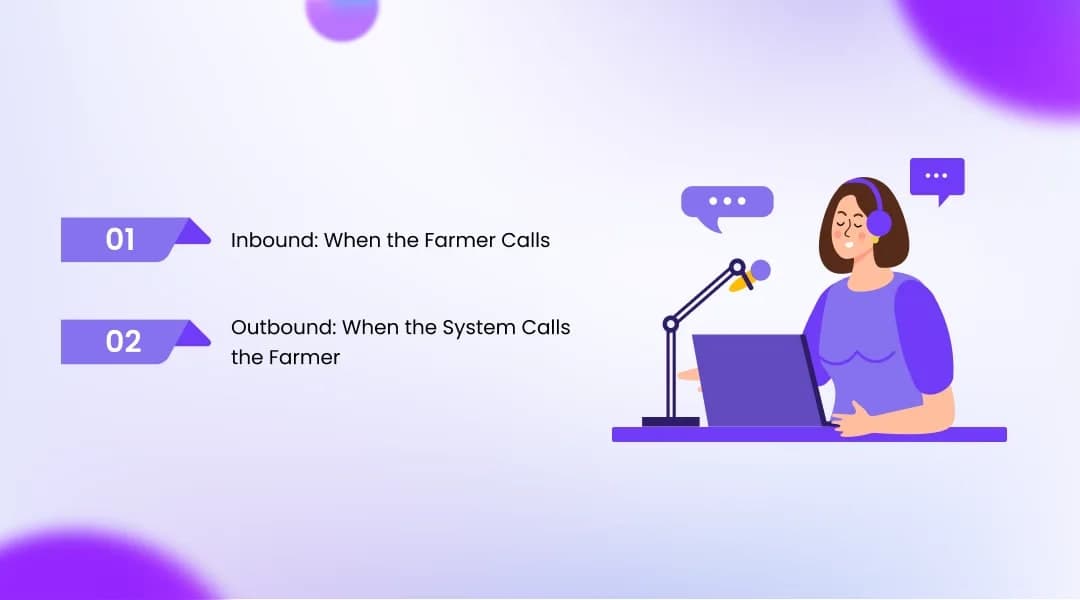
Inbound: When the Farmer Calls
The most common pattern is advisory. A farmer describes leaf discolouration, asks whether to irrigate before an expected rain, or checks the correct dosage for a specific pesticide on a specific crop stage. The agent asks clarifying questions the way a trained agronomist would, then answers.
The critical design choice sits underneath: the agent must retrieve from a verified agronomic knowledge base rather than generating from general model knowledge. Crop2Cash's FarmAdvice deployment grounds its responses in a tokenised knowledge base of verified agronomic data specifically because incorrect advice in this context causes real crop loss and financial harm. Ungrounded generation is not a minor quality issue in agriculture. It is a liability.
Outbound: When the System Calls the Farmer
The second pattern is proactive. The agent places calls for pest outbreak warnings, weather alerts before a spraying window closes, procurement confirmations, payment reminders, and scheme enrolment deadlines. This is where the economics usually work fastest, because outbound advisory calls at scale were previously impossible without a call centre.
I have seen the sequencing matter enormously here. Teams that launch outbound campaigns before proving inbound accuracy tend to burn farmer trust on the first wrong alert, and rebuilding that is far harder than earning it the first time.
The Trust Gap Nobody Puts on Their Landing Page
Here is the counter-intuitive part: the technology is no longer the constraint. Belief is.
Every vendor page on this topic assumes farmers are waiting for this. The live data says otherwise. The same MorganMyers survey found that while 64% of dairy producers qualified as active AI users, most row crop farmers did not, and agricultural retailers trusted AI recommendations even less than the farmers did. Trust in agricultural AI is the willingness to act on a recommendation when being wrong costs a season of income.
Why Farmers Discount AI Advice
Farming decisions are irreversible on a seasonal clock. A wrong spray recommendation in March is not correctable in April. That asymmetry means a farmer needs a much higher confidence threshold than a consumer deciding what to stream tonight.
There is also history. GPS guidance, variable-rate application, yield monitors, and cloud farm-management platforms all arrived with efficiency claims, and the ones that stuck delivered measurable value while the rest stayed niche. Farmers are not technology-naive. They are veterans of technology promises, which makes them harder to convince and far more valuable once convinced.
The Four Things That Make Advice Actionable
In projects we have worked on, the deployments that earn trust share four engineering decisions. None of them is about voice quality.
Grounding over generation. Every answer traces to a verified source, an agronomic database, a state agricultural university recommendation, or a published advisory. FarmAdvice reports 99% source fidelity as a deliberate safeguard against hallucination.
Counter-questioning. IFPRI's documentation of the Farm Vaidya deployment notes that early versions gave incomplete answers, wrong dosages, or skipped critical clarifying questions, and the fix was prompting the agent to validate context before answering, the way a real crop scientist does through AI voice agent services.
Visible escalation. The agent must be able to say it does not know and transfer to a human extension officer. Systems without an exit route eventually give a confident wrong answer.
Consistency across calls. If the same question yields different dosages on Tuesday and Thursday, adoption stops immediately.
Language, Dialect, and the Vernacular Problem
Multilingual voice agents for rural markets fail on vocabulary far more often than they fail on accent. This is the part that separates a demo from a deployment, and it is almost never discussed in vendor material.
Textbook Vocabulary Does Not Match Field Vocabulary
Farmers name crops, pests, diseases, and growth stages using terms that exist in no agricultural textbook and no training dataset. A pest may have four names across three districts within the same state. A model trained on formal agricultural literature simply does not recognise the word the farmer actually says.
The scale of this problem is measurable. IFPRI, serving as technical advisor to the Farm Vaidya project in India, documented teams travelling village to village recording conversations and accumulating a dataset of more than 5,000 previously undocumented vernacular terms before the system could function reliably for Telugu-speaking farmers.
Building a Dialect-Ready Voice Stack
The practical build sequence looks like this, and it is slower than most product roadmaps assume.
Collect real audio in the target region before writing a single prompt, including background noise, interruptions, and code-switching between languages mid-sentence.
Build a synonym and vernacular layer that maps local terms to canonical agronomic entities, then keep expanding it, because it is never finished.
Tune response register, since IFPRI's documentation notes that early responses came across as robotic and textbook-like even when factually correct, which suppressed usage.
Test with the least confident users, not the most enthusiastic ones, because the enthusiastic farmer will forgive a failure and the hesitant one will never call back.
Sounds straightforward on paper. It is the hardest six months of any agricultural voice deployment.
Voice as the Farm's Missing Data Layer
Now shift perspective. Everything above treats the voice agent as a way to deliver information to farmers. The more interesting shift is what it captures on the way back.
Every Call Becomes a Structured Record
Farm data capture through voice works because farmers describe what they did in the natural course of asking for help. What was planted, when it was sprayed, what was observed, what the yield looked like. Traditional farm record-keeping fails at smallholder scale because it requires deliberate data entry that nobody has time for.
A voice agent converts that spoken context into structured records as a by-product of a useful conversation. The farmer is not doing data entry. They are asking a question, and the record is the residue.
What Structured Farm Records Unlock
This is where the commercial case sharpens for agribusinesses, lenders, and insurers. A farm with a spoken history of inputs, timing, and observed conditions is a farm that can be underwritten.
Credit access. Loan decisions currently rely on land records and collateral rather than production behaviour, because production behaviour was never captured.
Crop insurance. Claims verification is expensive and slow without a record of what was actually done and when.
Input planning. Aggregated demand signals across a region let cooperatives and retailers forecast rather than guess. Learn more in Top AI Calling Companies IN India You Should Know.
Advisory improvement. Real query patterns show which problems are actually occurring, which is a better outbreak signal than a survey.
Where AI Voice Agents Fit in Agribusiness Operations
AI voice agents for agribusiness operations serve a different buyer than farmer advisory does, with different economics. The unit of value here is calls handled rather than yield improved.
Procurement, Prices, and Farmer Support Desks
Cooperatives, FPOs, and agri-input companies run high call volumes with severe seasonal spikes. Harvest windows and sowing seasons generate call loads that no fixed team can staff economically. Voice agents absorb that spike and hand off the complex calls.
The scale precedent exists in the public sector. India's Kisan Suvidha platform reportedly delivers AI-generated pest and irrigation advisories to around 50 million growers, alongside initiatives such as FarmerChat and Bharat-VISTAAR that integrate conversational and voice-based interfaces for local-language advisory. Private agribusinesses are now building the same capability for their own grower networks.
Compliance, Consent, and Calling Rules
Outbound calling to farmers is a regulated activity, and this is where deployments quietly fail. In India, that means TRAI's DLT framework for commercial communication and the DPDP Act for personal data handling. In the United States, TCPA governs automated outbound calls.
Beyond the legal minimum, there is a governance question the CGIAR analysis of voice advisory deployments raises directly: data governance, farmer trust, and the integration of local experts determine long-term success more than model quality does. Farmers should be told what is recorded, why, and how to opt out, in the same call and the same language.
Honest Limits: What Voice AI Still Cannot Do
I would rather you deploy this with accurate expectations than enthusiastic ones. Three limitations are real and current.
Where Accuracy Still Breaks
Diagnosis from spoken description alone is unreliable for anything visual. A farmer describing yellow leaves could be reporting nitrogen deficiency, a fungal infection, water stress, or herbicide damage, and voice alone cannot separate them. Serious deployments pair voice with image submission or a field visit for diagnostic categories.
Dosage and chemical recommendations remain the highest-risk output. The Farm Vaidya documentation is explicit that early systems produced wrong dosages, and that class of error causes measurable financial harm. Most responsible deployments constrain these responses to retrieved, approved recommendations rather than allowing generation at all.
The Evidence Base Is Thinner Than the Marketing
Published outcome data on voice-based agricultural advisory is limited and mostly comes from small pilots. One IJERT study of a voice-enabled farming assistant reported that 90% of users found voice input more convenient than typing and observed a 10% to 15% yield improvement among farmers who followed the recommendations, but that pilot covered only 40 users over two months. That is a promising signal, not proof at scale.
The market forecasts are far more confident than the field evidence. Future Market Insights projects the AI in agriculture market to reach USD 7.5 billion by the end of 2026 and grow at a 26.3% CAGR to USD 77 billion by 2036. Treat market growth as a statement about investment appetite, not about validated farm-level outcomes. And treat voice agents as a way to extend expert capacity rather than replace expert judgement, because that is what the evidence currently supports.
Conclusion
AI voice agents in agriculture are working, but not for the reason most articles suggest with OnDial. They succeed because a phone call is the only interface that survives a working field, and they fail when the advice behind the voice is not grounded, not verified, and not spoken in words the farmer actually uses. The trust gap is an engineering problem, not a marketing one.
You now have the four questions that separate a real deployment from a pilot: Is the advice grounded in verified sources? Does the agent ask clarifying questions? Can it escalate to a human? Was it built on real regional audio?
If you are evaluating voice for a grower network, cooperative, or agri-input business, talk to us at OnDial about what a regional-language pilot looks like in your specific districts, including the vernacular collection work most vendors skip. We would rather show you the constraints upfront than sell you a demo.