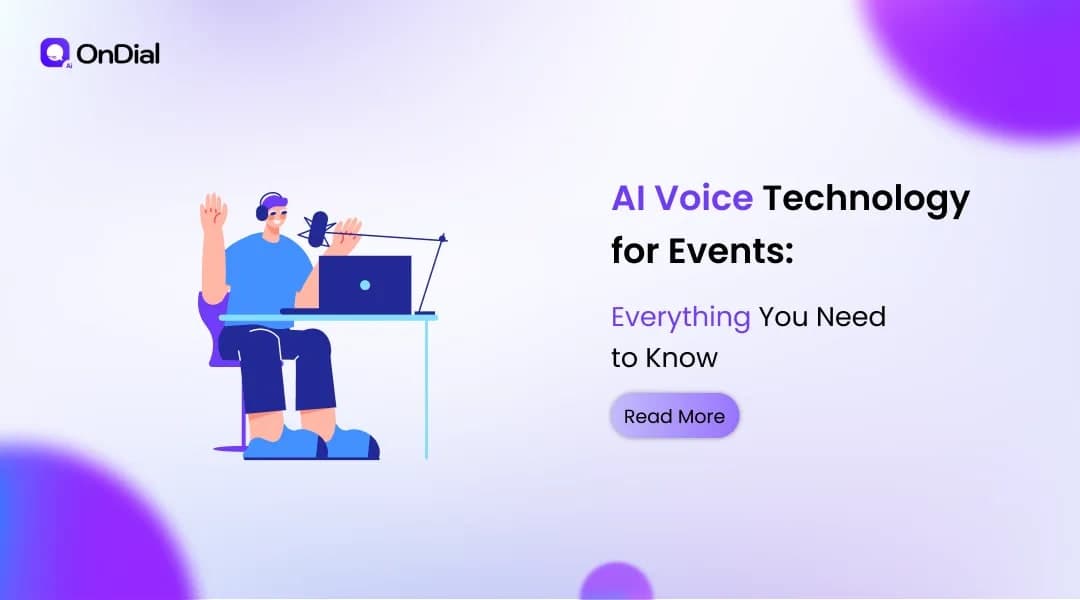
ExpoPlatform's 2026 B2B Event Technology Trends Report recorded a 47% increase in attendee engagement among organisers using AI solutions. That figure is doing something specific for you: it says the gap is no longer about whether the tools exist, but about which teams have wired them into the parts of an event that genuinely break. AI voice technology for events is the use of conversational voice agents to handle registration calls, attendee questions, attendance confirmations, and post-event follow-up over the phone, in natural spoken language, at event-scale volume.
If you are reading this half convinced and half exhausted, you are in normal company. Most organisers I speak with are stuck between two unhelpful stories: vendors promising total automation, and colleagues warning that a synthetic voice will embarrass the brand, including teams adopting AI voice agents for automotive. Neither one survives contact with a real deployment.
What follows is the working version: what this technology handles well, where it fails, what it actually costs, and how to run a first deployment without betting your flagship event on it.
What AI Voice Technology for Events Actually Means
AI voice technology for events uses conversational voice agents to answer and place phone calls across the full event lifecycle. It handles registration queries, ticket changes, logistics questions, attendance confirmations, and feedback collection in natural spoken language. Complex or high-value cases escalate to human staff, while every interaction syncs back into the event management platform.
The Three Layers Behind a Single Call
Every event voice agent runs three stacked components. Automatic speech recognition (ASR) converts the caller's audio into text, a reasoning layer built on a large language model interprets intent against your event knowledge base, and a text-to-speech engine such as ElevenLabs returns the spoken reply. Learn more in True Cost Human Call Centre Agent VS AI. Telephony providers like Twilio carry the call itself over the public phone network.
The component that decides whether this feels human is latency. Anything past roughly one second of silence before the agent responds reads as broken to a caller, which is why speech-to-speech architectures have become the 2026 benchmark. In deployments at OnDial, we treat the latency budget as a hard design constraint, not a performance target, because a well-scripted agent that lags will still lose the caller.
Why Event Voice AI Is Not a Contact Centre Bot
Here is the part almost every guide misses. A contact centre handles steady, predictable, year-round volume, so its automation is tuned for consistency. An event produces the opposite: near-zero call traffic for months, then a violent spike in the final fortnight, then a second spike on the morning of day one through AI voice agent services.
That shape is exactly why voice AI pays back faster at events than in most other settings. You cannot hire fourteen temporary agents for nine days and train them on a 200-page delegate handbook. You can, however, load that handbook into an agent that scales to 400 simultaneous calls and then costs you almost nothing in July.
Where AI Voice Agents for Event Registration Deliver Fastest
AI voice agents for event registration earn their place on the calls that are high-volume, low-judgment, and repetitive to the point of numbness. Start there before anything else.
Inbound Registration and Ticketing Calls
Ask yourself an honest question: how many of your inbound calls last quarter were someone asking what time doors open, whether their badge covers the workshop track, or how to transfer a ticket to a colleague? For most organisers, the answer sits between 60 and 80 per cent of total volume, and every one of those calls is answerable from a document you already wrote. Learn more in AI Voice Agent VS Human Call Centre Agent.
A voice agent connected to your registration system, whether that is Cvent or a bespoke stack, can look up a booking, confirm session access, process a name change, and resend a confirmation without a human touching it. Nextech3D.ai's Eventdex AI Voice Concierge, launched in February 2026, follows exactly this pattern: knowledge-base first, intelligent retrieval second, human transfer on request.
Outbound Confirmations That Cut No-Shows
Inbound automation saves cost. Outbound calling changes the outcome of the event, which is a different order of value entirely. Calling every registrant three to five days before doors open, confirming attendance, and answering the small objection that would have quietly turned into a no-show is the highest-leverage use of this technology.
Vendors report contact rates in the 85 to 90 per cent range for automated attendance confirmation, considerably above what email reminders achieve. Treat supplier figures with the scepticism they deserve, since these are self-reported and rarely audited. Even a conservative haircut on that number moves your headcount forecast enough to change catering and room-block commitments.
Voice AI for Attendee Support During the Live Event
Voice AI for attendee support during live days solves a different problem from registration: not volume over weeks, but chaos over hours.
The Onsite Question Flood
On day one, between 8 am and 10 am, your team will field the same eleven questions several hundred times. Where is Hall 3, is there a cloakroom, has the keynote moved, does my pass include lunch. Meanwhile, your actual operational emergencies- a speaker stuck in traffic or an AV failure- are competing for the same phone line.
A voice agent that absorbs the first category is not primarily a cost-saving. It is a triage system that keeps the line clear for the calls where a human decision genuinely matters.
Multilingual Voice AI for Events and Regional Audiences
Multilingual voice AI for events lets a single agent handle inbound calls across multiple languages without staffing a separate desk for each one. For Indian events, this is not a nice-to-have. A national conference in Ahmedabad or Hyderabad draws attendees whose comfort language is Gujarati, Telugu, Hindi, or Tamil, and a delegate who has to conduct a logistics call in their third language will simply not call at all.
Building this well at OnDial has taught us something counter-intuitive about language coverage. Accuracy on regional accents matters more than the raw number of supported languages, because an agent that speaks nine languages badly generates more escalations than one that speaks three languages fluently.
Event Call Automation ROI and the Real Cost Model
What the Market Data Says
Gartner forecasts that conversational AI will cut contact centre labour costs by $80 billion in 2026, and the broader voice AI agents market was valued at $2.4 billion in 2024 with projections reaching $47.5 billion by 2034 according to Market.us. Those numbers tell you the category is real and funded. They tell you very little about your specific event.
Event ROI resolves down to two lines: calls deflected from your staff, and no-shows prevented. The first is a cost line and the second is a revenue and sponsorship line, which is usually the larger of the two.
The Cost Model Most Organisers Get Wrong
Per-minute pricing looks alarming until you model it against your actual demand curve. The mistake I see repeatedly is organisers pricing voice AI as a monthly subscription across twelve months, when their real usage is concentrated into roughly fifteen active days per event cycle.
Model it per event, not per year. Build the estimate from three inputs: expected inbound call volume in the final fortnight, registrant count for outbound confirmation, and average handled call duration. Most mid-size conferences land somewhere between a single temporary staff hire and a fraction of one, for coverage no temporary hire could match.
Where AI Voice Technology for Events Still Falls Short
The best voice AI deployment I have seen at an event answered fewer calls in its second year than in its first, because the team had fixed the FAQ page that was generating the calls. Automation is not always the right answer, and honest vendors say so.
Escalation Design Is the Whole Product
The failure mode that damages your brand is not a robotic voice. It is an agent that traps a caller in a loop with no exit while their flight lands in ninety minutes. Industry practice has settled on roughly a 70/30 split, with AI handling routine volume and humans taking complex or high-value interactions.
Escalation is not a fallback. It is the feature.
What separates a good handoff from a bad one is the context payload. Your human agent should receive the transcript, the caller's registration record, and the reason for transfer before they say hello, so the attendee never repeats themselves.
Consent, Compliance, and Recording Rules
Voice calls carry obligations that chat widgets do not. Under GDPR, call recordings and voice data are personal data requiring a lawful basis and clear disclosure at the start of the call. In India, outbound commercial calling sits under TRAI's DLT registration framework, which governs sender registration and consent for promotional communication.
Two honest limitations remain open. Onsite ASR accuracy degrades measurably in high-noise venue conditions, and attendee comfort with disclosed AI callers still varies by market and age band. Neither is a reason to avoid deployment, but both belong in your risk assessment rather than your vendor's slide deck.
How to Deploy Before Your Next Event
A Four-Week Rollout
Week one, scope: Pull your last event's call log and categorise every call by type. Automate only the top three categories by volume. Resist the urge to cover edge cases in version one.
Week two, build: Load the event knowledge base, connect the registration platform, and define escalation triggers explicitly rather than leaving them to model judgement.
Week three, test: Run internal calls including deliberate interruptions, accents, and off-script questions. Listen to every recording yourself, without exception.
Week four, soft launch: Route a controlled slice of inbound traffic, review daily, then widen coverage as containment holds.
The Four Metrics Worth Watching
Track containment rate (calls resolved without transfer), escalation quality (whether transferred callers had to repeat information), contact rate on outbound confirmation campaigns, and no-show delta against your previous comparable event. Containment alone is a vanity metric, because an agent can contain a call by simply refusing to transfer.
Read those four together, weekly, and you will know within one event cycle whether this belongs in your permanent stack.
Conclusion
AI voice technology for events works because event demand is spiky, deadline-driven, and repetitive, which is precisely the shape automation handles best. Three things matter more than anything else you have read here. Automate the highest-volume, lowest-judgement calls first. Invest more design effort in escalation than in the script. Measure no-show delta, not just containment.
You now have enough to scope a first deployment without guessing, and enough to challenge any vendor who quotes you a number without asking about your call mix.
If you are running an event this quarter and want to know which of your call types are genuinely automatable, bring your last event's call log to the OnDial team. We will map it against a realistic containment estimate before you commit to anything, including multilingual coverage for regional attendees.