At 9:40 p.m. on a Tuesday, a Sacramento mother learns her ex-husband wants emergency custody by Thursday. Firms exploring AI voice agents for legal intake usually picture a night like hers. She will try three family law offices, and the first live voice she reaches will likely get the case.
Speed alone would not protect her Thursday hearing or the firm, though. The safer answer is AI voice agents for law firms set up as conflict-first gatekeepers. They hear her name and the ex-husband's before any story, then book only after both clear the conflict search.
Our running example is Ostrander & Vela, an invented six-lawyer family law firm in Sacramento. Swap its illustrative 160 monthly calls and $7,500 average fee for your own figures.
Where Retainers Go When the Intake Line Rings Out
The custody retainer goes to whichever firm picks up first, and most firms still do not. Phone pickup has actually slipped since 2019.
Clio's 2024 secret shoppers reached a live answer at just 40% of firms, compared with 56% five years earlier. Even counting callbacks, 48% of the firms in that Clio Legal Trends Report sample never connected by phone.
Patience runs short on the caller's side as well. In Clio's 2019 consumer survey, 79% of people expected a reply within 24 hours. Worse for a slow firm, 42% ended their search after one strong first impression.
For Ostrander & Vela, missed calls leak out through three specific gaps:
Evenings and weekends, when about 45 of its 160 monthly new-matter calls arrive.
Court mornings, when both intake paralegals sit beside lawyers at Thursday hearings.
Lunch-hour pileups, when one paralegal juggles two lines while a third custody caller waits on hold.
Pull 30 days of phone logs before pricing AI voice agents for law firms like yours. If fewer than one in ten new-matter calls goes unanswered, your problem may be intake quality rather than coverage.
How AI Voice Agents for Law Firms Handle One 9:40 p.m. Call
The agent answers as Ostrander & Vela, says it is automated, and follows the firm's fixed intake script. Behind that calm voice, a six-step software chain hands the Tuesday call along like a relay.
Here is that chain for the custody caller, step by step:
The phone system picks up on the first ring and plays the California recording and AI disclosure.
Speech-to-text software turns her words into text, including the opposing spouse's surname she spells out.
A language model, fenced in by the Ostrander & Vela script, picks the next question without improvising advice.
Every name she gives is searched against Ostrander & Vela's past matters in Clio or a similar tool.
If no match appears, the agent offers open Wednesday or Thursday slots from the family law partner's calendar.
A transcript, summary, and urgency flag land in the matter record before staff arrive Wednesday.
Each link can fail on its own. So when vendors demo the Tuesday call, ask which step logs errors and who sees them.
Legal Intake Automation That Hears Names Before Stories
Well-built AI voice agents for law firms collect only what the conflict search needs, then pause the custody caller. That restraint protects the firm under Model Rule 1.18, which sets out duties to prospective clients.
The rule's commentary favors narrow first conversations, and ABA Formal Opinion 492 from June 2020 explores those duties. ABA Formal Opinion 510, issued in March 2024, adds a practical twist. Screening off a lawyer who heard too much works only if reasonable steps limited what she heard.
A conflict-first script is one way to show those steps on the record. California's own version of Rule 1.18 differs in places, so Ostrander & Vela checks the state text too.
The firm's guidance then becomes a one-line test. Would this fact change the conflict search or the take-or-decline decision? If not, the detail waits for the Wednesday consult.
Maiden Names to Court Dates: What AI Voice Agents Collect First
For a family law caller, the Ostrander & Vela script asks for these details before anything else:
Her full legal name, plus any maiden name or earlier married name she has used.
The opposing spouse's full name, including nicknames that might sit in older firm records.
Any new partner, grandparent, or family business tied to the dispute who could already be a client.
The county where the case is filed, so Sacramento matters reach the right team.
The hearing date, if one exists, so a Thursday deadline triggers same-night escalation.
What AI Voice Agents Should Decline to Hear Yet
Suppose the Tuesday caller starts describing hidden accounts or her ex-husband's affair. The agent should steer her back, promising a lawyer will hear all of it once the records search clears.
This matters most in divorce work because of taint shopping. That is when one spouse calls several strong local firms simply to conflict them out.
The Illinois State Bar Association's Opinion 12-18 says lawyers may not encourage that tactic. Rule 1.18's commentary also states that someone consulting only to disqualify a lawyer is not a prospective client. Even so, proving motive later costs time, so a script that never collects the juicy facts is cheaper insurance.
How AI Voice Agents Book Consults Only After Names Clear
When the conflict search comes back clean, the agent books the custody consult straight into a partner's calendar. When the search needs human eyes, it places a pending hold instead of a confirmed slot.
Ostrander & Vela runs three booking rules, which a configurable platform should handle without custom code:
A clean search books the next open slot with the partner covering Sacramento County.
A possible match creates a 24-hour pending hold and an alert for the conflicts paralegal.
A confirmed conflict, like the ex-husband being a former client, ends with referrals and no hint why.
Outbound reminders are where AI voice agents for law firms meet federal telemarketing rules. A February 2024 FCC ruling treats AI-generated voices as artificial voices under the Telephone Consumer Protection Act. Before any AI reminder call goes out, the agent should capture her consent during the 9:40 p.m. intake.
Text reminders carry separate consent rules, so check both with compliance before Ostrander & Vela turns on follow-ups.
After-Hours Triage: Attorney Call Answering at 11 p.m.
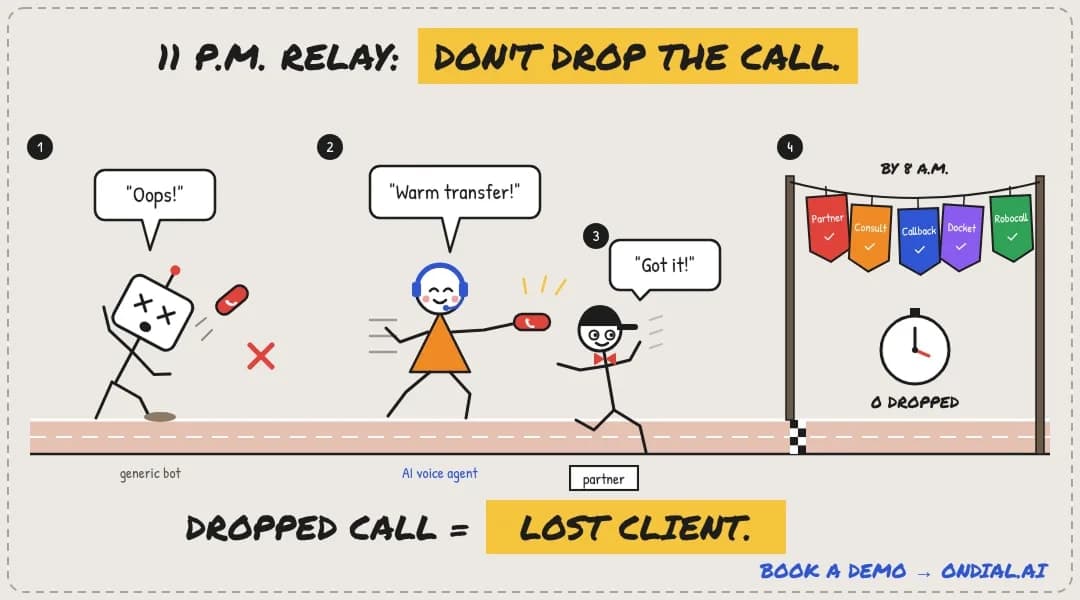
At 11 p.m., the agent's main job is sorting calls into lanes, not chatting. Each lane needs a named owner and a deadline before Wednesday morning. Without them, AI voice agents for law firms just move the voicemail pile.
This is how the Sacramento firm assigns its lanes:
Who is calling | What the agent does that night | Who hears about it, and when |
A new client whose custody hearing is within 72 hours | Clears names, then warm-transfers her to the on-call partner's cell | The on-call partner, live, before the Tuesday call ends |
A new divorce client with no court date this week | Runs the conflict-first script, then books a consult or pending hold | The intake paralegal, inside the 8 a.m. Wednesday summary |
An existing client upset about her ex-husband's new filing | Takes a detailed message about the filing and promises a 9 a.m. callback | Her responsible attorney, by text within 15 minutes |
Opposing counsel phoning about Thursday's hearing | Logs the caller, matter number, and hearing date for the assistant | That attorney's assistant, before the Wednesday docket check |
A sales pitch or recorded robocall at 11 p.m. | Ends politely after two questions and opens no record in Clio | Nobody, though the count appears in Friday's weekly report |
Family law adds one more question for callers like the Sacramento mother. Before any text or voicemail, the agent should ask if it is safe to text this number. An abusive ex-husband may check her phone, so that answer belongs in every Wednesday summary.
Night coverage is often where the change shows first. For more on that gap, read How law firms never miss a client with AI.
Confidentiality, Recording Consent, and Supervising AI Voice Agents
Treat the agent like a new Ostrander & Vela intake hire whose every word is recorded. The ethics duties stay with the partners, so Friday transcript reviews must be easy to run.
ABA Formal Opinion 512, released on July 29, 2024, applies existing rules to generative AI tools. Its six themes, including confidentiality, supervision, and fees, all bear on AI voice agents for law firms handling intake.
Recording law deserves its own line in the Ostrander & Vela script. California is an all-party consent state under Penal Code 632, and Section 632.7 reaches cellular calls too. As a result, Ostrander & Vela plays its disclosure before asking a single question.
Roughly a dozen states, California and Florida among them, use all-party rules, depending on the count. When a caller from one-party Texas reaches Sacramento, the stricter rule generally governs, so disclose on every call.
Before Ostrander & Vela signs with any vendor, it gets written answers on these points:
Where custody-call recordings and transcripts live, and how many days pass before deletion.
Whether caller audio from Sacramento ever trains the vendor's or a model provider's shared models.
Who at the vendor can open a transcript, and whether each access gets logged.
How the firm exports or deletes every transcript if the contract ends next year.
Security questions go well beyond those four custody-call checks. Our guide to AI voice agent security covers the enterprise side in more detail. On supervision, one habit helps most: at Ostrander & Vela, a partner reads ten random transcripts every Friday.
The ROI Math: AI Voice Agents for Law Firms Versus One Lost Retainer
At Ostrander & Vela, one extra $7,500 retainer covers about five months of an assumed $1,500 agent budget. The real question is how many extra consults it books, and four steps will tell you:
Count monthly new-matter calls that reach voicemail; Ostrander & Vela logs about 45.
Estimate how many of those callers bring matters you actually take; assume 20 here.
Compare consults booked now versus with the agent, then multiply the gap by your 30% retention rate.
Multiply retained matters by your average fee, which is $7,500 here, then subtract the agent cost.
Now plug in the numbers. Say voicemail callbacks currently save 8 of those 20 callers, and the agent books 14. Those 6 extra consults produce about 1.8 retainers, or roughly $13,500 at a $7,500 average fee.
Against that assumed $1,500 monthly budget, break-even arrives at under one extra consult a month. The formula is simple: monthly cost divided by the product of average fee and retention rate.
Hidden costs belong in the math too. Script writing, Friday transcript reviews, and calendar cleanup might take three or four staff hours weekly. Meanwhile, a practice earning $900 per matter would need about six extra consults monthly to break even.
Choosing an AI Agent or a Law Firm Answering Service for 45 Night Calls
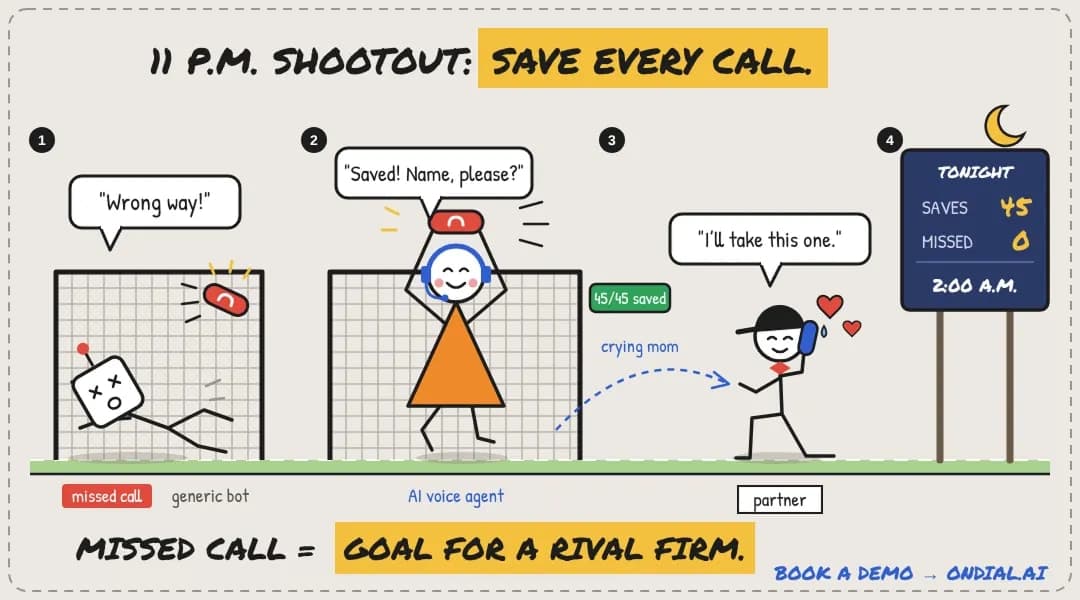
For 45 monthly night calls, the AI agent wins on volume and consistency. Pick people instead when callers like the Sacramento mother need long comfort, or the script changes weekly.
Here is how the two options compare on situations Ostrander & Vela actually faces:
Situation at the firm | AI voice agent | Human answering service |
45 after-hours calls in a month | Answers each of the 45 at once, with no night-shift staffing | Covers all 45, though per-minute plans often climb with volume |
Asking the same conflict questions at 2 a.m. as at noon | Asks about maiden names on every scripted call, without fatigue | Depends on the operator on shift and how well the Sacramento script was taught |
A Sacramento mother crying about her children | Stays calm and brief, then hands off to the on-call partner | A trained operator can offer longer, warmer reassurance at 11 p.m. |
Changing the custody intake script mid-week | Change goes live on the next call after a Friday test | Needs re-briefing across a rotating operator pool before Monday |
Many law firms blend the two, pairing AI voice agents with people. An AI receptionist for lawyers takes the first pass at 11 p.m., while a person handles escalations.
Where AI Voice Agents for Law Firms Stop and a Lawyer Takes Over
AI voice agents for law firms cannot give legal advice, judge credibility, or settle a near-match conflict. For a custody line, those limits are features of a safe design, not bugs.
The agent's hard lines at Ostrander & Vela look like this:
It cannot tell the Tuesday caller whether she will keep custody, because that is advice.
Near-match hits, like two clients named Maria Lopez, need a lawyer's ruling on identity.
Weak cell signals can garble a surname like Wojcik, so spelling checks stay mandatory.
Software reads fear less reliably than a trained person, so any protective order mention triggers escalation.
Engagement letters and custody fee quotes outside partner-approved ranges stay off limits.
Underneath it all sits the unauthorized practice of law. Rule 5.5 bars lawyers from helping anyone practice without a license, so merits questions stay hard stops.
Also, this setup is not for every practice. A two-lawyer estate planning office with eight calls a week may do better with quick personal callbacks.
A 30-Day Pilot Before AI Voice Agents Take Your Main Line
Start with the 45 after-hours calls only, measure for a month, and then decide on daytime coverage. Ostrander & Vela would run the pilot in this order:
Write the conflict-first script with your conflicts paralegal, not only your marketing lead.
Load former-client and adverse-party names, including maiden names, so first searches return real matches.
Have staff place 25 test calls, including one caller who refuses to give any names.
Switch on evenings and weekends only, so the 45 night calls become the test group.
Review every flagged transcript weekly and sample ten clean ones each Friday.
At day 30, compare booked consults and retainers with last month's voicemail results.
Vendors of AI voice agents for law firms differ on how much of this 30-day pilot they handle. Firms comparing managed options can review OnDial services to see where setup support fits.
Hear Your Own Intake Script Before You Commit
The surest test replays your own Tuesday-night custody call against your own conflict list. Book a demo and bring one real after-hours call from last month's phone log.