On a Friday night, a driving-school manager types voice generator into Google, hoping to cut weekend no-shows. Plenty of readers arrive the same way, so our What is voice AI guide maps the field first.
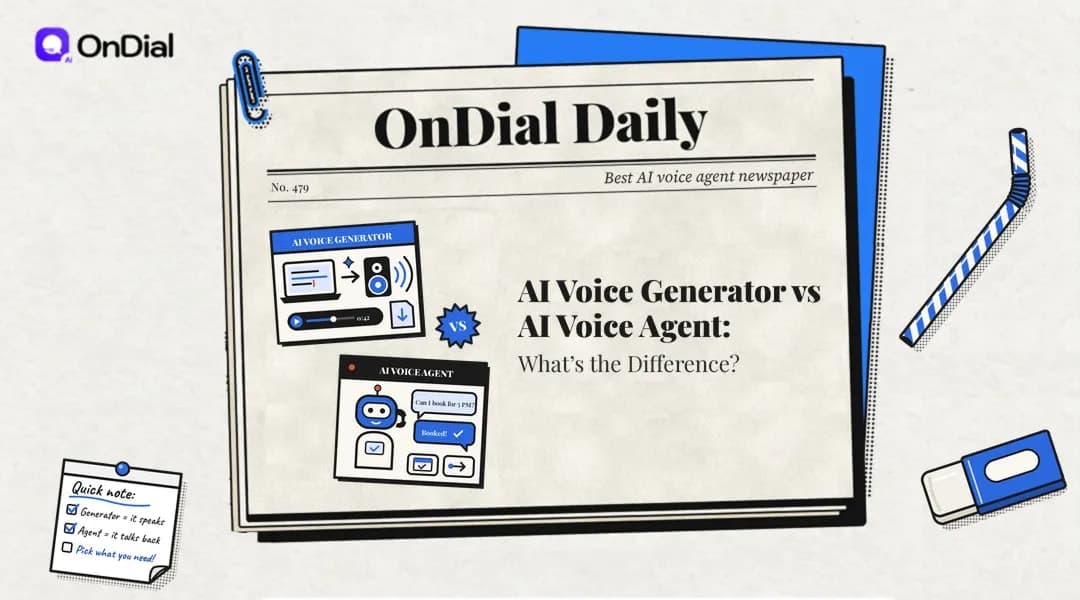
Then comes the narrower question. Does her Ahmedabad school need an AI voice generator, or an agent that handles phone calls?
Nidhi runs operations for Gearshift, an imagined four-branch driving school in Ahmedabad. She pictured a friendly recorded reminder about weekend lessons. What she actually needed was software that hears a learner mention an exam clash, then moves the slot.
The finish-line test: where an AI voice generator's job stops
An AI voice generator crosses its finish line the moment it exports an audio file. A calling agent crosses it later, when the caller hangs up and your calendar shows what changed.
That one difference explains the pricing, the setup effort, and most limits covered further down. So before you compare voices, ask a blunt question. What should be different in your business after the audio plays?
For Gearshift, an AI voice generator would produce a tidy 40-second MP3 about weekend lessons. Nobody can reply to an MP3, though. As a result, about 30 learners needing a new slot would still ring the front desk on Friday.
What a voice generator hands Gearshift: one file
Paste Gearshift's road-signs script into an AI voice generator, pick a calm voice, and press export. Out comes a WAV or MP3 file, ready for YouTube. That one-way trip from script to sound file is the entire promise of text-to-speech (TTS).
An AI voice maker wraps the same engine in an editor built for creators. In most of these products, Nidhi would get controls like the following:
A voice library for auditioning a patient instructor tone before Nidhi commits to one.
Speed, pitch and pause settings for slowing down tricky lines about roundabout priority.
Pronunciation overrides, so a brand name like Gearshift never comes out mangled.
Voice cloning from a short, consented sample of the head instructor, skipping a studio session.
Export buttons that drop the finished road-signs narration into a video editor or course builder.
Notice what is missing from that list. Nothing in it listens.
Ears, judgment and hands: what a calling agent adds
A calling agent keeps the lifelike sound of an AI voice generator, then adds ears, judgment and hands.
Ears mean speech recognition that transcribes the caller while they talk. Judgment means a language model that decides what to say next. Hands mean live connections to your booking system, CRM or ticket queue, so each call ends with work done.
Put together, that listen, decide, reply cycle is the heart of conversational software. For the broader idea behind it, read What is conversational AI on our blog. Back at Gearshift, here is what one agent could handle on a single reschedule call:
Spot that the learner wants Sunday instead and check which instructors are free.
Offer two open times rather than reading out the whole weekly timetable.
Write the Sunday booking straight into the school calendar, so the front desk retypes nothing.
Text a confirmation with the branch address once the learner agrees to a time.
Hand the call to a person when someone raises a refund dispute or a complaint.
Under the hood: an AI voice generator's MP3 pass vs a call loop
An AI voice generator runs once, from script to MP3. An agent, by contrast, repeats its loop on every turn of a learner's call.
The generator: script in, MP3 out, no return trip
Nobody waits on the other end of a narration, so an AI voice generator can favour polish over speed. The usual sequence runs like this:
You paste the road-signs script, adding tags where the narrator should pause or stress a word.
The engine normalises numbers and abbreviations, so 10:30 reads aloud as ten thirty.
A neural model predicts how each phrase should sound in the calm instructor voice Nidhi picked.
You download the MP3 once and replay it in every Gearshift video that needs it.
The calling agent: a loop that restarts with every learner reply
Timing is where a reschedule call succeeds or fails. Stivers and colleagues compared turn-taking across ten languages in a 2009 PNAS study.
The typical handover between speakers came in at roughly 200 milliseconds. Therefore an agent that goes quiet for two seconds sounds broken, however lovely its voice is.
Each turn on a live call follows roughly these steps:
The Gearshift line streams the caller's audio to a speech recognition model in small chunks.
Voice activity detection waits while a learner pauses to check her Monday exam date.
A language model reads the transcript, checks Gearshift's booking rules, and picks the next move.
When needed, it calls a tool, such as the school calendar, to fetch open Sunday slots.
Streaming TTS starts speaking the offered Sunday time before the full sentence is even written.
If the learner cuts in, the agent stops and listens again, which engineers call barge-in.
Look again at step five. It is the AI voice generator from the earlier list, now one part inside a bigger machine. For a longer walk through outbound use, see AI voice caller: how it works.
Text to speech vs voice agent over one busy Friday at Gearshift
At Gearshift, the choice comes down to broadcasting a message versus handling a conversation. The table runs both through the same Friday at the driving school.
Friday task at Gearshift | With a voice generator | With a calling agent |
Reminding 220 learners about weekend lessons | You record one clip, then still need a dialer to play it | The agent rings each learner and confirms attendance by name |
A learner says Saturday clashes with an exam | Nobody hears the reply, so the clash stays hidden until Saturday | The agent offers Sunday at nine or eleven and books the pick |
A parent phones at 9 p.m. about test fees | The call lands in voicemail or a recorded keypad menu | The agent answers from the fee sheet it was given |
Recording what each learner decided on Friday's calls | The front desk rebuilds Friday from missed-call lists on Monday | Each learner's Friday outcome lands in the calendar with a transcript |
Making a road-signs video for the YouTube channel | Ideal here: export the narration, edit, and publish within the hour | Overkill, because nobody watching a road-signs video talks back |
The last row matters as much as the others. An AI voice generator wins outright whenever nobody needs to answer back.
Voice generator vs voice bot: the press-one patchwork trap
Gluing AI voice generator clips onto a press-one phone menu creates a basic voice bot, not an agent. Gearshift's learners would feel the difference within seconds.
Many teams try this route first, because both pieces look cheap on their own. At a school like Gearshift, the patchwork tends to crack in predictable places:
The menu only understands keypresses, so a learner who says Sunday morning gets ignored.
Every new learner question needs a freshly generated clip and another branch in the keypad tree.
Nothing writes back to the calendar, so the front desk still rebooks every slot by hand.
Learners cannot interrupt a prerecorded clip, so one wrong keypress wastes a full minute.
Adding speech recognition to that bot fixes the Sunday-morning problem. However, scripted bots still follow fixed paths, so an unexpected answer usually ends in a transfer. A calling agent instead works toward the goal of the call, such as a confirmed Sunday lesson.
Choosing between AI voice tools by the finish line, not the voice
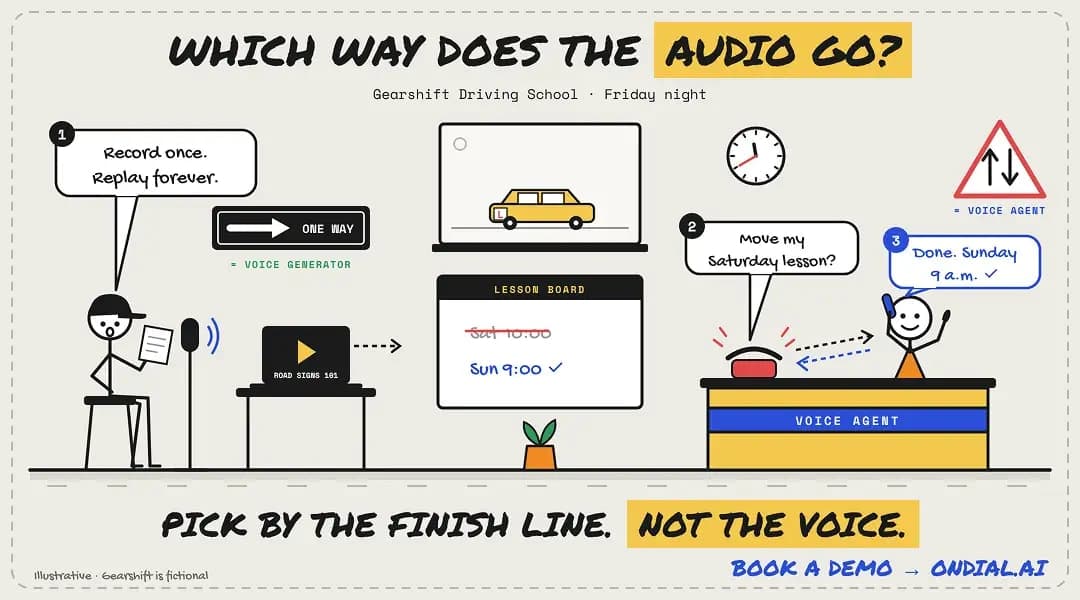
Pick by the direction of the audio, which is the finish-line test in one line. One-way audio needs a generator, while two-way audio needs an agent.
Stay with an AI voice generator if your audio is narration
An AI voice generator is often the cheaper, simpler buy, and Gearshift's YouTube channel would never need more. It suits you when:
Your audio is recorded once and replayed often, like a road-signs lesson or course module.
Listeners never need to ask about fees or move a Saturday lesson slot.
You want studio-style control over pacing and emotion for each line of narration.
Your workload is a handful of course scripts per month, not a ringing front desk.
Move to a calling agent if your front desk keeps ringing
Phone-heavy work, like Gearshift's Friday rush, points the other way. An agent makes sense when:
Learners or customers call you, and the right next sentence depends on what they say.
Each call should end with a booking, fee reminder, ticket or qualified lead saved.
Calls missed after 11 p.m. or on weekends cost you appointments, orders or follow-ups.
You field dozens of near-identical calls daily, like weekend reschedules or order-status checks.
Ticked boxes in both lists? Then you probably need both tools for separate jobs. Gearshift, for instance, would keep a generator for its YouTube series and add an agent for the phones.
Eleven cents a call: cost and consent once a voice dials out
An AI voice generator meters characters, while a calling agent meters minutes, so Nidhi's two bills look nothing alike.
On ElevenLabs' standard speech models, each character of text uses roughly one credit. So a 6,000-character course script costs the same whether ten people or ten thousand hear it.
Calling agents meter the conversation instead. OnDial's features page lists per-minute plans from $0.055 per minute on its Essential tier, as of November 2026. On that rate, a two-minute reschedule call costs about eleven cents, before channel and phone-number fees.
The legal picture also shifts once a synthetic voice dials a real person. In February 2024, the US Federal Communications Commission ruled on AI-generated voices in calls.
It found they count as artificial voices under the Telephone Consumer Protection Act. As a result, US callers generally need the person's prior express consent before such calls.
Indian campaigns, meanwhile, fall under TRAI's commercial-communication rules and the DPDP Act, 2023. This is general information rather than legal advice, so have counsel review consent records before any campaign.
Where a calling agent would still let Gearshift down
A calling agent cannot fully replace your best front-desk person. Some calls should never reach it.
Before launching, weigh these limits honestly:
Emotional or high-stakes calls, like a learner reporting a crash, deserve a human from the first second.
Noisy roadside lines, heavy code-switching and rare Ahmedabad street names still trip up speech recognition.
An agent only knows what you feed it, so an outdated fee sheet produces confident wrong answers.
Pauses grow when every turn waits on a slow CRM lookup, and learners hear that dead air.
Setup takes genuine work: scripts, guardrails, test calls, and a clear rule for front-desk handover.
Volume matters too. If a business takes five calls a week, a staff callback is simpler than configuring any agent.
How OnDial goes past text-to-speech for a school like Gearshift
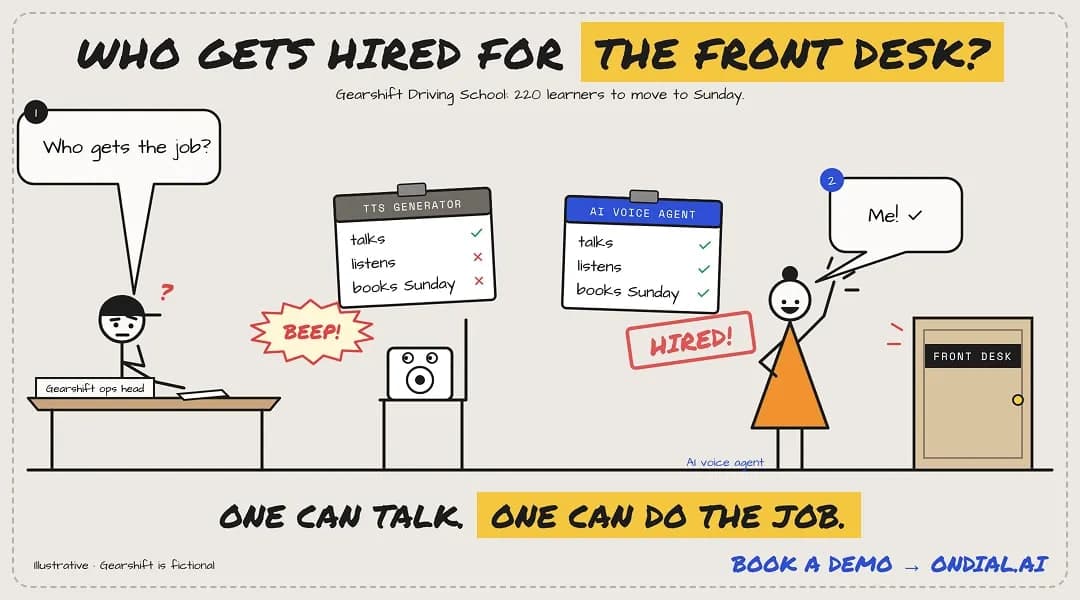
Call platforms treat the voice as one component, much as a front desk is one part of a school. OnDial fits that pattern, wrapping lifelike speech in listening, actions and integrations.
According to its features page, the platform covers these jobs that a generator cannot:
Inbound and outbound calls, including outreach campaigns that could dial all 220 learners at once.
Integrations with Salesforce, HubSpot, Zoho and Calendly, so a Sunday booking reaches the front desk's tools.
Appointment booking, lead scoring, support tickets, and a post-call text confirming the learner's new Sunday slot.
Voicemail detection, plus warm transfers to staff when a learner raises a refund dispute.
Recordings with searchable transcripts and sentiment scores, useful for reviewing Friday's tougher calls.
Language coverage is another place where generators rarely help on live calls. The Multilingual AI voice agent page lists over 100 languages, including Hinglish, with switching between languages during a call. In the Gearshift example, a learner could start in Gujarati, drift into English, and still book Sunday.
One caveat keeps this fair. If your main need is narration for videos, a dedicated AI voice generator remains the simpler purchase.