A voice agent is a chain of parts, not a single product. So the build vs buy voice ai question applies to each link, not to the whole chain. If you only want a vendor shortlist, start with this guide to the Best AI voice agent platform options.
This post is for technical leaders who must defend a number to finance. It gives you a layer-by-layer ownership rule, a worked break-even calculation, and hybrid paths that keep your options open.
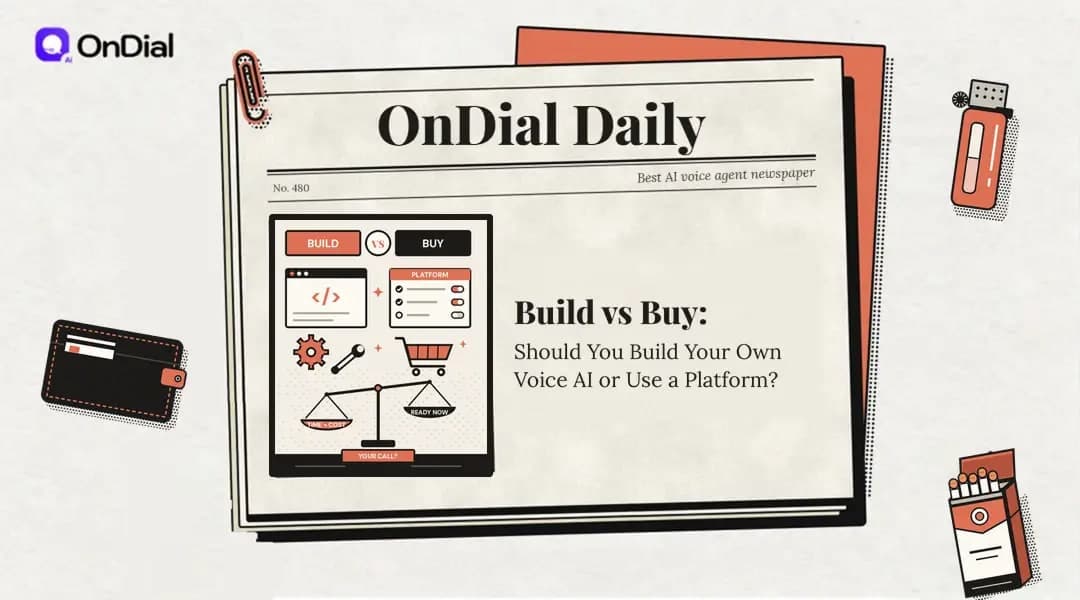
Build vs Buy Voice AI Is Really Five Ownership Decisions
Own the layers that make your calls different, and rent the ones every competitor also needs. Your edge lives in what the agent knows and does, not in who carries the audio.
Treat each layer as its own line item:
Telephony and numbers: carrier routing, number reputation and registration chores rarely set you apart, so rent them.
Speech recognition and synthesis: accuracy matters, but specialist vendors improve it faster than a small team can.
Language model and prompts: this is where policies, tone and edge cases live, so keep control here.
Orchestration and turn-taking: interruption handling and latency tuning are hard to get right, and callers notice flaws within seconds.
Business logic and monitoring: CRM writes, escalation paths and call review belong to you, whoever hosts the audio.
A platform packages the first four layers, but you still own the fifth either way. That is why the voice ai platform vs custom debate is a spectrum, not a switch. Nothing forces you to pick one end for every layer.
How One Phone Call Flows Through the Stack You Would Run
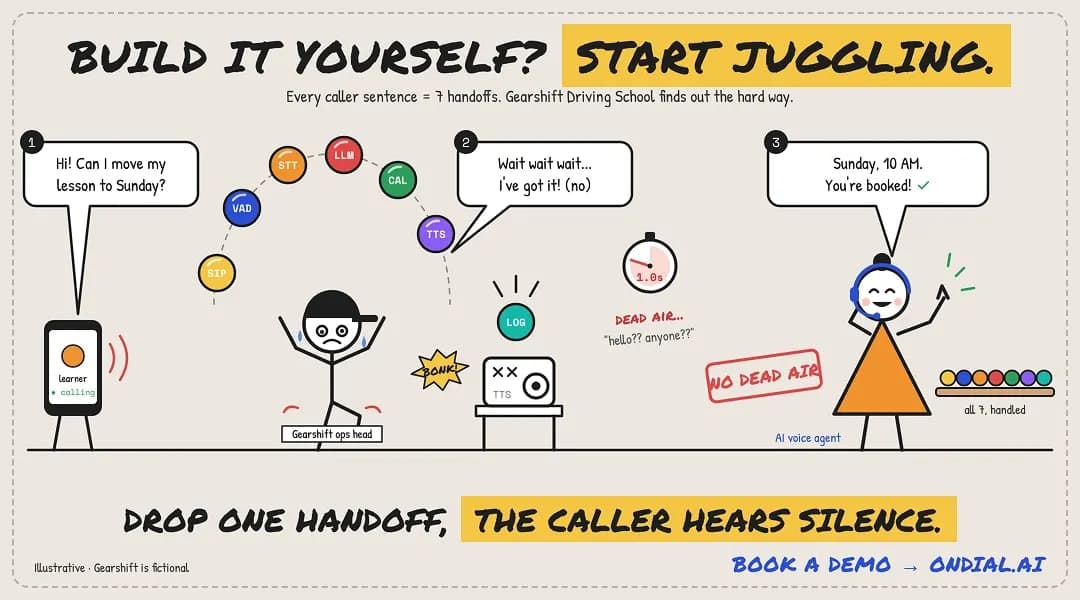
Each caller sentence crosses seven handoffs, and every handoff spends part of your delay budget. Before you settle build vs buy voice ai, count which of these handoffs you would run yourself:
The carrier routes the call to your SIP endpoint or webhook and opens a live audio stream.
Voice activity detection notices when the caller starts and stops talking.
Streaming speech recognition turns audio into partial text while the caller is still speaking.
The language model reads the transcript, your prompt and call state. Then it picks a reply or a tool call.
A tool call reaches your calendar, CRM or ticketing system and returns facts the model can use.
Text-to-speech renders the reply and streams audio back before the full sentence is finished.
Logging stores audio, transcript and outcome for review and compliance checks.
Timing is the unforgiving part. Stivers and colleagues (PNAS, 2009) measured pauses between speakers across a worldwide language sample. Average gaps differed by under 250 milliseconds between languages. As a result, a pipeline that stalls for a full second feels broken to most callers.
For the deployment side and the payback math, see the AI call agent architecture and ROI write-up.
What It Costs to Build Voice AI Beyond the Per-Minute Bill
The component bill is the small number. The team that keeps those parts running is the large one. So any honest build vs buy voice ai budget must price both.
CallSphere's 2026 price breakdown gives these ranges for one minute of conversation:
Telephony costs between $0.010 and $0.018 for each minute on the line.
Speech recognition runs from $0.012 to $0.024 per minute of audio.
Language model tokens add $0.02 to $0.10, depending on the model you pick.
Speech synthesis has the widest spread, from $0.024 up to $0.20 per minute.
Stacked together, that is roughly $0.07 to $0.34 per minute before orchestration or monitoring. Voice and model choice cause most of the gap.
People cost more than minutes. Raftlabs, a development agency, estimates that CRM and booking integrations take 40% to 60% of the engineering work. It also reports that telephony setup and real-call testing need two to four weeks even for a simple agent. Techsy estimates a from-scratch production system at $250K to $2M in year one. That figure assumes three to five senior engineers.
Prototype budgets usually skip these recurring costs:
A night and weekend pager schedule, because claims calls do not stop at five o'clock.
Staff or tooling to review sampled calls and catch quality drift.
Number registration and reputation upkeep so outbound calls are not flagged as spam.
Re-testing prompts whenever a model or voice vendor retires a version.
Load tests before a campaign or seasonal peak sends call volume sharply upward.
A Worked TCO Example: Buy or Build at 200,000 Minutes a Month
Imagine a regional insurer that routes 200,000 claims-intake minutes a month to a voice agent. These numbers are illustrations, not benchmarks, so swap in your own.
Year-one line item | Platform path | Custom path |
Call minutes (2.4 million a year) | $360,000 at an all-in $0.15 | $216,000 with components at $0.09 |
People who touch the system | $85,000 for half an integration engineer | $680,000 for four engineers at $170,000 loaded |
Hosting, monitoring and QA tooling | Bundled into the minute rate | $60,000 |
Year-one total | $445,000 | $956,000 |
The build vs buy voice ai math fits one rule. Divide the extra yearly fixed cost of building by the per-minute saving. Here, $655,000 divided by $0.06 gives about 10.9 million minutes a year, or roughly 910,000 a month.
That is far above 200,000, so this insurer should buy. Techsy's estimate puts its break-even nearer 500,000 monthly minutes, which shows how much the inputs matter.
Rerun the formula with these what-if changes:
A $0.12 platform rate shrinks the saving to $0.03 and doubles break-even to about 1.8 million monthly minutes.
A two-engineer team lowers break-even to roughly 440,000 minutes a month.
A six-month build adds about $340,000 of payroll before the first live call.
Time to Value and the Maintenance Tax of a Custom Stack
A platform can put a scoped agent on real calls in weeks. A full custom stack usually needs months, and then it needs permanent care.
Speed to first call quietly drives most build vs buy voice ai outcomes. Estimates vary by who is selling. Techsy puts a from-scratch build at four to nine months. Raftlabs cites six to twenty weeks for a scoped agent. Neither figure includes the wait for your own security review.
After launch, the maintenance tax shows up in these forms:
A vendor model update can shift tone or tool-calling overnight, so each needs a regression pass on recorded calls.
Latency drifts as traffic grows, and someone must re-profile the seven handoffs listed earlier.
Consent rules change the call script, and the legal duty stays with you whichever path you pick.
The FCC ruled on February 8, 2024 that AI-generated voices count as artificial under the TCPA. Calls using them therefore need prior express consent. A custom build puts that consent check in your code. A platform may offer tooling for it, depending on the provider.
When a Platform Wins and When a Build Is Worth It
Buy when voice is a tool in your operations. Build when voice is the product you sell, or when the audio cannot leave your own network. In most build vs buy voice ai reviews, that single question settles the argument.
A platform tends to win in these situations:
Nobody on staff has shipped streaming audio code, and the budget cannot absorb a specialist hire.
You need live calls this quarter, and a six-month build would miss the window.
Your monthly minutes sit far below the break-even figure from the insurer example.
Your differentiator is the service you deliver, not the technology behind the phone call.
A custom build earns its cost under different conditions:
You resell voice AI to other businesses and need margin control on every minute.
Strict data rules demand self-hosted speech and language models.
Volume is high and steady enough that fixed engineering cost spreads thin.
You need model behavior that no vendor configuration option can reach.
Large organizations add procurement, security review and support terms to the checklist. A vendor page such as OnDial for Enterprise shows how one provider frames those needs for bigger teams.
Buy vs Build Voice Agent Hybrids: Rent the Plumbing, Own the Logic
A hybrid keeps decision logic in your own repository while a vendor carries audio, numbers and scaling. For many teams, it beats both ends of the build vs buy voice ai spectrum.
Three patterns show up most often:
Platform plus your own logic: the vendor runs the call, and your service decides what the agent says or does next.
Open-source pipeline plus managed carrier: your team runs a framework such as Pipecat or LiveKit Agents, while a provider supplies numbers and routing.
Prototype first, migrate later: you prove the flows on a platform, then move the stable ones in-house once volume justifies it.
The first pattern depends on programmatic control. Any voice AI API worth shortlisting should let your code steer the conversation. For one vendor's approach, see the OnDial voice AI API page.
Whichever pattern you choose, keep prompts, call flows and test recordings in your own repository. That way, a later switch costs weeks instead of a rewrite.
Limits on Both Sides: Where Platforms Stall and DIY Voice Bots Break
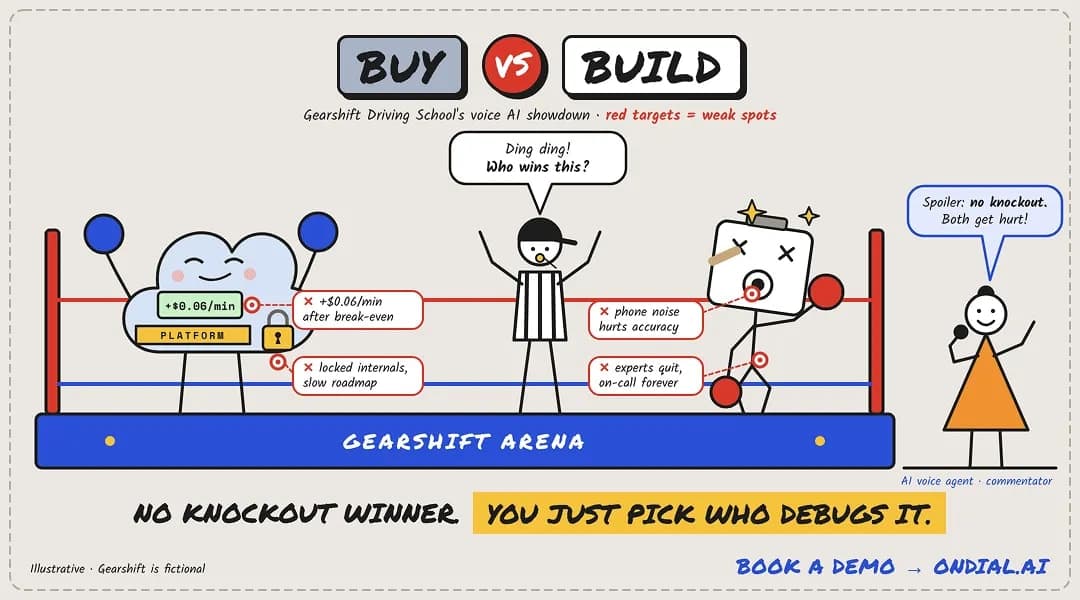
Neither side of build vs buy voice ai removes the hard parts of live conversation. Your choice only changes who debugs them.
Platforms stall in these places:
Once the insurer passes break-even, each extra minute pays the vendor a $0.06 premium over component cost.
Limited access to model internals means some latency fixes sit outside your reach.
A feature you need may rank low on the vendor's roadmap.
Data residency or on-premises demands can rule out some providers, depending on the vendor.
A DIY voice bot breaks in different places:
A demo on clean audio hides how phone-line noise hurts recognition accuracy.
If the two people who understand real-time audio leave, your support leaves with them.
Your team competes with vendors that ship speech and model upgrades continuously.
A custom build is a poor fit for any team that cannot staff an on-call rotation. The same goes for a team that expects the project to end at launch.
Price the Platform Path Before You Staff a Build
A sound build vs buy voice ai call starts with your own call volume and loaded engineering cost. Run the break-even formula before any hiring request goes out. Then compare the result with real vendor rates, starting with OnDial pricing and plans. A quote beats a guess in a budget review.