Let me be blunt.
Most sales teams don’t have a lead problem. They have a follow-up problem.
I’ve seen companies spend lakhs on ads, generate thousands of leads… and then let them rot in a CRM because no one called fast enough.
Or worse, they called once.
Once.
That’s not a strategy. That’s wishful thinking.
This is exactly where AI Voice Agents for Lead Generation enter the picture—not as some shiny tech trend, but as a brutally practical solution to a very human limitation: time, consistency, and scale.
But here’s the catch.
AI voice agents won’t magically fix a broken sales process. (Yeah, I said it.)
They amplify what already exists.
So if you’re expecting a plug-and-play miracle, this will disappoint you. If you’re ready to build a real system? Keep reading.
How AI Voice Agents Work
Let’s strip away the buzzwords.
At its core, an AI voice agent is a system that listens, understands, responds, and acts, just like a human rep… minus the burnout.
Speech Recognition & NLP
First, the system converts human speech into text using speech recognition.
Then comes NLP (Natural Language Processing). This is where intent is understood.
Not just what the user said, but what they meant.
Example:
“Yeah, maybe next week” ≠ interest It usually means “not now”
A good system catches that nuance.
Integration with CRM & Workflows
This is where most setups fail.
If your voice agent isn’t connected to your CRM, it’s basically talking into the void.
A proper system:
Pulls lead data
Updates statuses in real-time
Triggers workflows (emails, SMS, reminders)
No manual work. No lag.
Real-Time Conversation Handling
This part matters more than people think.
A good AI voice agent:
Handles objections
Asks follow-up questions
Adjusts tone dynamically
Not scripted. Structured.
There’s a difference.
Why Businesses Are Switching to AI Voice Agents
Let me ask you something.
How many leads can your team realistically call in a day?
50? Maybe 100?
Now imagine calling 5,000 leads daily. Without fatigue.
That’s the shift.
Speed & Scalability
AI doesn’t wait. No breaks. No “I’ll call later.”
Instant outreach = higher conversion probability.
Because timing is everything.
Cost Reduction
Hiring, training, managing SDRs, it adds up.
AI calling agents reduce:
Salary costs
Training time
Attrition risk
But don’t get it twisted.
Cheap ≠ effective.
The real value is consistency.
24/7 Lead Engagement
Your leads don’t operate on office hours.
Someone fills a form at 11:47 PM.
What happens?
With AI voice agents, instant call.
That alone can double conversions.
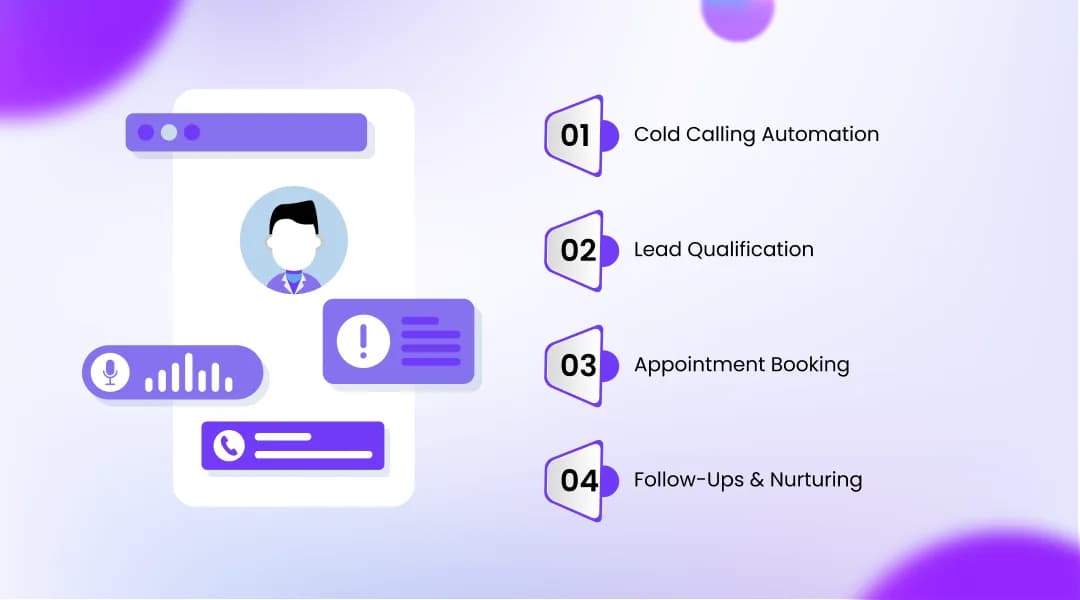
AI Voice Agents for Lead Generation: Core Use Cases
Let’s get practical.
Cold Calling Automation
Yes, AI can cold call.
And no, it’s not as bad as you think.
When done right, it sounds… human. Conversational. Respectful.
Lead Qualification
This is where AI shines.
Instead of wasting human time:
AI filters high-intent leads
Scores them
Passes only qualified ones to sales
Efficiency jumps. Immediately.
Appointment Booking
No back-and-forth emails.
AI:
Checks availability
Confirms schedules
Sends reminders
Done.
Follow-Ups & Nurturing
This is the silent killer in sales.
No one follows up enough.
AI does.
Relentlessly. Politely. Consistently.
AI Voice Agents vs Human Sales Teams
Let’s address the elephant in the room.
“Will AI replace sales teams?”
Short answer: No.
Long answer: It will replace bad processes.
Efficiency Comparison
AI:
Thousands of calls/day
Zero fatigue
Humans:
Limited bandwidth
Emotional variance
Cost Comparison
AI wins on scale.
Humans win on relationship depth.
Both matter.
Conversion Impact
Here’s what I’ve observed:
AI handles:
First touch
Qualification
Follow-ups
Humans close deals.
That hybrid model?
That’s where real growth happens.
Step-by-Step Strategy to Use AI Voice Agents for Lead Generation

Now we build.
Not theory. Execution.
1. Define Target Audience
If you skip this, stop reading.
You need:
Clear ICP
Pain points
Buying triggers
Otherwise, your AI will sound… clueless.
2. Build Call Scripts with AI
Don’t overcomplicate.
Start simple:
Greeting
Context
Question
Response paths
Then refine using real conversations.
3. Integrate CRM
This is non-negotiable.
Your AI sales calls automation system must:
Log every interaction
Track lead journey
Trigger next steps
4. Launch Outbound Campaigns
Start small.
Test:
Call timing
Messaging
Audience segments
Then scale.
5. Optimize with Data
This is where most people stop.
Don’t.
Analyze:
Call success rates
Drop-off points
Conversion triggers
Then iterate.
Again. And again.
Best Practices for High-Converting AI Voice Campaigns
Let’s refine.
Personalization Techniques
Use:
Name
Company
Context
Generic calls get ignored.
Always.
Timing & Call Frequency
Don’t spam.
But don’t under-follow-up either.
Sweet spot:
3–5 attempts
Different times
Script Optimization
Your first script will suck.
Good.
That means you’re learning.
Keep improving based on:
Real objections
Real responses
8. Common Mistakes to Avoid
I’ve seen these kill campaigns.
Over-Automation
Just because you can automate everything doesn’t mean you should.
Humans still matter.
Poor Scripting
If your script sounds robotic, people will hang up.
Immediately.
Ignoring Human Fallback
Always have a handoff option.
Always.
Because some conversations need… nuance.
Top AI Voice Agent Tools for Lead Generation
What should you look for?
Not flashy dashboards.
Real capabilities.
Key Features to Look For
Natural conversation flow
CRM integration
Multi-language support
Real-time analytics
Tool Comparison (Strategic Insight)
Most tools look similar on the surface.
The difference?
Customization.
Companies like OnDial focus on tailored solutions—not generic bots.
And trust me, that matters more than features.
Future of AI Voice Agents in Sales & Marketing
Here’s where things get interesting.
Trends & Predictions
Hyper-personalized conversations
Emotion detection
Context-aware AI
We’re moving from scripted interactions to adaptive conversations.
AI + Human Hybrid Model
This is the future.
Not AI vs humans.
AI + humans.
Together.
Efficient. Scalable. Human.
Conclusion
If you take one thing from this, let it be this:
AI voice agents are not magic.
They are systems.
And systems only work when designed intentionally.
I’ve seen companies double conversions using Voice AI Lead Generation. I’ve also seen companies fail miserably.
Same technology. Different execution.
So the real question is -
Are you building a tool?
Or a system?
Because only one of those scales.