Picture a mid-sized Pune lender whose AI agent places 40,000 EMI reminder calls every month. Before scripting them, most teams read up on AI calling legal in India: TRAI rules first. The harder question comes next: voice AI data security in India once each call is recorded, transcribed and stored.
That lender makes a useful test case. Every reminder touches a carrier, a speech engine, a language model and a database. Each of those hops carries its own DPDP duty and deadline, and the example numbers below are illustrative.
What one EMI reminder call actually puts on record
A single three-minute reminder can create six kinds of personal data, and the DPDP Act covers each one. Here is what the Pune lender's agent leaves behind after a borrower picks up:
The audio file, which holds the borrower's voice, name and overdue amount in one recording.
A machine transcript that turns spoken loan numbers and due dates into searchable, copyable text.
Call metadata, such as the dialled number, call time, duration and whether the borrower answered.
Model prompts and replies, created when a language model reads the transcript and picks the next overdue-payment line.
A CRM disposition, such as a promise to pay on the fifth, written back into the loan file.
A voiceprint, but only if the lender ever uses voice for login, and that identifier never changes.
Multiply that by 40,000 calls and the lender holds about 480,000 recordings a year, plus vendor copies. That archive is where most voice AI data security risk in India actually sits. Audio also gets no lighter treatment, because the DPDP Act uses a single class of personal data.
That single class cuts both ways for voiceprints, because the older SPDI Rules of 2011 apply until May 2027. They list voice patterns as sensitive biometric data. So a voice-login pilot launched this quarter already needs prior consent.
Where the DPDP clock stands for voice teams in November 2026
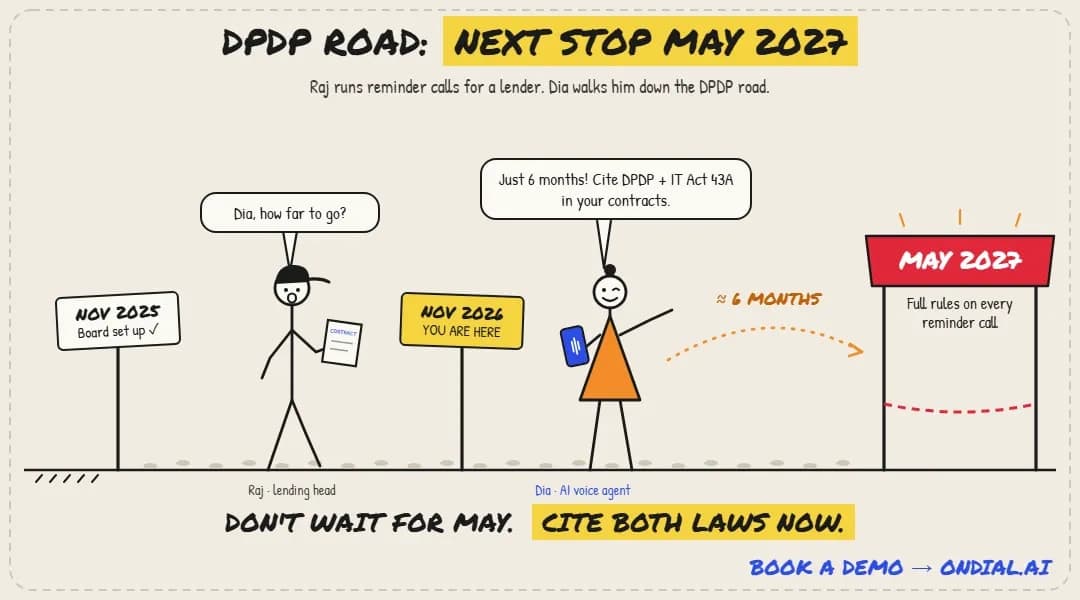
Right now the Data Protection Board exists, and Consent Manager registration opens in mid-November 2026. However, the core duties only start in May 2027, which leaves calling teams about six months. MeitY notified the Digital Personal Data Protection Rules, 2025 in November 2025 with three start dates.
Phase | Start | What it changes for an AI calling programme |
Phase one, when the lender gains no new duty | November 2025 | The Board is set up and definitions apply, but the lender's call flows face no new duty |
Phase two, when Consent Managers start registering | November 2026 | Consent Managers can register, so borrowers may route their permissions through one |
Phase three, when every reminder call is covered | May 2027 | Notice, consent, safeguards, breach reporting, retention, children's data and transfer rules reach every reminder call |
Meanwhile, Section 43A of the IT Act and the SPDI Rules stay alive until phase three. Section 44(2) of the DPDP Act removes them on that same May 2027 date. Until then, vendor contracts signed today should cite both regimes rather than only the new one.
Six hops a voice AI reminder call takes, and the duty at each one
Each of the lender's reminder calls passes through roughly six systems in under a second. Mapping them is step one of voice AI data security in India, because each hop has an owner. For the Pune lender, the path of one reminder looks like this:
Telephony leg: the carrier connects the call from a 1600 or 140 number and logs the dialled number.
Speech-to-text: audio streams to a recognition engine, which might keep borrower snippets for model tuning unless barred.
Language model: the transcript, often with the borrower's name and dues, goes to an LLM for the reply.
Text-to-speech: the engine voices that reply, and even this light hop still sees the overdue amount.
Recording store: full audio and transcripts land in storage, where access rules decide most of the lender's risk.
CRM write-back: a summary flows into the loan system, where far more staff can read it than call logs.
The decision rule is short. Any hop run by an outside company makes that company a Data Processor acting for the lender. Each one therefore needs a written contract, a known location and a deletion promise you can verify.
Voice AI consent in India: what a borrower's yes must survive
A borrower's spoken yes holds up only with an itemised notice, a specific purpose and an easy exit. Section 6 of the DPDP Act and Rule 3 of the DPDP Rules set that bar together.
For the lender, the recording disclosure cannot hide inside loan terms signed two years ago. Rule 3 asks for a standalone notice in plain language, listing each data item and each purpose. A short spoken line, followed by an SMS link to the full notice, is one workable pattern.
Language matters too. Section 6(3) lets the borrower read that request in English or any Eighth Schedule language. Marathi qualifies, so a Hindi-only disclosure to a Marathi-speaking borrower in Satara makes a weak record.
Real calls test consent in three awkward moments that scripts rarely plan for:
Stop recording, mid-sentence: if the borrower says it, the agent should stop at once and log the withdrawal.
The teenage son answers: anyone under 18 counts as a child, so the agent closes politely.
Permission gathered last year: consent taken before May 2027 was never tested against Rule 3, so plan a refresh.
Why a borrower's DPDP yes does not settle AI calling compliance in India
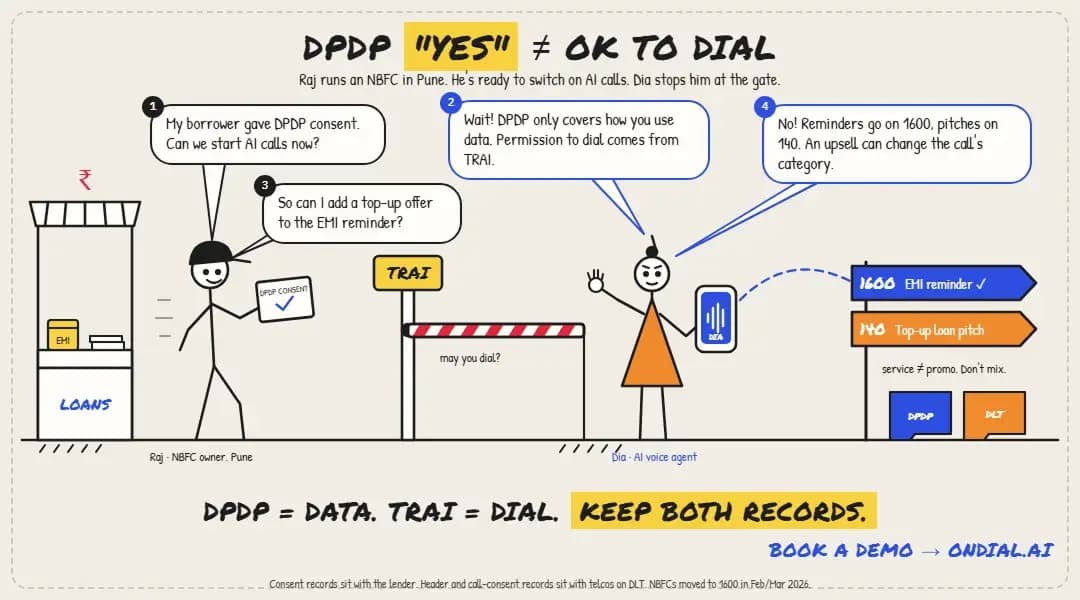
DPDP consent governs what the lender does with a borrower's data. TRAI, by contrast, decides whether the lender may dial at all, so both records matter.
TRAI's February 2025 amendment to the TCCCPR moved promotional calls to the 140 series. Service and transactional calls went to the new 1600 series. A later TRAI direction, issued in November 2025, made the 1600 series compulsory for BFSI service calls.
For NBFCs, TRAI set the switch dates in February or March 2026, depending on the lender's size. So the Pune lender's EMI reminders belong on a 1600 number, while a top-up loan pitch does not.
A common slip is adding an upsell line to a 1600-series reminder, which can change the call's category. Header registration and commercial-call consent records sit with telecom operators on their DLT platforms. For that operator layer, read our explainer on TRAI DLT rules for AI calling.
Call data privacy controls Rule 6 actually names
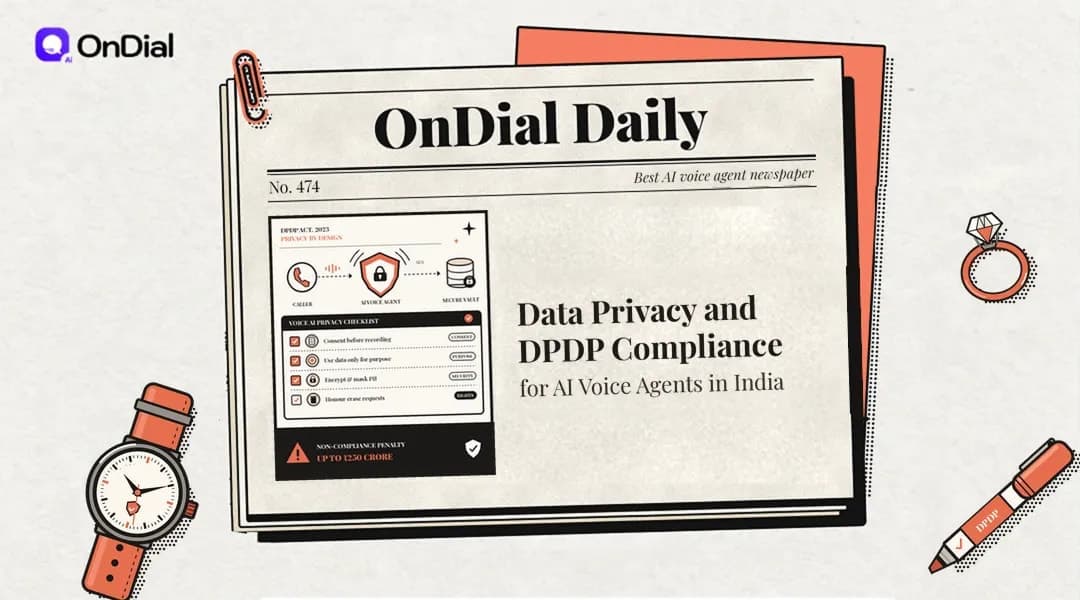
Rule 6 sets the minimum: encryption or masking or tokens, access control, logging, monitoring, backups and processor terms. Missing them exposes a business to the Act's top penalty band, up to ₹250 crore. For a calling programme, each control maps to a specific artefact:
Audio files: encrypt at rest, and limit playback to the collections QA team instead of every branch login.
Transcripts: mask account numbers and PAN digits before the text reaches the model or an analytics tool.
Prompts and model logs: get written confirmation that the model provider will not train on your borrowers' calls.
Access logs: note which QA analyst replayed which borrower's recording, and keep those logs a year.
Backups: hold encrypted copies so a ransomware event cannot wipe out your only proof of consent.
For voice AI data security in India, the weak spots tend to be access rules and stray vendor copies. Encryption alone does not close those gaps. Our breakdown of AI voice agent security for enterprises covers that technical layer in more depth.
Keeping 480,000 recordings for a year without keeping them forever
Plan the lender's archive around a one-year floor and a purpose-based ceiling. Under Rule 8(3), you keep personal data, traffic data and processing logs for at least a year. Section 8(7) then expects erasure once the purpose ends or consent is withdrawn, unless another law needs the data.
For the lender, that floor means a rolling archive of roughly 480,000 recordings at any moment. One schedule that respects both rules could run in four stages:
Days 0 to 30: full audio stays open to QA and dispute teams, while analytics sees masked transcripts only.
Day 31 to month 12: audio moves to locked storage, opened only for disputes, breach probes or legal requests.
After month 12: the system deletes audio and transcripts, unless an RBI rule, court matter or open dispute applies.
On withdrawal: processing of that borrower's data stops at once, and stored items wait for erasure.
CERT-In adds a separate clock. Its 2022 directions require ICT system logs for 180 days on a rolling basis, kept within India. Retention is where voice AI data security in India most needs counsel, so confirm these floors with yours.
Sending voice AI transcripts to a model hosted abroad under Section 16
Today nothing in the DPDP Act stops the Pune lender from doing it. From May 2027, transfers stay open unless the government restricts a particular country. Section 16 and Rule 15 work as a negative list, and that list was still empty in September 2026.
Two catches matter more than the list itself. Section 16(2) keeps stricter sector laws in force, so a regulated lender should check its own regulator's rules first. Also, the Rule 6 safeguards follow the data to whichever region the model runs in.
A quick test cuts through most voice AI data security debates about India-based processing. If a vendor cannot name the region that processes your transcripts, treat that as a no. Masking also shrinks the problem, since a model rarely needs the full account number to draft a reminder.
A leaked call archive: the first 72 hours under Rule 7
Tell the Board and every affected borrower without delay, then send the Board a detailed report within 72 hours. Missing that duty risks a separate penalty of up to ₹200 crore. If the lender's recording bucket leaked tonight, the sequence would run like this:
Hours 0 to 6: contain the leak, then file the CERT-In report its 2022 directions expect within six hours.
Same day: send the first intimation to the Board and plain-language notices to every borrower affected.
By hour 72: give the Board a fuller account of the cause, scope, mitigation and steps already taken.
Week two: rotate vendor keys, review which staff could replay borrower audio, and close the gap.
One detail trips up many voice AI data security plans in India. The borrower notice must explain likely consequences in plain words. A leaked reminder reveals overdue status, which can embarrass someone at home or at work.
DPDP voice AI contracts: why the Data Fiduciary pays for a vendor's slip
The lender pays, because as Data Fiduciary it stays answerable even when a processor causes the breach. That leaves the contract as the main lever. Before renewing any calling vendor, the Pune team would want these terms in writing:
Named processing regions for the lender's audio, transcripts and model calls, with notice before changes.
A clear ban on training speech or language models on the lender's borrower calls.
Breach alerts within hours, fast enough to meet the six-hour CERT-In clock and Rule 7.
Deletion on instruction with written proof, covering backups and every sub-processor copy.
A current sub-processor list naming speech engines, model hosts and cloud storage providers.
Contract terms are only one half of vendor diligence; behaviour on live calls is the other half. A fuller AI voice agent vendor evaluation checklist works through the wider buying questions alongside these. Large lenders notified as Significant Data Fiduciaries face extra duties, with penalties up to ₹150 crore.
What DPDP compliance won't fix when a voice AI agent calls borrowers
A fully compliant reminder pipeline can still mishear a borrower, mislabel a call and annoy. The law governs data handling, but it does not make an agent accurate or courteous. Expect these gaps even after the paperwork is clean:
Speech engines can misread a Marathi yes on a noisy line, so store the audio clip with each consent.
After May 2027 the Act has no separate biometric class, so voiceprint risk rests on your own policy.
A tidy DPDP file will not prevent DND complaints if the number series or call type is wrong.
Many borrowers never open the SMS notice, so the spoken line carries most of the real disclosure.
Voice biometrics is one feature many lenders should skip for now. A leaked password can be reset, but a leaked voiceprint follows the borrower for life.
A six-step plan for voice AI data security in India before May 2027
Six months is enough for the Pune lender if consent, retention and vendor work run in parallel. The plan would run in this order:
List every system that touches a reminder call, including speech and model engines behind your vendor.
Write the spoken and SMS notices in Marathi, Hindi and English, itemising data items and purposes.
Build a voice command for withdrawal, then test it on ten noisy Satara recordings per language.
Fix the retention schedule around the Rule 8(3) one-year floor, purpose-based deletion and dispute holds.
Re-paper processor contracts with regions, training bans, six-hour breach alerts and deletion proof.
Rehearse a breach by running the six-hour and 72-hour clocks against a fake leaked archive.
Step six is where most written plans show their gaps. Running it now tests your voice AI data security in India before the Board does.
Your call flows and the May 2027 date
Most lenders can close these gaps before May 2027 if consent, retention and contracts move together. To trace one of your live reminder flows against this checklist, Contact sales and bring a sample call script. OnDial's team can walk through each hop with you.