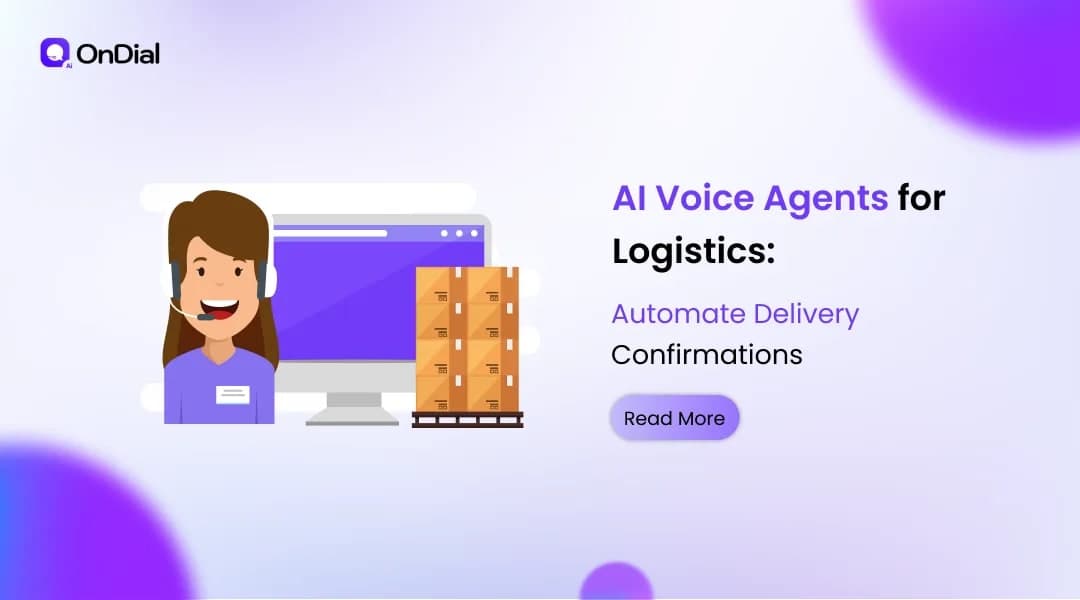
Here is a number that should sting. RTOs now cost high-volume brands up to 1.5% in revenue, with half caused by unreachable customers. That second half is the part you can fix today. AI voice agents for logistics make automated outbound calls that confirm orders, validate addresses, and rescue failed deliveries before they harden into returns.
If you run fulfilment in India, you already know the grind. The endless follow-ups. The dispatchers chasing the same five questions all day. The orders that quietly slip into RTO while everyone is busy.
I have watched ops teams treat confirmation calls as an unavoidable tax. They are not. They are an automatable lever on your margin, and the gap between a managed and an unmanaged confirmation process is enormous.
This guide breaks down how these agents actually work, the exact workflows they handle, the India-specific rules you must follow, and how to measure whether it pays off.
Why Delivery Confirmation Calls Are Quietly Killing Your Margins
Most leaders track shipping cost and courier SLAs closely. Far fewer track the cost of the calls that never got made in time. That blind spot is expensive.
The NDR-to-RTO window nobody manages well
A Non-Delivery Report (NDR) is the record a courier creates when a delivery attempt fails. It is a warning, not a verdict. Left alone, that warning becomes an RTO (Return to Origin), and your unit economics take the hit twice.
The window is brutally short. Unmanaged NDRs convert to RTO within 24 to 72 hours. Inside that window, a single conversation that confirms the address or reschedules the slot can save the order.
The scale of the problem is India-specific. NDR rates in Indian e-commerce logistics range from 20 to 40 percent by category. Payment mode is the strongest predictor here. COD orders generate an RTO of nearly 26 percent, compared with under 2 percent for prepaid.
What a missed confirmation actually costs you
A returned COD order does not just cost the return freight. It charges you forward shipping, reverse shipping, frozen working capital, and lost margin all at once.
The per-order damage is real money. Industry analysis from bepragma.ai puts the cost of a single returned COD order at ₹180 to ₹240 in forward shipping, reverse logistics, and processing overhead, all while generating zero revenue. Multiply that across a few hundred daily orders and the number gets serious fast.
Here is the structural insight most founders miss. Last-mile delivery failures account for 53 percent of total logistics costs, because mismanaged exceptions compound both forward and reverse charges. The call you skip is not a minor task. It sits at the centre of your biggest cost bucket.
(Worth sitting with that for a second.)
How Do AI Voice Agents Confirm Deliveries?
Let me answer this plainly before going deeper, because this is the question everyone actually types.
Featured snippet answer: An AI voice agent confirms a delivery by placing an automated phone call, reading order details from your system, verifying the address and availability in natural conversation, then writing the outcome (confirmed, rescheduled, or cancelled) straight back into your TMS or OMS in real time.
The anatomy of a single confirmation call
Picture one COD order flagged for confirmation. The agent dials the customer and speaks like a person, not a phone tree. It greets them, states the order, and confirms the delivery address.
If the address is incomplete, it asks for the missing landmark or flat number. If the customer cannot accept delivery tomorrow, it offers two alternative slots and locks one in. Then it logs the result instantly.
This is the core difference from old systems. Unlike traditional IVRs, AI voice agents understand natural, unscripted speech and take real action like checking POD status or updating a delivery ETA. No "press 1 for tracking." Just a conversation that ends with a resolved order.
How the agent connects to your TMS, OMS, and WMS
A voice agent is only as useful as its connection to your systems of record. The intelligence lives in the integration, not the voice.
Read access at call time: The agent pulls the live order, address, and status from your OMS or TMS so it speaks with accurate context. This is what powers real shipment tracking calls, where a customer asking "where is my shipment" gets a real answer, not a script.
Write-back after the call: Confirmed slots, corrected addresses, and reschedule requests sync back automatically. Your dispatch board updates without anyone retyping anything.
Escalation rules: When a case needs judgement, the agent routes it to a human with the full transcript attached. The machine handles routine volume; your team handles exceptions.
In the projects I have seen at OnDial, this write-back loop is where the value compounds. A call that updates the system in real time prevents the next failed attempt from ever happening.
The Delivery Workflows Voice AI Handles Best
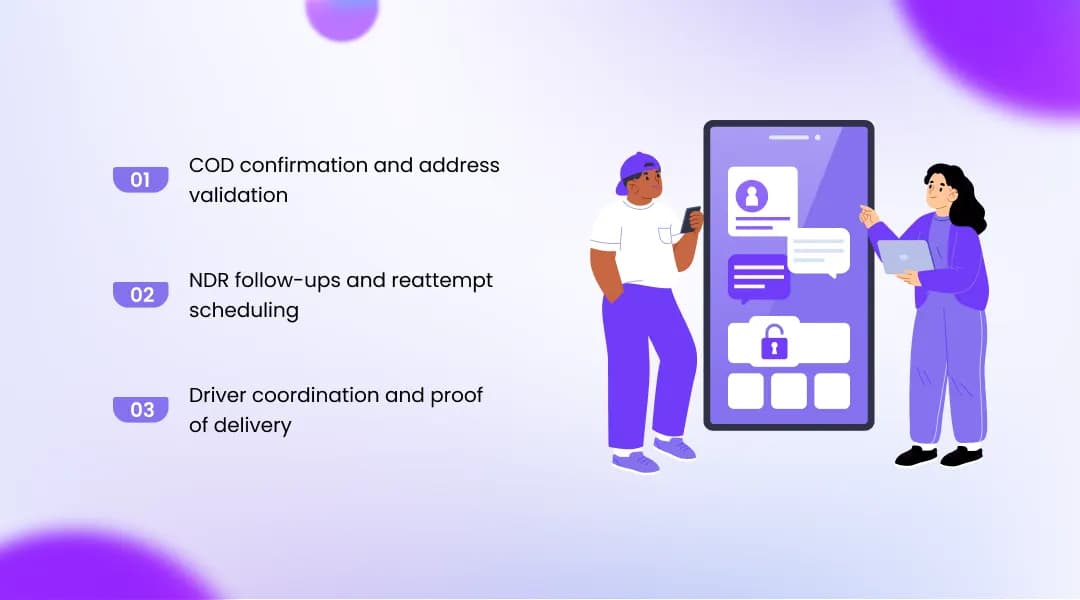
Not every logistics call deserves automation. The wins come from the high-volume, repetitive ones. Here are the three that consistently earn their keep.
COD confirmation and address validation
COD is where Indian RTO pain concentrates, so it is where confirmation calls pay back fastest. A pre-dispatch call that confirms intent and address removes the most common reasons a parcel bounces.
The leverage point is precise. Address confirmation before dispatch catches a meaningful share of failures, with bepragma noting that incomplete or incorrect details cause 18 to 24 percent of total RTOs. Fixing a flat number on a 20-second call is far cheaper than a two-way shipping charge.
NDR follow-ups and reattempt scheduling
This is the highest-impact workflow, full stop. The moment a courier logs an NDR, the clock starts, and a fast automated call inside that window does the heavy lifting.
The data backs the approach. Eshopbox reports that automating NDR handling reduces failed delivery rates by up to 30 percent, while eShipz finds proactive NDR handling lifts delivery success by 20 to 35 percent. The agent calls, learns why the attempt failed, and books a reattempt the customer will actually be home for.
Driver coordination and proof of delivery
Confirmation is not only customer-facing. Drivers and dispatchers generate enormous call volume too, and voice AI absorbs the routine slice.
Driver check-ins: The agent confirms load details, pickup windows, and route changes without a dispatcher on the line. Drivers stay focused on the road.
Proof of delivery capture: After a drop, the agent can call to confirm receipt and capture POD details, feeding clean data back into your system.
Dispatcher relief: Routine status and update calls shift to the agent. One logistics provider, per Lasoft, reports automating these reduces dispatcher call volume by 50 percent.
Why This Works Differently in India
Counter-intuitive truth: a voice agent built for the US market will underperform on Indian delivery calls, even if its English is flawless. India is structurally different, and two things decide success here.
Hinglish, regional languages, and real customer speech
Your customer does not speak in clean English or clean Hindi. They code-switch mid-sentence, and a stiff agent loses them in the first ten seconds.
A strong logistics agent handles Hinglish and regional languages natively. It understands "address galat hai, sahi likhwa deta hoon" without breaking stride. That naturalness is what keeps the customer on the call long enough to fix the order.
Channel choice matters alongside voice. WhatsApp pairs well with calls in COD markets, where egrow notes a 98 percent open rate makes it the strongest confirmation channel. The best operators run voice and WhatsApp together, not as rivals.
TRAI DLT, DPDP, and DND compliance for outbound calls
This is the part vendors gloss over, and it is where unprepared brands get burned. Outbound delivery calls in India sit inside a real regulatory stack, and the penalties are not theoretical.
TRAI DLT and DND: Commercial outbound calls require registration and DND scrubbing. Enforcement is active. Auto Interview AI reports that over 47,000 numbers were disconnected by TRAI in Q1 2026 alone.
DPDP Act 2023: Delivery calls process personal data, so you need purpose-specific consent, defined retention, and erasure rights. Penalties can reach ₹250 crore for significant violations.
Consent logging: Every call needs a logged, timestamped consent event linked to data stored in India. This is a build requirement, not an afterthought.
I will be honest about the trade-off here. Compliance is the unglamorous work, but a platform that bakes in DLT registration and DPDP consent capture saves you from a problem that can shut down your calling entirely.
Measuring ROI: Does Voice AI for Delivery Confirmation Pay Off?
A pilot that feels impressive but never gets measured is just a cost. So before you deploy, decide exactly what proof looks like.
The metrics that prove value
Tie every claim to a number your CFO already cares about. These four tell you the truth quickly.
RTO rate movement: The headline metric. Compare RTO on confirmed orders against your baseline over 60 days.
NDR resolution rate: What share of failed attempts the agent converts to a successful reattempt inside the window.
Containment rate: How many calls the agent resolves end to end. For context, Rootle reports a bilingual agent autonomously resolved 82 percent of customer queries end to end, routing the rest to humans.
Cost per resolved order: Total platform cost divided by orders saved. This is the number that settles the build-vs-buy debate.
Where voice AI does not help (honest limitations)
Now the part most vendor pages will never tell you. Voice AI is not a fix for everything, and pretending otherwise sets you up to fail.
It will not rescue a genuinely fraudulent COD order, and it will not fix a courier that simply does not attempt delivery in a pincode. Those need fraud scoring and carrier changes, not a friendlier call. Noisy environments and heavy accents can still trip up speech recognition, which is why a clean fallback-to-human path is non-negotiable.
The right mental model is narrow and powerful. Automate the repetitive, time-sensitive calls where speed and consistency win, and keep humans on the messy, high-judgement cases. That division of labour is where the ROI actually lives.
Conclusion
AI voice agents for logistics turn delivery confirmation from a manual cost into a measurable lever on your margin. Three things matter most. First, the NDR-to-RTO window is short and winnable, and a fast automated call rescues orders that would otherwise return. Second, the value lives in the integration and the write-back, not the voice. Third, in India, language fluency and DLT plus DPDP compliance decide whether this works at all.
You do not have to accept failed deliveries as the cost of doing business. At OnDial, we build voice AI that speaks your customer's language, plugs into your delivery stack, and stays compliant from day one. If RTO is eating your margin, start by automating your COD confirmation and NDR follow-up calls, and measure the RTO drop over 60 days.