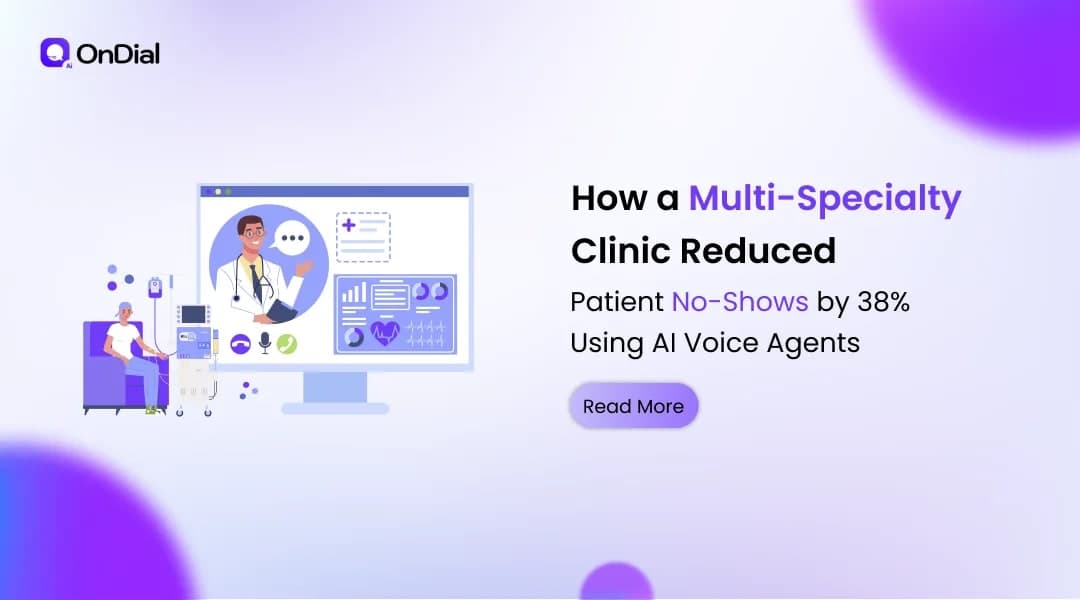
Patient no-shows create a problem that goes beyond an empty appointment slot. A missed visit can leave clinicians underutilized, increase administrative work, delay care, and prevent another patient from receiving an appointment sooner.
Healthcare organizations have traditionally addressed the problem with SMS reminders, emails, manual phone calls, and automated robocalls. These methods can help, but they often stop at delivering information. If a patient cannot attend, the patient still has to contact the clinic and complete the next step.
AI voice agents change that workflow by turning an appointment reminder into a two-way conversation. The agent can confirm an appointment, understand that a patient cannot attend, offer available alternatives, record the outcome, and escalate the conversation when human assistance is required.
This makes AI voice agents useful not only for preventing no-shows, but also for reducing the friction that causes patients to miss appointments in the first place.
Why Patient No-Shows Remain a Healthcare Operations Problem
A no-show is rarely just a forgotten appointment.
Patients may miss visits because the appointment conflicts with work, transportation becomes difficult, family responsibilities change, instructions are unclear, or they cannot reach the clinic when they need to reschedule.
For the healthcare organization, these situations create a chain reaction. A clinician may have an unused slot, front desk staff may spend time attempting follow-up calls, and another patient who wanted an earlier appointment may remain on a waitlist.
The problem becomes more complicated as appointment volume increases. A clinic with multiple specialties may need different reminder processes for consultations, diagnostics, follow-ups, procedures, and recurring visits.
Manual calling can address these situations, but it is difficult to perform consistently at scale.
Why Traditional Appointment Reminders Are Not Enough
SMS and Email Deliver Information
SMS and email reminders are useful because they are inexpensive and easy to automate. However, they generally require the patient to take the next action independently.
If the patient receives a reminder and realizes the appointment no longer works, they may need to search for the clinic number, call during working hours, navigate an IVR system, wait for an employee, and then request another appointment.
Every additional step creates friction.
Manual Calls Provide Conversation but Have a Capacity Limit
A staff member can ask whether a patient is attending, answer questions, and help find another appointment. The limitation is operational capacity.
When hundreds of patients require confirmation calls, staff have to prioritize which patients receive personal outreach. Calls can also be delayed during busy periods, leaving less time to contact patients before their appointments.
Pre-Recorded Robocalls Lack Context
A pre-recorded message can tell someone that an appointment is approaching, but it cannot meaningfully respond to the patient's answer.
A patient saying, "I cannot make that time, but I can come tomorrow afternoon," needs a system that can understand the request and take action. A recorded message cannot do that.
How AI Voice Agents Reduce Patient No-Shows
AI voice agents combine automated outreach with conversational interaction. Instead of treating the reminder as the final objective, the system treats the conversation as part of a broader scheduling workflow.
1. Confirm Appointments Through a Conversation
The agent can contact patients before scheduled appointments and confirm the relevant details.
A typical conversation can establish whether the patient plans to attend, needs additional information, or wants to make a change.
This approach is more useful than simply announcing the appointment because the patient's response determines what happens next.
2. Reschedule Patients During the Same Call
Rescheduling is one of the most important parts of the no-show prevention workflow.
Consider a patient who has an appointment on Thursday but discovers a work conflict. With a conventional reminder, the patient may need to call the clinic later. With an integrated AI voice workflow, the agent can identify the scheduling issue, check available slots, offer suitable alternatives, and confirm the new appointment.
OnDial's appointment scheduling service is designed around live availability, booking, rescheduling, cancellation workflows, and automated confirmation.
AI appointment scheduling with OnDial
3. Make Cancellations Actionable
A cancellation does not always have to become an empty slot.
When a patient cancels early enough, the scheduling workflow can make the released appointment available to another patient. An AI voice agent can support this process by recording the cancellation and triggering the appropriate follow-up workflow.
For clinics with active waitlists, this creates an opportunity to turn a cancellation into another completed appointment.
4. Support Waitlist Backfilling
Waitlist management is often dependent on staff availability.
When a slot becomes available unexpectedly, employees may need to search through a list of patients, call them individually, wait for responses, and continue until someone accepts the appointment.
An AI voice workflow can automate much of this repetitive communication. Patients can be contacted about newly available slots, and accepted appointments can be routed into the scheduling workflow.
This is particularly useful for specialties where appointment availability is limited and earlier slots are valuable to patients.
5. Reach Patients in Their Preferred Language
Healthcare organizations often serve multilingual populations.
A reminder that is difficult for a patient to understand is less useful, even if the technology behind it is sophisticated. Voice agents can support multilingual conversations so organizations can communicate appointment details and routine scheduling information in the patient's preferred language.
OnDial currently describes support for more than 100 languages, including Indian languages such as Hindi, Tamil, Telugu, Bengali, Marathi, Gujarati, Kannada, Malayalam, and Punjabi.
For healthcare organizations operating across different regions, multilingual calling can make appointment communication more accessible without requiring staff to manually handle every language.
What an AI Healthcare Appointment Call Can Handle
The value of an AI voice agent depends on what happens during the conversation.
A well-designed appointment workflow can cover several routine scenarios.
Patient Confirms
The patient confirms the appointment. The system records the outcome and can trigger the next scheduled reminder or confirmation process.
Patient Wants to Reschedule
The agent identifies the request, checks available appointments, offers suitable alternatives, and confirms the selected slot.
Patient Wants to Cancel
The cancellation is recorded, and the workflow can initiate appropriate follow-up actions such as waitlist outreach.
Patient Has a Routine Question
The agent can answer approved questions about appointment timing, location, preparation requirements, or other information included in its configured knowledge and workflow.
Patient Needs Human Assistance
Not every conversation should be automated.
Clinical questions, complaints, complex insurance matters, urgent concerns, or requests requiring professional judgment should be escalated to an appropriate staff member.
The goal is not to remove people from healthcare communication. It is to reserve human attention for conversations where human judgment adds the most value.
AI Voice Agents Can Help With More Than No-Shows
No-show prevention is one application within a larger patient communication workflow.
Healthcare organizations can use conversational voice AI for appointment booking, follow-ups, recalls, routine notifications, patient surveys, and inbound scheduling calls.
This creates an important distinction between an AI voice agent and a simple reminder system.
A reminder sends information.
A conversational agent can understand the response and initiate the next business action.
That difference becomes particularly important when an organization wants to connect patient conversations with its scheduling, CRM, EHR, or other operational systems.
The Role of Integration in No-Show Reduction
AI voice automation is only as useful as the systems behind it.
If an agent can tell a patient that an appointment is available but cannot access current availability, the patient may still need to speak with staff.
An effective workflow should connect the voice layer with the systems responsible for scheduling and patient records.
The general process looks like this:
The system identifies the upcoming appointment.
The AI agent contacts the patient.
The patient confirms, reschedules, or cancels.
The workflow validates the requested action.
The scheduling system is updated.
A confirmation is sent.
The conversation outcome is recorded.
A human receives the interaction if escalation is required.
This creates a closed workflow instead of another isolated communication channel.
How Healthcare Teams Should Measure Results
Reducing no-shows should not be evaluated using a single percentage.
Healthcare organizations should establish a baseline and monitor several operational metrics.
No-Show Rate
Compare the percentage of scheduled appointments that are missed before and after implementation.
Confirmation Rate
Measure how many patients respond to reminder outreach and how many confirm their appointments.
Rescheduling Rate
Track how many patients who cannot attend successfully move to another appointment instead of becoming no-shows.
Cancellation Recovery
Measure how many released appointments are successfully offered to waitlisted or other eligible patients.
Staff Time
Calculate how much employee time is spent on repetitive appointment confirmation and rescheduling work before and after automation.
Escalation Rate
Monitor how frequently conversations require human intervention. A high escalation rate may indicate that the workflow needs better configuration or that certain use cases should remain human-led.
These measurements provide a clearer view of operational improvement than simply counting completed calls.
Building a Healthcare AI Voice Workflow Responsibly
Healthcare communication requires more care than a typical customer service workflow.
Protect Patient Information
The AI system should only access and disclose the information necessary for the specific workflow.
Identity verification, access controls, encryption, auditability, retention policies, and appropriate data handling should be considered before deployment.
Healthcare organizations should also evaluate compliance requirements based on their location and the type of patient information being processed.
Define What the AI Should Not Handle
A reliable healthcare agent needs clear boundaries.
The system should know when it is handling a routine scheduling request and when the conversation needs a human.
Clinical diagnosis, treatment decisions, urgent medical concerns, and other sensitive situations should be routed according to the organization's escalation policies.
Design Conversations Around Patients
A healthcare AI agent should not sound like a generic call center script.
Conversation design should account for elderly patients, multilingual communities, people with hearing or speech differences, patients who are anxious about procedures, and callers who may interrupt or change their request.
The objective should be clarity and convenience rather than forcing patients through a rigid script.
Where AI Voice Agents Fit Into a Healthcare Communication Strategy
AI voice agents work best as part of a broader patient communication system.
A clinic may use SMS for simple notifications, email for documents, a patient portal for records, and voice conversations for situations where interaction is important.
The best channel depends on the task.
For an appointment that requires confirmation or rescheduling, voice can be particularly useful because the patient can explain the situation without navigating several digital steps.
For healthcare organizations evaluating this approach, the practical starting point is usually a limited workflow such as appointment reminders and rescheduling. Once the system demonstrates reliable performance, additional workflows can be introduced.
AI Voice Agents and the Future of Appointment Management
The future of appointment management is unlikely to be about replacing every human interaction with automation.
A better model is a combination of automation and human judgment.
AI voice agents can handle repetitive, high-volume conversations consistently. Staff can focus on complex patient needs, exceptions, clinical communication, and situations where empathy or professional judgment matters most.
This approach can make appointment operations more responsive without turning healthcare communication into a fully automated experience.
For organizations exploring the broader use of voice AI across healthcare, OnDial provides a dedicated healthcare solution covering appointment management, reminders, patient follow-ups, and other routine communication workflows.
AI voice agents for healthcare and medical providers
Frequently Asked Questions
Can AI voice agents reduce patient no-shows?
AI voice agents can help reduce no-shows by combining appointment reminders with two-way conversations, rescheduling, cancellation handling, and follow-up workflows. The actual impact depends on the clinic's baseline no-show rate, patient population, outreach strategy, and system integration.
Can an AI voice agent reschedule healthcare appointments?
Yes, when the agent is connected to an appropriate scheduling system and configured with the required booking rules. It can check available slots, offer alternatives, and record the selected appointment.
Can AI voice agents handle appointment cancellations?
Yes. A configured workflow can recognize a cancellation request, record the outcome, and trigger follow-up actions such as waitlist outreach.
Can AI voice agents contact patients after business hours?
Yes. Automated calling can operate outside normal front desk hours, allowing healthcare organizations to create reminder and scheduling workflows that are not limited to staff availability.
Can AI voice agents support multiple languages?
Yes. Multilingual voice agents can conduct appointment-related conversations in multiple languages, which can help healthcare organizations serve linguistically diverse patient populations.
Should AI voice agents handle clinical questions?
They should only handle questions that fall within an organization's approved workflow and knowledge boundaries. Clinical, urgent, or complex requests should be escalated to qualified human staff.
Can AI voice agents work with existing scheduling systems?
Integration depends on the scheduling or healthcare system and the available APIs or other integration methods. OnDial supports integrations through APIs and connected systems for scheduling workflows.
How should a clinic measure AI voice agent performance?
Clinics should track no-show rate, confirmation rate, successful rescheduling, recovered appointment slots, staff time saved, patient experience, and escalation rate.
Are AI voice agents suitable for small clinics?
They can be suitable for small clinics when the use case is clearly defined and the workflow is simple enough to automate reliably. Appointment confirmation and scheduling are practical starting points because they involve repeatable processes.
What should a healthcare organization automate first?
Appointment reminders and rescheduling are logical starting points because they are high-volume workflows with clear outcomes. Organizations can expand into recalls, follow-ups, patient surveys, and other communication tasks after validating the initial workflow.
Conclusion
Patient no-shows are not caused by forgetfulness alone. Scheduling conflicts, limited communication windows, language barriers, unanswered calls, and difficult rescheduling processes can all contribute to missed appointments.
AI voice agents address these problems by turning appointment reminders into actionable conversations. Instead of simply telling a patient about an appointment, the system can confirm attendance, identify a scheduling conflict, offer another slot, process a cancellation, support waitlist workflows, and escalate complex requests.
The strongest healthcare deployments do not treat AI as a replacement for patient-facing staff. They use automation for repetitive scheduling communication while keeping humans responsible for clinical judgment and sensitive interactions.
For healthcare organizations looking to improve appointment utilization and patient communication, the opportunity is not simply to make more reminder calls. It is to make every reminder more useful.
For more information about OnDial and its AI voice automation platform: OnDial AI voice agent platform