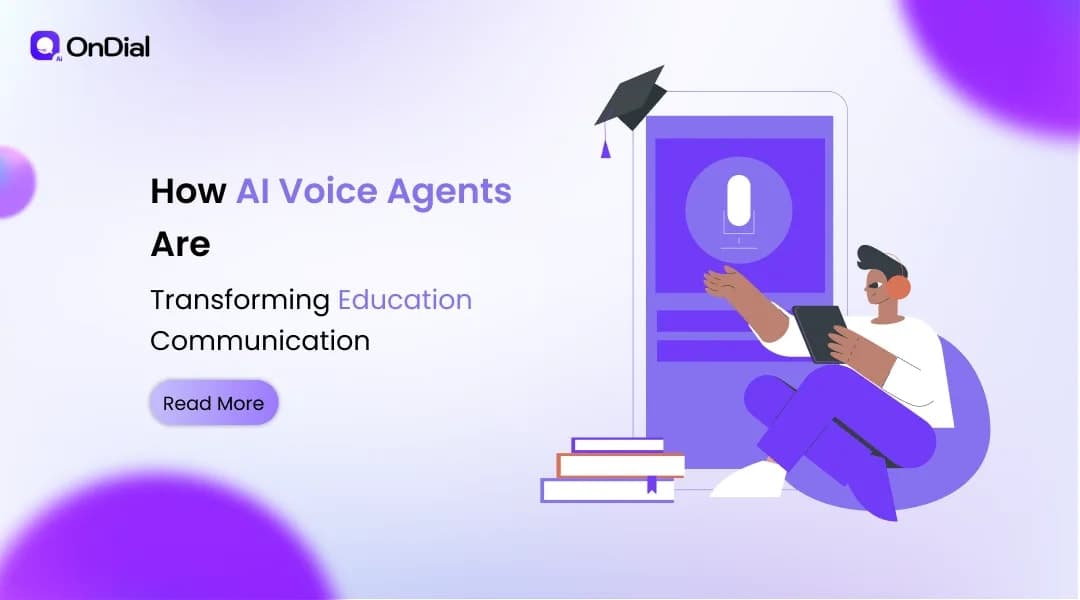
Education communication has become more demanding.
Students expect quick answers about admissions, courses, fees, schedules, exams, and support services. Parents often need updates about payments, attendance, events, and academic processes. Admissions teams, meanwhile, have to manage large volumes of inquiries while keeping up with follow-ups and administrative work.
This creates a communication gap.
AI voice agents for education can help institutions close that gap by handling routine conversations through natural voice interactions. Instead of forcing students or parents through long IVR menus or waiting for a staff member to become available, a voice agent can understand a request, provide relevant information, complete certain actions, and transfer the conversation when human assistance is needed.
For schools, colleges, universities, coaching institutes, and EdTech companies, the value is not simply automated calling. The bigger opportunity is creating a more responsive communication layer across the student journey.
What Are AI Voice Agents for Education?
An AI voice agent for education is a conversational system that can conduct inbound and outbound phone conversations with students, parents, applicants, and other stakeholders.
Unlike a traditional IVR, the system is designed to understand natural language rather than relying entirely on fixed menu options. A caller can explain what they need in their own words, and the agent can determine the intent and respond according to the institution's configured information and workflows.
For example, a prospective student might ask:
"I submitted my application yesterday. What documents do I still need to provide?"
An appropriately configured voice agent can identify the application-related request, retrieve available information from connected systems, explain the next step, and escalate the conversation if the required information is unavailable.
The technology typically combines speech recognition, language understanding, conversational logic, text to speech, integrations, and workflow automation.
The important distinction is that the voice agent should not simply speak information. It should be capable of helping complete a defined process.
Why Education Institutions Need Better Voice Communication
Education organizations deal with communication peaks that are difficult to staff efficiently.
Admissions create bursts of inquiries. Enrollment deadlines generate reminder calls. Examination periods produce questions about schedules and procedures. Fee deadlines generate payment-related conversations. Schools also need to communicate with parents throughout the academic year.
These interactions share several characteristics:
Many questions are repetitive
Information changes frequently
Calls can arrive outside office hours
Staff need context before handling complex cases
Students and parents may prefer different languages
Follow-ups can easily be missed
Multiple departments may need access to the same communication history
Adding more staff can help with volume, but it does not automatically solve consistency, availability, or repetitive workload.
Voice AI provides another approach. Routine conversations can be automated while human teams remain responsible for situations requiring judgment, empathy, exceptions, or institutional decision-making.
How AI Voice Agents Support the Student Journey
The strongest education deployments do not treat voice AI as a single-purpose answering system. They use it at different stages of the student journey.
Before Admission
Before applying, prospective students often need information about programs, eligibility, deadlines, fees, campus facilities, scholarships, and application procedures.
A voice agent can answer common questions and capture the caller's intent. If someone is interested in a specific program, the system can collect relevant information and route the inquiry to an admissions counselor.
This creates a structured transition from initial inquiry to human follow-up.
During the Application Process
Once an applicant begins an application, communication becomes more specific.
A voice agent can be configured to handle reminders about incomplete applications, missing documents, upcoming deadlines, or scheduled counseling conversations.
Outbound calling is particularly useful here because the institution does not have to wait for the applicant to make another call.
After Admission
Communication does not stop when an applicant is accepted.
Students may need reminders about enrollment confirmation, tuition payments, orientation, document submission, or class schedules.
Automated calls can help institutions maintain consistent communication during this transition while reducing the number of routine calls handled manually.
During the Academic Year
The same communication infrastructure can support existing students and parents.
Depending on the institution's systems and policies, voice agents can assist with schedule notifications, administrative questions, event reminders, attendance-related communication, and other routine interactions.
The objective is not to automate every student conversation. It is to automate predictable communication so staff have more time for work that requires human involvement.
Key AI Voice Agent Use Cases in Education
1. Admissions Inquiry Handling
Admissions teams receive many questions that follow recognizable patterns.
An AI voice agent can answer questions about programs, eligibility, application steps, deadlines, required documents, and general enrollment information.
When the caller demonstrates strong intent, the agent can collect relevant details and route the conversation to the appropriate admissions representative.
For institutions with multiple programs or campuses, routing rules can also help direct inquiries to the correct team.
2. Admission Lead Follow-Up
A submitted inquiry does not always result in an immediate application.
Students may need additional information before deciding. Others may start an application and stop midway.
An outbound AI voice agent can follow up according to predefined rules. It can ask whether the student needs assistance, answer basic questions, record the outcome, and schedule a human callback when appropriate.
This creates a more consistent follow-up process without requiring counselors to manually call every inquiry.
For a deeper look at this specific workflow, see AI Voice Agents for Student Admission Follow-Ups.
3. Fee and Payment Reminders
Fee communication can generate a significant amount of repetitive administrative work.
Voice agents can remind students or parents about upcoming payment deadlines, explain basic payment instructions, and direct callers to the appropriate payment channel.
Sensitive financial questions should follow the institution's verification and escalation policies. The AI should not improvise when it does not have the required information.
4. Class, Exam, and Schedule Notifications
Students frequently need timely information about schedule changes.
Voice automation can support notifications about examinations, class changes, cancellations, orientation sessions, events, or other scheduled activities.
For time-sensitive communication, the advantage is consistency. A defined campaign can contact the intended audience according to the institution's rules instead of relying entirely on manual calling.
5. Student and Parent Support
Parents may call about attendance, events, administrative procedures, or fee-related questions. Students may need help with schedules, enrollment processes, or other routine matters.
A voice agent can handle clearly defined questions and direct more complicated conversations to the appropriate department.
The handoff matters as much as the automation. A good workflow should preserve relevant context so the student does not have to repeat everything to the human representative.
6. Appointment and Counseling Scheduling
Education organizations often schedule admissions counseling, campus visits, demo classes, parent meetings, and other appointments.
An AI voice agent can ask what the caller needs, check available slots through an integrated scheduling system, confirm the appointment, and trigger a reminder.
This can be especially useful when appointments are requested outside normal office hours.
Institutions can explore this workflow through OnDial's AI Appointment Scheduling service.
7. Multilingual Student Communication
Language can influence how comfortable a student or parent feels during a conversation.
This is especially relevant for institutions serving multilingual populations in India and international education organizations serving students across regions.
A multilingual voice agent can support conversations in the languages configured for the deployment. The goal should be more than translating a fixed script. The system should understand the caller's intent and maintain context throughout the conversation.
For broader context on multilingual voice communication in India, see Why Multilingual AI Calling Is a Massive Advantage for Indian Businesses.
What Makes an Education Voice Agent Useful?
Not every voice bot is suitable for education.
Institutions should evaluate the system based on the quality of the complete workflow rather than the quality of a short product demonstration.
Natural Conversation
Students should be able to speak naturally instead of memorizing commands.
The system should be able to handle normal interruptions, clarification questions, corrections, and changes in intent.
Reliable Knowledge
The AI should answer from approved institutional information.
Admission deadlines, fee details, course availability, and schedules can change. A system that provides outdated information can create more problems than it solves.
A knowledge management process should therefore be part of the deployment.
Human Escalation
Some conversations should never be forced through automation.
Sensitive complaints, unusual admissions situations, complex financial questions, safeguarding concerns, and requests requiring institutional judgment should be transferred to people.
The AI should recognize its boundaries rather than attempting to answer every question.
System Integration
Voice automation becomes more valuable when it can work with existing systems.
Depending on the institution, this may include:
Student information systems
Learning management systems
CRM platforms
Admission platforms
Calendars
Payment systems
Communication platforms
Integration allows the AI to move beyond answering questions and participate in actual workflows.
Analytics and Reporting
Institutions should be able to understand what happens during calls.
Useful information can include call outcomes, inquiry categories, escalation rates, common questions, appointment activity, and follow-up status.
These insights can also reveal gaps in the institution's communication process.
AI Voice Agents vs Traditional IVR in Education
Traditional IVR systems work well for simple routing.
A caller may press one for admissions, two for fees, or three for another department.
The limitation is that the caller must understand the menu structure and follow the predefined path.
Conversational voice AI provides a different experience.
A student can explain the reason for calling in natural language. The system can identify the intent and decide what workflow should happen next.
This does not mean IVR has become useless. In some environments, a combination of conventional routing and conversational AI may be appropriate.
The right choice depends on call volume, use cases, system integrations, compliance requirements, and the complexity of conversations.
How to Implement AI Voice Agents in an Education Institution
A successful deployment should begin with the communication problem rather than the technology.
Step 1: Identify Repetitive Conversations
Review call recordings, support tickets, admission inquiries, and frequently asked questions.
Look for conversations that are frequent, structured, and predictable.
These are usually the strongest starting points for automation.
Step 2: Define What AI Can and Cannot Do
Create clear boundaries.
For example, the AI might answer general admission questions but transfer scholarship exceptions to a counselor.
It might schedule a campus visit but transfer complaints to a human representative.
Clear boundaries reduce risk and improve the student experience.
Step 3: Connect Approved Data Sources
Determine which systems contain the information the AI needs.
The institution should decide which information can be accessed, what can be changed, and which actions require verification.
Step 4: Design the Human Handoff
Define escalation triggers before launching.
The system should know when to transfer based on intent, uncertainty, caller request, sensitivity, or business rules.
The receiving employee should ideally receive the relevant conversation context.
Step 5: Test Real Scenarios
Testing should cover more than perfect sample conversations.
Institutions should test accents, interruptions, incomplete questions, background noise, incorrect information, language switching, unexpected requests, and requests for human assistance.
Step 6: Measure Operational Outcomes
Track metrics that matter to the institution.
These might include answer rate, response time, successful automation rate, transfer rate, appointment completion, inquiry handling, and student satisfaction.
The goal is not simply to increase the number of calls handled by AI. The goal is to improve the underlying communication process.
Privacy, Security, and Governance Considerations
Education organizations may handle sensitive student information.
Before deployment, administrators should understand what information the voice system accesses, where call data is stored, how long records are retained, who can access transcripts, and how information is protected.
Institutions should also define rules for authentication and sensitive requests.
For example, an AI agent should not disclose private student information simply because someone asks for it over the phone. Identity verification and access controls should be part of the workflow where required.
Clear governance is essential when voice AI connects to student records or other institutional systems.
Where Human Staff Still Matter
AI voice agents should not be positioned as a replacement for every education employee.
A counselor can understand complex personal circumstances. A teacher can provide educational judgment. A student support professional can handle sensitive situations with empathy.
Voice AI is most useful when it handles the repetitive layer surrounding those human interactions.
That creates a practical division of responsibility:
AI handles predictable communication, information retrieval, reminders, scheduling, and defined workflows.
People handle judgment, empathy, exceptions, sensitive situations, and decisions that require institutional authority.
The Future of Voice AI in Education
The next stage of education communication will likely involve connected systems rather than isolated voice bots.
A student may begin with a phone call, receive a message containing an application link, complete a form, schedule a counseling session, and later receive an automated reminder.
For this to work well, the communication history needs to move across channels.
Voice can become one part of a broader communication layer that connects admissions, student support, scheduling, reminders, and institutional systems.
The important shift is from answering calls to completing useful actions.
How to Evaluate an AI Voice Platform for Education
Before selecting a platform, education leaders should ask:
Can it handle the institution's real use cases?
A generic demonstration is not enough. Test actual admission, fee, scheduling, parent, and student support scenarios.
Can it integrate with existing systems?
Ask which CRM, LMS, SIS, calendar, telephony, and API integrations are available.
How does it handle uncertainty?
The system should know when it does not have enough information and transfer the conversation instead of inventing an answer.
Can it support multilingual conversations?
If the institution serves multiple regions, test real accents and natural speech rather than relying only on a language list.
What analytics are available?
The institution should be able to measure outcomes and identify where conversations fail.
How is student data protected?
Review access controls, retention policies, security practices, authentication, and applicable compliance requirements.
How does human escalation work?
A human handoff should preserve useful context and minimize repetition for the caller.
Conclusion
AI voice agents can give education organizations a practical way to improve communication without turning every interaction into a fully automated experience.
They can answer routine inquiries, support admissions, follow up with applicants, send reminders, schedule conversations, provide multilingual assistance, and connect communication workflows with existing systems.
The strongest deployments start small, define clear boundaries, connect reliable data sources, and preserve human involvement where it matters.
For schools, colleges, universities, coaching institutes, and EdTech companies, the opportunity is not simply to answer more calls.
It is to make every important communication easier to start, easier to complete, and easier for staff to manage.
OnDial provides AI voice automation designed to support inbound and outbound business conversations, including education workflows. Institutions can explore the broader platform to determine which voice workflows fit their communication needs.