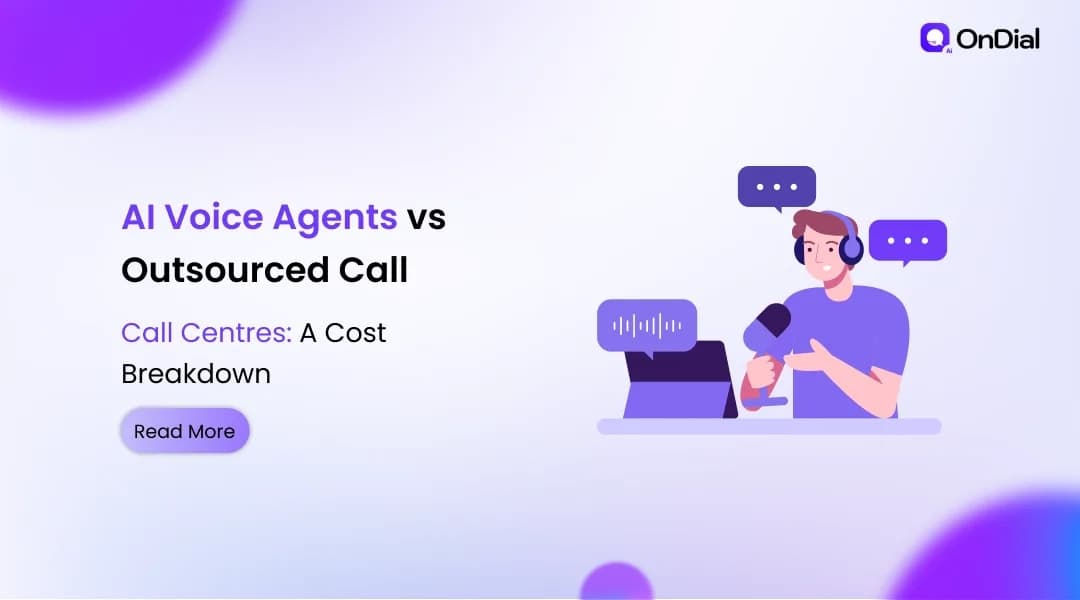
A fully loaded human telecaller in India costs roughly ₹40 to ₹120 per resolved contact, clustered around ₹55 to ₹85 for most mid-market operations (Caller Digital). Run the same routine call through an AI voice agent and the per-outcome cost often lands at ₹8 to ₹25 depending on the use case (Caller Digital). That single line is why the AI voice agents vs outsourced call centres debate has moved from boardroom theory to budget reality in 2026.
If you manage a calling operation, you have probably stared at a rising BPO invoice and wondered whether the savings everyone promises are real or just vendor noise. I get it. The numbers floating around are confusing, mostly priced in dollars, and rarely account for how calling actually works in India.
So here is what I will do. I will break down what an outsourced call centre genuinely costs once you include the parts vendors leave off the quote, what an AI voice agent costs once you include the parts AI vendors leave off theirs, and where each one honestly wins. No hype. Just the math, the trade-offs, and the India-specific costs almost nobody else covers.
What Actually Drives the Cost Gap
The cost gap between the two models is not really about wages. It is about a structural assumption.
The real per-call economics
Most comparisons start with the wrong question. They ask what an agent costs per hour, when the number that runs your budget is cost per resolved contact. Those are not the same thing, and the difference is where money quietly leaks.
Globally, the contrast is stark. A routine four-minute call costs around $0.28 to $0.60 handled by AI versus $3 to $7 with a human agent (Retell AI). Forrester research puts a live agent interaction at $6 to $12 while an automated interaction can cost as little as $0.25. The pattern holds across regions: AI competes on a per-task basis, not a per-hour one.
An outsourced call centre charges you for every interaction the same way, whether a customer needs genuine help or just wants to know if you are open on Sunday. AI changes the unit economics of the boring 70 percent.
Why the sticker price hides part of the true cost
The advertised rate is never the real rate. This is true on both sides of the comparison, which is exactly why so many switching decisions go wrong.
On the AI side, independent testing found that hidden costs inflate the advertised price by 40 to 60 percent on average (SuperMia), usually through token charges or text-to-speech surcharges that do not appear in the headline quote. On the BPO side, an all-in rate and a base rate can differ by 30 to 50 percent depending on what the contract folds in.
So the real comparison is not quoted price against quoted price. It is true cost per resolved contact against true cost per resolved contact, for your actual mix of calls. Hold that thought. It decides everything that follows.
Outsourced Call Centre Costs in 2026: The Full Line-Item Breakdown
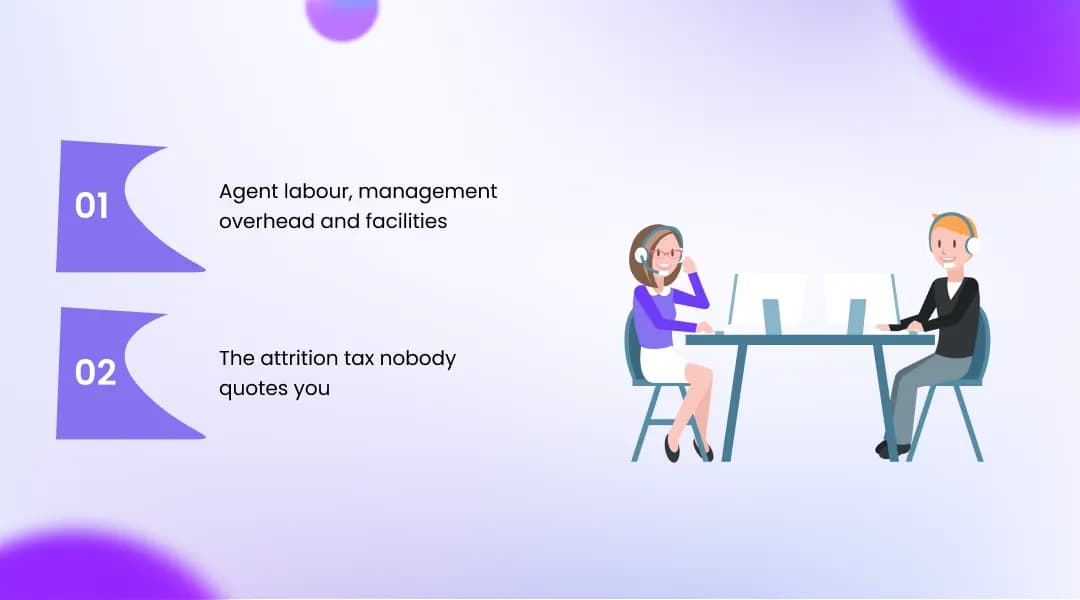
Let me reconstruct an outsourced call centre cost the way it actually appears once every line item is on the table.
Agent labour, management overhead and facilities
In India, the labour line is the cheapest in the world, and it is still the biggest cost you carry. Voice support runs at roughly $6 to $14 per agent hour, with a fully loaded dedicated agent costing about $1,200 to $2,400 per month (Octopus Tech). Expressed in talk time, a fully loaded Indian agent works out to around ₹8 to ₹20 per minute once salary, infrastructure, management, and idle time are included (Awaaz AI).
Then there is the part nobody quotes upfront. A management layer sits on top of every floor, and supervisors, QA analysts, and workforce managers typically add another 15 to 25 percent before a single call is answered.
• Minimum team sizes bite. Most Indian BPOs require around 10 to 15 agents for a dedicated-team model, so you pay for capacity you may not need on a quiet Tuesday.
• Idle time is billed time. You pay for the agent sitting between calls, not just the conversation.
• Facilities and software stack up. Real estate, workstations, and platform licences are real line items even at offshore rates.
The attrition tax nobody quotes you
This is the cost that breaks budgets quietly, and it is uniquely brutal in India.
Indian voice operations run attrition of 80 to 120 percent annually, and collections, inside sales, and NDR teams routinely lose 100 percent of their headcount in a year (Caller Digital). Every exit means recruiting, onboarding, and 60 to 90 days of ramp-up before a new agent is productive. For scale, India employs between 2.8 and 3.4 million voice agents in 2026, in a NASSCOM sub-segment worth USD 14 to 16 billion.
In projects I have worked on at OnDial, the attrition tax is the number clients underestimate most. You are not just paying for the agent who is on the phone today. You are pre-paying for the three who will replace them this year. That recurring churn is invisible on the per-hour quote and very visible on the annual P&L.
AI Voice Agent Costs: What You Pay and What You Don't
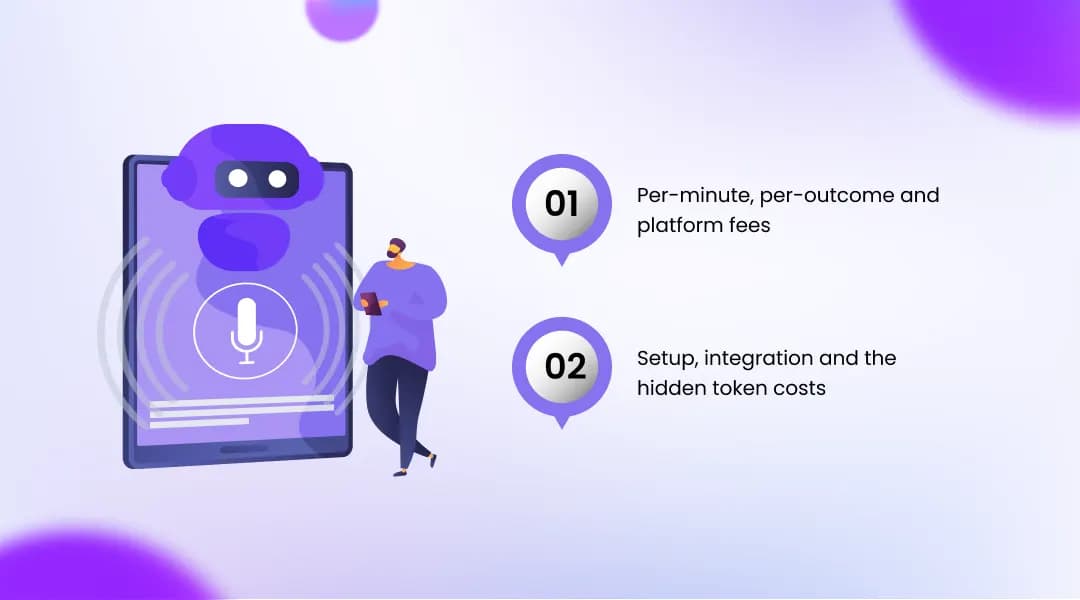
Now flip the model. AI voice agent pricing has its own honest breakdown, and pretending it is free is as misleading as pretending BPO is cheap.
Per-minute, per-outcome and platform fees
An AI voice agent has three core cost components: a platform fee, a per-minute connected fee for talk time, and a small internal team for tuning and exception handling. The talk-time rate itself is low.
Production AI voice pricing in 2026 generally runs $0.05 to $1.00 per minute, with infrastructure-layer platforms starting at $0.05 to $0.15 and managed all-in-one platforms around $0.25 to $0.50 (Aircall). For Indian use cases, several platforms have moved to per-outcome pricing in INR, charging only on a successful resolution rather than per variable-length minute. This matters because Hinglish conversations meander, and per-minute billing punishes you for the way Indians actually talk.
Setup, integration and the hidden token costs
Here is where I will be honest about my own side of the table. AI is not plug-and-play, and the cheapest quoted rate is rarely the real one.
The integration work is real. Connecting the agent to your CRM, your telephony, and your knowledge base takes engineering time, and someone has to monitor quality and tune flows after go-live. On top of that, remember the earlier finding: those low per-minute rates often climb 40 to 60 percent once token and voice-synthesis costs are counted in production.
• Ask for all-in pricing, not base. If the quote excludes LLM tokens or TTS, your real bill will surprise you.
• Model your true call length. Indian conversations with code-switching run longer than scripted English calls.
• Price the internal ops time. Someone owns the agent. Budget for that person.
Is an AI Voice Agent Actually Worth It Compared to a Call Centre?
That is the verdict the data keeps pointing to, and it is more useful than a winner-takes-all claim.
Where AI wins, and where it genuinely doesn't
AI voice agents now handle 60 to 90 percent of typical call centre workloads at 10 to 30 percent of the cost (CallSphere), and in mature deployments they contain roughly 40 to 70 percent of inbound calls without escalation (Fini Labs). That is the routine band: order status, appointment confirmation, EMI reminders, balance checks.
But should I pretend AI wins everywhere? No. There are real limits, and ignoring them is how deployments fail. Voice quality still has persistent gaps in non-English, accented speech and code-switching between languages (Retell AI testing), and latency matters more than people expect, because a delay of around 700 milliseconds starts triggering distrust while the best platforms stay under 200 (NewVoices). Complex, emotional, high-stakes conversations still belong to a human.
Why the hybrid model usually wins on cost
The cheapest answer is rarely to rip out the call centre.
The most efficient structure routes first contact to the AI, which qualifies, resolves simple queries, and books, then transfers anything needing human judgment to a person. Industry analysis suggests this reduces call centre volume by 40 to 70 percent, lowering cost without losing quality on complex cases (VivaSpeak). You keep your best agents for the calls that earn or save real money, and you stop paying ₹70 for someone to read out a shipping status.
(The quiet benefit nobody invoices: your remaining human agents stop burning out on drudgery, which is the single biggest lever against that 100 percent attrition rate.)
The India Cost Layer Nobody Else Breaks Down
Most cost comparisons stop here. This is where the India-specific math actually lives, and where a global dollar-based guide will mislead you.
Compliance costs that apply to both models
In India, an automated call is not a regulatory grey area. TRAI explicitly classifies AI and prerecorded calls as robocalls, which means every voice AI deployment in India falls under the regulation regardless of scale (Rootle.ai). Both human and AI outbound operations must register on the TRAI DLT platform, scrub against DND, and use the correct number series.
• Recording retention is mandatory. Call recordings must be retained for the TRAI minimum of 90 days on Indian infrastructure (Caller Digital), a storage and data-residency cost on both models.
• DPDP consent is separate from TRAI consent. A customer who has not opted out under TRAI has not given DPDP-compliant consent to process and store their voice data (Caller Digital). The recording, transcript, and sentiment tag are all personal data.
The advantage a well-built AI platform has here is that DLT template checks, opt-out propagation, and consent logging can be wired into the workflow by default, rather than depending on whether a rotating agent remembers the rule.
Regional language and Hinglish: the real comprehension test
Cost per call means nothing if the call fails. In India, the make-or-break variable is language.
A telecaller who genuinely handles Hinglish code-switching and vernacular comprehension converts better, and that capability is exactly where generic AI voice agents stumble. This is the most important thing to test before you sign anything: does the agent actually understand a customer who starts in Hindi, drops into English, and back again in one sentence?
At OnDial, this is the part we care about most, because we build human-centric voice AI tuned for real Indian conversation patterns rather than scripted English. An agent that mishears a regional name or stalls on code-switching does not save money. It quietly destroys trust, and trust is the thing you cannot put back on a spreadsheet. Honest limitation: no AI handles every accent and dialect perfectly yet, which is precisely why intelligent escalation to a human is a feature, not a failure.
Conclusion
The real lesson of comparing AI voice agents vs outsourced call centres is that the winner is rarely all of one. Three things matter most: compare true cost per resolved contact rather than quoted hourly rates, account for the attrition and hidden costs that never appear on either quote, and treat India's TRAI DLT and DPDP obligations as a shared cost line on both models.
You can now run this math for your own call mix instead of trusting anyone's dollar-based estimate. That clarity is the point.
If you want to see what your routine call volume would actually cost on a per-outcome basis in INR, with Hinglish handling and compliance built in, talk to us at OnDial. We will model it against your current BPO spend honestly, including where a human still wins.