Tier 2 and tier 3 cities in India now account for 66 percent of all new direct to consumer orders in the country, according to a 2026 report cited by KPMG India. Cities like Jaipur, Indore, Coimbatore, Surat, and Kochi are no longer secondary markets. They are originating demand, launching startups, and building customer bases that rival metro operations. By 2030, tier 2 cities alone are projected to generate two trillion dollars in economic output, nearly tripling from current levels. Yet many of these fast growing businesses face a challenge that threatens to cap their growth: they cannot answer all the calls coming in.
Every missed call costs a business between 100 and 1,200 dollars in lost revenue depending on the industry, and 85 percent of callers who reach voicemail never call back. For a growing clinic in Indore, a real estate agency in Jaipur, or a logistics company in Coimbatore, those missed calls represent patients, property buyers, and freight bookings walking straight to a competitor. Hiring a full call centre team is not realistic for most of these businesses. The average call centre agent in India costs between 1.8 and 3.5 lakhs per year in salary alone, before training, attrition, and infrastructure costs.
This is where AI voice agents for Indian businesses have created a genuine turning point. Instead of building a 20 seat call centre, a business in Surat or Bhopal can deploy an AI voice agent that answers every call in the customer's preferred language, qualifies leads, schedules appointments, and operates 24 hours a day. This blog examines how businesses in tier 2 and tier 3 Indian cities are using AI voice agents to outperform traditional metro call centres, what makes this technology suited to the Indian market, and what it takes to get started.
The Tier 2 and Tier 3 Boom: Why These Markets Need a Different Approach to Customer Communication
India's economic centre of gravity is shifting. The government's Urban Challenge Fund, backed by one lakh crore rupees, aims to unlock nearly four lakh crore of investments in tier 2 and tier 3 cities. More than 48 percent of the two lakh startups registered with DPIIT have emerged from cities outside traditional metros. This is not a trend on the horizon. It is the current reality of Indian business growth.
But this growth creates a specific operational problem. When a healthcare chain in Bangalore scales its appointment booking, it has access to trained multilingual staff and established call centre vendors. When a diagnostic lab in Nagpur or a coaching institute in Lucknow experiences the same growth in inbound calls, the options are far more limited.
The Hiring Bottleneck in Smaller Cities
Finding and retaining skilled call centre agents in tier 2 cities is significantly harder than in metro areas. While cities like Indore and Coimbatore have strong educational institutions, the talent pool for customer facing phone operations is thinner and harder to retain. Businesses report that training a new agent takes four to six weeks, and that many agents leave within six months. A 15 person business in Jaipur does not have the luxury of dedicated HR teams and continuous recruitment pipelines, and every agent departure creates a direct gap in customer coverage.
A cloud based AI voice agent sidesteps these challenges entirely, operating from remote servers and requiring nothing more than a phone line and internet connection to deliver enterprise grade call handling.
The Language Complexity of Indian Markets
Perhaps the most significant challenge for tier 2 and tier 3 businesses is language. India has 22 officially recognised languages and hundreds of dialects, and customers in these markets overwhelmingly prefer to communicate in their regional language or in a mix of their regional language and Hindi. A customer calling a real estate developer in Ahmedabad may speak Gujarati, switch to Hindi mid sentence, and expect the agent to follow along. This code switching is the natural way millions of Indians communicate, and traditional call centres have always struggled to handle it consistently.
AI voice agents that support Indian languages and handle code switching natively eliminate this bottleneck. Platforms like OnDial support 9 Indian languages with over 80 Indian voice variations, allowing a single deployment to handle calls in Hindi, Tamil, Telugu, Kannada, Bengali, Marathi, Gujarati, Malayalam, and Punjabi without separate agent teams for each language.
How AI Voice Agents Level the Playing Field Against Metro Call Centres
AI voice agents for Indian businesses fundamentally change the economics of customer communication. A traditional call centre achieves quality through headcount. More agents mean more calls answered, more languages covered, and more hours of availability. An AI voice agent achieves the same outcomes through technology, and it does so at a fraction of the cost and with none of the scaling constraints.
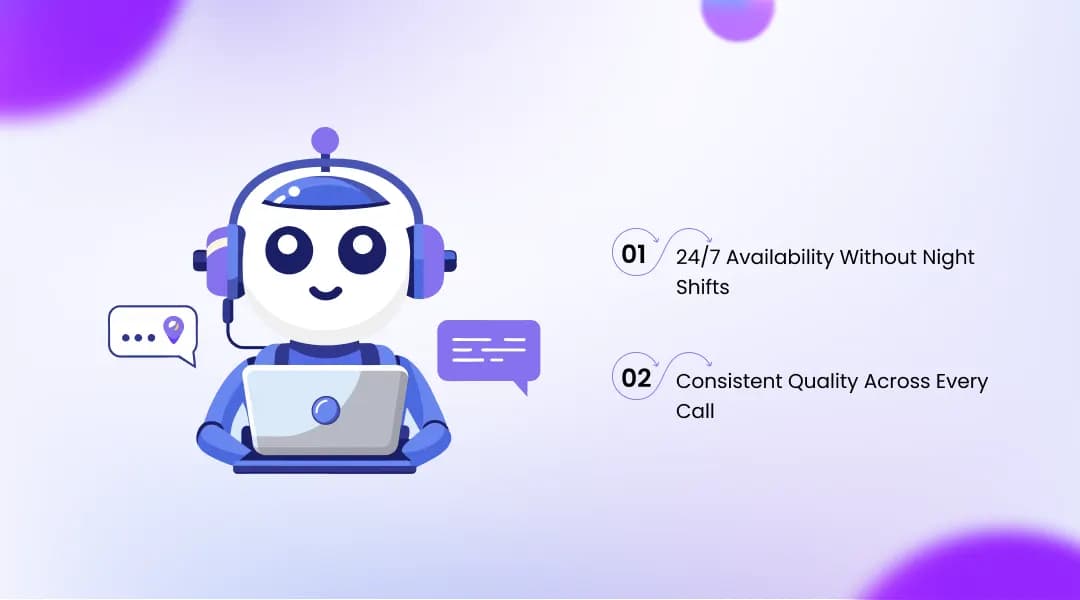
24/7 Availability Without Night Shifts
One of the most immediate advantages is round the clock availability. Research consistently shows that 78 percent of customers buy from the first business that responds to their inquiry. For a business in a tier 2 city competing against metro companies, the ability to answer every call at 10 PM or 6 AM on a Sunday is transformative. An AI voice agent does not require shift scheduling, overtime pay, or the management complexity of running a night team.
This matters enormously in industries where customer inquiries are time sensitive. A patient calling a hospital about symptoms does not wait until morning. A property buyer responding to a listing at midnight will call the next agency if the first one does not pick up. For tier 2 businesses that previously lost these calls to metro competitors with 24/7 call centres, AI voice agents eliminate the gap entirely.
Consistent Quality Across Every Call
Human call centre performance varies. An agent's first call of the day sounds different from their hundredth. Monday mornings sound different from Friday afternoons. This variability is managed in large call centres through quality assurance teams and regular training, all of which add cost and management overhead.
An AI voice agent delivers identical quality on every call. The script adherence is 100 percent, the product information is always current, and the tone is always professional. OnDial's AI voice agents maintain this consistency across thousands of simultaneous calls, meaning that a surge in call volume during a promotional campaign does not degrade service quality the way it would with a fixed team of human agents.
Multilingual AI Calling: The Key Advantage for Indian Markets
The single biggest competitive advantage that AI voice agents deliver for Indian businesses is multilingual capability. India's linguistic diversity is not a problem to be solved. It is the fundamental reality of doing business across the country. A business that can speak to customers in their own language builds trust faster, closes more sales, and retains more customers over time.
Beyond Translation: Understanding How Indians Actually Speak
Effective multilingual AI calling in India requires far more than simple translation. It requires understanding the way Indians actually speak on the phone, which includes frequent code switching between languages, regional expressions and idioms, varying levels of formality, and different accent patterns across states. A customer in Chennai might begin a call in English, switch to Tamil when discussing specifics, and mix in Hindi terms. An AI voice agent that only handles pure single language conversations would fail this customer.
Modern AI voice agents trained on real Indian call data handle these transitions naturally. They recognise when a caller switches languages and respond accordingly, maintaining context across the switch. This capability, which would require hiring trilingual agents in a traditional call centre, comes built into the AI platform at no additional cost per language.
Serving Customers in Their Comfort Language
Customers who are served in their preferred language report higher satisfaction, stay on calls longer, and convert at higher rates than those forced to communicate in a language that is not their first. For a tier 2 business in Karnataka, being able to answer calls in Kannada is a competitive necessity against local competitors and a clear differentiator against metro businesses that default to Hindi or English.
OnDial's support for 9 Indian languages with 80 plus voice variations means a single AI voice agent deployment can serve customers across multiple Indian states without additional hiring. A real estate company in Pune can handle inquiries from Marathi speaking locals, Hindi speaking migrants, and English speaking NRI investors through the same system.
The Real Cost Comparison: AI Voice Agent vs Traditional Call Centre in India
Understanding the true cost difference between an AI voice agent and a traditional call centre is essential for any Indian business evaluating this technology. The comparison goes beyond salary savings and extends into hidden costs that most businesses underestimate.
The Full Cost of a Human Call Centre Agent
The average call centre agent salary in India ranges from 1.8 to 3.5 lakhs per year, but salary is only a fraction of the total cost. Recruitment costs average 15,000 to 30,000 rupees per hire. Training adds another 20,000 to 50,000 rupees per agent, with the training period itself representing four to six weeks of non productive paid time. Infrastructure costs including workstation, headset, CRM software, telephony, and office space add 8,000 to 15,000 rupees per month per agent. Management overhead typically adds 20 to 30 percent on top of direct agent costs.
When all costs are included, a single call centre agent in a tier 2 Indian city costs approximately 3 to 5 lakhs per year. A team of 10 agents providing basic business hours coverage costs 30 to 50 lakhs annually, and this team still cannot provide 24/7 coverage, multilingual support beyond two or three languages, or handle sudden call volume spikes without quality degradation.
What AI Voice Agents Cost in Comparison
An AI voice agent deployment through a platform like OnDial eliminates recruitment, training, attrition, and infrastructure costs entirely. The agent is available 24/7 from day one, handles calls in multiple languages simultaneously, and scales to handle any volume of concurrent calls. Businesses typically see a 60 to 80 percent reduction in customer communication costs when switching from a human team to an AI voice agent, with the additional benefit of zero attrition and zero retraining requirements.
The cost advantage is particularly pronounced for tier 2 and tier 3 businesses that need multilingual support. An AI voice agent handles all supported languages through a single deployment, making true multilingual service accessible to businesses of any size.
How Tier 2 Businesses Are Actually Using AI Voice Agents Today
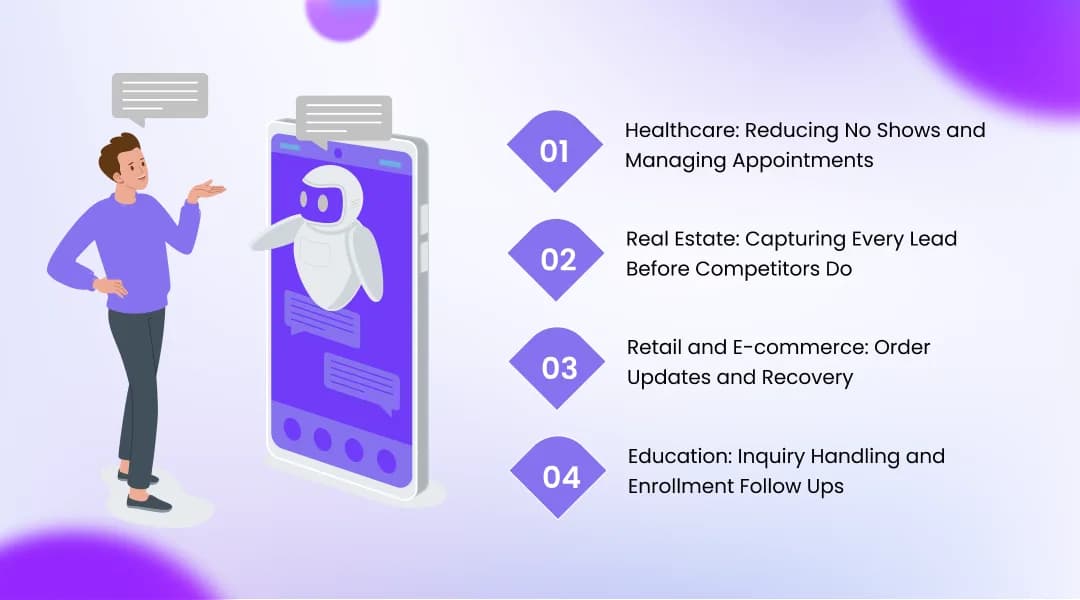
The applications of AI voice agents across tier 2 and tier 3 Indian businesses span virtually every industry. The common thread is that these businesses need to handle customer calls professionally and in the customer's preferred language, without building a large call centre.
Healthcare: Reducing No Shows and Managing Appointments
Clinics and diagnostic labs in cities like Indore, Visakhapatnam, and Kochi are using AI voice agents to handle appointment scheduling, send automated reminders, and manage prescription refill requests. A diagnostic lab that previously missed 30 to 40 percent of inbound calls during peak hours can now answer every call instantly, book the appointment, and send a confirmation. AI calling has reduced patient no show rates by 25 to 40 percent in clinics that deploy automated reminder calls before scheduled appointments.
Real Estate: Capturing Every Lead Before Competitors Do
Real estate is one of the most call dependent industries in India, and speed of response is the primary differentiator. A property buyer who submits an inquiry on a listing portal expects a call back within minutes. Tier 2 real estate agencies using AI voice agents can instantly call back every lead, qualify their budget and preferences, and schedule a site visit within the first minute. This speed, combined with regional language capability, gives tier 2 agencies a direct competitive advantage over slower responding metro operations.
Retail and E-commerce: Order Updates and Recovery
Direct to consumer brands based in tier 2 cities are using AI voice agents to handle order status inquiries, process return requests, and recover abandoned carts through outbound calls. With 66 percent of new D2C orders now coming from tier 2 and tier 3 cities, the volume of customer service calls has grown rapidly. An AI voice agent handles these routine inquiries instantly, freeing the business team to focus on growth.
Education: Inquiry Handling and Enrollment Follow Ups
Coaching institutes and educational institutions in cities like Jaipur, Lucknow, and Bhopal receive thousands of inquiry calls during admission seasons. AI voice agents handle the initial inquiry, provide course information, answer fee related questions, and schedule counselling sessions, all while communicating in Hindi, the regional language, and English simultaneously.
Getting Started: What Deployment Actually Looks Like
One of the most common concerns businesses have about AI voice agents is that deployment must be technically complex. In reality, modern AI call centre alternative India platforms are designed for businesses without technical teams. OnDial offers both API integration for businesses with development resources and a no code deployment option for businesses that want to start without writing a single line of code.
The Typical Deployment Timeline
A standard AI voice agent deployment follows a straightforward process. The business defines its call flows, including what questions the agent should answer, what information it should collect, and what actions it should take such as scheduling appointments or transferring to a human agent. The AI agent is configured with the business's specific product information, pricing, and availability. Voice and language preferences are selected based on the customer base. The system is connected to the business's existing phone number and integrated with any CRM or scheduling tools already in use.
Most businesses can go from initial configuration to live deployment within one to two weeks. OnDial's platform handles the telephony infrastructure, language processing, and call routing automatically. Once deployed, the AI agent begins handling calls immediately with sub 500 millisecond response latency, meaning callers experience natural, responsive conversations without awkward pauses.
Analytics and Continuous Improvement
Unlike a traditional call centre where quality monitoring requires dedicated staff listening to recorded calls, AI voice agent platforms provide comprehensive analytics automatically. Every call is logged, transcribed, and analysed for sentiment, outcome, and key topics. OnDial's smart analytics and call sentiment tracking give business owners a clear dashboard showing how many calls were handled, what outcomes were achieved, and where customers expressed frustration or satisfaction. The AI agent becomes both the customer service team and the market research tool, providing continuous insight into what customers want and how the business can improve.
24/7 AI Customer Service India: The New Standard for Competitive Businesses
The expectation of 24/7 availability is no longer limited to large enterprises. Indian consumers across all city tiers now expect immediate responses, and businesses that cannot deliver lose customers. A 2026 survey found that 97 percent of businesses using AI voice agents reported increased revenue, and 82 percent saw stronger customer engagement.
For tier 2 and tier 3 businesses, 24/7 AI customer service India is not about matching what metro businesses offer. It is about surpassing it. A metro call centre with 50 agents still has limited language coverage, inconsistent quality across shifts, and capacity constraints during volume spikes. An AI voice agent handles unlimited concurrent calls in multiple languages with perfect consistency at every hour. The tier 2 business that deploys AI voice agents is not just catching up to metro competitors. It is leapfrogging them.
This dynamic is already playing out across Indian industries. Insurance companies in tier 2 cities are using AI voice agents to handle policy renewal calls and claims intake around the clock. Logistics companies are using AI agents to provide real time shipment updates at any hour, matching the service level of national brands. Automotive dealerships are using AI calling to follow up on every test drive inquiry within minutes, regardless of when the inquiry arrives.
Conclusion
The transformation happening in tier 2 and tier 3 Indian cities is not just an economic story. It is a technology adoption story where smaller businesses are using AI voice agents to deliver customer experiences that match or exceed what large metro call centres provide. Three realities define this shift. First, the cost of building a traditional call centre is prohibitively high for most growing businesses outside metro cities, and AI voice agents reduce that cost by 60 to 80 percent. Second, India's linguistic diversity means true multilingual service requires either an impractically large team or an AI platform that handles multiple languages natively. Third, 24/7 availability has become a baseline expectation, and AI voice agents are the only way for lean teams to meet it without running night shifts.
OnDial delivers exactly this combination: AI voice agents with sub 500 millisecond response latency, support for 9 Indian languages with 80 plus voice variations, 24/7 inbound and outbound call handling, lead qualification and appointment scheduling, smart analytics with sentiment tracking, and both API and no code deployment options. For businesses in Jaipur, Indore, Surat, Coimbatore, and hundreds of other growing Indian cities, the question is no longer whether to adopt AI voice agents but how quickly you can deploy them. Visit OnDial to schedule a demo or start a free trial and see how AI voice agents can transform your business from day one.