Students ask about admissions, courses, fees, schedules, applications, examinations, scholarships and support. Parents have their own questions, while admissions and administrative teams must manage large volumes of calls during enrollment periods.
For many institutions, the problem is not a lack of information. The information already exists across websites, student information systems, CRMs, learning management systems and internal databases.
The challenge is making that information available at the right time, through a communication channel students and parents can actually use.
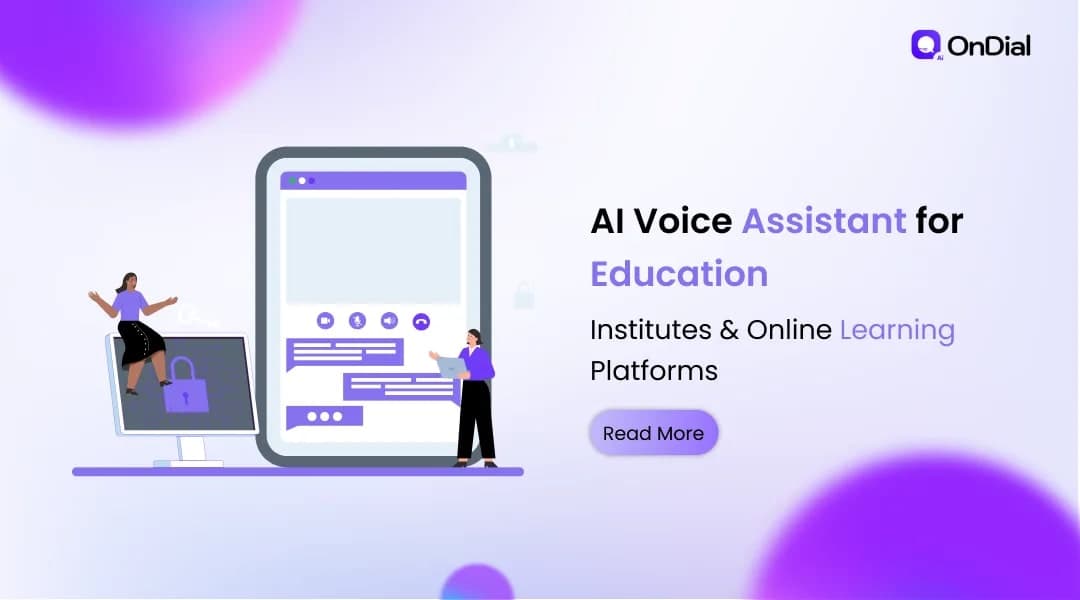
That is where an AI voice assistant for education can provide practical value.
Instead of forcing every caller through a rigid IVR menu or requiring staff to answer repetitive questions manually, a voice AI system can understand spoken requests, respond conversationally, collect information, trigger workflows and transfer complex situations to the appropriate person.
What Is an AI Voice Assistant for Education?
An AI voice assistant for education is a conversational AI system designed to communicate with students, parents, applicants and staff through voice calls.
It can handle inbound conversations, outbound calls or both, depending on the institution's workflow.
For example, a prospective student could call and ask:
"Is the MBA program accepting applications?"
The assistant can identify the intent, retrieve the relevant information and respond. If the student wants to continue the application process, the conversation can move into qualification, scheduling or human handoff.
The important distinction is that a modern AI voice assistant is not simply a recorded message system.
It can combine speech recognition, language understanding, conversational logic, business rules, system integrations and voice generation to complete useful actions during a call.
For education providers, that creates opportunities across admissions, student support, reminders, scheduling and engagement.
Why Education Institutions Are Turning to Voice AI
Educational organizations deal with recurring communication problems.
Admissions teams receive similar questions throughout the enrollment cycle. Administrative departments spend time answering routine queries. Parents may call outside office hours. Online learning platforms need to support learners across different time zones.
These situations create several operational challenges.
High volumes during peak periods
Admission inquiries can increase sharply around application deadlines, entrance examinations, counseling periods and course launches.
Hiring temporary staff can address capacity, but it also creates training, scheduling and consistency challenges.
AI voice assistants can provide an additional communication layer during periods when call demand exceeds available staff.
Missed calls and delayed responses
A missed admission call can mean a prospective student does not receive the information they need when they are ready to make a decision.
An AI system can answer eligible calls immediately and route conversations requiring human expertise to the appropriate team.
Repetitive questions consume staff time
Questions about eligibility, fees, documents, course duration and schedules are often predictable.
Automating appropriate routine conversations allows counselors and administrative staff to spend more time on complex cases, personal guidance and conversations that genuinely require human judgment.
Key Use Cases for AI Voice Assistants in Education
An education voice assistant can support more than admissions.
Its value increases when institutions identify specific communication workflows and connect them to the systems already used by their teams.
1. Admission and enrollment inquiries
The assistant can answer common questions about:
Programs and courses
Eligibility requirements
Application deadlines
Required documents
Admission procedures
Campus information
Counseling availability
For qualified prospects, it can collect relevant information and route the conversation to an admissions counselor.
Institutions can also use outbound voice calls for follow-ups after an inquiry or application event.
For a deeper look at this workflow, see AI Voice Agents for Student Admission Follow Ups, which covers automated admission follow-up for educational institutions.
2. Student and parent support
Once a student is enrolled, communication needs continue.
Students and parents may need information about schedules, academic services, events, payment deadlines or administrative procedures.
A voice assistant can handle defined support requests and provide information based on approved institutional data.
For sensitive or complex matters, the workflow should move the caller to a human representative rather than attempting to answer outside the assistant's authorized knowledge.
3. Fee and payment reminders
Educational institutions frequently need to remind students or parents about upcoming payments.
Voice automation can support outbound reminder campaigns by contacting the appropriate person, explaining the purpose of the call and directing them toward the next step.
The exact workflow depends on the institution's payment systems and privacy requirements.
4. Class, examination and schedule notifications
Changes to schedules can create large volumes of calls.
Voice AI can support proactive communication about:
Class changes
Examination schedules
Holiday notices
Counseling appointments
Orientation sessions
Campus events
Assignment or administrative deadlines
This can reduce the need for staff to repeat the same notification individually.
5. Online learning platform support
EdTech companies and online learning providers have a different communication challenge.
Their learners may be distributed across cities, countries and time zones. Support requests can involve account access, course enrollment, subscriptions, assignments and technical issues.
A voice assistant can serve as another support channel for defined requests while escalating technical or account specific cases to human agents.
This makes voice particularly useful for learners who prefer speaking rather than navigating multiple support pages.
Multilingual Voice AI for Indian Education
Language can significantly influence how comfortably students and parents communicate.
India's education ecosystem serves people across different linguistic backgrounds, making multilingual communication particularly relevant for schools, colleges, coaching institutes, universities and EdTech companies.
A multilingual AI voice assistant can allow callers to communicate in supported languages instead of forcing every interaction into English.
However, multilingual capability should mean more than translating individual sentences.
A useful system needs to maintain the caller's intent and conversation context while handling different accents, pronunciation patterns and natural changes in language.
This is especially important for admission inquiries where a misunderstanding about eligibility, fees or deadlines can create unnecessary friction.
AI Voice Assistant vs Traditional IVR
Traditional IVR systems typically guide callers through predefined menus.
For example:
Press 1 for admissions.
Press 2 for fees.
Press 3 for examinations.
This structure can work for simple routing, but it becomes restrictive when callers have questions that do not fit neatly into a menu.
Conversational voice AI approaches the interaction differently.
A caller can explain the request in natural language, and the system can identify the relevant intent before responding or routing the conversation.
The goal is not to eliminate every IVR menu.
It is to make voice communication more conversational where the use case justifies it.
How AI Voice Assistants Integrate With Education Systems
The quality of an education voice assistant depends heavily on the information and workflows behind it.
A voice interface without reliable data can only provide limited value.
Institutions should consider connecting the assistant with systems such as:
CRM platforms
Student information systems
Learning management systems
Admission databases
Calendars
Ticketing systems
Knowledge bases
Communication platforms
For example, an admission inquiry could follow this workflow:
A prospective student calls.
The AI identifies the program they are interested in.
The system retrieves approved program information.
The AI answers the question.
The caller provides additional details if qualification is required.
The conversation is logged.
A qualified inquiry is routed to an admissions counselor.
The counselor receives the relevant conversation context.
This turns the voice assistant into part of the institution's operational workflow rather than an isolated call answering tool.
Appointment Scheduling for Education
Counseling sessions, campus visits, demo classes and admissions consultations often require scheduling.
Instead of asking staff to manually coordinate every appointment, an AI assistant can collect the caller's requirements, check available slots and help complete the booking workflow when connected to the appropriate scheduling system.
This is one reason AI appointment scheduling can complement education voice automation.
For example, a student could call to request an admissions counseling session. The assistant can identify the request, collect the necessary information, offer available appointment options and trigger confirmation according to the configured workflow.
The same approach can support demo classes for online learning providers.
What Educational Institutions Should Measure
Implementing voice AI should not be evaluated only by the number of automated calls.
Institutions should measure whether the system improves the underlying communication workflow.
Useful metrics can include:
Response rate
How many inbound inquiries are answered instead of missed?
Human escalation rate
How many conversations require a counselor or support representative?
A high escalation rate may indicate that the automation scope needs refinement.
Lead qualification rate
For admissions teams, how many inquiries meet the institution's defined qualification criteria?
Appointment completion
If the assistant schedules counseling or demo sessions, how many appointments are successfully booked and attended?
Resolution rate
How many defined support requests are resolved without human intervention?
Call outcome quality
Are conversations producing useful outcomes, or are callers repeatedly asking to speak with a person?
These metrics help institutions improve workflows based on actual call behavior instead of assuming automation is effective simply because calls are being handled.
How to Implement AI Voice Automation in an Education Institution
A successful implementation does not need to automate everything at once.
Start with a clearly defined workflow.
Step 1: Identify repetitive conversations
Review call logs, support tickets and admission inquiries.
Find the questions that occur frequently and have relatively clear answers.
Step 2: Define the AI's boundaries
Decide what the assistant can answer, what information it can access and which situations require human intervention.
This is particularly important when conversations involve sensitive student information.
Step 3: Connect the required systems
Integrate the assistant with the CRM, scheduling system, knowledge base or other platforms needed to complete the workflow.
Step 4: Build escalation paths
A good voice assistant should know when not to continue.
Complex complaints, sensitive student matters, unusual requests and cases outside defined business rules should be routed to an appropriate human team.
Step 5: Test with real scenarios
Test different accents, incomplete questions, interruptions, background noise, unexpected responses and language changes.
The goal is not simply to make the scripted demo work.
The goal is to make the real conversation reliable.
Step 6: Monitor and improve
Review call outcomes, escalation reasons and unanswered questions.
Use those insights to refine the knowledge base, workflows and escalation rules over time.
Privacy and Responsible Use of AI in Education
Education organizations handle information that can be sensitive.
Before deploying voice automation, institutions should understand what information the system accesses, where call data is stored, how long recordings and transcripts are retained, who can access them and which security controls are available.
The assistant should only access information required for the workflow.
It should also clearly identify itself as an AI system where appropriate and provide a straightforward path to human assistance.
Responsible implementation is particularly important when voice automation interacts with minors, student records, payment information or other sensitive data.
What the Future of Voice AI in Education Looks Like
The next stage of education voice automation is likely to move beyond answering questions.
Voice systems can become interfaces for specific institutional workflows.
A student could call to request a counseling appointment.
A parent could receive a reminder about an upcoming school event.
An applicant could receive a follow-up after submitting an inquiry.
An online learner could receive assistance with a defined support request.
The common factor is not the voice itself.
It is the ability to connect a natural conversation with useful business actions.
That is where education institutions can get more value from conversational AI.
Choosing an AI Voice Platform for Education
Institutions should evaluate providers based on the actual requirements of their communication workflows rather than choosing a platform solely because it offers a voice demo.
Important questions include:
Does it support the languages your callers use?
Can it handle natural interruptions and conversational requests?
Can it connect with your CRM, LMS or student systems?
Can it schedule appointments?
Can it transfer conversations to human staff with context?
Can administrators review call outcomes and analytics?
Can access to sensitive information be controlled?
Can the system scale during admission and examination periods?
Can the institution define what the AI should and should not do?
These questions help separate a useful education automation platform from a basic automated calling system.
For institutions evaluating broader voice automation capabilities, OnDial AI Voice Agents provides a platform for inbound and outbound conversations, workflow automation, integrations and human handoff.
Conclusion
AI voice assistants can help education institutions address a practical communication problem: too many repetitive conversations across too many channels.
The strongest implementations do not attempt to replace counselors, teachers or administrative teams.
They handle defined conversations, provide approved information, trigger routine workflows and route situations that require human judgment.
For schools, universities, coaching institutes and online learning platforms, that can mean faster responses, more consistent communication and better use of staff time.
The right starting point is simple.
Identify the conversations that consume the most repetitive effort, connect the necessary systems, define clear boundaries and measure the outcomes.
That is how AI voice assistance becomes an operational capability rather than another technology experiment.