Gartner forecasts that conversational AI will save contact centers roughly $80 billion in labor costs this year. That is not a distant prediction or a rounding error. It is happening right now, and voice AI is the engine behind a large chunk of it. If you have been hearing the term everywhere and quietly nodding along without being sure what it actually means, you are in very good company.
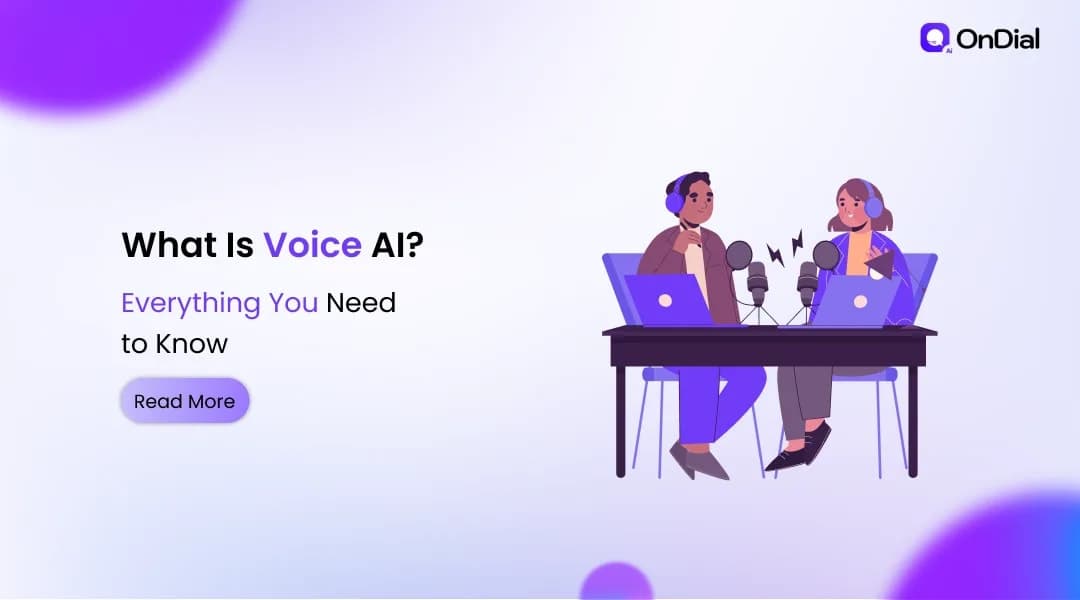
Most people first meet voice AI as a fuzzy buzzword attached to Siri, robocalls, or those unsettlingly human customer service lines. It leaves them more confused than informed. So here is the short version, stripped of jargon: voice AI is technology that lets a computer understand spoken language, work out what the speaker wants, and reply in a natural voice, all in real time.
That is the whole idea in one sentence. Everything else is detail. In this guide, I will walk you through what voice AI is, how it works under the hood, where it is already earning its keep, what it genuinely does for a business, and the honest limits nobody likes to advertise. By the end, the buzzword should feel like a tool you actually understand.
So, What Is Voice AI, Really?
Let me give you the answer you can copy, paste, and quote before we go anywhere near the mechanics. Voice AI is a branch of artificial intelligence that lets machines understand spoken language, interpret the speaker's intent, and respond in real time with natural, human-sounding speech. It combines speech recognition, natural language processing, and text-to-speech into a single conversation loop that runs in under a second.
That definition covers most of what you need. The confusion usually starts because the same two words get stretched across two completely different products.
Voice AI in one plain sentence
In the simplest terms, voice AI is software that can listen, understand, and talk back like a person would. It is the difference between a machine that plays a recorded menu and one that actually holds a conversation with you. The first follows a script. The second follows your meaning.
At OnDial, the systems we build sit firmly in that second camp, and I have watched non-technical business owners go from skeptical to sold the moment they hear one handle a messy, real-world call. The magic is not that it speaks. Plenty of old systems could speak. The magic is that it understands what you meant even when you phrased it badly, trailed off, or changed your mind halfway through.
The two very different things people mean by "voice AI"
Here is the disambiguation almost no article bothers to make, and it saves a lot of headaches. When people say "voice AI," they are usually talking about one of two things:
Voice generation tools: These focus on the sound. Think text-to-speech platforms, voice cloning, and AI voiceover apps that turn written words into audio for videos, audiobooks, or narration. The goal is a realistic voice, not a conversation.
Conversational voice agents: These focus on the exchange. Think AI phone agents that answer calls, understand intent, pull up an account, and complete a task end to end. The goal is a two-way interaction that gets something done.
Both are real, and both are legitimately called voice AI. But if you are a business wondering whether this technology can answer your phones and book your appointments, you care about the second kind. That is the definition I will use for the rest of this guide.
How Does Voice AI Actually Work?
Here is something that surprises people: the hard part of voice AI is not the talking. It is the listening. Getting a machine to sound human is largely a solved problem. Getting it to correctly understand a caller with an accent, background noise, and a half-finished sentence is where the real engineering lives (and yes, this is exactly where cheap voice bots fall apart).
For the snippet-hunters: voice AI works by chaining four systems together. It converts your speech to text, interprets what you meant, decides how to respond, and converts that response back into speech. The entire round trip happens in roughly a second, which is what makes it feel like a real conversation rather than a transaction.
The four stages behind every spoken conversation
Every modern voice AI interaction moves through the same four-stage pipeline, and knowing it helps you evaluate vendors honestly. Each stage has a name you will see thrown around, so it is worth learning them once:
Automatic Speech Recognition (ASR): Also called speech-to-text, this converts your spoken words into text the software can process. Good ASR handles accents, crosstalk, and noise because it was trained on huge volumes of real call audio.
Natural Language Understanding (NLU): This layer, built on natural language processing, figures out intent and pulls out the important details like dates, names, or account numbers. It is what lets the system know that "I need to move my Tuesday thing" means "reschedule an appointment."
Dialogue and reasoning: Powered increasingly by large language models (LLMs), this stage decides what to actually do, whether that is answering a question, querying a CRM, or asking a clarifying question when the request is ambiguous.
Text-to-Speech (TTS): Finally, the system converts its written response back into natural audio, adding pauses and emphasis so it sounds like a person rather than a robot reading a paragraph.
The quality of a voice AI product is really the quality of these four stages working together. A weak link anywhere breaks the illusion, and callers notice immediately.
Why good voice AI feels instant
Latency is the quiet make-or-break factor, and it is the metric I tell every OnDial client to test first. If there is an awkward pause after they stop speaking, the whole experience collapses into something that feels robotic and frustrating. The best systems respond in well under a second, which is close to the natural rhythm of human conversation.
Achieving that speed means running four heavy processes almost simultaneously without the caller ever sensing the machinery underneath. It also means handling interruptions gracefully, because real people cut each other off mid-sentence all the time. A voice agent that cannot be interrupted is not really conversational; it is a monologue with extra steps.
Voice AI vs IVR vs Chatbots: What Actually Changed
If voice AI feels like a repackaged version of the phone menus you already hate, I understand the suspicion. The difference is real, though, and it comes down to one word: understanding. Old systems matched your input to a rigid list of options, while voice AI works from your actual meaning.
Why "press 1 for billing" is on its way out
Interactive Voice Response (IVR) is the traditional automated phone menu that asks you to press or say a number to route your call. It never understood you; it just sorted you into a predefined bucket. Voice AI does not sort you into a bucket. It listens to what you need in your own words and either resolves the issue or hands you to the right person with the context already gathered, which is exactly what makes it worth understanding what an AI phone agent actually is before you evaluate one.
Think about the last time you called a business after hours. Did anyone pick up?
That gap between "we are closed" and "we can help" is where voice AI does its most obvious work. An AI voice agent answers on the first ring at 8 pm on a Sunday, handles the routine request, and only escalates the genuinely complex cases to a human the next morning. IVR deflected calls; voice AI resolves them, and that is a meaningfully different promise.
Is voice AI just a chatbot with a voice?
This is one of the most common questions I get, and the honest answer is: related, but not the same. A chatbot handles text conversations in a window, where the user reads and types at their own pace. Voice AI handles spoken conversations in real time, which is a much harder problem.
Speech is messy in ways text is not. People pause, mumble, talk over each other, and rarely speak in clean sentences. A voice system has to manage all of that live, with no backspace key and no time to think. So while voice AI and chatbots share a lot of underlying technology like NLP and LLMs, calling voice AI "a chatbot that talks" undersells the engineering that makes real-time speech feel natural.
Where Voice AI Is Already Working
Voice AI is not a future bet. The global voice AI market reached about $11.71 billion in 2026, growing at a 29.3% CAGR according to The Business Research Company, and roughly 80% of businesses plan to integrate AI voice technology into customer service by the end of this year, per Nextiva. Those numbers reflect deployments that are running today, not pilots gathering dust.
Customer support, reception, and scheduling
The most common voice AI use cases cluster around the phone, because that is where businesses feel the most pain. A voice agent can answer inbound calls, confirm a caller's identity, pull their account, resolve a billing question, and text a confirmation, all without a human touching the call. That single workflow removes a huge share of repetitive volume from support teams.
Reception and scheduling are close behind. In projects we have worked on at OnDial, the highest-value early win is almost always appointment booking, because it is high-volume, rule-based, and measurable. The agent captures the request, checks availability, books the slot, and updates the calendar, freeing staff for the conversations that actually need a human.
The cost, scale, and accessibility case
The benefits of voice AI for business come down to three levers: cost, scale, and reach. On cost and scale, a single system can handle thousands of concurrent calls without hiring, without holidays, and without hold music, and companies deploying voice AI report three-year ROI between 331% and 391% according to Forrester and PolyAI. The economics work because voice AI automates something both expensive and universal: answering the phone.
The accessibility angle gets far less attention and deserves more. The WHO-UNICEF Global Report on Assistive Technology (2022) estimates that more than 2.5 billion people need at least one assistive product, and voice interfaces lower barriers for people with motor impairments, low vision, or limited reading ability. When you build voice AI well, you are not just cutting costs. You are making a service usable for people a form or an app quietly excludes.
The Honest Limits of Voice AI
Now for the part most vendor pages skip. Voice AI is genuinely good, but it is not magic, and pretending otherwise is how businesses end up disappointed. I would rather you deploy it with clear eyes than oversell it and lose trust with your own customers.
What it still gets wrong
Voice AI struggles with heavy background noise, thick accents it was not trained on, and genuinely novel requests that fall outside its knowledge. It can also mishandle sensitive specifics, like pronouncing a medication name or an account number incorrectly, which matters enormously for healthcare call centers or finance. These are solvable engineering problems, but they are not solved by default, and any provider who claims 100% accuracy is selling you something.
The right design assumes imperfection and plans for it. That means clear escalation paths to human agents, confidence thresholds that trigger a handoff, and honest scoping of what the agent will and will not attempt. A voice agent that knows when to say "let me connect you to someone" is more trustworthy than one that bluffs.
Disclosure, compliance, and trust
Regulation is catching up fast, and this is a good thing for everyone building responsibly. Under Article 50 of the EU AI Act, AI voice systems operating in the EU must disclose that the caller is speaking with an AI at the start of the conversation. Even outside the EU, telling callers plainly that they are talking to an AI is simply the honest move.
Transparency is not a compliance burden to grumble about; it is a trust advantage. Callers are far more forgiving of an AI that introduced itself than one that tried to pass as human and got caught. At OnDial, we treat disclosure and clear handoffs as defaults rather than afterthoughts, because partnership with a client's customers matters more than a moment of clever illusion.
How to Get Started With Voice AI Without Overcommitting
You do not need to automate your entire operation on day one, and you should not try. The businesses that succeed with voice AI start narrow, prove it works, and expand from there. Here is the approach I recommend to anyone asking where to begin.
Start with one high-volume workflow
Pick a single, measurable, repetitive task and point the voice agent at that. Inbound call handling on your busiest line is the classic starting point, because success is easy to measure and the risk is contained. Deploy it, monitor closely for a few weeks, refine, and only then expand to after-hours coverage, outbound follow-ups, or additional lines.
Starting small does two things. It gives you real data instead of assumptions about how your specific customers behave. And it lets you build internal confidence before you stake a core process on the technology.
What to check before you pick a platform
Not all voice AI is built to the same standard, and the differences are easy to test if you know what to listen for. Before you commit to a vendor, evaluate them against a few non-negotiables:
Latency: Does it respond in under a second, or is there an awkward pause that gives it away? Test this on a real call, not a polished demo, so you can see how OnDial's voice AI features hold up against this exact checklist.
Voice quality and interruption handling: Does it sound natural, and can you cut it off mid-sentence like you would a person?
Understanding under stress: Feed it accents, background noise, and vague requests. See whether it recovers gracefully or falls apart.
Escalation and transparency: Does it hand off to a human cleanly, and does it disclose that it is an AI?
Pricing clarity and integration: Can it connect to your CRM or calendar, and is the pricing predictable rather than full of surprises?
Score vendors against your actual use case, run a small pilot, and validate the ROI before you scale. The market is crowded, and a structured evaluation is the fastest way to cut through the noise.
Conclusion
Voice AI is no longer a science-fiction concept; it is a practical tool that understands speech, holds a real conversation, and completes tasks on your phone lines around the clock. If you remember three things from this guide, make them these: voice AI works by chaining speech recognition, understanding, reasoning, and speech generation into a one-second loop; it already delivers measurable returns on high-volume workflows; and it works best when you start narrow and stay transparent with your callers.
You came in unsure what the buzzword meant. You can now evaluate it like a professional, ask vendors the right questions, and spot the difference between a real conversational agent and a glorified phone menu. That clarity is the whole point.
If you are ready to see what a genuinely human-sounding voice agent could do for your busiest phone line, that is exactly what we build at OnDial. Bring us your highest-volume call workflow, and we will help you pilot it, measure it honestly, and scale it only when the numbers earn it.